It’s been a while since I picked up David Bentley Hart’s The Experience of God, and I was pleased to see that I’m a third of the way through the book, nearing the end of the first part, on Being. I wasn’t pleased to find myself struggling to follow his train of thought as he picked apart what is known as Anselm’s argument, and was relieved when he moved on after a few pages, saying that he didn’t want to get “entangled in needless complications on this matter.”
Though I am philosophical by nature, I’m woefully unschooled in the discipline and its fundamentals. How many times have I looked up words like phenomenology, ontology, and epistemology? Whatever I read on the subject is an attempt to correct that lack, and I appreciate Hart’s clarity and organization; he does seem to be writing for someone like me.
When we say that God is Being or “the source and ground of all reality,” following in the tradition of centuries of philosophers and theologians, many contemporary thinkers say it is because we are “mired in sheer nonsense.” Hart tells what he considers an important source of this lack of agreement:
…The analytic tradition is pervaded by the mythology of “pure” philosophical discourse, a propositional logic that somehow floats above the historical and cultural contingency of ideas and words, and that somehow can be applied to every epoch of philosophy without any proper attention to what the language and conceptual schemes of earlier thinkers meant in their own times and places. This is a pernicious error under the best of conditions, but it has worked arguably its greatest mischief in the realm of ontology, often as a result of principles that, truth be told, are almost entirely arbitrary.
I enjoy learning about particular people of the past and of their contributions to the wealth of humanity’s philosophical legacy. Hart mentions Meister Eckhart and his idea of “Is-ness,” and that takes me back to when I was a college freshman and privileged to be in a tutorial course that was an introduction to Meister Eckhart. I certainly had no intellectual grid prepared to fit him into then! How nice to have him come around again when I can appreciate his place in history.
Hart’s book was on the table with my bowl of stew this morning, but now the breakfast philosophy session has come to an end and other tasks are calling; I will go forward with the prayer that the presence of Him Who Is will sustain me. Given my ignorance of that floating kind of logic, I shouldn’t have any trouble keeping my feet on the ground and my self in the flow of history, soon to close out the year twenty-fifteen.
Enjoy it while it lasts! Let’s be here, now.
 and nearly all the time, we live as if we were trying to catch a bus.
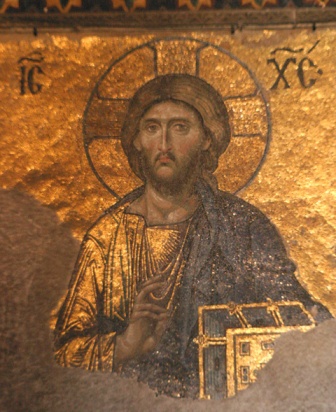 question ‘What?’ It answers the question ‘Who?’ Eternity is God, God who is always contemporaneous with each moment of time; He is always there, completely stable, unchanged and unchangeable because He already has in Himself, before the first thing was, all the richness necessary to meet all things and all situations. He does not need to change in order to be contemporaneous.
