I’m still in the middle of Jacque Ellul’s great work, The Technological Society, which is really helpful in understanding the way our modern world works. When Ellul talks about technique he does not mean merely the physical machinery or medicine or digital technology, but more importantly, the manner in which so much of our life is managed according to systems and measurements; our activities are prompted and organized according to the primary value of efficiency. Here he explains it himself: “Technique”
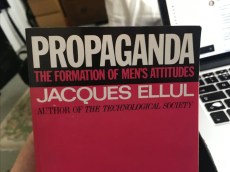 Not bothered by the fact that I haven’t finished that book (or his Humiliation of the Word, which I also loved), I began to listen to another one by the author: Propaganda. Propaganda is just one facet of the technological society. Ellul’s books are so thought-provoking and full of insights, it’s hard for me to pick a few of the best paragraphs to share. But here is one, which I broke up into smaller parts for ease of reading:
“To the extent that propaganda is based on current news, it cannot permit time for thought or reflection. A man caught up in the news must remain on the surface of the event; he is carried along in the current, and can at no time take a respite to judge and appreciate; he can never stop to reflect. There is never any awareness — of himself, of his condition, of his society — for the man who lives by current events.
 “Such a man never stops to investigate any one point, any more than he will tie together a series of news events. We already have mentioned man’s inability to consider several facts or events simultaneously and to make a synthesis of them in order to face or to oppose them. One thought drives away another; old facts are chased by new ones. Under these conditions there can be no thought. And, in fact, modern man does not think about current problems; he feels them. He reacts, but he does not understand them any more than he takes responsibility for them. He is even less capable of spotting any inconsistency between successive facts; man’s capacity to forget is unlimited. This is one of the most important and useful points for the propagandist, who can always be sure that a particular propaganda theme, statement, or event will be forgotten within a few weeks.
“Moreover, there is a spontaneous defensive reaction in the individual against an excess of information and — to the extent that he clings (unconsciously) to the unity of his own person — against inconsistencies. The best defense here is to forget the preceding event. In so doing, man denies his own continuity; to the same extent that he lives on the surface of events and makes today’s events his life by obliterating yesterday’s news, he refuses to see the contradictions in his own life and condemns himself to a life of successive moments, discontinuous and fragmented.”
-Jacques Ellul, Propaganda: The Formation of Men’s Attitudes, 1965

Image is from the website of the International Jacques Ellul Society.


 Gladsome Lights