Tag Archives: re-post

This is how the Word becomes incarnate.

THE NATIVITY OF CHRIST ~ A MEDITATION

…The greatest mystery of the Incarnation is that, having happened once in history, it recurs  in every person that comes to Christ. In the deep silence of the night the Word of God became incarnate on earth: this is how the Word becomes incarnate in the silent depths of our soul, where our mind lapses into silence, where words run out, where our spirit stands before God.

Christ was born on earth unknown and unrecognized, for only the Magi and the shepherds went out to meet him. In the same way, quietly and unrecognizably to others, Christ is born in a human soul, and it comes out to meet him, because a star has been born in it, leading to the light.

We mysteriously recognize Christ in us during prayer, when we discover that our prayer has been accepted and heard, that God ‘came and abode in us’ and filled us with his life-bearing presence. We encounter Christ in the Eucharist, when, having received his body and blood, we feel that our own body is penetrated by his divine energy, and the blood of God runs though our veins.

We encounter Christ in other sacraments of the Church, when through union with him we are renewed and revived unto eternal life. We encounter Christ in our neighbors, when we gain sight of his innermost depth where the image of God shines. We encounter Christ in our everyday life, when amidst its noise we hear his beckoning voice or when we see his manifest intrusion into the course of history.

Precisely so — unexpectedly and suddenly — God intruded into the life of humanity twenty centuries ago, when by his birth he turned the course of history. Precisely so is he born again and again in the souls of thousands of people, changing, transforming and transfiguring their lives, making believers out of non-believers, saints out of sinners, saved out of dying.

When, around two thousand years ago, the Divine Infant was born, the angels sang: ‘Glory to God in the highest, and on earth peace, good will toward men’ (Lk 2:14). In our days the world yearns for peace and good will. In the very place where Christ was born there is war, and Bethlehem itself is under siege. The Christian Church prays for peace in the Holy Land and in other countries for the forces of good to triumph over the forces of evil. May the Divine Child born in Bethlehem grant peace to the entire world, and good will to all its people.

—Metropolitan Hilarion (Alfeyev) of Volokalamsk


Lemon-Poppyseed Sandwich Cookies

My story from 2012, about the wonderful Glad cookie from that Christmas:

Last week I finished baking the last of the Christmas cookies. Encouraged by the happy eaters of the Lemon-Poppyseed Sandwich Cookies at previous holiday gatherings, this year I had made a double batch, and then ran out of time to complete more than half of them. The remaining dough and filling waited in the fridge until I got back some strength, and a plan for where to send the finished product so that I wouldn’t eat them all myself.

With so many young, even teen-aged, folk around here at Christmas, I expected to see the cookies go faster than they did. But never during the week of feasting did I spy anyone who might vie with me for the Cookie Monster title, and there are certainly no other contenders remaining in this house now. So when I found a willing person to be my delivery man, I sent them to Soldier and Joy.

The recipe (based on one not longer on the Epicurious site) starts with sugar cookies that are heavy with poppyseeds and two sources of lemon flavor, and finishes with the crunchy cookies enclosing an also lemony cream cheese filling.

At the epicurious.com site one can read comments from many readers detailing what happened when they tried the recipes, and the various changes that we daring cooks insist on making.

Most people who had made these cookies thought there should be more filling than planned for in the recipe as given, and I also ran out of filling at my first trial, so this year I doubled the cookie part, but tripled the filling. Not that it’s a problem to have leftovers of either. The cookies are wonderful by themselves, and the filling would be awfully nice spread on toast.

The majority of bakers also liked the cookies better after they had sat in the refrigerator and softened up, though the original recipe said to fill them not long before eating to keep the cookies crisp. I prefer them soft, as did most of the people I fed them to. They are good straight from the freezer, too, I found out!

Here is my version with the extra filling, and a couple of other changes, cut in half so that no one has to assemble 60+ cookies to find out if she likes them.

Lemon-Poppyseed Sandwich Cookies

COOKIES:

2 3/4 cups all purpose flour
1/2 teaspoon salt
1/2 teaspoon baking powder
1 cup (2 sticks) unsalted butter, room temperature
1 cup sugar
1 large egg
2 tablespoons poppy seeds
4 teaspoons grated lemon peel
1 teaspoon vanilla extract
1 teaspoon lemon extract

FILLING:

12 ounces cream cheese, room temperature
1/2 cup sugar
3/4 teaspoon lemon extract
1/2 teaspoon vanilla extract

FOR COOKIES:

Mix flour, salt and baking powder in medium bowl. Using electric mixer, beat butter in large bowl until light. Gradually beat in sugar. Beat in egg, then poppy seeds, lemon peel and extracts. Mix in dry ingredients. Gather dough into ball, divide into two parts and flatten each into a disk. Wrap in plastic and chill at least 2 hours. If wrapped well, it will last in the refrigerator over a week.

Preheat oven to 325°F. Butter 2 large baking sheets. Roll out 1 dough disk on floured surface to 1/8-inch thickness. Using 2-inch-diameter cookie cutter, cut out cookies. Arrange cookies 1 inch apart on prepared baking sheets. Gather scraps; reroll and cut out more cookies.

Bake cookies until edges just begin to color, about 18 minutes. (If you use insulated sheets as I did they might take longer.) Cool cookies on sheets 3 minutes, then transfer to racks and cool completely. Repeat rolling, cutting and baking with remaining dough. (Can be made ahead. Store in airtight container at room temperature up to 2 weeks or freeze up to 1 month.)

FOR FILLING:

Beat all ingredients in large bowl until light and fluffy. Spread 2 teaspoons filling over bottom of 1 cookie. Press second cookie, bottom side down, onto filling. Repeat with remaining cookies and filling. (Can be made ahead. Cover and chill.)

Some of the cookies in this later batch are a bit wrinkly, a result of the dough having dried out a little. I did add a few drops of water when I re-rolled the scraps and that helped them look better. But the wrinkly cookies were otherwise fine.

After my last post featuring a photo of lemons, Jody asked how I like to use these fruits. I consider myself a good person to ask, because my father raised not only oranges but lemons, and until a few years ago when someone very stupid — yes, I mean it — took out the two large trees that remained from ten acres of lemon grove, I used to have as many lemons as I wanted for free.

Lately I’ve been using a lot of lemons just to add the juice to hot water for drinking on cold days. But of more elaborate recipes, some that I’ve loved over the years are Lemon Curd, Greek Egg-Lemon Soup, Lemon Chicken, and Lemon Pudding Cake. And now — Lemon-Poppyseed Sandwich Cookies!

Mellowness and kindly wisdom.

This post that is very fallish in more than one way, I am sharing again nine years later. It is about Lin Yutang, whose writings my late husband and I were reading aloud together, during the illness that was to end his earthly life only a few months later. Much of what I read during that period is very foggy in my mind at this point, and many of those and other books from the past keep calling me back, especially when I read my own reviews.

               –  –  –  –  –  –  –  –  –  –  –  –  –  –  –  –  –  –  –  –  –  –  –  –  –  –  –  –  –  –  –

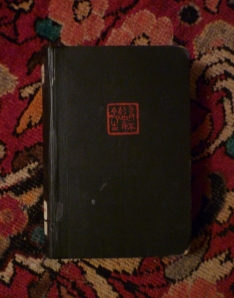
If you like thought-provoking quotes as much as I do, you might sometime run across one by the eloquent Lin Yutang. I find that I did have a quote by him about autumn in my files, so that is probably how he came under my radar recently, long enough for me to decide to borrow his book The Importance of Living from the library. It was in the closed stacks, and looks old and Chinese. But as Samuel Butler said, “The oldest books are only just out to those who have not read them,” and for me, Lin Yutang is definitely a new and exciting discovery.

I expected a small book of proverbs, perhaps, but The Importance of Living is a large conversational and philosophical treatise that I won’t be ableLin Yutang - Living to read in bed. I may have to buy a copy, because in the very first paragraph of the preface I found beautifully written lines that drew me in to his mind and his ruminations:

“Very much contented am I to lie low, to cling to the soil, to be of kin to the sod. My soul squirms comfortably in the soil and sand and is happy. Sometimes when one is drunk with this earth, one’s spirit seems so light that he thinks he is in heaven. But actually he seldom rises six feet above the ground.”

I opened the book randomly in the middle and there, also, his words were worth thinking about as poetry or motivational talk. Did someone very gifted translate the works of this Chinese man? No, he wrote in English in such a graceful way that it is pure joy to read him aloud.

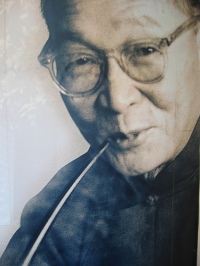
Lin Yutang was born in China in 1895 of Chinese Christian parents. His father was a pastor and a very progressive, forward-thinking man who made sure that Lin learned his Bible stories and went to the schools that produced the best speakers of English. He eventually got a degree from Harvard and another from Leipzig University.

I began to read The Importance of Living aloud with Mr. Glad. I usually do the reading because I enjoy it more than he does, and I immediately noticed the easy flow of Lin’s prose and the equally smooth progression of ideas. Everything he says makes perfect sense given his worldview in 1937, and at that time he was no longer a Christian.

What happened? Mr. Glad and I were very curious, because we had information Lin didn’t have at the time; we knew that later in life he would return to the faith and live to write about it, in his book From Pagan to Christian. So we stopped reading Importance and started in on the book about his spiritual journey that he wrote about 20 years later.

Putting together what he says in the relatively little we have read of him so far, I can tell you this about Lin’s first change of mind: As soon as he came of age to notice, he realized that he had not received the usual Chinese philosophical or literary heritage, much of which was typically learned through the theater; the theater was forbidden to Lin and his siblings who were in some ways raised as Puritans. He hadn’t taken the time to learn to write beautiful calligraphy, either, so he found that he was by Chinese standards completely uncivilized. At this point the one very Chinese thing he did know was intense shame.

He felt he had to go back and learn to be an authentic Chinese man, and having learned as a child the diligence and study habits of a Puritan, he did a very thorough job of learning Chinese philosophy and literature, not to mention a stunningly broad understanding of Western culture. This knowledge base combined with the ability to think and write about all that he has figured out — or is figuring out, as the story evolves — makes him fascinating to me.

We haven’t progressed very far in either of these books, but having this articulate author “friend” to explain Chinese culture and history to me from the inside has given me an interest in that part of the world that I have always lacked. So I hope to read more, and I expect to have more to share. But for now, I’ll close with his quote from My Country and My People about the lin_yutangseasons of the year.

“I like spring, but it is too young. I like summer, but it is too proud. So I like best of all autumn, because its tone is mellower, its colours are richer, and it is tinged with a little sorrow. Its golden richness speaks not of the innocence of spring,nor the power of summer, but of the mellowness and kindly wisdom of approaching age. It knows the limitations of life and is content.”

This meditation seems to me an expression of a perspective that could be both Chinese, as he felt at the time, and truly Christian. I’m looking forward to reading more of the kindly wisdom of Lin Yutang.

Moroccan lamb pie warms and charms.

In the first autumn of Gladsome Lights, I shared this old recipe for a lamb stew served as a shepherd’s pie. I haven’t had occasion to make it for a long time, but this evening when my mind turned to the kind of dishes that warm both body and soul, this one appeared.

Mutton is the meat I love.
On the dresser, see it lie;
Oh, the charming white and red;
Finer meat ne’er met the eye.

Roasting lamb is one of those aromas that reminds me of my grandmother. Combine it with Moroccan spices, and it makes for one of my favorite dishes:

Moroccan Lamb and Sweet Potato Pie

2 tsp. ground cinnamon
4 tsp. ground cumin
3 tsp. ground coriander
2 T. freshly grated ginger
1 T. all-purpose flour (or arrowroot)
1 ½ tsp. salt, plus more to taste
¼ tsp. freshly ground pepper, plus more to taste
2 lb. lean leg of lamb, cut into 1-inch cubes
3 T. olive oil
4 T. unsalted butter
2 large onions, thinly sliced
1 T. sugar
3 large cloves garlic, peeled and minced (about 1 ½ T.)
3 c. beef stock
1 28-oz. can whole Italian plum tomatoes
2 pieces star anise
2 cinnamon sticks, about 3 inches long
2 medium carrots, peeled and cut into ½-inch rounds
2 lb. sweet potatoes, peeled and cubed
12 oz. fresh spinach (optional) washed
½ c. dried tart cherries

½ c. dried pitted prunes, cut in half freshly grated nutmeg, for sprinkling

1. In a medium mixing bowl, combine the ground cinnamon, 2 tsp. cumin, 1 tsp. coriander, flour, ½ tsp. salt, and ¼ tsp. pepper. Toss the lamb pieces with the spice mixture to coat.

2. In a Dutch oven or a large saucepan, heat 2 T. olive oil over medium-high heat. Add the lamb in two to three batches, in a single layer, and sear until dark brown on all sides, about six minutes per batch. Add the remaining T. olive oil during searing if pan becomes dry. Remove the lamb pieces and set aside.

3. Reduce heat to medium; add I T. butter. Add onions and sugar; cook 10 minutes, stirring frequently, scraping up brown bits on bottom of pan while stirring the onion.

4. Reduce heat to medium low, add the minced garlic, and cook until brown and well caramelized, about 15 minutes.

5. Stir in the stock, tomatoes, star anise, cinnamon sticks, carrots, remaining 2 tsp. cumin, 2 tsp. coriander, the fresh ginger, remaining 1 tsp. salt, and reserved lamb. Bring to a boil, reduce heat to medium, and simmer, stirring occasionally, uncovered, for about 1 hour, until lamb is tender and sauce is thick.


6. Meanwhile, place sweet potatoes in a large saucepan; cover with cold water. Bring to a boil, reduce heat to medium, and simmer, uncovered, for 15 minutes, until very tender when pierced with a fork. Drain potatoes, and return to saucepan. Dry potatoes, over medium heat, for 1 minutes. Pass potatoes through a food mill into a medium bowl. Stir in remaining 3 T. butter; add salt to taste. Set aside, loosely covered.

7. Preheat oven to 325 degrees. If using spinach, place in a large skillet over medium-high heat. Season to taste with salt and pepper, cover, and cook until wilted, about 1 ½ minutes. Drain, and rinse under cold water to stop the cooking. Set aside.
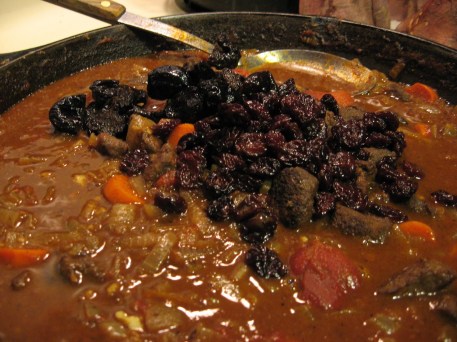
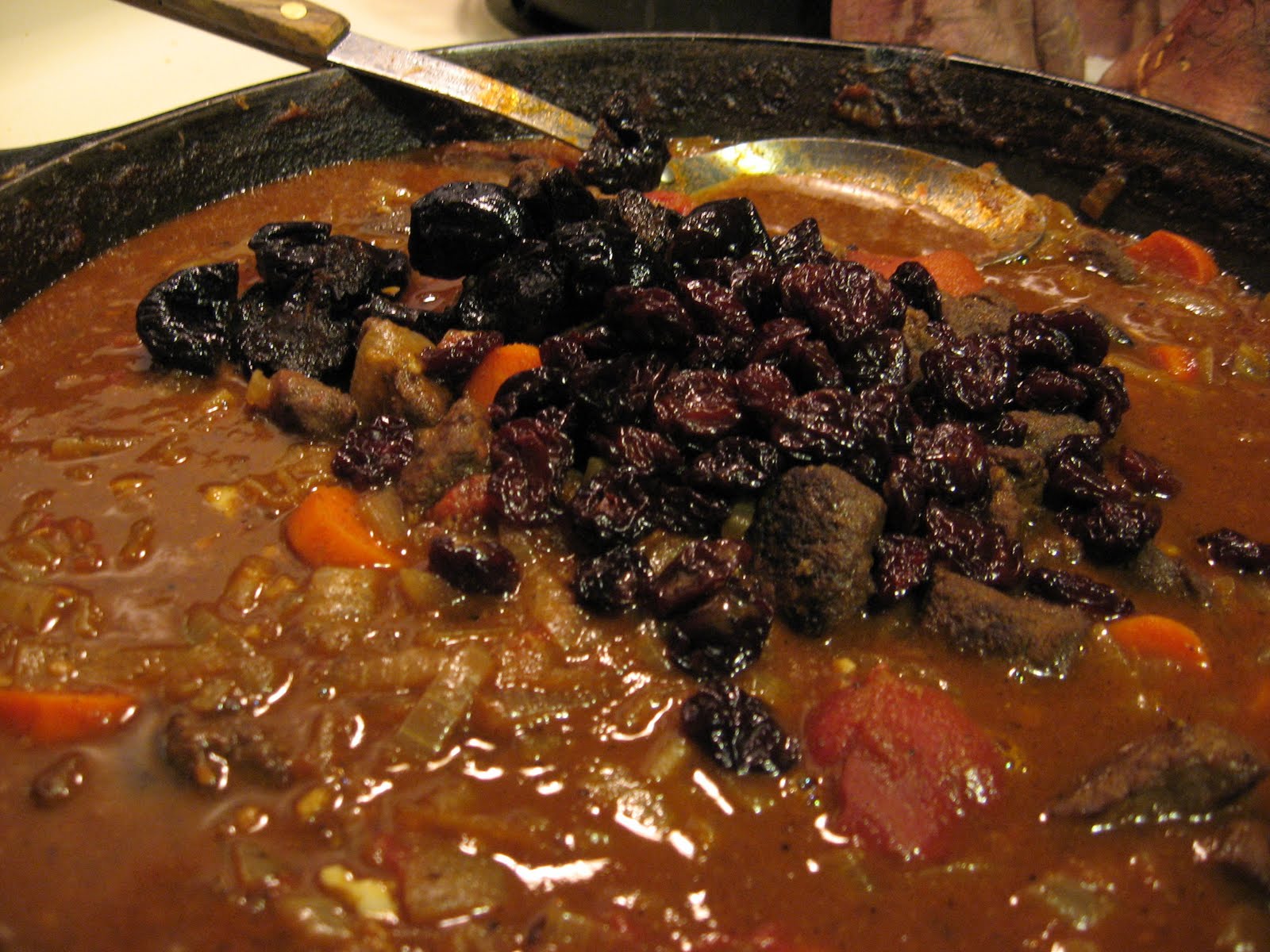
8. Remove the star anise and cinnamon sticks from the stew. Stir in the cherries and prunes. Transfer mixture to a deep 2-qt. Casserole, and place a layer of spinach, if using, over the stew. Spoon the sweet potato mixture onto the stew. Place on a baking sheet, and bake for 30 minutes. Sprinkle with freshly grated nutmeg.
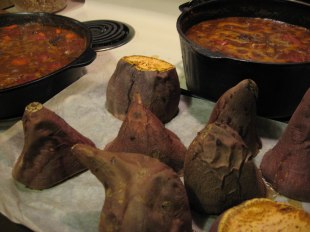
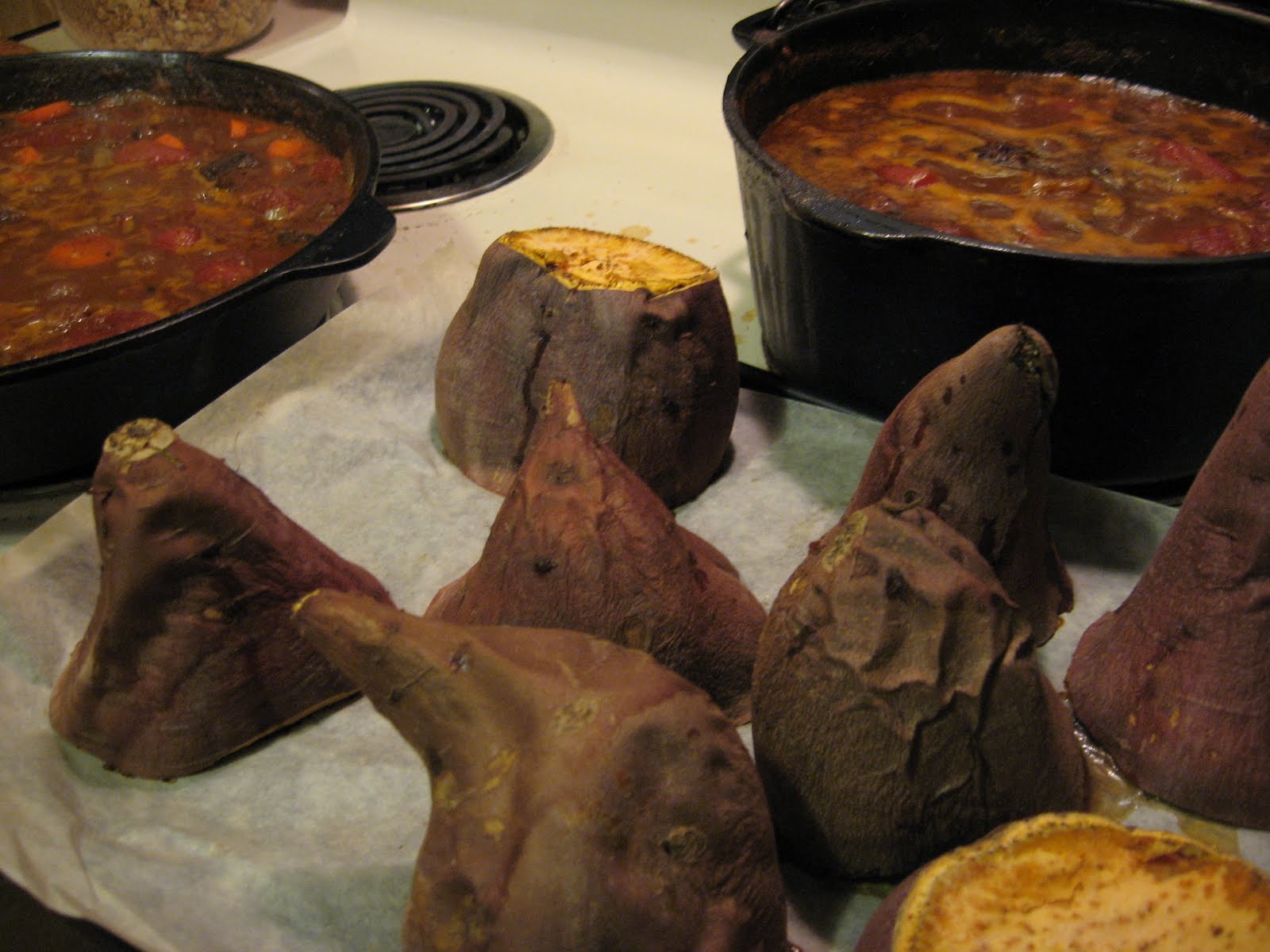
Notes: I have always used a whole boneless leg of lamb for this recipe, which usually is about 5 lb., not 2 lb., so I end up with more than 2 times the quantity. You can see  I have two pots of the stew simmering.

This gives me plenty to put in the freezer for another day, which raises the question of how to prepare the yams. If I purée all the yams, they end up getting  mushed up into the stew by the time I have reheated it, especially if it spends time in the freezer.

The stew tastes especially nice if the flavors have blended overnight, so I try to cook it a day ahead. Also this time I baked ahead of time the sort of monster yams, not very sweet, that are in the discount supermarket around Thanksgiving, not knowing yet how I would arrange everything the next day. Sometimes I have baked smaller sweet potatoes and served them to the side of the stew…

…but on this occasion, I ended up slicing them on top, brushed with butter and sprinkled with parsley and cinnamon, to take to a potluck. Sorry, the photo shows the dish before it had its final heating in the oven, and the butter is still solidifying on the cold yams. That evening the yam slices were gone before the stew itself.

In this season of my life, I don’t have a crowd to feed every day, but I think if I made a big pan of this stew I might be able to find enough friends to eat with me, and fortify ourselves against the coming winter. Next I’ll consider what other fallish items would fill out the menu… How about a dessert pie?