“Whenever I see someone reading a book . . . I feel civilization has become a little safer.” Matt Haig, How to Stop Time
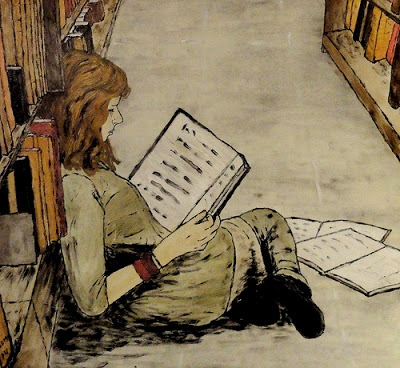
You turn the page because you have to know— because the youthful wizard is in trouble, because the wife’s about to pack and go, because you just like living in this bubble of graceful prose and other people’s ills and joys, because turning the pages makes you see things from a new perspective, fills your mind with more than you, and maybe breaks your heart or your routine, or breaks apart what’s rusted shut, or else draws a connection where you thought there was none. And once you start, the pages lead you to the intersection of art and life and your own empathy; the pages turn you toward humanity.
-Jean L. Kreiling
Jean Kreiling expresses so many of the reasons that we love to read — Did she leave anything out? I do like very much — often, but not constantly! — living in this bubble of graceful prose, even when the bubble doesn’t contain other peoples’ ills and joys. I hope my reading is doing all the positive things the poet sees. I read this poem Sunday afternoon to eleven fellow readers, when our parish women’s book group met on my patio and enjoyed our usual lively discussion of such pleasures. I’m also keeping it tucked in my purse to share with any friend or stranger I might meet, anytime our conversation turns to our latest favorite books.
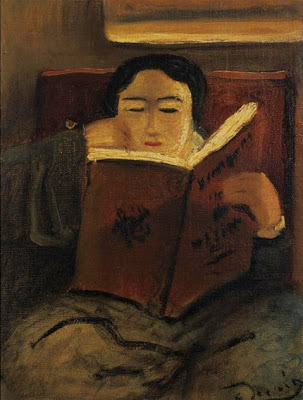
A wife is not composed of words, so Unlike a novel that takes till dawn To devour she cannot be read through in a night
Repeating the uneasy lines of a poem Over and over, rereading again and again would be different, too (though it probably looks the same)
Yesterday, while driving the car In a break in the din I heard for a moment the beat of a bird’s wings Ah, I thought
That ‘Ah’ was just for one moment, but It would need an eternity to comprehend, never mind My wife, who is before me sleeping or awake
Is it arrogant to even want to read a person? Not her expressions or gestures But to want to read that person, my wife Unable to be satisfied with just living together?
My wife speaking to me from across the table My wife wordlessly tossing and turning in bed The one there that seems like Loyal ladies-in-waiting serving a wife I can’t see
In the breath inscribed in each sentence Punctuated by daily reality Its draft turns the pages of my wife
I wish to grasp not the look but the way of the words In a quiet place far from both my wife and myself And like a twig that smells the approach of snow in the air I want to read my wife
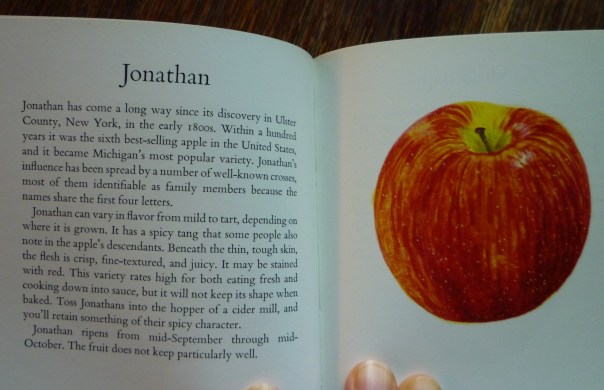
My kitchen and both refrigerators are overflowing with apples right now, as I recently made my annual visit to the apple farm I am so fond of. I’ve made jars and jars of applesauce to put in the freezer, at this point mostly from unpeeled Jonathans, which after it has cooked down and been put into pint jars, makes as pretty and pink a picture as I have ever had a hand in painting. It’s a good time to revisit as well this passage from a favorite novel, which I first shared ten years ago:
– – – – – – – – – – – – – – – – – – – – – –
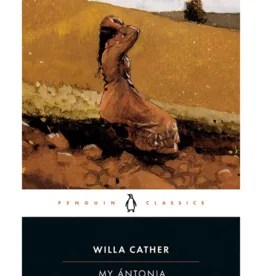
Willa Cather’s novel My Ántonia held a special place in the hearts of both my late husband and me, perhaps in our conjugal heart ? by reason of our sharing the story together more than once, and reading it on our own as well. When I’ve read it aloud it’s not uncommon for me to start sobbing at places in the narrative where the pathos hits home.
I was surprised to see recently a review in which the reader did not enjoy Cather’s writing, saying it was dry and lacking emotion. Those qualities might be why I appreciate her skill at capturing the story and drawing us in. Cather gives us the perspective of Jim, and we experience with him as narrator the various levels on which he is in love with our heroine and all that she represents, and he makes us fall in love with her, too.
Our differing response from the reviewer above probably has something to do with what we bring to the story. Though we haven’t lived in Nebraska or known any Bohemians, perhaps we are like Jim (and Willa Cather) in our grieving for the past, for the lifestyle of the pioneers and their farm life, for the good hardworking people we have lost; as I understand it, that was a theme that reappears in many of her works, but she accomplishes it without what might be called “emotional” prose. Mr. Glad and I both have farming in our roots, and our love for nature and the outdoors (and for people) is only encouraged and expanded by reading books like this.
I thought to transcribe some passages from the book on my blog, representative snatches for my own enjoyment and yours, as a way to savor again some moments from my reading experience, and perhaps introduce people who haven’t yet made friends with these characters and their world.
In the novel, there is no question but that Jim must leave the country life and go away to school and to city life. The passage below is from the last part of the book when he returns many years later for a visit, and I appreciate the way it conveys something of Ántonia’s character and also the mood of this season of the year.
“At some distance behind the house were an ash grove and two orchards: a cherry orchard, with gooseberry and currant bushes between the rows, and an apple orchard, sheltered by a high hedge from the hot winds. The older children turned back when we reached the hedge, but Jan and Nina and Lucie crept through it by a hole known only to themselves and hid under the low-branching mulberry bushes.
“As we walked through the apple orchard, grown up in tall bluegrass, Ántonia kept stopping to tell me about one tree and another. ‘I love them as if they were people,’ she said, rubbing her hand over the bark. ‘There wasn’t a tree here when we first came. We planted every one, and used to carry water for them, too — after we’d been working in the fields all day. Anton, he was a city man, and he used to get discouraged. But I couldn’t feel so tired that I wouldn’t fret about these trees when there was a dry time. They were on my mind like children. Many a night after he was asleep I’ve got up and come out and carried water to the poor things. And now, you see, we have the good of them. My man worked in the orange groves in Florida, and he knows all about grafting. There ain’t one of our neighbors has an orchard that bears like ours.’
“…The afternoon sun poured down on us through the drying grape leaves. The orchard seemed full of sun, like a cup, and we could smell the ripe apples on the trees. The crabs hung on the branches as thick as beads on a string, purple-red, with a thin silvery glaze over them. Some hens and ducks had crept through the hedge and were pecking at the fallen apples.”


 Our differing response from the reviewer above probably has something to do with what we bring to the story. Though we haven’t lived in Nebraska or known any Bohemians, perhaps we are like Jim (and Willa Cather) in our grieving for the past, for the lifestyle of the pioneers and their farm life, for the good hardworking people we have lost; as I understand it, that was a theme that reappears in many of her works, but she accomplishes it without what might be called “emotional” prose. Mr. Glad and I both have farming in our roots, and our love for nature and the outdoors (and for people) is only encouraged and expanded by reading books like this.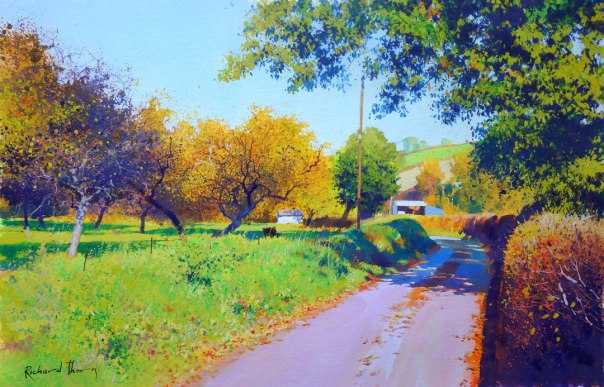
 Gladsome Lights