The following excerpt is from an interview with poet Dana Gioia that was, but is no longer, on the Fact and Arts website of the BBC, I think more than ten years ago. Gioia has been Chairman of the National Endowment for the Arts and Poet Laureate of California. I’m sorry I can no longer link to the whole interview, but I think this small part is worthwhile.
F&A: You’ve said, “I don’t think Americans are dumber than they were 25 years ago, but our culture is.” Tell me how our culture is dumber.
Dana Gioia: Our culture is vastly dumber. I’ll give you an example. If you’ve got a copy of The New Yorker from 30 years ago, it would have about six times as many words as it does now. The same thing for The Atlantic. With most of our newspapers, if somebody wrote a review of a book, it was thousands of words long. People would actually think through things in print in a serious way. Even if you didn’t like The New Yorker, you had to take it seriously.
Nowadays we have the USA Today version of culture. People have been trained by TV and the Internet to want an image and a headline. The notion of careful sequential thought contextualized historically, ideologically is a vanishing skill. When we collectively lose our ability to have sustained linear attention, whole types of thought are impossible. I see this in my students who are bright kids but have read very little.
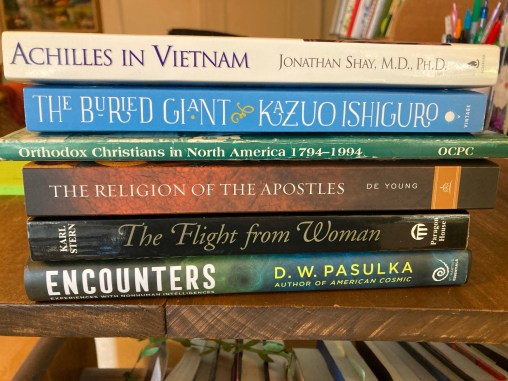
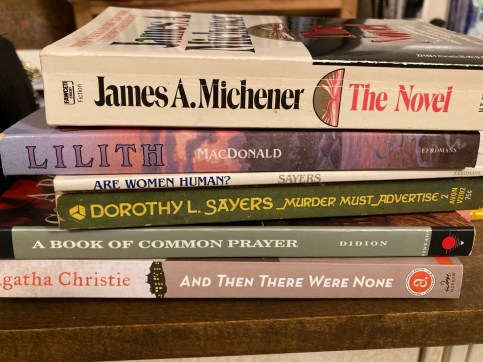
As soon as I got inspired by the 5×5 reading plan that I mentioned in my last post, I collected most of the books from around my two-storey house that were in stacks and not on shelves, and spread them on the dining table. I started to arrange the appropriate ones according to topics, and the two categories of “Women” and “Church History/Saints” were quite overloaded.
As I perused this scene, I recalled that in the last few years, many books I’ve read have been by audio — and few of those on the table were of the sort that are easy for me to attend to, by the “ear gate.” I wondered, “When will I sit and read all these books, most of which are too big to read in bed at night?” Quickly my mood also went into the Overloaded/Overwhelmed category and I climbed the stairs to bed.
Soon I decided the 5×5 plan is not for me. Clearly it wasn’t designed for me, but for young homeschooling mothers who need to read more books and look less at screens, who need to develop the habit of lifelong learning. I picked out several — not 25 — that I want to try extra hard to read in print this year.
Hmm… I almost forgot these I want to read after that first bunch. Altogether I see that they add up to about half of 25:
My two long-time friends Cori and Di came to visit for a couple of days last week, and because I planned for us to eat at the smaller table near the kitchen, I left my book mess as it was. They each brought dozens of titles for show-and-tell, give-or-lend. The warmth of the wood stove drew us to the nearby love seats, where we talked about all the volumes they brought out of their bags, a broad variety of genres and titles that would make the Scholé Sisters proud.
Many of Di’s offerings had Cori in mind, because she and her husband had lost their extensive library when their house burned down, in one of the many northern California fires of recent years. The only books I kept from this trading session were small paperbacks that I can easily read lying in bed, while my mind is turning off just before conking out for the night.
Our gathering was a festival, and a marathon
of talking and thinking, laughing and even weeping.
Now, it’s time for the reading to begin.
It’s been a long time since I read Mark Twain’s Personal Recollections ofJoan of Arc. When I came across the quote below it made me want to read it again — though I can see the good in reading a different biographer.
The Scholé Sisters presented again their idea of the 5×5 reading plan. You pick five topics or genres of books and try to read five books in each category. Personally, I won’t be officially joining the group challenge, but this organizing of my stacks does sound appealing. Already “Women” was one of the categories that immediately came to my mind, and a book about Joan of Arc would fit very nicely. I wish Chesterton had written one; this is from his book Orthodoxy:
“Joan of Arc was not stuck at the Cross Roads either by rejecting all the paths like Tolstoy or by accepting them all like Nietzsche. She chose a path and went down it like a thunderbolt. Yet Joan, when I come to think of her, had in her all that was true either in Tolstoy or Nietzsche — all that was even tolerable in either of them.
“I thought of all that is noble in Tolstoy: the pleasure in plain things, especially in plain pity, the actualities of the earth, the reverence for the poor, the dignity of the bowed back. Joan of Arc had all that, and with this great addition: that she endured poverty while she admired it, whereas Tolstoy is only a typical aristocrat trying to find out its secret.
“And then I thought of all that was brave and proud and pathetic in poor Nietzsche and his mutiny against the emptiness and timidity of our time. I thought of his cry for the ecstatic equilibrium of danger, his hunger for the rush of great horses, his cry to arms. Well, Joan of Arc had all that and, again, with this difference, that she did not praise fighting, but fought. We know that she was not afraid of an army, while Nietzsche for all we know was afraid of a cow.
“Tolstoy only praised the peasant; she was the peasant. Nietzsche only praised the warrior; she was the warrior. She beat them both at their own antagonistic ideals; she was more gentle than the one, more violent than the other. Yet she was a perfectly practical person who did something, while they are wild speculators who do nothing.”
Joseph Brodsky was born in St. Petersburg, what was then Leningrad, in 1940. He writes in the first, title essay of his book, about his generation in postwar Soviet Russia, how they were “somewhat spared” the full experience of what their country had become: a “drab hell, with a shabby materialist dogma and pathetic consumerist gropings.”
“We emerged from under the postwar rubble when the state was too busy patching its own skin and couldn’t look after us very well. We entered schools, and whatever elevated rubbish we were taught there, the suffering and poverty were visible all around. … The empty windows gaped at us like skulls’ orbits, and as little as we were, we sensed tragedy. … The amount of goods was very limited…. we didn’t develop a taste for possessions. Things that we could possess later were badly made and looked ugly. Somehow, we preferred ideas of things to things themselves….”
I can’t help comparing the cultural environment in which Brodsky came of age to that of the generation currently in their teens and twenties. When those young people in Leningrad were trying to survive the privations at every level of their being, they didn’t have the option of comforting themselves with marijuana or escaping to the metaverse. Their daily life didn’t include such diversions as shopping at the mall for the current fashions in jeans or phones. What they did have was books:
“If we made ethical choices, they were based not so much on immediate reality as on moral standards derived from fiction. We were avid readers and we fell into a dependence on what we read. Books, perhaps because of their formal element of finality, held us in their absolute power. Dickens was more real than Stalin or Beria. More than anything else, novels would affect our modes of behavior and conversations, and 90 percent of our conversations were about novels. It tended to become a vicious circle, but we didn’t want to break it.
“In its ethics, this generation was among the most bookish in the history of Russia, and thank God for that. A relationship could have been broken for good over a preference for Hemingway over Faulkner; the hierarchy in that pantheon was our real Central Committee. It started as an ordinary accumulation of knowledge but soon became our most important occupation, to which everything could be sacrificed. Books became the first and only reality, whereas reality itself was regarded as either nonsense or nuisance. Compared to others, we were ostensibly flunking or faking our lives. But come to think of it, existence which ignores the standards professed in literature is inferior and unworthy of effort. So we thought, and I think we were right.”
-Joseph Brodsky, Less Than One
This passage gives me a clue as to a question I’ve had about Brodsky: How, born a Jew and growing up under atheist Communism, did he come to be a “Christian poet”? Not only does he say (quoted in a previous post about him) that he tries to be a Christian, but Wikipedia tells us:
Daniel Murphy, in his seminal text Christianity and Modern European Literature, includes Brodsky among the most influential Christian poets of the 20th century, along with T. S. Eliot, Osip Mandelstam, Anna Akhmatova (Brodsky’s mentor for a time), and W. H. Auden (who sponsored Brodsky’s cause in the United States). Irene Steckler was the first to categorically state that Brodsky was “unquestionably a Christian poet”.
What the writer tells us about this education he and his friends got for themselves shows the power of the vicarious experience that can be had from reading good stories. The best books helped them to endure the “nonsense or nuisance” of totalitarian society, and at the same time gave them a broad, universal understanding of Reality. What a blessed bookishness; as Brodsky says, Thank God for that.

 As soon as I got inspired by the 5×5 reading plan that I mentioned in my last post, I collected most of the books from around my two-storey house that were in stacks and not on shelves, and spread them on the dining table. I started to arrange the appropriate ones according to topics, and the two categories of “Women” and “Church History/Saints” were quite overloaded.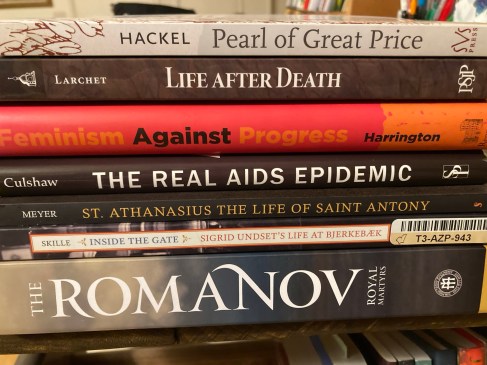


 Gladsome Lights