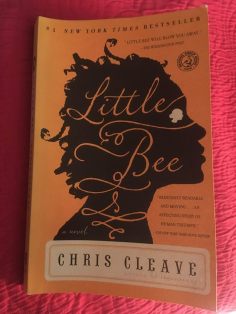
 Little Bee is among a rare set of books in my personal Modern Era, in that I found it in “hard copy” right in front of me, and picked it up with my own hands, and read it through to the end without consulting Goodreads or Amazon in making a guess as to its worth or suitability. That day last week, when I visited the used bookstore in Colorado Springs, it was the four double-sided book racks on the sidewalk that drew me closer, and that’s where I found Little Bee carrying a $1 sticker like all its shelfmates. A cheap risk.
The book appealed to me first because of its short and sweet title that reminded me of the friends in my garden, and secondly because of its appearance: small (unintimidating), paperback, and mostly a pleasing orange color. I did read a few lines of blurbs on the back and inside cover, and noted words like “dark” and “hope.” I probably also read a bit in the middle somewhere, to see if anything tacky jumped out.
I bought it and read it in a couple of days. It helped that I had at least three solid hours coming home Tuesday, on the plane and bus and at the bus stops, and I reached the last page in bed, just before turning out the light. — Forgive me, that was a long intro that would annoy me if I read it somewhere.
Little Bee is a page-turner of a novel. It tells the story of a young refugee from Nigeria first of all: “Everything was happiness and singing when I was a little girl. There was plenty of time for it. We did not have hurry. We did not have electricity or fresh water or sadness either, because none of these had been connected to our village yet….that village we did not yet know was built on an oil field and would soon be fought over by men in a crazy hurry to drill down into the oil.”
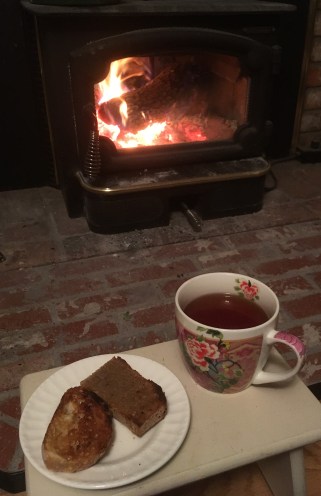
Though she never drank tea in her country, because it was mostly exported, she did get a cup on arrival at the detention center: “And when I tasted it, all I wanted to do was to get back into the boat and go home again, to my country. Tea is the taste of my land: it is bitter and warm, strong, and sharp with memory. It tastes of longing. It tastes of the distance between where you are and where you come from. Also it vanishes — the taste of it vanishes from your tongue while your lips are still hot from the cup. It disappears, like plantations stretching up into the mist.”
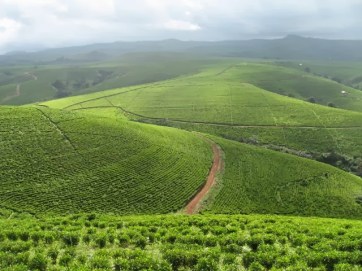
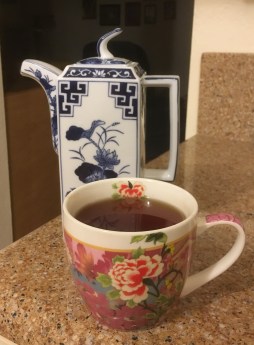
I likely read those lines before I got on the airplane, and when the attendant asked what I would drink, hot tea seemed the best choice. I resolved to drink more real tea in the future. I always knew it was rich in historical associations, but Little Bee’s words reveal it as rich in art and philosophy as well.
After Little Bee, this is the story of the British family with whose lives hers is indissolubly linked by one of those events called “dark.” Given the subject matter, the novel might have been highly politicized, but instead it is an account of how the various characters cope with the traumas from outside, and with the troubling revelations of their own souls’ poverty.
“Isn’t it sad, growing up? You start off like my Charlie. You start off thinking you can kill all the baddies and save the world. Then you get a little older, maybe Little Bee’s age, and you realize that some of the world’s badness is inside you, that maybe you’re a part of it. And then you get a little bit older still, and a bit more comfortable, and you start wondering whether that badness you’ve seen in yourself is really all that bad at all….”
“Maybe that’s just developing as a person, Sarah.”
“Well,” I said, “Maybe this is a developing world.”
Because of the grace of God, the way He made us humans with the strength of spirit to survive all the darkness threatening to kill us, there is much beauty and joy in the book. Like Little Bee’s description of this breakfast table scene: “The sun was lighting up the kitchen. It was thick yellow — a warm light, but not a show-off light. It did not want the glory for the illumination of the room. It made each object look as if it was glowing with a light from deep inside itself. Lawrence, the table with its clean blue cotton tablecloth, his orange tea mug and my yellow one — all of it glowing from within. The light made me feel very cheerful. I thought to myself, that is a good trick.”
The two women in the story alternate telling the tale in the first person, sometimes describing the same event from their vastly different perspectives. And those two characters especially spend a good bit of time filling each other in on their past. This is Little Bee talking again, typically philosophical:
“Everyone in my village liked U2. Everyone in my country, maybe. Wouldn’t that be funny, if the oil rebels were playing U2 in their jungle camps, and the government soldiers were playing U2 in their trucks. I think everyone was killing everyone else and listening to the same music. Do you know what? The first week I was in the detention center, U2 were number one here, too. That is a good trick about this world, Sarah. No one likes each other, but everyone likes U2.”
The girl tells how U2 was playing in her Nigerian home, the radio on which they were supposed to be listening to the BBC having been tuned by her sister to the music station instead, because “Nkiruka loved music and now I saw that she was right because life is extremely short and you cannot dance to current affairs.”
The motivations that drive these characters’ actions, their rationalizations, their good deeds, are not pure or simple. Survival, anger, boredom, revenge, guilt… and sometimes, the heart knowledge that we are fellow humans on our way to the grave, and we have nothing to lose from loving.
I very much enjoyed the character of Little Bee, whose child self is haunted by horrific memories even as she is growing into a wise young woman. The less sympathetic characters are shown to be not all that different from us average lost sheep who wander bleating here and there looking for food, and they all get at least a little more light and understanding as the novel progresses. Even one of the “baddies” is shown in remarkably few words to be irreducible to a caricature.
Picking up a book that I know nothing about, and then reading the whole thing privately, with not one iota of input digital or otherwise from another reader — that is a refreshing experience. It feels almost wild and irresponsible to my recent self. But this experiment with Little Bee was satisfying at all levels, and I can see myself taking similar risks in the future. Here’s to more reading adventure!
 my “book larder” almost as soon as I got home on Sunday, and have been taking that nourishment.

 I have begun reading a few Japanese novels, in translation of course, and maybe I will add a nonfiction book, because Bellezza has drawn me into her
 lion furrows? Let us admit that reading with us is just a drug that we cannot do without—who of this band does not know the restlessness that attacks him when he has been severed from reading too long, the apprehension and irritability, and the sigh of relief which the sight of a printed page extracts from him?—and so let us be no more vainglorious than the poor slaves of the hypodermic needle or the pint-pot.

