Tag Archives: Richard Wilbur

A Measuring Worm

More than one reviewer of Richard Wilbur’s latest collection of poems has noticed that since his wife died, the poet has written more about death, as in this example below. That would be a natural response, of course, for someone 90 years old, even if he weren’t recently widowed.

I’m a lot younger than Wilbur, but I know it’s recommended that people of all ages live with awareness of the shortness of our lives, as in Psalm 90: “Teach us to number our days, that we may gain a heart of wisdom.” Or as another translation goes, “Teach us to realize the brevity of life….”

If our dearest friends and family have departed, it could exacerbate any feeling of weariness we already had with this earthly existence. In the same Psalm the poet mentions the less-than-thrilling aspects of life: “The days of our years are threescore years and ten; and if by reason of strength they be fourscore years, yet is their strength labour and sorrow; for it is soon cut off, and we fly away.”

A MEASURING WORM

This yellow striped green
Caterpillar, climbing up
The steep window screen,

Constantly (for lack
Of a full set of legs) keeps
Humping up his back.

It’s as if he sent
By a sort of semaphore
Dark omegas meant

To warn of Last Things.
Although he doesn’t know it,
He will soon have wings,

And I, too, don’t know
Toward what undreamt condition
Inch by inch I go.

~ Richard Wilbur

Richard Wilbur is a lot smarter than an inchworm, so I like to think he had this verse from I Corinthians in mind when he wrote those last lines: “But as it is written, Eye hath not seen, nor ear heard, neither have entered into the heart of man, the things which God hath prepared for them that love him.”

Because the Preparer is Love, our Last Things, though unimaginable, will be the best.
wilbur 2011

Snow and Tears


BOY AT THE WINDOW

Seeing the snowman standing all alone
In dusk and cold is more than he can bear.
The small boy weeps to hear the wind prepare
A night of gnashings and enormous moan.
His tearful sight can hardly reach to where
The pale-faced figure with bitumen eyes
Returns him such a God-forsaken stare
As outcast Adam gave to paradise.

The man of snow is, nonetheless, content,
Having no wish to go inside and die.
Still, he is moved to see the youngster cry.
Though frozen water is his element,
He melts enough to drop from one soft eye
A trickle of the purest rain, a tear
For the child at the bright pane surrounded by
Such warmth, such light, such love, and so much fear.

~ Richard Wilbur

The morning air is all awash with angels.


Lots of us homemakers, in the Northern Hemisphere anyway, are writing about laundry, as the summer sunshine makes it easy to use the fresh warm air to do part of the job. Cathy even posted a poem, which reminded me of my own favorite laundry poem. Funny, it’s from a man’s point of view, and written by a man who probably didn’t have too much direct experience, but maybe that’s why he could see not just the mundane and practical aspects, but the poetry and love of washing and drying the clothes of our fellow humans.
.

 Love Calls Us to the Things of This World

    The eyes open to a cry of pulleys,
And spirited from sleep, the astounded soul
Hangs for a moment bodiless and simple
As false dawn.
                          Outside the open window
The morning air is all awash with angels.
    Some are in bed-sheets, some are in blouses,
Some are in smocks; but truly there they are.
Now they are rising together in calm swells
Of halcyon feeling, filling whatever they wear
With the deep joy of their impersonal breathing;
    Now they are flying in place, conveying
The terrible speed of their omnipresence, moving
And staying like white water; and now of a sudden
They swoon down into so rapt a quiet
That nobody seems to be there.
                                                       The soul shrinks
    From all that it is about to remember,
From the punctual rape of every blessèd  day,
And cries,
                  “Oh, let there be nothing on earth but laundry,
Nothing but rosy hands in the rising steam
And clear dances done in the sight of heaven.”
    Yet, as the sun acknowledges
With a warm look the world’s hunks and colors,
The soul descends once more in bitter love
To accept the waking body, saying now
In a changed voice as the man yawns and rises,
       “Bring them down from their ruddy gallows;
Let there be clean linen for the backs of thieves;
Let lovers go fresh and sweet to be undone,
And the heaviest nuns walk in pure floating
Of dark habits,
                          Keeping their difficult balance.”
–Richard Wilbur

More or less of what?

My thoughts about children’s books and Lent converge on this excerpt from Richard Wilbur’s More Opposites, which I think one of The Most Fun collections of poems and drawings. I don’t even require another person to read Wilbur’s humorous poems to — they often make me chuckle contentedly or muse to myself. I see that I already posted this particular one, but it was years ago, and I for one can use it often.

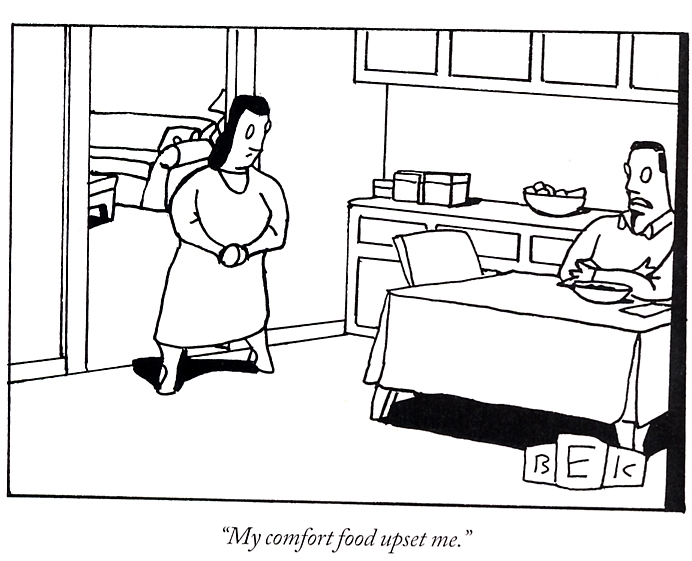
The illustrations of this question in the book include a simple drawing of people with distressed faces holding their tummies. I think the cartoon at bottom makes a similar companion to the poem.

It’s #15 in the More Opposites book:

The opposite of less is more.
What’s better? Which one are you for?
My question may seem simple, but
The catch is — more or less of what?

“Let’s have more of everything!” you cry.
Well, after we have had more pie,
More pickles, and more layer cake,
I think we’ll want less stomach-ache.

The best thing’s to avoid excess.
Try to be temperate, more or less.

There is a Mennonite cookbook titled More With Less, from which I gleaned many good cooking ideas in the early days of my homemaking career. But more valuable than the actual recipes was the refreshing concept that one might have more health and more enjoyment of eating and probably more money to spend on other things if you ate less.

Of course this is something we need to keep in mind all the time, not just during Lent. The church fathers caution us not to eat so much food that we aren’t able to pray after eating it; an overfull stomach hinders prayer. If it’s possible that Less Food = More Prayer….
Let’s just pause and think on that.