Tag Archives: Scripture

Royal Hours of Theophany

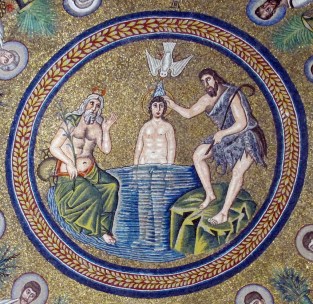
Ravenna, 6th Century


The service of Royal Hours of Theophany, which we prayed this evening as part of the forefeast of baptism of Christ, is so rich; it “brings the mind into the heart,” as we say. We read and sang several Old Testament readings, as many Epistle and Gospel Readings, and many Psalms chosen for the feast. When I came home afterward I found the liturgical texts online, hoping to hold on to the “afterglow” a little longer. Tomorrow we will continue our celebration of this major feast, on through the 7th.


Here are a very few portions of the service:

To the voice of one crying in the wilderness,
“Prepare the way of the Lord,”
Thou didst come, O Lord, taking the form of servant.
Thou didst ask to be baptized
though Thou hast no knowledge of sin.
The waters saw Thee and were afraid.
The Forerunner trembled and cried aloud:
“How will the Lamp illumine the Light?
How will a servant lay his hand on the Master?
Thou takest away the sin of the world, O Savior.
Sanctify both me and the waters!”
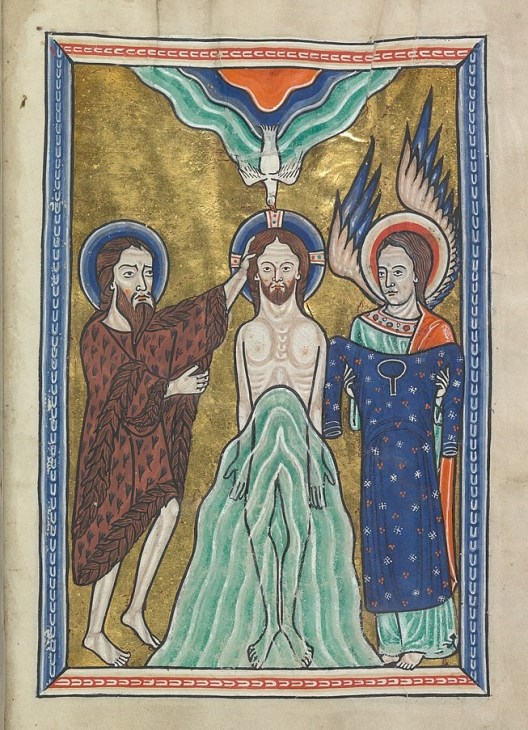
From the Psalter of Eleanor of Aquitaine, c. 1185

The Father bore witness to Thee,
and the Divine Spirit in the form of a dove
descended to Thee,
as Thou camest in flesh to the Jordan, O Lord.
Thou didst desire to be baptized in human form,
that in Thy compassion
Thou mightest enlighten us who have gone astray,
and deliver us from all the snares and wiles of the Dragon.
Make Thy home in our souls, O Thou Who lovest mankind.


Therefore with joy shall ye draw water

out of the wells of salvation.

And in that day shall ye say, Praise the Lord,
call upon his name, declare his doings among the people,
make mention that his name is exalted.

Sing unto the Lord; for he hath done excellent things:
this is known in all the earth.

Cry out and shout, thou inhabitant of Zion:
for great is the Holy One of Israel in the midst of thee.

Isaiah 12:3-6

Ethiopia

Titus 3

4 But after that the kindness and love of God our Saviour toward man appeared,
5 Not by works of righteousness which we have done, but according to his mercy he saved us, by the washing of regeneration, and renewing of the Holy Ghost;
6 Which he shed on us abundantly through Jesus Christ our Saviour;
7 That being justified by his grace, we should be made heirs according to the hope of eternal life.

Gospel for Forgiveness Sunday

For if you forgive men their trespasses, your heavenly Father will also forgive you. But if you do not forgive men their trespasses, neither will your Father forgive your trespasses.

Moreover, when you fast, do not be like the hypocrites, with a sad countenance. For they disfigure their faces that they may appear to men to be fasting. Assuredly, I say to you, they have their reward. But you, when you fast, anoint your head and wash your face, so that you do not appear to men to be fasting, but to your Father who is in the secret place; and your Father who sees in secret will reward you openly.

Do not lay up for yourselves treasures on earth, where moth and rust destroy and where thieves break in and steal; but lay up for yourselves treasures in heaven, where neither moth nor rust destroys and where thieves do not break in and steal. For where your treasure is, there your heart will be also.

Matthew 6:14-21 – Gospel for Forgiveness Sunday

Expulsion from Paradise – Palatine Chapel, Palermo, 12th century

It will break open my hardened heart.

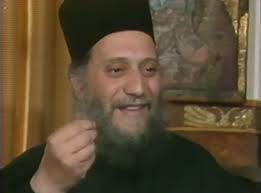
A word on approaching the Scriptures from Elder Aimilianos, who from 1974 to 2000 was abbot of Simonopetra Monastery on Mt. Athos:

“When one undertakes to examine Scripture in an idle, intellectual way, he creates hatred and quarreling. Why? Because the intellectual approach to Scripture does not help us to turn and reflect on our sins, but instead makes us focus on problems and concepts related to the study of Scripture, with the result that our logical and intellectual faculties are aroused to no real purpose.

“’Knowledge’ by itself does not add anything. On the contrary, it encourages the cultivation of the individual and his private sense of things; it fosters the self-sufficiency of his personal opinions, which he then seeks to justify and impose on others. This kind of approach to Scripture immediately places you in conflict with others; it opposes your will and opinion to theirs, prompting you to disagree and argue with them, and to make enemies of your brothers. Filled as I am with my own opinions about things, I am not able to receive anything from God.

“The correct way is to read Scripture with simplicity and to allow God to tell us what He wants to tell us. It’s one thing to read Scripture because you want to collect information, and another thing to read it aimilianos-of-athos-photobecause you want to acquire its true content, that is, the Holy Spirit.

“This kind of knowledge is the life of God (cf. John 17:3), the entry and extension of God into our life; it is God’s descent and dwelling among us. We can judge whether or not our study of Scripture is authentic based on the number of tears we shed when we study. To be sure, I can also read Scripture without shedding tears, and without a strong sense of my sins, but with the hope that God’s grace, through my reading of Scripture, will break open my hardened heart. Read Scripture, then, but don’t forget about your sins and reduce Scripture to an object of intellectual inquiry, for at that point it ceases being the word of God and you start seeing it as something human.

“The criterion for your study should be this: the way you read the Bible should bring peace to your heart, communion with God, love of neighbors, and the consciousness of your own sinfulness: the recognition of how unworthy and ill-prepared you are to stand before God.”

-Elder Aimilianos of Mount Athos