“Devils take great delight in fullness, and drunkenness and bodily comfort. Fasting possesses great power and it works glorious things. To fast is to banquet with angels.”
+ St. Athanasius the Great

“Devils take great delight in fullness, and drunkenness and bodily comfort. Fasting possesses great power and it works glorious things. To fast is to banquet with angels.”
+ St. Athanasius the Great
 Athanasius of Alexandria has been highly regarded throughout Christian history, East and West. Today is one of his feast days In the Orthodox Church. I first heard of Athanasius when I was a Protestant, because his treatise On the Incarnation was recommended to me many times. I finally read it a few years ago at Christmastime, and found it very encouraging. I notice lots of discussion of Athanasius still going on in the blogosphere in this century.
Athanasius was born about 297 and was present as a deacon at the Council of Nicea in 325. It was he who suggested the word “consubstantial” (homoousion) to describe Christ’s relationship to the Father, in opposition to the Arians who believed Christ to be a creature. The word was immediately adopted and became an important point of sound doctrine from then on.
When Bishop Alexander of Alexandria died, Athanasius reluctantly consented to take the bishopric, and he remained bishop for 43 years, though he spent a total of 17 of those years in exile at the command of four different emperors, and was many times forced to leave the city under threats to his life. These incidents led to the phrase “Athanasius contra mundum” or “Athanasius against the world.”
I don’t need to repeat what I have written before, or tell you things about St. Athana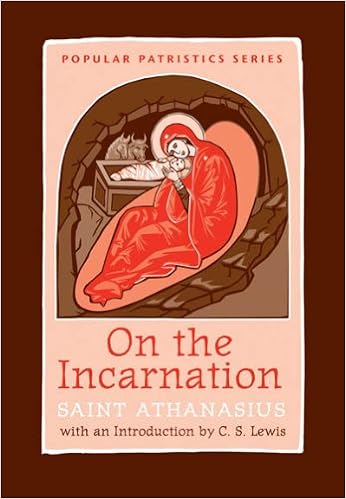 sius that you can easily discover online, but I wanted to remember this important saint here. Here is are some excerpts from St. Nicolai in his Prologue for today:
Only for a while before his death did he live peacefully, as a good shepherd among his good flock, who truly loved him. Few are the saints who were so mercilessly slandered and so criminally persecuted as was St. Athanasius. His great soul patiently endured all for the love of Christ and, in the end, emerged victorious from this entire terrible and long-lasting struggle.
For counsel, for comfort and for moral support, Athanasius often visited St. Anthony the Great, whom he respected as his spiritual father. A man who formulated the greatest truth, Athanasius had much to suffer for that truth–until the Lord gave him repose in His kingdom as His faithful servant, in the year 373 A.D.
Through Athanasius, wisdom shone,
And the truth of God enlightened men.
The people recognized that wisdom is not bitter,
But, to all who drink it to the bottom, it is sweet;
To all who suffer for it, it is dear.
From Father Stephen Freeman:
When the Fathers used the word “symbol,” they understood that something was actually, really and truly made present. A symbol makes present that which it represents. This is fundamental in the doctrine of the Holy Icons. In our modern world, a symbol represents something that is not there, it is a sign of absence. Indeed, because our modern world-view is essentially one of nominalism, we believe that the ancient notion of symbol is simply impossible. It feels like superstition to the modern consciousness.
…..
But this brings us to my description of sin as not being a “legal problem.” St. Justin says that “sin defiles a man and his being.” This is not contemporary language. He means exactly what he is saying. It is of a piece with St. Athanasius’ description of sin as death, corruption and non-being. Sin is something, not just a thought in the mind of God. It kills us, and not because God is doing the killing. Sin is death itself. The “lawlessness” of I John 3:4 is the anarchy, chaos, and disorder of death and corruption. Sin is utterly contrary to the life that is the gift of God.
This is why St. Justin (and the Church) can say that the remedy of sin is holiness, the “synthesis and unity of all the holy virtues and grace-filled energies.” When we partake of the holy mysteries of Christ’s Body and Blood, they “cleanse us from all sin.” This is not a simple change of our status in the mind of God. His Body and Blood are life. They are the antidote to death, decay, corruption and non-being. They destroy the lawlessness that is the anarchy, chaos and disorder of death and corruption.
You can read the entire article here: Secularized Sin
On this Sunday in the Orthodox Church we remember the Holy Forefathers, the faithful ancestors of Christ, many of whom are named in a long list in the services yesterday and today, men and women like David, Jael, Daniel, Rachel, Moses and Ruth….
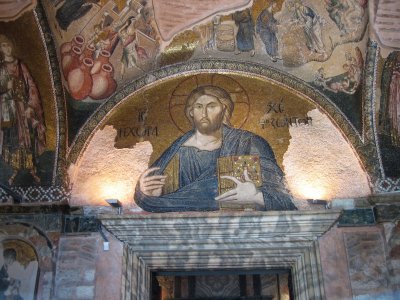
And the hymns sing of how they all, long since passed from this earthly existence, are even now “in the Land of the Living.” Thomas Hopko in The Winter Pascha mentions a church near Constantinople where a huge mosaic of Christ is named: “The Land of the Living.” I found a photo of it (above).
I learned in the short account of the life of Athanasius at the beginning of his On the Incarnation that the last and worst persecution of Christians ended in Egypt in 311 A.D., when Athanasius was about fourteen. From the age of five he had lived with the constant threat of death, and with the ever-present reality of persecution of his friends and family. The behavior of the ungodly is irrational and inhuman, and tends to cause great pain and suffering, often unto death, not only of the innocent but also of the most Christ-like. As an adult the scenes and events of his childhood seem to be fresh in his mind when he writes:
“A very strong proof of this destruction of death and its conquest by the cross is supplied by the present fact, namely this. All the disciples of Christ despise death; they take the offensive against it and instead of fearing it, by the sign of the cross and by faith in Christ trample on it as on something dead. Before the divine sojourn of the Saviour, even the holiest of men were afraid of death, and mourned the dead as those who perish. But now that the Saviour has raised his body, death is no longer terrible, but all those who believe in Christ tread it underfoot as nothing, knowing full well that when they die they do not perish, but live indeed, and become incorruptible through the resurrection. But that devil who of old wickedly exulted in death, now that the pains of death are loosed, he alone it is who remains truly dead.”
I started composing this post about death and the saint’s childhood before the horrific murders at a Connecticut school last week. I found the description Athanasius gives, of people bravely and even joyfully facing death daily, foreign to my 21st-century suburban self. But the topic turns out to be pertinent, and the recent stories of gutsy teachers in our own country inspiring — especially when taken with the letter from our Archbishop Tikhon after that event:
“Concerning those who have fallen asleep, Saint Paul exhorts us not to “grieve even as others who have no hope” [1 Thessalonians 4:13]. And yet, herein he does not forbid us from grieving. Now is the time for us to weep, but we must weep with the firm hope that comes from our faith in our Lord Jesus Christ. “Shed tears, but remain calm; weep modestly, and with fear of God,” writes Saint John Chrysostom. And following this example, each of us must strive to transform our sorrow into prayer.
Just this week I was asked to tell one of my favorite Bible verses, one that readily comes to mind without effort. It is always this one, that speaks of our complete dependence on the Lord as our LIFE, whether living or dying. Our leaves will not wither, because Christ Himself is The Land of the Living.
 Gladsome Lights