 …night possessed us and the shadow of death encompassed us, for we had fallen into sin and lost the power of sight which was ours by God’s grace, and by which we were able to perceive the light that bestows true life. Night and death had been poured out on our human nature, not because of any change in the true light, but because we had turned aside and no longer had any inclination towards the life-bearing light. In the last times, however, the Giver of eternal light and Source of true life has had mercy upon us.
Tag Archives: St. Gregory Palamas
We prescribe what is fitting.
 … we grapple with this ‘law of sin’ (Romans 8:2) and expel it from our body, establishing in its place the surveillance of the intellect. Through this surveillance we prescribe what is fitting for every faculty of the soul and every member of the body. For the senses we prescribe what they should take into account and to what extent they should do so, and this exercise of the spiritual law is called self-control.
We have needed just such a drink.
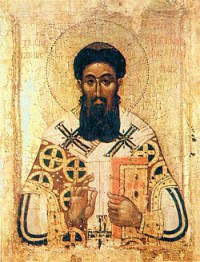 …the grace of the Spirit takes possession of the quiet soul, and gives it a taste of the unspeakable good things to come, which no passionate and negligent eye has seen, nor ear heard, neither have entered into the heart of such a man (cf. I Cor. 2:9). This taste is the earnest of these good things, and the heart which accepts these pledges becomes spiritual and receives assurance of its salvation. -St. Gregory Palamas
Today we commemorate St. Gregory Palamas. Frequently I am so scattered that I forget to look at any calendar: my wall calendars or my everyday planning calendar or the church calendar. But today I did, so I noticed. Last year I attended the most enriching retreat during which we were taught much about the spiritual life, understanding and practices that are our inheritance from St. Gregory, but I never managed to process it in a way that I could share here.
Nor could I look it up in my notes, because of not being able to find them in the remodeling upheaval. So I read what St. Nicolai has to say about him in his Prologue. Here is a bit of it:
St. Gregory Palamas learned much through heavenly revelations. After he had spent three years in stillness in a cell of the Great Lavra, it was necessary for him to go out among men and benefit them with his accumulated knowledge and experience. God revealed this necessity to him through an extraordinary vision: One day, as though in a light sleep, Gregory saw himself holding a vessel in his hand full to overflowing with milk. Gradually, the milk turned into wine which likewise spilled over the rim, and drenched his hands and garments.
Then a radiant youth appeared and said: “Why would you not give others of this wonderful drink that you are wasting so carelessly, or are you not aware that this is the gift of God’s grace?” To this Gregory replied: “But if there is no one in our time w ho feels the need for such a drink, to whom shall I give it?” Then the youth said: “Whether there are some or whether there are none thirsty for such a drink, you are obligated to fulfill your debt and not neglect the gift of God.” Gregory interpreted the milk as the common knowledge (of the masses) of moral life and conduct, and the wine as dogmatic teaching.
Also I mused on quotes from him that I found online, such as the one at top. Here are three more that give me courage:
Life of the soul is union with God, as life of the body is union with the soul. As the soul was separated from God and died in consequence of the violation of the commandment, so by obedience to the commandment it is again united to God and is quickened. This is why the Lord says in the Gospels, ‘The words I speak to you are spirit and life’ (John 6:63).
Prayer changes from entreaty to thanksgiving, and meditation on the divine truths of faith fills the heart with a sense of jubilation and unimpeachable hope. This hope is a foretaste of future blessings, of which the soul even now receives direct experience, and so it comes to know in part the surpassing richness of God’s bounty, in accordance with the Psalmist’s words, ‘Taste and know that the Lord is bountiful’ (Psalm 34:8). For He is the jubilation of the righteous, the joy of the upright, the gladness of the humble, and the solace of those who grieve because of Him.
Given that we desire long life, should we not take eternal life into account? If we long for a kingdom which, however enduring, has an end, and glory and joy which, great as they are, will fade, and wealth that will perish with this present life, and we labour for the sake of such things; ought we not to seek the kingdom, glory, joy and riches which, as well as being all-surpassing, are unfading and endless, and ought we not to endure a little constraint in order to inherit it?
-St. Gregory Palamas
He started off by fasting.
 “… Adam chose the treason of the serpent, the originator of evil, in preference to God’s commandment and counsel, and broke the decreed fast. Instead of eternal life he received death and instead of the place of unsullied joy he received this sinful place full of passions and misfortunes, or rather, he was sentenced to Hades and nether darkness. Our nature would have stayed in the infernal regions below the lurking places of the serpent who initially beguiled it, had not Christ come. He started off by fasting (cf. Mk. 1:13) and in the end abolished the serpent’s tyranny, set us free and brought us back to life.”
— St. Gregory Palamas, The Homilies Vol. II
 Gladsome Lights