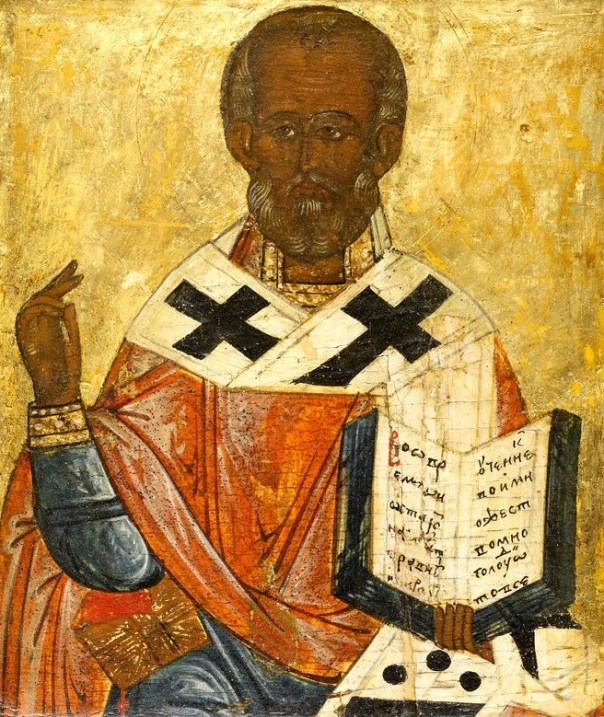
Tag Archives: St. Nicholas of Myra

St. Nicholas Day through the years.

On this day ten years ago I did not post anything about St. Nicholas, whose feast day it was and is. Just now I was checking back through the years to find out what I’ve already said about the God-loving man who is so dear to people all over the world, when I discovered this post from ten years ago, at the time my new garden was pretty much installed (the back part of the property). If I didn’t have pictures like the one below, I would not believe how fast a garden can happen. The fountain shown did not remain long, because it exfoliated in its first winter and was returned to the nursery where I’d bought it.

Early December 2015

The most enjoyable posts here over the years on St. Nicholas Day seem to me these two: One when I traveled to a parish of which he is the patron saint, and one in which I have a lovely icon and the quote from Fr. Thomas Hopko in honor of him. So if you’d like to read about St. Nicholas or his feast you can click on those links. One of the posts includes this photo:

2025 is another year in which I won’t be celebrating with our sister parish on their feast day, because I am not completely well from a cold that knocked me down a bit, and I’m catching up on rest and everything else that didn’t happen for a few days. But it doesn’t feel right to let the day pass without joining in the commemoration at some level.
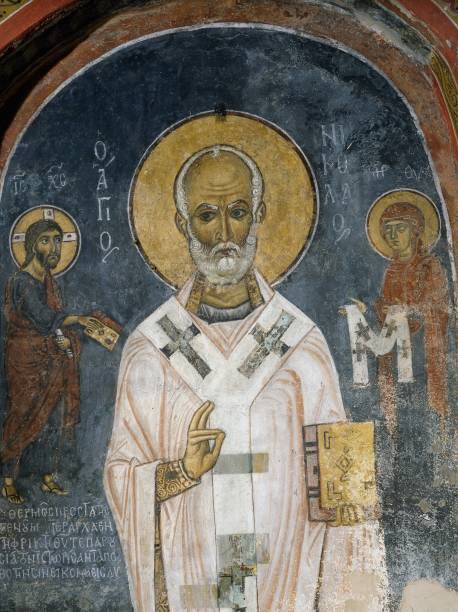
St Nicholas of Myra, 12th century; Church of Saint Nicholas of the Roof, Troodos mountains, Cyprus.

I’m sure that after Divine Liturgy for the feast, everyone at St. Nicholas parish will be singing this song at their festal meal. It is playing in my mind right now:
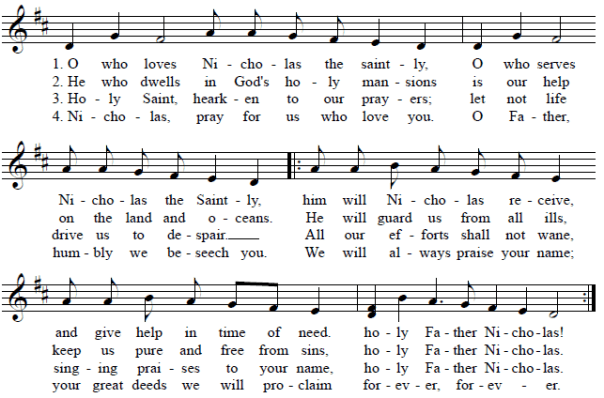
Though they are singing in a different language, Old Church Slavonic or Russian, I like the rendition of these men the best:  “O Who Loves Nicholas the Saintly.”

I pray that the joy of St. Nicholas reaches you wherever you are.
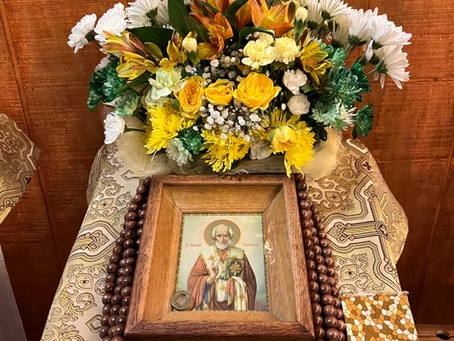
He was a divinely good person.

On the Feast of Saint Nicholas, I give you once more the words of Fr. Thomas Hopko from The Winter Pascha:

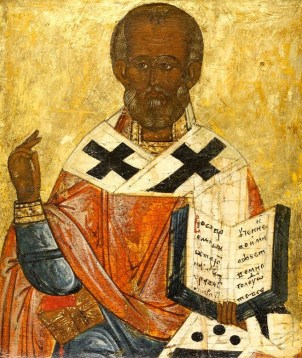
“The extraordinary thing about the image of St. Nicholas in the Church is that he is not known for anything extraordinary. He was not a theologian and never wrote a word, yet he is famous in the memory of believers as a zealot for orthodoxy, allegedly accosting the heretic Arius at the first ecumenical council in Nicaea for denying the divinity of God’s son. He was not an ascetic and did no outstanding feats of fasting and vigils, yet he is praised for his possession of the “fruit of the Holy Spirit…love, joy, peace, patience, kindness, goodness, faithfulness, gentleness, self-control” (Gal. 5:22-23). He was not a mystic in our present meaning of the term but he lived daily with the Lord and was godly in all his words and deeds. He was not a prophet in the technical sense, yet he proclaimed the Word of God, exposed the sins of the wicked, defended the rights of the oppressed and afflicted, and battled against every form of injustice with supernatural compassion and mercy. In a word, he was a good pastor, father, and bishop to his flock, known especially for his love and care for the poor. Most simply put, he was a divinely good person.”

Happy Saint Nicholas Day!

St. Nicholas Orthodox Church in San Anselmo, California

The electrician learns of his special day.

Today the cousins and brothers who are the electricians on my project brought a fourth young man who was introduced as Nico. After they had all been working upstairs and I had been cleaning downstairs all morning, I began to wonder if any of them knew that today was St. Nicholas Day.

Then it occurred to me that “Nico” is probably short for “Nicholas,” so I ran up and waited nearby while he finished installing a fixture in the new hallway, and asked him if he was named for St. Nicholas. He said Nicholas was indeed his “real name,” and I said, “Today is your day! It’s St. Nicholas Day.” He had no idea, poor boy. But now he knows; I told him St. Nicholas is probably praying for him today.

Until that little conversation I hadn’t thought of putting anything pertinent on my blog, but it made me want to take advantage of the calendar to honor St. Nicholas again. I am giving you (for the third time!) a quote from Fr. Thomas Hopko below, in my post re-published from last year. Those of you who have had enough of that might like to go instead to this blog post from on how the memory of St. Nicholas can help us resist the spirit of the age and the “talk about our having ‘the best Christmas ever!’ It is as if Christmas is a rush that brings us perfect happiness.” It is here: “Saint Nicholas and the Meaning of Christmas.”

St. Nicholas is one of the “favoritest” saints in the Orthodox Church. I have read about him many times and don’t usually remember much. I didn’t grow up hearing about him as the real historical not-Santa-Claus person that he is, or knowing that there was such a thing as St. Nicholas Day, and since I became Orthodox I haven’t succeeded in implanting him in my heart in any satisfying way.

But we both live by and in the love of Christ, so he must be in my heart in spite of my neglect. I will pass on to you (again) what blessed me some years ago, from The Winter Pascha:

“The extraordinary thing about the image of St. Nicholas in the Church is that he is not known for anything extraordinary. He was not a theologian and never wrote a word, yet he is famous in the memory of believers as a zealot for orthodoxy, allegedly accosting the heretic Arius at the first ecumenical council in Nicaea for denying the divinity of God’s son.

“He was not an ascetic and did no outstanding feats of fasting and vigils, yet he is praised for his possession of the “fruit of the Holy Spirit…love, joy, peace, patience, kindness, goodness, faithfulness, gentleness, self-control” (Gal. 5:22-23). He was not a mystic in our present meaning of the term but he lived daily with the Lord and was godly in all his words and deeds. He was not a prophet in the technical sense, yet he proclaimed the Word of God, exposed the sins of the wicked, defended the rights of the oppressed and afflicted, and battled against every form of injustice with supernatural compassion and mercy.

“In a word, he was a good pastor, father, and bishop to his flock, known especially for his love and care for the poor. Most simply put, he was a divinely good person.”

-Fr. Thomas Hopko