Tag Archives: suffering

What Athanasius knew.

Psalm 58:8

Thou tellest my wanderings:
put thou my tears into thy bottle:
are they not in thy book?

The more one researches current events, historical accounts, and the tangled web of cultures and civilizations going back to the foundation of the world, the more likely is a fall into worry and even despair. We fear especially for children who have to grow up in a violent era, as many have done. That’s why I take courage from the life of St. Athanasius, and pray that my children, grandchildren, godchildren, and all of us, might learn deep in our souls what he knew. The following is an excerpt from a post I wrote several years ago in a time of sorrow. I have shared the quote from his treatise more recently than that, but I hope you might agree with me that it’s worth rereading:
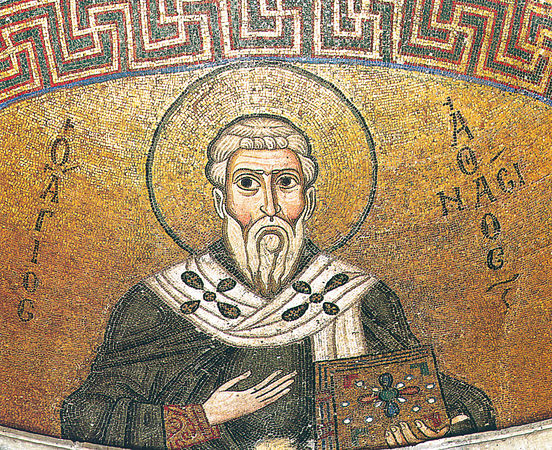
I learned in the short account of the life of Athanasius at the beginning of his On the Incarnation, that the last and worst persecution of Christians ended in Egypt in 311 A.D., when Athanasius was about fourteen. From the age of five he had lived with the constant threat of death, and with the ever-present reality of persecution of his friends and family. The behavior of the ungodly is irrational and inhuman, and tends to cause great pain and suffering, often unto death, not only of the innocent but also of the most Christ-like. As an adult the scenes and events of his childhood seem to be fresh in his mind when he writes:

“A very strong proof of this destruction of death and its conquest by the cross is supplied by the present fact, namely this. All the disciples of Christ despise death; they take the offensive against it and instead of fearing it, by the sign of the cross and by faith in Christ trample on it as on something dead. Before the divine sojourn of the Saviour, even the holiest of men were afraid of death, and mourned the dead as those who perish. But now that the Saviour has raised his body, death is no longer terrible, but all those who believe in Christ tread it underfoot as nothing, knowing full well that when they die they do not perish, but live indeed, and become incorruptible through the resurrection. But that devil who of old wickedly exulted in death, now that the pains of death are loosed, he alone it is who remains truly dead.”
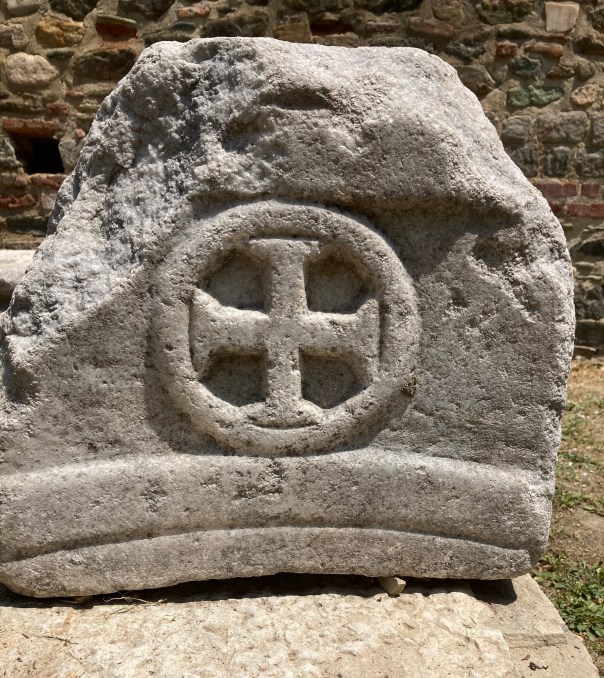
Thessaloniki – Rubble at Church of the Acheiropoietos

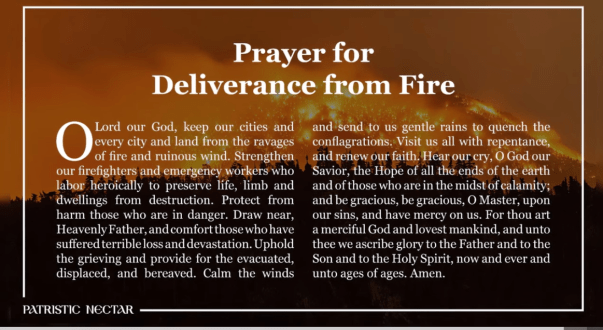
Prayer for Deliverance from Fire

I myself live in northern California, far from the fires that are devastating large areas in the southern part of our state. The situation doesn’t affect me directly, but I do have friends and family who are suffering and still endangered, as many of you probably do, too — not to mention all the thousands of people whom we don’t know who are literally embroiled in this disaster. So I appreciate this prayer that just came to me through email, and which may give relief to your hearts’ groanings as well. I transcribed the text below the image.

O Lord our God, keep our cities and every city and land from the ravages of fire and ruinous wind. Strengthen our firefighters and emergency workers who labor heroically to preserve life, limb and dwellings from destruction. Protect from harm those who are in danger. Draw near, Heavenly Father, and comfort those who have suffered terrible loss and devastation. Uphold the grieving and provide for the evacuated, displaced, and bereaved. Calm the winds and send us gentle rains to quench the conflagrations.

Visit us all with repentance, and renew our faith. Hear our cry, O God our Savior, the Hope of all the ends of the earth and of those who are in the midst of calamity, and be gracious, be gracious, O Master, upon our sins, and have mercy on us. For Thou art a merciful God and lovest mankind, and unto Thee we ascribe glory to the Father and to the Son and to the Holy Spirit, now and ever and unto ages of ages. Amen.

To make broken things beautiful.

From Mother Melania:

Japanese kintsugi mending tools“Have you ever heard of kintsugi? Literally ‘golden joinery,’ kintsugi is ‘the Japanese art of repairing broken pottery by mending the areas of breakage with urushi lacquer dusted or mixed with powdered gold, silver, or platinum … As a philosophy, it treats breakage and repair as part of the history of an object, rather than something to disguise’ (Thanks, Wikipedia!). I won’t presume to discuss the Japanese philosophies related to this art. But there are certainly deeply Christian parallels to be drawn. Three come immediately to mind.

“First are those who valiantly and humbly endure life’s inequities or unjust persecution, such as Job, Patriarch Joseph, Jeremiah, and the beggar Lazarus. Crushed in various ways through no fault of their own, these saints became beautiful not despite the cracks, but because of how they dealt with them. Without such trials, these saints would never have become as great as they are.

“Second are those who sinned greatly but repented deeply, such as King David, Peter, and Paul. Their great sins are there for all to see and the sins remain sinful. Yet, Christ healed their fractured souls with the gold of their repentance and faithfulness.

“Then there is Christ Himself. He didn’t just valiantly and humbly endure unjust persecution: He came to earth for that very purpose – for OUR sake. So, His wounded side and hands remain in eternity as visible signs of the beauty of His victorious self-sacrificial love.

“So, let’s take heart. Are we innocently enduring persecution? Christ can make us beautiful through our trials. Have we fallen into serious sin? We can repent and still become great saints. We can even go past these things to suffer freely for love of Christ and His people. Thus, we shall most deeply resemble Him Whose greatest glory is that He was freely broken for our sake.”

—Abbess Melania, Holy Assumption Monastery

People are weeping – St. Tikhon of Zadonsk

On this day we remember St. Tikhon of Zadonsk, a man born into a poor Russian family in 1724. He excelled in school, and after attending seminary became a teacher, and then a monk. After being elevated to the bishopric, at one time he had over 800 churches under his care; the story of his life is well told: here.

It was a huge job, and he accomplished a great deal, but his health began to suffer to the point that he wasn’t able to carry out his duties. He was transferred to a monastery in Zadonsk, and in solitude and relative rest continued to write. Bodily afflictions didn’t cease, but changed, and he became plagued with insomnia and depression, as this article “Victor over Melancholy” explains:

“It was a time of desperate and total battle with his thoughts, of overcoming the spirit of melancholy, despair, and despondency, and of a reassessment of his life circumstances; in the end, his soul acquired the priceless experience of overcoming, and with that the boldness to comfort the despairing….”

Being in seclusion was in some ways harder than overseeing hundreds of parishes, and the saint considered a petition to go back to his former overly-busy life. But eventually he gave up trying to change his situation, and gave himself to ministering to the many needs of the people in the community:

“In the small house where he lived, he organized a type of hospital for those who contracted any kind of illness on the way to work or on pilgrimage. He also offered spiritual alms, tearfully praying for the needs and illnesses of those closely and not so closely known by him.”

His writings were widely read by this time; in one of his compilations of “spiritual treasures” he exhorts us:

“We see in the world that people are weeping… They are born with weeping, live with weeping, and die with weeping. People weep because they live in the world—a place of weeping, the vale of tears… And you weep, Christian!… Weep, while time yet remains, while tears are yet beneficial. Weep, and you will not weep eternally. Weep, and be comforted.”   Source

The first Orthodox monastery established in the United States is dedicated to St. Tikhon of Zadonsk: St. Tikhon’s Monastery in Pennsylvania was founded in 1905 concurrently with an orphans’ home, and the current campus is shared with St. Tikhon’s Seminary and Bookstore as well.

Annual Memorial Day Pilgrimage to St. Tikhon’s Monastery, May 2024

Before falling asleep in death, at the age of 59, St. Tikhon was delivered of his melancholy. But in the years previous, during which his writings were proving beneficial to so many, it’s clear from them that his spiritual struggles were already bearing fruit. His example is inspiring, and his words confirm it:

“A manifest sign of love for God is a heartfelt gladness in God, for we rejoice in what we love. Likewise love of God cannot exist without joy, and whenever a man feels the sweetness of the love of God within his heart, he rejoices in God. For so sweet a virtue as love cannot be felt without joy. As honey sweetens our throat when we taste of it, so the love of God makes our heart glad when we taste and see that the Lord is good (LXX-Ps. 33:9 [KJV-Ps. 34:8]). –“On Love for God”

Saint Tikhon was glorified on Sunday August 13, 1861.