Tag Archives: suffering

I need more than energy.

Yesterday when I wrote about my grief, I had started out to write a critique of the book I quoted from. Being my sweet self I had begun my essay not with what I didn’t like, but with something I appreciated about this grief counselor’s message. Immediately I realized that I wasn’t competent at that time to do anything requiring intellectual focus, because the quote helped me to see that I was scrambling to find my bearings without my “landmarks,” and that can consume all of one’s inner resources. So I wrote about that.spiral staircase

The fact is, I recommend the book with great reservations. It is Grieving Mindfully: A Compassionate and Spiritual Guide to Coping With Loss, by Sameet M. Kumar. The author presents several helpful metaphors like Landmarks and (traveling up) a Spiral Staircase, and important warnings about not trying to relieve the pain and depression with drugs, because that prevents you from doing the work of grieving.

All of those good things, and even the advice I didn’t find useful, could have been presented in a book half the length. The author is very repetitive, as though you are consulting him in his office for a year during which he has to reiterate the prescription every week.

Kumar is a clinical psychotherapist and grief counselor, and a Buddhist who credits the Dalai Lama with giving him the tools to find his career path and change his own life for the better. I mentioned some major concerns I had about his philosophy in my post on Changing Views, so if you like you can read them there; today I have thoughts on other aspects, though I haven’t the time, and maybe not the ability, to treat all of the problems I find.

I just read over that article and find that back then I unknowingly used a phrase that I hadn’t yet encountered in Kumar’s book: emotional energy. On the day I was writing about in August, I was surprised to find that I lacked emotional energy to do simple everyday tasks that should have been easy and even fun. But Kumar says that we should “use the tremendous influx of emotional energy that comes from experiencing loss to nurture life.” This labeling of the debilitating pain of grief as just another kind of power we can use to drive whatever activity we want is very odd, if not ludicrous.

Kumar writes a lot about compassion, and how we can turn the energy of our grief to compassion for others, but the book is short on concrete examples of what this looks like. From what I can tell, it means telling people, “Everyone suffers. Get used to it.” Can compassion be cold? Buddhists say yes.

Recently I read a brief account of a Buddhist who converted to Orthodox Christianity and became a monk on Mount Athos. He was questioned by a visiting priest about his reasons for leaving “such a great cultural tradition,” and he answered,

“Divine companionship!…In Buddhism, my Father, you are very very much alone. There is no God. Your entire struggle is with yourself. You are alone with yourself, with your ego. You are totally alone in this path. Great loneliness, Father. But here you have an assistant, a companion and a fellow-traveler in God. You are not alone. You have someone who loves you, who cares about you. He cares even if you don’t understand Him. You speak with Him. You tell Him how you feel, what you would have hoped for – there is a relationship. You are not alone in the difficult struggles of life and spiritual perfection.”

I can well understand this man’s natural desire to be with God, a Trinity of three persons in love and community, because it is a desire instilled in us by that God, who made us in such a way that we can’t be fully ourselves until we are pulled into that love relationship.

But Kumar says, “The acceptance of emotional hardship is the core of radical acceptance—simply being present with your feelings in the here and now, rather than longing for something different. [emphasis mine] Acceptance, I realize, is the path I am also on, but I think of it as being something like full contentment. My favorite word on contentment is in the book of Hebrews,

Let your conversation be without covetousness; and be content with such things as ye have: for he hath said, I will never leave thee, nor forsake thee. So that we may boldly say, The Lord is my helper, and I will not fear what man shall do unto me.”

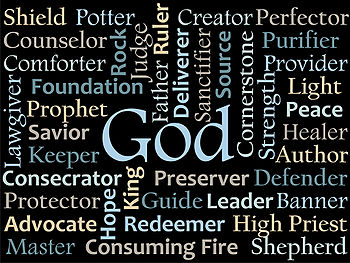
For many of us, being with God is something different and well worth longing for. To accept and be content with our lot is only proper and possible if we have found the One who will never leave us or forsake us. Divine Companionship is the very Presence of the Almighty God who has many names, each one speaking to one aspect of our heart’s longing.
Names_of_God

This brings me to the last point of disagreement I will address, which is the form of mindfulness and meditation that is taught in this book. I don’t think it hurts to “simply be present with your feelings,” or to “come in full contact with yourself,” at least as a starting place. But I don’t believe that those encounters are likely in themselves to reveal “how capable we are of containing and healing the grief we carry.”

Jeffrey Brantley tells us in the Foreword that “…the benefits depend not upon trying to change anything, but instead mainly upon one’s willingness and commitment to reside in the present moment, while making room and becoming intimate with the texture of unfolding experience – whatever that is.”

And Kumar goes further in describing the intended results of this activity: “Mindful attention does not try to change what is happening. Instead, it reflects— accurately and precisely.” This idea of the accuracy HolyTrinity new sketeand precision of our thoughts that float by also seems to me lofty and unrealistic.

What we need is PRAYER, People! I am no expert on it, except to know assuredly that I need to do it, and that it is work. It doesn’t spontaneously generate from my random thoughts, but it comes from finding God in the present moment, in spite of our thoughts. Just google Orthodox and Prayer and you can find all the resources you need for getting started. My spiritual father told me early on to read anything that Anthony Bloom writes on the subject. It is in real prayer, in Divine Companionship, that we will find healing and contentment and a truly spiritual kind of energy, the Energies of God.

The wounds are consecrated.

P1120829 holy unctionI attended a Holy Unction service with my goddaughter last night. Before the service proper our priest read an article on The Grace of Suffering. An excerpt:

Weakness and sickness wipe away everything superficial in us. We are inwardly purified when we are baptized with tears of suffering. The Lord always visits us there, while we are dry  on the inside, truly thirsting for living water and reaching out for Him in what we know, deeply and seriously.

He also told us about various responses he has seen in people who were healed from their sicknesses, and said that usually if we are relieved of one form of suffering, it is for further suffering.

It was a long service, including psalms, hymns, prayers, and seven anointings with oil, each preceded by an epistle reading and a Gospel reading. Before each Gospel reading a candle was lit, which helped us keep track of where we were in the service. Seven times the ill and afflicted lined up to be anointed on their forehead, cheeks, lips, chest, and hands.

I was a bit scattered in mind and heart and didn’t feel able to participate with as much attention as I’d have liked, but it was a great blessing nonetheless to help in little practical ways and by praying along. Having my mind washed by the Word, and being in the church with so many repentant hearts singing, “Hearken unto me, O Master, Hearken unto me, O Holy One….” was soothing to my own soul.

Here is an excerpt from another article about this sacrament:

The express purpose of the sacrament of holy unction is healing and forgiveness. Since it is not always the will of God that there should be physical healing, the prayer of Christ that God’s will be done always remains as the proper context of the sacrament. In addition, it is the clear intention of the sacrament that through the anointing of the sick body the sufferings of the person should be sanctified and united to the sufferings of Christ. In this way, the wounds of the flesh are consecrated, and strength is given that the suffering of the diseased person may not be unto the death of his soul, but for eternal salvation in the resurrection and life of the Kingdom of God.

It is indeed the case that death inevitably comes to man. All must die, even those who in this life are given a reprieve through healing in order to have more time on the earth. Thus, the healing of the sick is not itself a final goal, but is merely “instrumental” in that it is given by God as a sign of his mercy and as a grace for the further opportunity of man to live for him and for others in the life of this world.

Enduring and Truthful Fictions

Today is Book Lovers’ Day, my friend Myriah just informed me, and I’m so glad she did. It’s actually one of two days that are celebrated for and by people like us. To mark the day I am re-posting an old book review I wrote, from 2009. It’s a response to three books, so we could think of it as a triple treat for our readers’ party:

Three Truthful Fictions

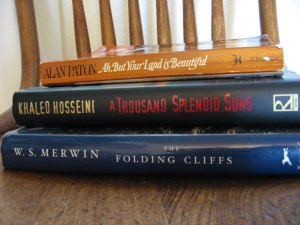
In early summer I read three works of fiction in a short space of time:

Ah, But Your Land is Beautiful by Alan Paton
A Thousand Splendid Suns by Khaled Hosseini
The Folding Cliffs by W.S. Merwin

These were all pretty dramatic stories of historical fiction. Paton’s book follows closely the events in South Africa mid-20th century. Hosseini writes about Afghanistan in the last 30 years, and Merwin’s book is an epic poem about Hawaii, mostly in the 19th century.

I was sitting around after surgery with my foot up, and that was what had made it possible for me spend more time reading and thinking. Some things I thought about: How funny that the settings of these thr3 truthful fictions picee books were at three corners of the globe. Obviously they were not part of any theme. So were there some ways they were alike? What made them all worth reading to the end, when so many books I’ve tried lately were not?
Suffering was a large part of all the stories. The Afrikaners in Ah, But Your Land is Beautiful were treating all people of color unjustly and inhumanely. Whites who did otherwise suffered along with the oppressed, and often sacrificed their careers, homes, and reputations.

All the women suffer miserably in A Thousand Splendid Suns. War and famine, selfish and sinful men and women supported by bad cultural traditions, all combine to keep the women trapped in complicated and painful predicaments. Factions of Muslims hate one another.

The Folding Cliffs makes vivid the way conquering peoples oppress the vanquished, all the while thinking it is “for their own good.”

What benefit is there in dwelling on Man’s Inhumanity to Man? Don’t we already know how wretched we are? If that were all one gets from these stories, I don’t think they would be worth reading, but there is another bigger part to all of them, and that is Man’s Love. Just as Christ gave His life in love for us suffering humans, so He gives grace to men to rise above their suffering, show compassion to their fellow man, and do deeds of mercy.

“Courage is not simply one of the virtues but the form of every virtue at the testing point, which means at the point of highest reality,” said C.S. Lewis, and it is this courage that is shown by the young parents in Cliffs who flee to the hills and fight off government agents who are shooting at them, rather than have their family torn apart by the health officials who are shipping lepers off to Molokai like so many unclean animals. Their love is demonstrated in the test of courage.

In Land, the author and his companions find joy and fellowship in realizing the sacrificial, mercy-giving aspect of their humanity as they fight what seems to be a losing battle against political power. Perhaps they were living what Winston Churchill was talking about when he said, “We shall draw from the heart of suffering itself the means of inspiration and survival.”

Alan Paton in his autobiography Towards the Mountain writes of the experience:

“…the inhumanity of man to man could be made endurable for us only when we manifested in our lives the humanity of man to man….there is a wound in the creation and…the greatest use we could make of our lives was to ask to be made a healer of it.”

I haven’t lived with the kinds of suffering I read about, and that is partly why I think these writings are valuable, for as we read we take as our companions in mind and heart characters who are historically real or fictionally true, who can train us in Christian virtue.

Khaled Hosseini has given his countrymen and all of us a wonderful gift in the two books of his I am familiar with. In Kite Runner and in A Thousand Splendid Suns he paints a backdrop of horror, including much personal moral failure. Kite Runner exposed my own innate cowardice as I empathized with the protagonist, and as he was able to find healing and hope after repentance, I was also comforted.

In Suns the author gives a tender role model to women everywhere who are beaten down by life. The character of Miriam is the ultimate in misery, as she has no friends and no family who care about her, and she is barren, so her husband hates her. Then a young woman comes into her life, a woman who could easily slide into being another tormentor. But instead she shows kindness and becomes a true friend, and Miriam finds hope and courage, as well as other parts of her humanity and womanhood that had been obscured. She is transformed from a passive recipient of abuse into a woman who can return love, and she is happy, even in the face of continued abuse.

These stories have the potential to become part of the collective consciousness of a people, and help us to live more humanly, more humanely. I hope that Suns in particular can give vision to the women of Afghanistan, a vision of themselves as able to rise above their circumstances by means of love toward others.

We won’t eliminate the oppressors; our hope does not consist of that, as Father Alexander Schmemann has summarized:

“The fundamental Christian eschatology has been destroyed by either the optimism leading to the Utopia, or by the pessimism leading to the Escape. If there are two heretical words in the Christian vocabulary, they would be ‘optimism’ and ‘pessimism.’ These two things are utterly anti-biblical and anti-Christian…. It is for us, Christians, to reconstruct this unique faith, in which there are no illusions, no illusions at all, about the evil.”

Keeping with the theme of inspiring fiction, I’ll end with a quote by Whittaker Chambers from Witness (which book I love, but it is not fiction) about a novel that was formative for him. I haven’t read Les Miserables, but I noticed a few years ago that at least three important writers I knew of had mentioned they read it more than once as children. Sorry, I can’t remember who the others were. Chambers describes what can happen when a good writer connects with the reader:les miz pic

“I read and reread Les Miserables many times in its entirety. It taught me two seemingly irreconcilable things–Christianity and revolution. It taught me first of all that the basic virtue of life is humility, that before humility, ambition, arrogance, pride and power are seen for what they are, the stigmata of littleness, the betrayal by the mind of the soul, a betrayal which continually fails against a humility that is authentic and consistent. It taught me justice and compassion, not a justice of the law, or as we say, human justice, but a justice that transcends human justice whenever humanity transcends itself to reach that summit where justice and compassion are one….”

Three Truthful Fictions

In early summer I read three works of fiction in a short space of time:

Ah, But Your Land is Beautiful by Alan Paton

A Thousand Splendid Suns by Khaled Hosseini

The Folding Cliffs by W.S. Merwin

These were all pretty dramatic stories of historical fiction. Paton’s book follows closely the events in South Africa mid-20th century. Hosseini writes about Afghanistan in the last 30 years, and Merwin’s book is an epic poem about Hawaii, mostly in the 19th century.

I was sitting around after surgery with my foot up, and that was what had made it possible for me spend more time reading and thinking. Some things I thought about: How funny that the settings of these three books were at three corners of the globe. Obviously they were not part of any theme. So were there some ways they were alike? What made them all worth reading to the end, when so many books I’ve tried lately were not?

Suffering was a large part of all the stories. The Afrikaners in Ah, But Your Land is Beautiful were treating all people of color unjustly and inhumanely. Whites who did otherwise suffered along with the oppressed, and often sacrificed their careers, homes, and reputations.

All the women suffer miserably in A Thousand Splendid Suns. War and famine, selfish and sinful men and women supported by bad cultural traditions, all combine to keep the women trapped in complicated and painful predicaments. Factions of Muslims hate one another.

The Folding Cliffs makes vivid the way conquering peoples oppress the vanquished, all the while thinking it is “for their own good.”

What benefit is there in dwelling on Man’s Inhumanity to Man? Don’t we already know how wretched we are? If that were all one gets from these stories, I don’t think they would be worth reading, but there is another bigger part to all of them, and that is Man’s Love. Just as Christ gave His life in love for us suffering humans, so He gives grace to men to rise above their suffering, show compassion to their fellow man, and do deeds of mercy.

“Courage is not simply one of the virtues but the form of every virtue at the testing point, which means at the point of highest reality,” said C.S. Lewis, and it is this courage that is shown by the young parents in Cliffs who flee to the hills and fight off government agents with guns rather than have their family torn apart by the health officials who are shipping off lepers to Molokai like so many unclean animals. Their love is demonstrated in the test of courage.

In Land, the author and his companions find joy and fellowship in realizing the sacrificial, mercy-giving aspect of their humanity as they fight what seems to be a losing battle against political power. Perhaps they were living what Winston Churchill was talking about when he said, “We shall draw from the heart of suffering itself the means of inspiration and survival.”

Alan Paton in his autobiography Towards the Mountain writes of the experience:

“…the inhumanity of man to man could be made endurable for us only when we manifested in our lives the humanity of man to man….there is a wound in the creation and…the greatest use we could make of our lives was to ask to be made a healer of it.”

I haven’t lived with the kinds of suffering I read about, and that is partly why I think these writings are valuable, for as we read we take as our companions in mind and heart characters who are historically real or fictionally true, who can train us in Christian virtue.

Khaled Hosseini has given his countrymen and all of us a wonderful gift in the two books of his I am familiar with. In Kite Runner and in A Thousand Splendid Suns he paints a backdrop of horror, including much personal moral failure. Kite Runner exposed my own innate cowardice as I empathized with the protagonist, and as he was able to find healing and hope after repentance, I was also comforted.

In Suns the author gives a tender role model to women everywhere who are beaten down by life. The character of Miriam is the ultimate in misery, as she has no friends and no family who care about her, and she is barren, so her husband hates her. Then a young woman comes into her life, a woman who could easily slide into being another tormentor. But instead she shows kindness and becomes a true friend, and Miriam finds hope and courage, as well as other parts of her humanity and womanhood that had been obscured. She is transformed from a passive recipient of abuse into a woman who can return love, and she is happy, even in the face of continued abuse.

These stories have the potential to become part of the collective consciousness of a people, and help us to live more humanly, more humanely. I hope that Suns in particular can give vision to the women of Afghanistan, a vision of themselves as able to rise above their circumstances by means of love toward others.

We won’t eliminate the oppressors; our hope does not consist of that, as Father Alexander Schmemann has summarized:

“The fundamental Christian eschatology has been destroyed by either the optimism leading to the Utopia, or by the pessimism leading to the Escape. If there are two heretical words in the Christian vocabulary, they would be ‘optimism’ and ‘pessimism.’ These two things are utterly anti-biblical and anti-Christian….It is for us, Christians, to reconstruct this unique faith, in which there are no illusions, no illusions at all, about the evil.”

Keeping with the theme of inspiring fiction, I’ll end with a quote by Whittaker Chambers from Witness (which book I love, but it is not fiction) about a novel that was formative for him. I haven’t read Les Miserables, but I noticed a few years ago that at least three important writers I knew of had mentioned they read it more than once as children. Sorry, I can’t remember who the others were. Chambers describes what can happen when a good writer connects with the reader:

“I read and reread Les Miserables many times in its entirety. It taught me two seemingly irreconcilable things–Christianity and revolution. It taught me first of all that the basic virtue of life is humility, that before humility, ambition, arrogance, pride and power are seen for what they are, the stigmata of littleness, the betrayal by the mind of the soul, a betrayal which continually fails against a humility that is authentic and consistent. It taught me justice and compassion, not a justice of the law, or as we say, human justice, but a justice that transcends human justice whenever humanity transcends itself to reach that summit where justice and compassion are one….”


Note in 2019: If you are reading this ten years later and feel like commenting, please do. The subject matter is never out of date and I’d be glad to renew the discussion.