Tag Archives: tarweed

Rain on zinnias, seeds on crackers.

It was hard to keep up with myself last week, and with all the friends, projects and tasks that fill my life to overflowing. I guess I was somewhat playing catch-up after my mountain retreat the previous week. The garden got gently rained on three times that last week of September, which is unusual. Combined with fog on other days, the dampness caused mildew in the planter boxes, but mostly the lower leaves of the tall zinnias have been affected.

When I noticed the Japanese anemones looking better than ever, it occurred to me to plant a few more this fall, maybe some pale pink ones — but I corrected my impulsivity in time, and won’t be taking on one more project, what with so many others unfinished. A more reasonable goal would be to try to take better care of the anemones I have, and see if they can be encouraged to be taller and more robust. It’s a sign of their middling health, that they do not ever spread and multiply, and their flowers are few and small.

The sneezeweed I grow in a pot looks as well as it ever has. I bought it a few years ago at a native plant nursery, because I love the mountain versions of the flower. I put it in a pot so I could be sure to water it enough; the irrigation settings for most of my garden are set for drought-tolerant plants, and sneezeweed is not one of those. My type is pretty plain, or at least monochromatic, compared to the mountain ones.

In search of fancier kinds, a few months ago I browsed sneezeweeds online for quite a while, and ordered seeds for this one, Purple-Headed. When I am looking at seed catalogs or even plants in nurseries, all the options seem so do-able and desirable. But once the time comes to get on with the actual work of planting… well, I literally drag my feet. So who knows what will happen with these seeds…
I used my sourdough starter twice last week, first to make a large pan loaf of seeded wheat-and-spelt bread. This is the recipe I have been trying to perfect, but perfection hasn’t happened yet. I may have to pause the sourdough project while I branch out and reach back, to other breads I have made or have wanted to try, like chocolate bread, Indian flatbreads, and applesauce rye.

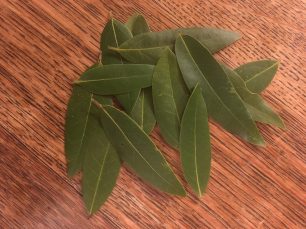
Buttery Sourdough Crackers was a satisfying recipe that used a bit of starter. This picture shows the dough as it was resting overnight, along with leaves of the lemon verbena that I am drying, after pruning my plant for the first time ever.
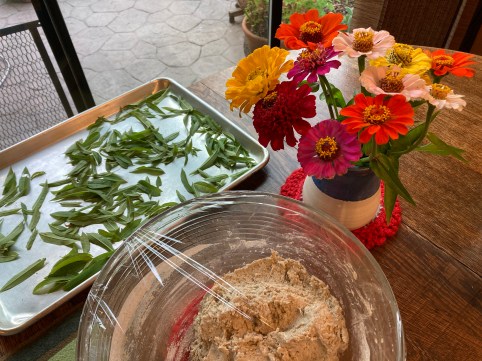
I used this recipe for: Rustic Sourdough Butter Crackers as my jumping off place, substituting half dark rye flour, and adding sesame seeds to one half, and poppy seeds to the other. I baked them a lot longer than the recipe called for. The resulting crackers are nice and crispy and easy to eat. The butter ingredient plus the sourdough tang is a great combination.

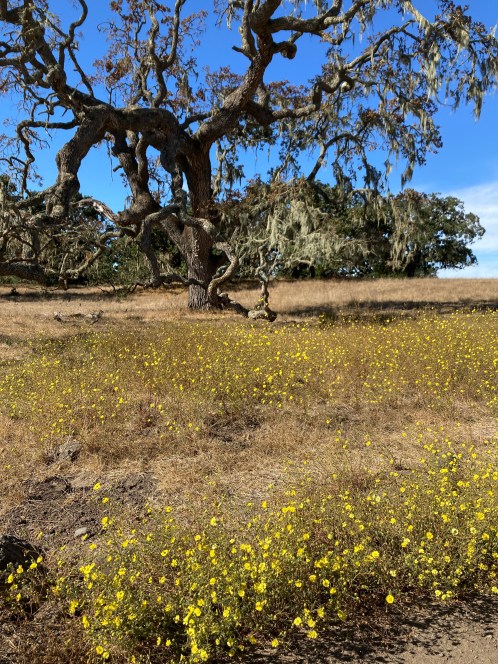
My friend Lucy and I took another one of our monthly walks, up in the hills again but to a park she hadn’t been to before. It’s mostly very brown up there now, but the poison oak is making red splashes in the landscape. And my old friend tarweed!
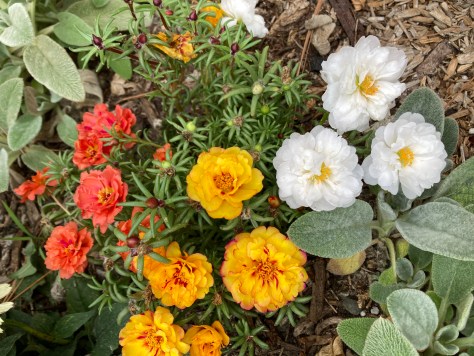
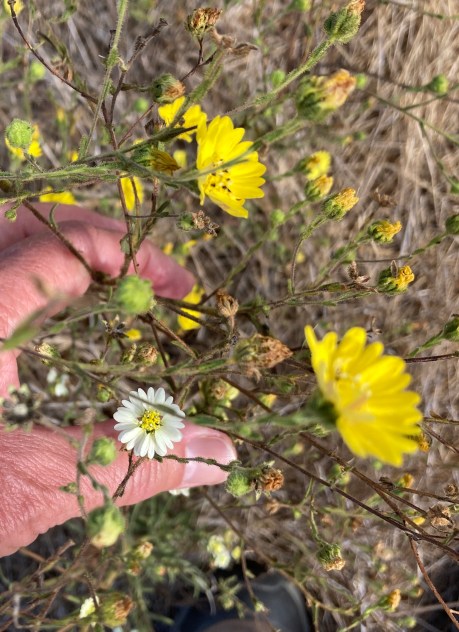
The Seek app tells me this is not either of the species I saw on my way up the mountain last month, but Hayfield Tarweed. And it seems to come in white or yellow versions, in one case growing side by side:
The third online Beowulf class was this week, and I spent more than two happy hours in the company of the most delightful teachers, Richard Rohlin and Jonathan Pageau. They both love the subject, and Richard is definitely a Beowulf scholar from way back. I will have to at least quote a couple of lines from the poem here eventually, though it seems that unlike me, most people I’ve talked to got an introduction to Beowulf in school. So you may already be more familiar with the story than I.

Apple orchard where I go.

At the end of the week, I remembered: apples! It’s time to make a trip my favorite apple ranch, and see which of their 30+ varieties is available now. I squeezed it in on Saturday afternoon, and added a stop at a nursery out that way, hoping they would have starts of some kind of leafy greens I could tuck into spaces in the planter boxes after I take out zucchini and tomatoes and eggplant. They did!

So here in the back of my car is a mix of apples Empire, Jonathan and Macintosh; and six packs of Swiss chard and collards. I do have chard growing right now, but I think I need more. And I wasn’t able to get collards started from seed in August.

One more glad sighting of late summer I want to share, is this half wine barrel that was unplanted through last winter:
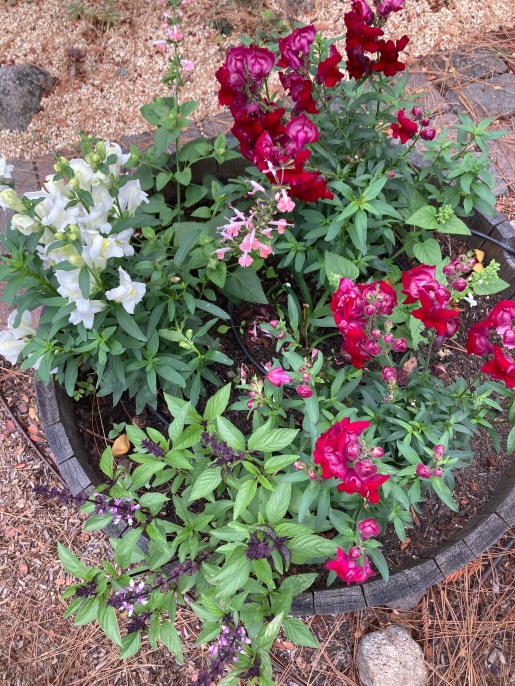
When I put in some snapdragon plants in late spring, I noticed a couple of tiny mystery plants that didn’t look like weeds, so I left them undisturbed. Now everything has filled out and I find that I have beautiful Thai basil and tropical sage complementing the snaps. Gardens are ever surprising.

Happy October!

In the weeds and happy about it.

On my way up the mountain earlier in the week I came across several plants whose common names include the word weed: Two tarweeds and two vinegarweeds. They all got my attention by the way they added color to the drying-out landscape of late summer.

When I was still only approaching the foothills, I saw bluish plants dotting the yellow-brown expanse stretching out away from the road, and it didn’t look like anything I had ever noticed before.

It may be that in the past they were not as tall and visible from the road, and that this year’s extra rainfall helped Trichostema lanceolatum to thrive. It was hard to get a picture of it without my socks attracting various stickers waiting in ambush, but this closeup on Wikipedia shows what a graceful flower form is hidden in the overall unimpressive bush:

“The plant is an important pollen source for native bees and other insects. When a pollinating insect alights on the lower lobes of the corolla, and inserts its mouth parts into the nectar-containing lower section of the same tube, the narrow corolla portion above is straightened and snaps rapidly downward brushing pollen onto the insect’s back.

“The volatile oils make it unpalatable to grazing and foraging animals.

“The indigenous peoples of California used this as a traditional medicinal plant, as a cold and fever remedy, a pain reliever, and a flea insect repellent.”

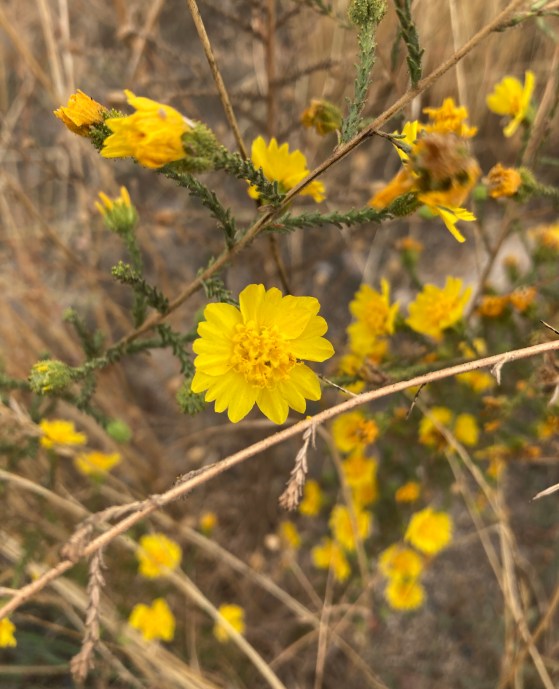
The two species of tarweeds caught my eye a little further on. I think it was mostly Fitch’s Tarweed, Centromadia fitchii, that had turned the slopes and flatlands gold in large swaths on either side of the highway.

But the more photogenic plant I managed to get close to was Heermann’s Tarweed (according to my Seek app), Holocarpha heermannii. Both of these plants are in the Aster Family, but different genera. A lot of tarweeds are in the Madia Family, but it seems that Heermann’s is irregular.

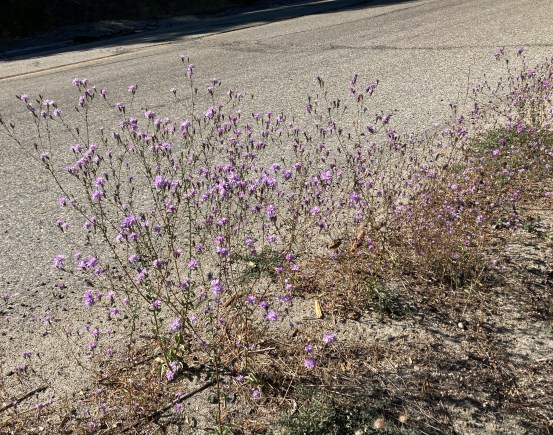
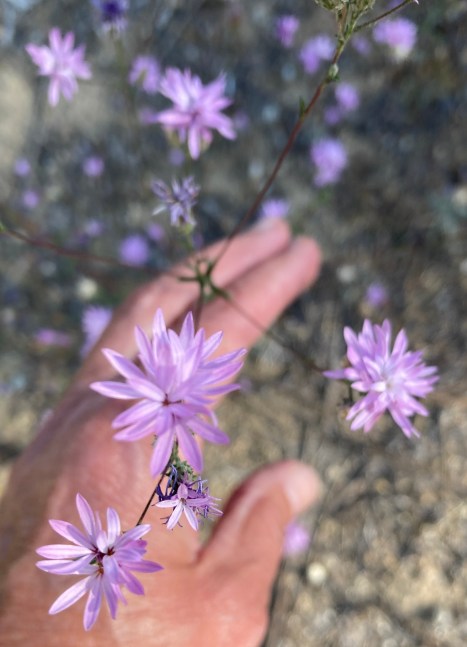
The second plant called vinegarweed grows along the roads in the High-er Sierra. When I first met it in 2009, it didn’t occur to me to taste it; maybe if I had, the idea of vinegar would have been uppermost? But my mind immediately wanted to call it Purple Haze, or Lavender Mist.

It typically gets my attention as I come  around a curve in the road, floating as a long pastel smudge on the shoulder. That first sighting was long before I had any kind of nature identification app, and when I eventually found someone who could tell me what it was (Sierra Vinegarweed or Lessingia leptoclada), that amateur botanist told me that if it had been up to her, she’d have named it Lavender Groundsmoke. The hope of encountering these flowers again would alone be enough to bring me up to the mountains every summer.

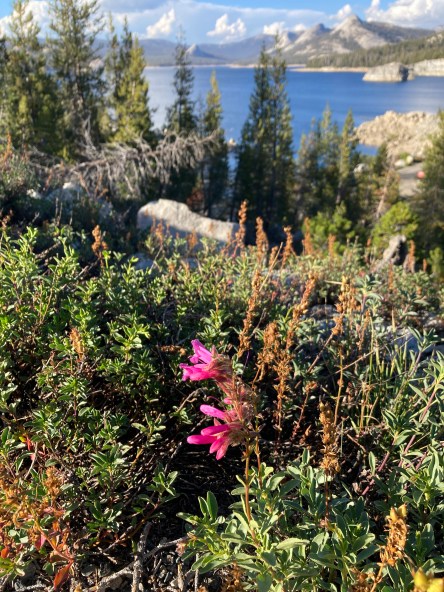
The last plant I will share has no connections to vinegar or tar; it is the favorite Mountain Pride, or Newberry’s Penstemon. In an average year, its flowers would have faded to brown by now, and in fact most of them have. But the snow hung on so late here this summer, till the end of July, that the earliest wildflowers had to wait at least a couple of weeks longer to emerge. I was happy to find one bloom of Mountain Pride still fresh and bright. These plants that sit overlooking the lake are a landmark for me, announcing at the end of my journey to the cabin, You have arrived!

The balm of thistles and a mighty tree.

tarweed

“Mmm-mmm, star thistle and tarweed — the scents of fall!” That’s what my daughter Pippin said as we started out from the trailhead on our latest outing together. Every time I am outdoors with her I learn something new. I should say, I don’t remember being introduced to tarweed  before, and that feels as exciting as brand new.

Pippin and the Professor had come from their home in more northern California for the weekend. Saturday we hung around my neighborhood in the morning, and went afield in the afternoon.

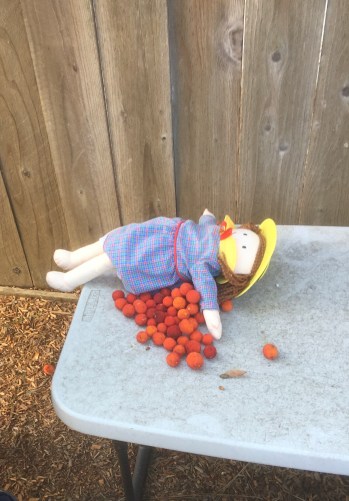
Ivy adopted the doll Madeleine for the day and took her out to gather strawberry tree fruit. Scout dissected the ripest-looking dwarf pomegranate, and we decided it was almost sweet enough to be worth the bother. We walked along the creek path to the playground at the park, but probably the “playground” on the way was the most fun. In two places kids had hung rigging from big trees, from which you could swing out into the space where the ground fell away steeply toward the creek channel. Pippin was the only one with the strength and length to hoist herself up on to what seemed to be a launching platform. Jamie tried to be patient, but reminded us, “Let’s go, to the park!”

Our destination in the afternoon was a giant California bay laurel tree that may be the largest of its species. I had visited this particular tree at least twice before, but probably not since the 80’s.

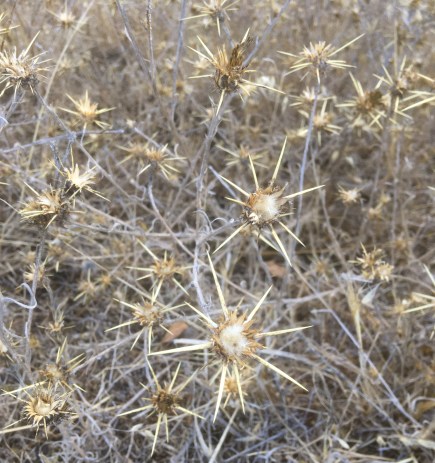
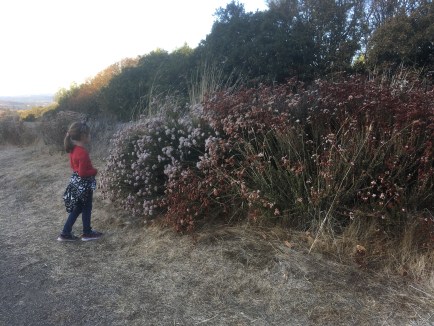
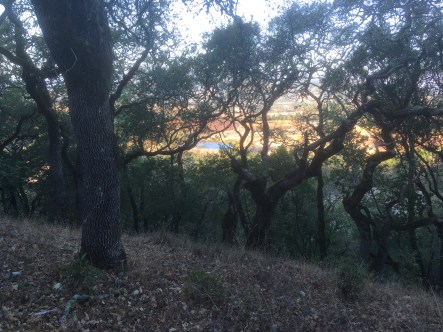
Our short walk up the hill stretched out, as we stopped to observe lichens and poison oak, the tarweed and star thistle. Two of us had painful feet that slowed us down. We saw a wild buckwheat, Eriogonum, taller and bushier than the species we were familiar with. From my reading today I think it might be California Buckwheat. But as you can probably guess, the first photos below are of star thistle, a plant you never want to have to break a trail through.

Eventually we came out of the woods onto the grassy hilltop where lots of cows were grazing with their calves, and bellowing almost without stopping. There was The Tree on the horizon, and a smaller companion alongside.

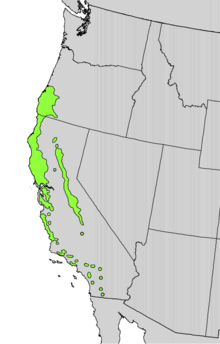
Umbellularia californica is the only species in its genus, in Oregon known as the Oregon myrtle. It’s been called by several other names including pepperwood and balm of heaven. The flavor of its leaves is similar to the true bay leaves from Laurus nobilis, only stronger, and most of my life I’ve used leaves from the abundant local “bay” trees in cooking. For a long time I didn’t know they were not the real thing. The map shows its natural range.

Umbellularia californica range map.png

I hadn’t read that nickname “balm of heaven” before our outing, but standing under the massive canopy with thousands and thousands of leaves exuding their aromatic oil, I definitely felt the olfactory presence as a balm, its scent filling my nostrils as hugely as its image filled my vision.

The children right away began to climb, and to stake out their “houses” in the several neighborhoods that have been formed under branches as thick as big tree trunks, some of them weighing themselves down horizontal with the ground. The adults took pictures of the wide views of the landscape below. Pippin and I studied the tree’s flowers, trying to figure out where they are in their bloom cycle. If it hadn’t been late in the day it would have been the perfect place to have a picnic and linger a while.

In the last few years I’ve been buying the few bay leaves I need. But I brought home a handful of the mega-flavored, special California-and-Oregon pepperwood/balm of heaven leaves, and will simmer them in a winter soup. When I get a whiff of their essence in the steam that rises from my bowl, it will keep me connected to that magnificent tree until I can get back for a longer visit.