Tag Archives: The Incarnation

From bitter cold to laughter and light.

I know that the Feast of the Nativity of Christ has passed; the Leavetaking of Nativity was yesterday, so that we might enter fully into today’s feasts. So it may seem a bit odd for me to post the poem below, but for many reasons it seems most appropriate. (One practical reason is that I only now rose from my sick bed to look at my blog!) I might be hearkening back to the early church, about which we read:

“During the first centuries of Christianity, the Feast of Theophany was celebrated together with a number of observances as recorded in the Gospels. They are: the Annunciation of the archangel Gabriel to the Holy Virgin Mary; the Birth of our Lord Jesus Christ, with the glorification of the heavenly hosts, the veneration by the shepherds and the coming of the Magi; the Circumcision; the Naming of our Lord; the Presentation in the Temple; the Flight into Egypt and Return; the Baptism at the River Jordan; the Temptation in the Wilderness and the Testimony (Witness) of St. John the Forerunner.

“This group of feasts was celebrated from the 6th to the 13th of January, called the octave of Theophany; the most prominent being the Birth and Baptism of our Lord Jesus Christ, with special importance afforded to the Baptism. The church grouped the birth and baptism, together (called Theophany, “the revelation of God,”) on January the 6th because they were the first revelations of His divinity, incarnation, and the beginning of His ministry as Lord and Savior of mankind.”

I first read the poem last summer on Elizabeth’s blog, so she obviously thought it applicable at any time of the year. And for myself, I can’t imagine looking forward to a new calendar year with anything but foreboding, were it not for the fact that “God is with us.”

Do you count this the seventh or eighth day of Christmas? Most Christians count Christmas Day itself as the first day, so New Year’s Day is the Eighth Day. For us Orthodox, it is also the Feast of the Circumcision of Christ, and St. Basil’s Day. Soon we will arrive at the glorious Feast of Theophany.

So many feasts and commemorations! But they all flow from the astounding fact and reality that “The Word became flesh, and dwelt among us.” Happy New Year, Dear Friends!

NOËL

Grim was the world and grey last night:
The moon and stars were fled,
The hall was dark without song or light,
The fires were fallen dead.
The wind in the trees was like to the sea,
And over the mountains’ teeth
It whistled bitter-cold and free,
As a sword leapt from its sheath.

The lord of snows upreared his head;
His mantle long and pale
Upon the bitter blast was spread
And hung o’er hill and dale.
The world was blind, the boughs were bent,
All ways and paths were wild:
Then the veil of cloud apart was rent,
And here was born a Child.

The ancient dome of heaven sheer
Was pricked with distant light;
A star came shining white and clear
Alone above the night.
In the dale of dark in that hour of birth
One voice on a sudden sang:
Then all the bells in Heaven and Earth
Together at midnight rang.

Mary sang in this world below:
They heard her song arise
O’er mist and over mountain snow
To the walls of Paradise,
And the tongue of many bells was stirred
in Heaven’s towers to ring
When the voice of mortal maid was heard,
That was mother of Heaven’s King.

Glad is the world and fair this night
With stars about its head,
And the hall is filled with laughter and light,
And fires are burning red.
The bells of Paradise now ring
With bells of Christendom,
And Gloria, Gloria we will sing
That God on earth is come.

-J.R.R. Tolkien
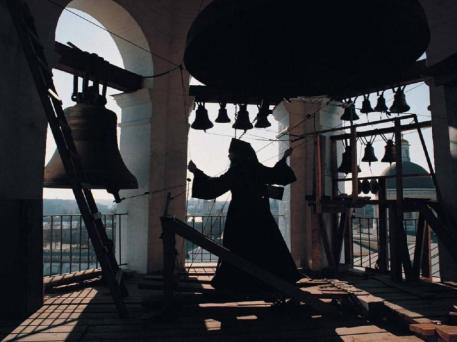
If your Christmas celebrations were lacking in bells, I recommend these videos of bell-ringing from New Jersey to California and abroad. Most of them start out slow and progress to very lively and joyous. Nothing compares to hearing them as you are leaving church after services of a Great Feast, but these are worthwhile substitutes. The bells of Paradise never stop ringing.

Bells of St. Nicholas

Brother Seraphim

St. Alexander Nevsky

Sf. Ioan Teologul

St. Alexander Nevsky (shorter)

Matters of heart and flesh.


Today we celebrate the second of three days considered the “Winter Pascha.”
We are still singing these hymns of Nativity:

Thy Nativity, O Christ our God,
Has shone to the world the Light of wisdom!
For by it, those who worshiped the stars
Were taught by a Star to worship Thee
The Sun of Righteousness,
And to know Thee, the Dayspring from on High.
O Lord, glory to Thee!

and

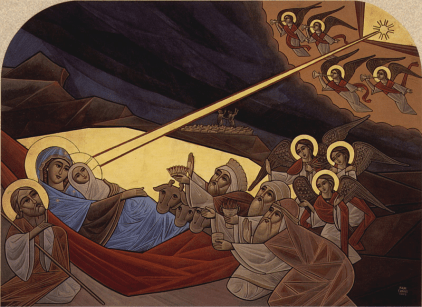
Today the Virgin gives birth to the Transcendent One
And the earth offers a cave to the Unapproachable One!
Angels with shepherds glorify Him!
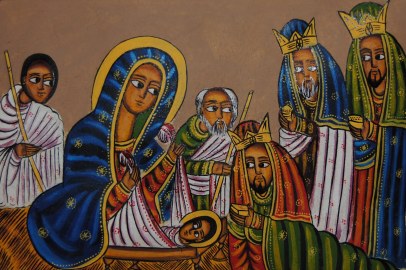
The wise men journey with a star!
Since for our sake the Eternal God was born as a Little Child!

On Christmas Eve, the sky dark with clouds at midday, we celebrated a Vesperal Liturgy, and the church glowed in a special way with the combination of candlelight and muted daylight.

Then Christmas Eve proper, when it became the next day liturgically, the Festal Matins of Nativity. How joyous! In the cathedral was the darkness of winter night, but with more candles and more festivity, because Christmas Day had begun! Our hearts were soaring. The children were drooping….

When I woke on Christmas Day I also was bushed. I had baked a few cookies between the previous day’s services, which meant I’d been on my feet most of that day. I chose different shoes Christmas morning, and before the service even began I had retrieved my joy. I was introduced to a woman who was visiting out of curiosity, had been raised Christian Scientist, and considered herself “more of a Buddhist.” But her friend of Ukrainian descent, who also had not been to our parish before, had invited and brought her.
As I began to explain why the icons, the incense and candles…  to tell her about the materiality of our worship, how this very feast was a celebration of God Who has no flesh taking on human flesh for our sakes… well, it was thrilling to be able to give a little background to what was so vividly being expressed in fullness right there.

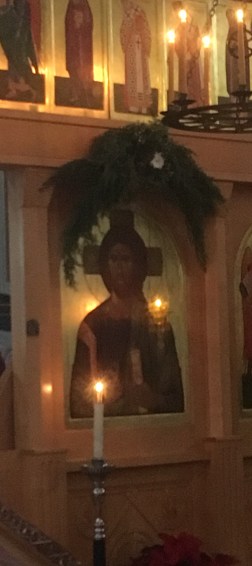
I pointed to the pillar with a fresco of St. John of Damascus painted on the side, and part of this quote on the scroll he is holding: I do not venerate matter, I venerate the fashioner of matter, who became matter for my sake and accepted to dwell in matter and through matter worked my salvation, and I will not cease from reverencing matter, through which my salvation was worked.

On the home front, concerning the matter that is our earthly food, I feel that I am way behind in my cookie-baking.  I have made four kinds now… and no chocolate yet! I guess I never do have much chocolate in the Christmas cookies. But so far my collection leans heavily toward the nut-brown tones, partly because Trader Joe’s was out of their cranberry-orange relish that I use to make my jellies. I am out of energy to create an alternative recipe from scratch. I did one of those already last week.

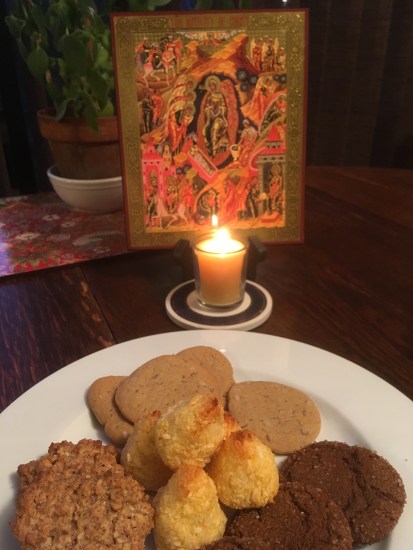
The cookies above are the Apricot-Coconut Macaroons, which ended up low on the apricot element this time; I don’t know how that happened. I hope to make cookies for several more days, and during the next couple of weeks to invite friends to eat them with me!

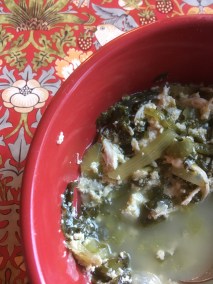
Today after church I visited two friends on opposite sides of town. I have no family with me this year, meaning more options than usual; I’m almost forgetting that I need to go to bed early and provide for some down time. At first I thought I could make four stops on Christmas afternoon, but that doesn’t sound very likely, does it? As it turned out, I got home in time for a bowl of Greek Wedding Soup that my housemate had made, and which tasted perfectly delicious and also seemed the perfect delicious holiday food to balance out cookies. She also had a fire burning in the stove, and Christmas movies playing on the TV.

I have plans for today, too, so I had to draft this post last night. I’m still trying to write every day in December — but maybe that was intended to be only till Christmas? I’ll check with Pom Pom. I think it’s been good for me to have this gentle pressure to write every day, because it’s a kind of work that satisfies something in me and helps keep me on an even keel in the midst of such a busy season. And it’s given me more chances to warm up to this:

Christ is born! Glorify Him!

The height of the fall of God.


GLORIA IN PROFUNDIS


There has fallen on earth for a token
A god too great for the sky.
He has burst out of all things and broken
The bounds of eternity:
Into time and the terminal land
He has strayed like a thief or a lover,
For the wine of the world brims over,
Its splendour is spilt on the sand.

Who is proud when the heavens are humble,
Who mounts if the mountains fall,
If the fixed stars topple and tumble
And a deluge of love drowns all—
Who rears up his head for a crown,
Who holds up his will for a warrant,
Who strives with the starry torrent,
When all that is good goes down?

For in dread of such falling and failing
The fallen angels fell
Inverted in insolence, scaling
The hanging mountain of hell:
But unmeasured of plummet and rod
Too deep for their sight to scan,
Outrushing the fall of man
Is the height of the fall of God.

Glory to God in the Lowest
The spout of the stars in spate-
Where thunderbolt thinks to be slowest
And the lightning fears to be late:
As men dive for sunken gem
Pursuing, we hunt and hound it,
The fallen star has found it
In the cavern of Bethlehem.

~G.K. Chesterton

The Word of the Father has been made manifest.

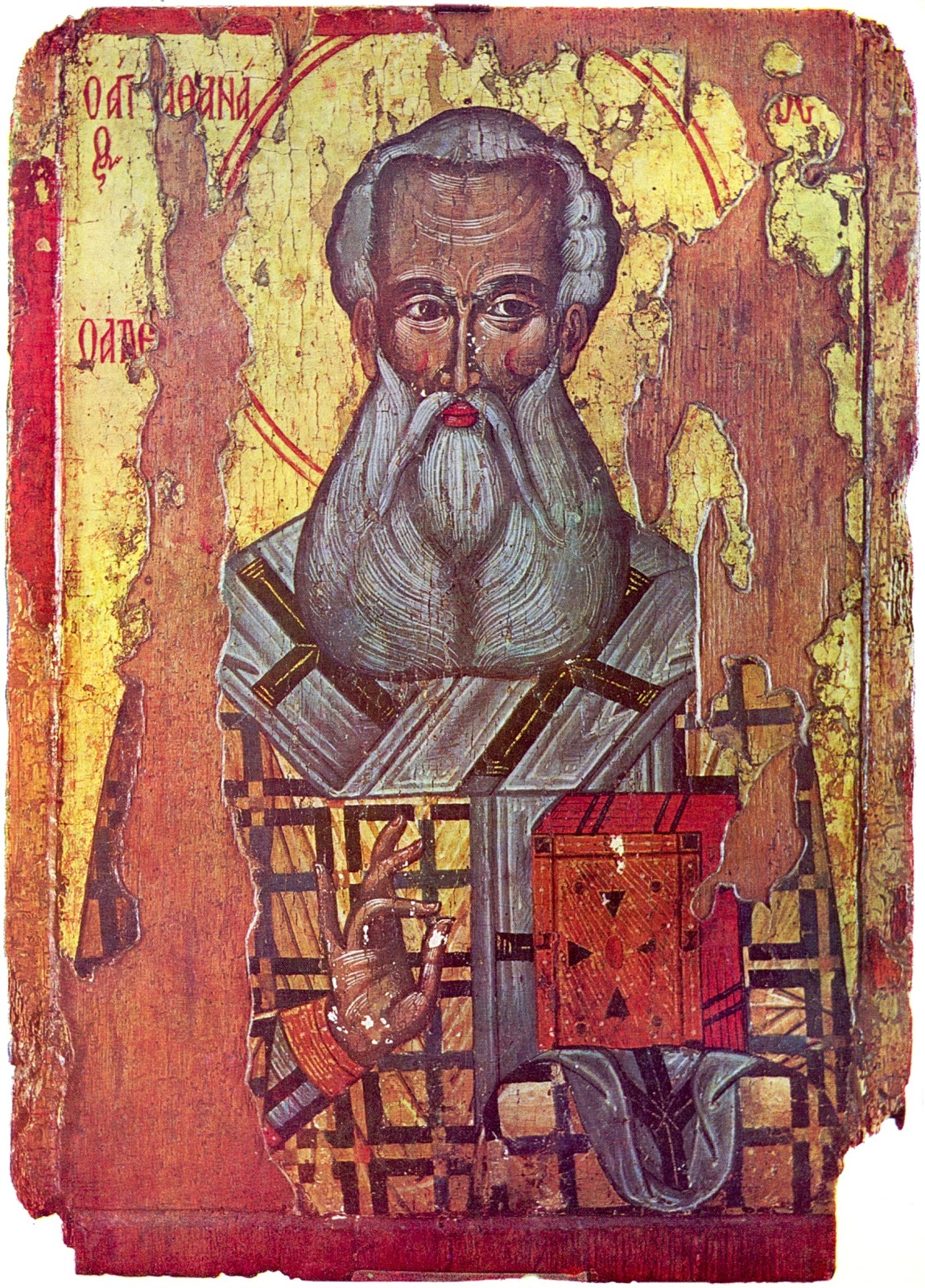
I must have read C.S. Lewis’s introduction to St. Athanasius’s On the Incarnation twice before in an attempt on the whole book, without getting much beyond it, but on this third try I have kept going. It seemed a fitting little paperback to read during Advent.

In the introduction we have an instance of Lewis’s exhorting us to read more of the Old Books, like this one from the 4th century, though we are timid: “The student is half afraid to meet one of the great philosophers face to face. He feels himself inadequate and thinks he will not understand him. But if he only knew, the great man, just because of his greatness, is much more intelligible than his modern commentator.”

And Lewis also writes here about devotional vs. doctrinal works, On the Incarnation being one of the latter, that he finds the doctrinal books often “more helpful in devotion” than the expressly devotional ones. I can relate to his description of people who “find that the heart sings unbidden while they are working their way through a tough bit of theology with a pipe in their teeth and a pencil in their hand.”

Actually I don’t know about the pipe in the teeth, but I always have a pencil in my hand as I lie in bed with my book of theology or literature or whatever. And I marked some passages from St. Athanasius to share in this season when we focus on God With Us.

You must understand why it is that the Word of the Father, so great and so high, has been made manifest in bodily form. He has not assumed a body as proper to his own nature, far from it, for as the Word He is without body. He has been manifested in a human body for this reason only, out of the love and goodness of His Father, for the salvation of us men.

We will begin, then, with the creation of the world and with God its Maker, for the first fact that you must grasp is this: the renewal of creation has been wrought by the Self-same Word Who made it in the beginning. There is thus no inconsistency between creation and salvation; for the One Father has employed the same Agent for both works, effecting the salvation of the world through the same Word Who made it in the beginning.

From the archives – 2010