Tag Archives: Theotokos

The Icon of the Sign

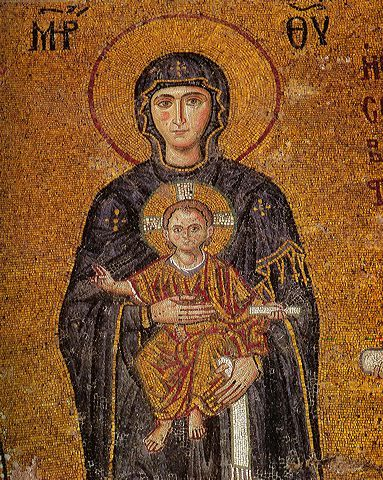
Today is the commemoration of this particular icon of Mary and Christ, signifying the Incarnation: the Icon of the Sign.

OCA: “The Icon of the Mother of God ‘Of the Sign’
depicts the Most Holy Theotokos with prayerfully uplifted hands,
and the Divine Infant is at Her bosom in a mandorla (or sphere).”

Icon Reader also has an article about this icon, “The Theotokos ‘of the Sign’ Icon.” There are many, many renditions of this form, and I especially love the one at my parish:

“Her prayerful stance also gives the impression of presenting us with Christ,
and our attention is drawn – as always with icons of the Theotokos –
to her Son, our Saviour.”

Health and healing, water and blessing.

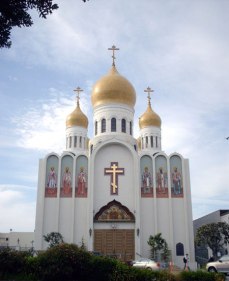
Last weekend I drove a visiting priest to San Francisco, from where he was going to return to his home across the world the following day. But before I dropped him off at the church where he would serve that evening, he asked if we might stop by Holy Virgin Cathedral, where the relics of St. John the Wonderworker reside. I was quite happy to do that!

Every time I visit there, I feel more comfortable and more deeply blessed, but so far, not less overwhelmed by the size of the space, especially the height of the cathedral, and the numerous icons covering the walls and also freestanding around. The names are all in Cyrillic, so there are many who remain unidentified to me, though this time I recognized more of the saints just from having got to know them better elsewhere.

When I tried to get a picture of my companion as he stood praying next to St. John’s casket (he is somewhat hidden behind a palm), I realized that I could include the whole of one of the stained glass crosses in my picture. Later he and I discussed the used of stained glass in Orthodox churches, and I made note of how in the image we were looking at, there were no human figures, so no saints were cut in pieces, as it were, by leaded lines. He liked these examples of stained glass. I guess I still am not used to them.

It was timely that I came away with that picture, because today was our commemoration of the Procession of the Honorable Wood of the Life-Giving Cross of the Lord.

“The origin of this Feast is explained in the Greek Horologion of 1897: ‘Because of the illnesses which occur during the month of August, it was customary at Constantinople to carry the Precious Wood of the Cross in procession throughout the city for its sanctification, and to deliver it from sickness.'”

A service for the Blessing of Water was held this evening, the hymns all about healing; and our rector reminded us that though we may tend to seek medical care when we are ill, we ought always to pray first, especially for the healing of our sin-sick souls.

Today is also the beginning of the Dormition Fast, by which we prepare our hearts to imitate the life of the Mother of our Lord, and we make ready to remember her death, on August 15th. The consideration of her example, and the shortness of our own lives, also help put us in a condition of receptiveness to the healing power of the Holy Spirit.

The Lord is my Light and my salvation; whom shall I fear?
The Lord is the strength of my life; of whom shall I be afraid?

A prayer from tonight’s service:

O Lord our God, Who art great in counsel and wondrous in deeds; Fashioner of all creation, Who preservest Thy covenant and Thy mercy for those who love Thee and keep Thy commandments; Who receivest the compunctionate tears of all who are in need. For this reason Thou camest in the form of a servant, being not afraid of our image, but granting true health to the body and saying, “Behold, you who have become healed; sin no more!” And with clay Thou madest the eyes whole, having commanded them to be washed, at a word making them to rejoice in the light, putting to confusion the floods of passions caused by the enemies and drying up the bitter sea of this life, subduing the floods of sweet things heavy to bear: As the same King, O Lover of mankind, Who hast granted us to clothe ourselves with the garment of snowy brightness, by water and the Spirit, send down upon us Thy blessing by the partaking of and sprinkling with these waters, washing away the filth of passions.

The supreme moment of hospitality.

Because when I recently rediscovered this post from three years ago, I was nourished by it again, I am re-posting it for my new readers and for all of us. It concerns the most enduring things, never outdated. One of those always-new things, which I’ve only this year begun to read and think about in the context of the Annunciation, is hospitality of the sort that the Virgin demonstrated toward the very Son of God. She is an example for us all.
Today is the beginning of our salvation;
the revelation of the eternal Mystery!
The Son of God becomes the Son of the Virgin
as Gabriel announces the coming of Grace.
Together with him let us cry to the Theotokos:
“Rejoice, O Full of Grace, the Lord is with you!”
I had wanted to continue my ruminations on The Lily of the Field and the Bird of the Air by further considering The Moment that Søren Kierkegaard refers to when, after waiting in silence, “…the silent lily understands that now is the moment, and makes use of it.”

I don’t know what that moment consists of for you, for me, for us as a world community, or in our cities or church communities or families. No doubt there are overlapping times and seasons containing infinite instants, and only by quiet listening can we make any sense of them. But this passage in particular I wanted to pass on, in which the writer discusses what is missed when we fail to make the proper, standing-before-God kind of preparation:

“Even though it is pregnant with rich significance, the moment does not send forth any herald in advance to announce its arrival; it comes too swiftly for that; indeed, there is not a moment’s time beforehand…. But of course everything depends upon “the moment.” And this is surely the misfortune in the lives of many, of far the greater part of humanity: that they never perceived ‘the moment,’ that in their lives the eternal and the temporal were exclusively separated.”

So many thoughts swirl in my own noisy mind and heart that I could not imagine how I might find a way to share even these few gleanings with you. Then, in God’s providence and the church calendar, appeared someone who is the supreme example for us of being ready for the moment, that time in history and that time in her life, in a particular moment of a day, when the Angel Gabriel appeared to her. Today we remember that event, when Mary listened, and responded, “Behold, I am the handmaid of the Lord; let it be to me according to your word.”

The Word became flesh and came to live with us, taking on all our human experience, its weakness and suffering and  death. He defeated death, and opened the gates of Paradise. The Incarnation, the beginning of our salvation, is The Moment of history; our own “Yes” to God, echoing Mary’s willingness, can be the essence of our every prayer as well, as we wait on Him.

Kierkegaard exhorts us, in words that seem especially fitting for this time of uncertainty and change: “Would that in the silence you might forget yourself, forget what you yourself are called, your own name, the famous name, the lowly name, the insignificant name, in order in silence to pray to God, ‘Hallowed be your name!’ Would that in silence you might forget yourself, your plans, the great, all-encompassing plans, or the limited plans concerning your life and its future, in order in silence to pray to God, ‘Your kingdom come!’ Would that you might in silence forget your will, your willfulness, in order in silence to pray to God, ‘Your will be done.’

We know that God’s will for us is good, now as ever. Our inability to see or understand that is due to our weakness or sin, or His hiding of His works. May He give us grace to wait and to pray, and eventually we will see the full salvation of the LORD.

Oh, the depth of the riches and wisdom and knowledge of God!
How unsearchable are his judgments and how inscrutable his ways!
For who has known the mind of the Lord,
or who has been his counselor?
Or who has given a gift to him that he might be repaid?
For from him and through him and to him are all things.
To him be glory forever. Amen.

Romans 11

I return joyful from San Francisco.

My godmother Charity and I took a trip to San Francisco yesterday, to the Orthodox cathedral affectionately called “Joy of All Who Sorrow.” I have mentioned visits to this holy place a couple of times before. The relics of St. John (Maximovitch) of Shanghai and San Francisco reside here, and draw pilgrims from around the world.

We wanted to present our petitions to the Lord with the help and intercession of St. John.

As many of my prayers have to do with my children and grandchildren, I was touched to see this icon near the front of the cathedral soon after I came in:

Being so large, the church has lots of space for iconography, an overwhelming number of images to take in, in one visit. This sweeping 360 degree tour of the cathedral might be interesting to give you an idea of the whole of the interior. It starts with the exterior and you have to click on the little square picture at the upper right of the frame to see the interior.

A photo of my companion hints at the feeling of being in the space:

Since my last visit here, I have become familiar with the traditional depictions of various saints and can recognize more of them, even if the names on them are in Cyrillic script. But I didn’t know this couple, whom Charity guessed to be Ss. Peter and Fevronia, and which the man at the candle desk in the narthex confirmed:

I have only recently learned about this royal couple, but they have long been famous in Russia, because:

“The Day of Saints Peter and Fevronia since the days of Kievan Rus and until 1917, was broadly celebrated in Russia because it is believed that the Saints Peter and Fevronia are the patrons of marriage and family, as well as the symbols of love and fidelity. On this day it was common to go to church, where the people asked for love and family grace.” (Wikipedia)

Their holiday has been revived in this century, now celebrated every July 8.

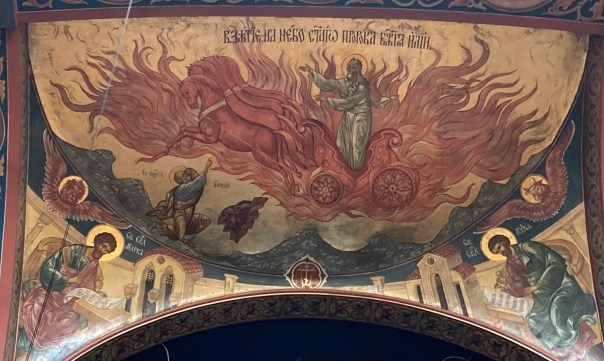
On the west wall I was surprised by a very large icon of Elijah in his chariot of fire:

One icon that blessed me very much was of the Holy Myrrhbearing Women. I am always especially interested in them because one is my patron saint, but this is the first time I have been so touched by their expressions, which seemed more emotional than is typical. (I really don’t know much about art, so take anything I say with a huge grain of salt!)

Just today I was reminded that icons are re-presentations of those depicted, an opportunity for us to engage further with the saints whom we know and love in the Lord. I offer one excerpt from an article by Fr. Lawrence Farley in which  he explains why we ask saints to pray for us:

“If the living and departed are both united to Christ, they are by virtue of this union also united to one another.  Even while on earth all Christians are united in a bond of mutual prayer and intercession (Ephesians 6:18)—how much more will our departed brethren pray for us when they are closer to Christ in heaven?”

In the huge Holy Virgin Cathedral full of saints re-presented to me, made present in a mysterious way, I experienced that reality which was also expressed by Bishop Dimitri (Royster) at the glorification of St. Herman of Alaska:

“The Church on earth lives in a loving fellowship with the saints who have already run their race, who have fought the good fight, and have received their crowns (2 Timothy 4:7) (James 1:12). This is what the Apostle means when he says that we are compassed about or surrounded by the witness-martyrs or saints. We are assured both of their presence and their interest in us. In fact, they are concerned about the whole world and its salvation, for ‘there is joy in heaven over the repentance of one sinner’ (Luke 15:7).”

It encouraged  my heart to be with so many, many saints at the cathedral. I know that the ones presented in icons are only a few out of the great Cloud of Witnesses who are examples and friends for us, who love and pray for us. Their faith is like a magnet that draws me in to the Kingdom, and keeps me from getting discouraged. Their love is a comfort to my heart, and no wonder, for I was in the cathedral named for her whom we know to be the “Joy of All Who Sorrow.”