Tag Archives: Theotokos

A young girl stopped to see.

ANNUNCIATION

We see so little, stayed on surfaces,
We calculate the outsides of all things,
Preoccupied with our own purposes
We miss the shimmer of the angels’ wings,
They coruscate around us in their joy
A swirl of wheels and eyes and wings unfurled,
They guard the good we purpose to destroy,
A hidden blaze of glory in God’s world.
But on this day a young girl stopped to see
With open eyes and heart. She heard the voice;
The promise of His glory yet to be,
As time stood still for her to make a choice;
Gabriel knelt and not a feather stirred,
The Word himself was waiting on her word.

-Malcolm Guite

You can hear the poet read his sonnet.

Zoë

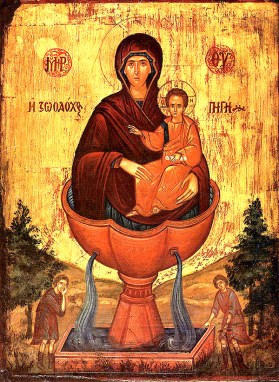
On Bright Friday, that is, the Friday after Pascha, the Orthodox Church commemorates The Life-Giving Spring of the Most Holy Theotokos. Though I had heard of the monastery by that name, it seems I had never paid attention on Bright Friday before to get the backstory; this year I heard about it twice. The story of a miraculous pool of water and how it was rediscovered is well told here.

I also learned that women with the name Zoë might have been named for this feast of the Theotokos. Zoë means life in Greek. In his Prologue of Ohrid St. Nikolai Velimirovich relates the story of a St. Zoë and her family, who were slaves in the second century. On the same day’s entry St. Nikolai’s homily is on this pertinent scripture from Jeremiah:

Be amazed at this, O heavens, and shudder with sheer horror, says the Lord. Two evils have my people done: they have forsaken Me, the source of living waters. They have dug themselves cisterns, broken cisterns that hold no water.

From the homily:

The Source of living water is the Lord Himself: inexhaustible, copious and sweet. The cistern is every man’s work which is performed in opposition to God and God’s law, and from which men expect progress, happiness and satisfaction for their hungeTheotokos lifegivingfountr and thirst….
….O Lord, Immortal Source of every good that the heart of man can desire and the mind of man can imagine, have mercy on us sinners and unworthy ones. With Thy powerful right hand, turn us away from our godless and vain works and quench our thirst with Thy sweet and living water.

Whether in her womb, or in a pool of healing waters, or in her example and exhortation to “Do whatever He tells you,” it is the life of the Lord Himself that His mother offers us.

This concludes my alphabetical posts. As in the first I acknowledged that Christ is Alpha and Omega, the first and last — according to the Greek alphabet — so here at “Z”, the last letter of our alphabet, we find that He is Zoë, Life itself.


On behalf of Eve she repaid the debt.

I don’t think many of us will be reading blogs on Christmas morning, so I offer this meditation a little early, from a Christmas homily of very long ago, found here.

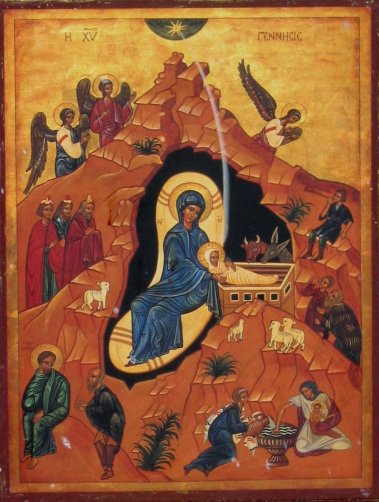
It was fitting that the Giver of all holiness should enter this world by a pure and holy birth. For He it is that of old formed Adam from the virgin earth, and from Adam without help of woman formed woman. For as without woman Adam produced woman, so did the Virgin without man this day bring forth a man. For it is a man, saith the Lord, and who shall know him [Jer. 17:9]. For since the race of women owed to men a debt, as from Adam without woman woman came, therefore without man the Virgin this day brought forth, and on behalf of Eve repaid the debt to man.Nativity.0

That Adam might not take pride, that he without woman had engendered woman, a Woman without man has begotten man; so that by the similarity of the mystery is proved the similarity in nature. For as before the Almighty took a rib from Adam, and by that Adam was not made less; so in the Virgin He formed a living temple, and the holy virginity remained unchanged. Sound and unharmed Adam remained even after the deprivation of a rib; unstained the Virgin though a Child was born of her.

+ St. John Chrysostom, “Homily on Christmas Morning”

Do you wonder where Joseph is? Orthodox icons don’t show him in the typical western setting of the birth of Christ. You can find out about any unfamiliar elements of this picture from Iconreader in his post about the Nativity icon.

Web Gleanings from July

Several articles I’ve read lately strike me as worth sharing.

Boredom is a topic that comes up a lot, maybe more so in summertime, when some people have more time to be bored.  In “The Quiet Alarm” Andreas Elpidorou explains why  “Boredom is precious, but there’s nothing particularly good about being bored. Its unpleasantness is no illusion, its subjective character no taste worth acquiring. We should give thanks for it – and avoid it like the plague.” 5161~Girl-Reading-Book-Posters

I’m not sure what I think about all of this; perhaps Boredom is so related to Time that it’s one of those realities that I could muse on for a long time and get more and more confused – but never bored! Read the whole article here.

The threat of boredom comes to mind when I think of cocktail parties, but David Brooks uses them as a metaphor for the exciting “online life” in his article “Building Attention Span”: “Being online is like being a part of the greatest cocktail party ever and it is going on all the time….” He says that “This mode of interaction nurtures mental agility,” or what he calls “fluid intelligence.”

He contrasts that with “crystallized intelligence,” which is what we get more of in offline learning, “…the ability to use experience, knowledge and the products of lifelong education that have been stored in long-term memory.” This kind of learning leads to wisdom, and goodness knows we need that. Read the whole article here.

Fr. Stephen Freeman’s retheotokos Decani monasterycent article “Why the Orthodox Honor Mary” begins a discussion that continues in the resulting comments,  contrasting the humility and submission of Mary as something to recognize and emulate, with the actual veneration of her as an aspect of our worship of God.

A fascinating bit of Bible exposition is in the comments where Fr. Stephen explains Jesus’s words to Mary at the marriage of Cana, and the meaning that becomes clear when you see that they hearken back to the story in I Kings of Elijah and the widow of Zarephath. Read it all here.

https://i0.wp.com/cdn8.openculture.com/wp-content/uploads/2015/07/28001845/Emily-Dickinson-Coconut-Cake.jpgTo end on a lighter note, how about some coconut cake to have with your iced tea on a summer afternoon? (If you are in the Southern Hemisphere, even better – just make that hot tea.) This picture of Emily Dickinson’s Handwritten Coconut Cake recipe, and the accompanying text, do encourage me that if I get back into the kitchen more, it won’t necessarily mean a lessening of my writing output. I do wonder what the form of the coconut ingredient is intended to be, but it would be fun to experiment with one of my favorite foods.

As I write, the sun has yet to emerge in my cool corner of California, but by mid-afternoon the situation will probably have changed enough that I could sit outdoors with some tea and some more reading material from which to glean. Happy reading to you, too!