Tag Archives: time

Two to Remember

Today is the birthday of C.S. Lewis, and that’s a good reason to post a thought-provoking quote from him. Lewis was born in 1898 and died on Nov. 22, 1963, the same date as President John F. Kennedy and author Aldous Huxley. Peter Kreeft wrote a book based on his imagination of what a conversation among these three people might sound like if they met after death; it is titled Between Heaven and Hell: A Dialog Somewhere Beyond Death with John F. Kennedy, C. S. Lewis & Aldous Huxley.

I don’t think I’ve read that book yet, but today is Lewis’s birthday. Maybe I’ll read the book prompted by the date of his death before next November 22 and have some thoughts on it then. For now, I’d like to think on this:

  Gratitude looks to the Past and love to the Present; fear, avarice, lust, and ambition look ahead.

The first clause describes what characterized our family’s Thanksgiving celebration so recently. The second describes what I have daily to turn from, to put off from my thoughts just as I might drop an icky thing from my hands, so that I can freely touch and hold, really be present with, what and who is right here now.

While I’m remembering people who inspire, let me not forget to mention St. Andrew The First Called, whose feast day is tomorrow. I learned last year about how he is the patron saint of Scotland. We don’t have our priest-intern Fr. Andrew any longer but we are having Vespers tonight and Liturgy tomorrow for Saint Andrew all the same, which makes me happy right now.

In thinking about Lewis’s quote above, I realized that one reason we plan for the future is just so we will be able to love and serve when the future has become the present. It’s the way we can look ahead in love and faith and not in those other ways. But what a lot of Love I have to live in today.

California Mountains – Gnarly Patriarchs

(6th in the “California Mountains” diary of our July 2011 vacation)

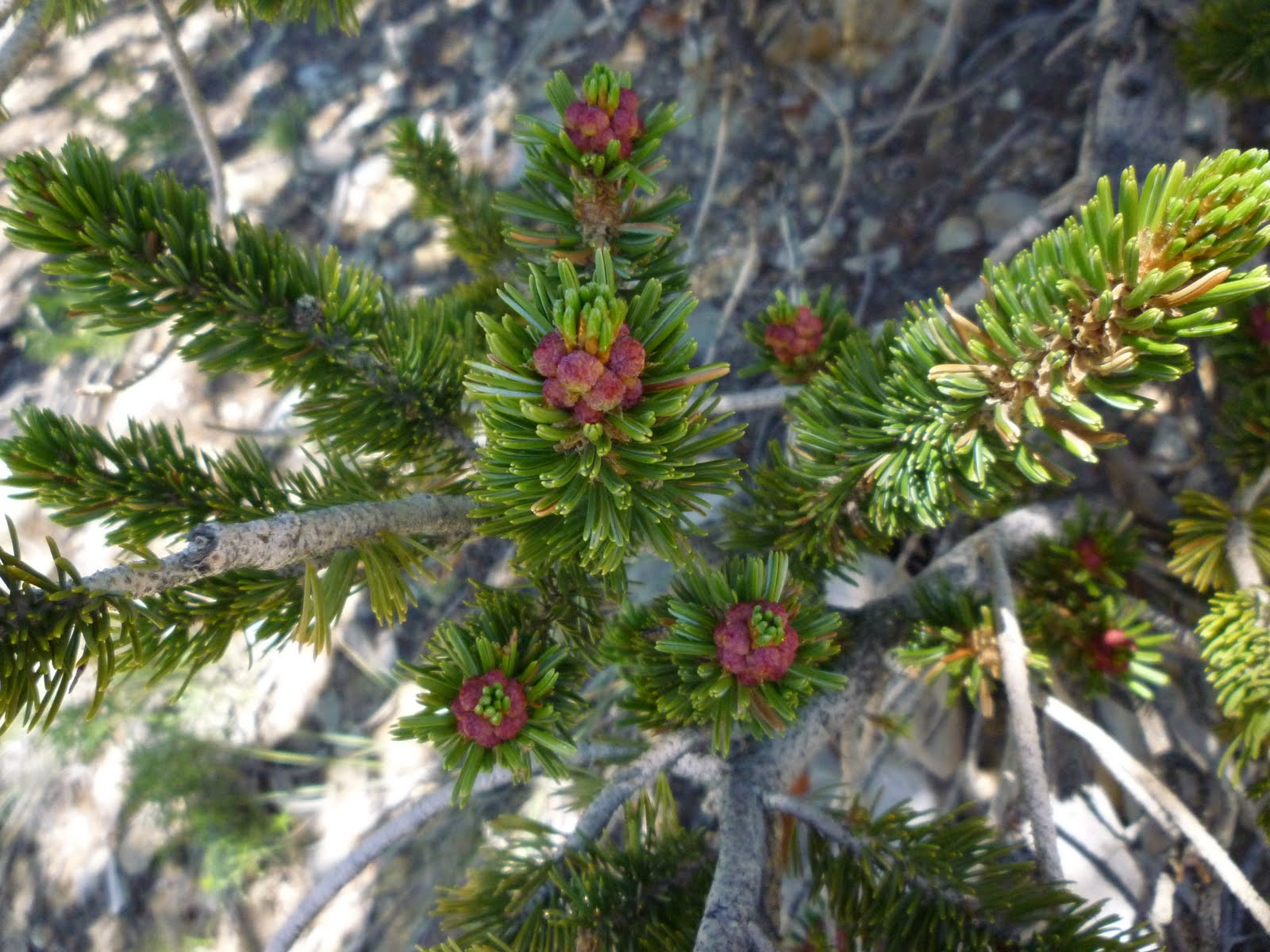
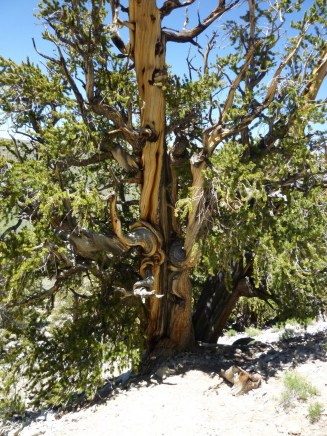
If the Bristlecone Pines were humans, I’m pretty sure they would be ascetic saints like Father Seraphim of Sarov or Mary of Egypt, people who lived in the wilderness and had “meat to eat that we know not of.”

Stanleya pinnata; Desert Plume

It was to visit these inspiring creatures that Mr. Glad and I drove up into the White Mountains that rise up east of the Sierra Nevada on the other side of the Owens Valley. The climbing part was a repeat of the previous day’s experience of a quick uphill, and this time it took just 24 miles for us to traverse zones of desert and sagebrush steppe, and come to a land where alpine wildflowers live stunted lives.

Mormon Tea

On the way up through the forbiddingly dry and rugged desert region, waving yellow plumes were the first vegetation to get my attention. Now I know where Dr. Seuss got the images for some of his crazy drawings.

Purple Sage; Salvia dorri

Another drought-tolerant plant we ran across is called Mormon Tea, though it has other common names that aren’t as folksy. It’s a member of the Ephedra family of plants, perhaps milder — and safer? — than the Chinese herb. I didn’t collect any.

The uglier plants passed from view as we entered the steppe zone, and we began to get our eye-fill of gorgeous purple sage, the very flower referred to in the five movie versions of Zane Grey’s novel Riders of the Purple Sage; I haven’t seen the the movies or read the book, but just now learned that there is a Mormon element to that story. This area is geographically part of the Great Basin Desert that covers much of the state of Nevada, and of which Utah’s Great Salt Lake Desert is a part, so the Mormon connection to the natural history makes sense.

Bristlecone Pines grow in other areas of the Great Basin, too, and maybe on less steep roads. The ones in California aren’t on the way to anywhere, but they are well worth the worry of hearing your car’s engine groan a bit on the sharp inclines.

The longevity of these trees is the primary fact one learns right off. Except for cloning plants, the Bristlecones are the oldest living plants. The current oldest one is known to be 4,788 years old, and as many as 19 of them are over 4,000 years old.

Not only are they of great age, but they keep their vitality. While other trees show changes in their DNA or produce fewer cones, the Bristlecones are just as healthy and fruitful at 4,000 years as they were at 1,000.

They have ways of dealing with the severe climate, and with seasons that are harder than usual. How to determine what is a particularly hard year in their habitat seems to me difficult, seeing how they always have to do with very little water, and with freezing temperatures much of the year, and soil that is poor. Some of the oldest trees grow in “soil” that is a form of limestone called dolomite, shallow and infertile white rock. The sun is relentless in summer, and the winds are often brutal.
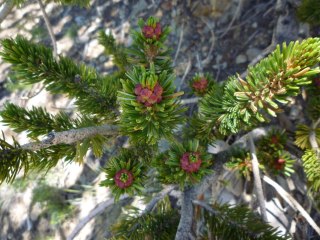
Clearly their youth is renewed not by superfoods and a friendly environment but by a meager diet and suffering — and yes, by their genetic predisposition to “behaviors” that conserve nutrients and strength. For example, instead of dropping needles and replacing them every year or two, they hold their needles for up to 45 years, and it requires less energy to renew the old ones than to grow completely new ones.

If they suffer unusually severe drought or stress, they put some limbs into dormancy so that they can keep producing the maximum number of cones. If we compare them to humans, they are fertile even longer than the biblical patriarchs, or our mother in the faith, Sarah.

The white rock actually reflects some of the sun so that more moisture is retained in the soil, and the trees tend to live relatively far apart from each other in their forests, so they don’t have to compete for light and food. In this way they are the opposite of redwood trees, which need the moisture that collects between trees in the grove if they are going to be their healthiest.

These trees make me think of Bible verses about youth being renewed, but also the ones about hoary heads and the dignity of age. The old and weather-worn patriarchs have a beauty of a sort we don’t see in young upstarts or in overfed and coddled 20-somethings. Even in death the wood is so dense that it remains for centuries and doesn’t decay, much as some saints’ bodies remain incorrupt.

I so love the Bristlecones! I can’t figure out all that they are telling me, but I know it’s something about God and the Christian life. Maybe if I grow really old I will understand more.

The main grove is at 10,000 ft. elevation. After walking the loop trail there we decided to get in the car again and crunch over gravel up another 1,000 feet in a cloud of dust to the Patriarch Grove. It’s only twelve miles, but takes at least 45 minutes. The next installment of this series will tell what I saw there.

Flowing from Easter – The Church Year

I’m preparing for the expected blessing of having three dear and longtime friends as house guests at different times over the next two weeks. While my home is full of busyness and women’s talk, in The Orthodox Church we’ll be commemorating some of those events of the church year that are becoming more lovely to me with every cycle of the church calendar. And because I doubt I’ll even think of blogging while I am hostessing, I am looking ahead, blogging ahead.

In the years when I was first learning about Orthodoxy, I’m thankful I was able to participate quite a bit in various services throughout the seasons, so that I got a good foundation in how the intellectual knowing is the lesser part of a relationship with God. With every year that passes I see this more, and also feel my inability to convey in words this Reality that is Christ in His Church. Even the most eloquent and holy men and women would communicate by their entire persons, and relatively little by words, the Love that has been shed abroad in their hearts.

Still, their words are more eloquent than mine and express a deeper grasp of the realites by far, so I am depending on them to tell a little of how the day-to-day structure of the Church Year gives the grace of God. It all flows from the Resurrection. From the Orthodox Church in America site:

Although the first of September is considered the start of the Church year, according to the Orthodox Church calendar, the real liturgical center of the annual cycle of Orthodox worship is the feast of the Resurrection of Christ. All elements of Orthodox liturgical piety point to and flow from Easter, the celebration of the New Christian Passover. Even the “fixed feasts” of the Church such as Christmas and Epiphany which are celebrated according to a fixed date on the calendar take their liturgical form and inspiration from the Paschal feast.

Next week we have the Leavetaking of Pascha, which I love very much, because it always seems to me that I haven’t been able to sing enough times those exultant hymns of “Christ is risen from the dead, trampling down death by death.” Every year I become more familiar with some of the words and tunes, and try to learn a new one. “Why seek ye the living among the dead? Why mourn ye the incorrupt amid corruption?” On Leavetaking of Pascha we’ll repeat the Easter service in its entirety – and then won’t sing those hymns again until next year.

Even though we will still be in “the time of Easter” for another ten days, until Pentecost, we must say good-bye to the Feast of Feasts, so to speak, because we are coming up to the Ascension! Then we will update our greeting from “Christ is risen!” to “Christ is ascended!” the response to that being, “…from earth to heaven!”

In his book, The Year of Grace of the Lord, Fr. Lev Gillet tells at length the meaning of the Church Year. An excerpt from one paragraph, to which I have added breaks to make it more readable on the screen:

The liturgical year is, in fact, expressed as a calendar, but simply to identify it with a calendar would be totally inadequate. One could also say that the purpose of the liturgical year was to bring to the minds of believers the teachings of the Gospel and the main events of Christian history in a certain order. That is true, but this educational, pedagogical, function does not exhaust the significance of the liturgical year.

Perhaps we could say that its aim is to orient our prayer in a certain direction and also to provide it with an official channel which is objective, and even, in a certain way, artistic. This, too, is true, but the liturgy is more than a way of prayer, and it is more than a magnificent lyric poem.

The liturgy is a body of sacred “signs” which, in the thought and desire of the Church, have a present effect. Each liturgical feast renews and in some sense actualizes the event of which it is the symbol; it takes this event out of the past and makes it immediate; it offers us the appropriate grace, it becomes an “effectual sign,” and we experience this efficacy to the extent that we bring to it a corresponding inclination of our soul.

But still, this does not say everything. The liturgical year is, for us, a special means of union with Christ. No doubt every Eucharist unites us intimately with Christ, for in it he is “both he who offers and who is offered,” in the same way that every prayer, being the prayer of the members of the mystical body, shares in the prayer of him who is the head of the body and the only one whose prayer is perfect.

But, in the liturgical year, we are called to relive the whole life of Christ: from Christmas to Easter, from Easter to Pentecost, we are exhorted to unite ourselves to Christ in his birth and in his growth, to Christ suffering, to Christ dying, to Christ in triumph and to Christ inspiring his Church. The liturgical year forms Christ in us, from his birth to the full stature of the perfect man. According to a medieval Latin saying, the liturgical year is Christ himself, annus est Christus.

Thinking about work and smiles

If I am feeling scattered, might it help if I got one thing done, like writing one little blog post? I could just make it the Poem of the Week or the Quote of the Day or something like that.

Perhaps a quote about time, like this:

Time is always ahead of us, running down the beach. Barbara Crooker said that. It’s an interesting way of looking at it, but not really the way I myself feel.

Today I seem to be leaning more toward Oscar Wilde’s policy of I never put off till tomorrow what I can do the day after. 

Because I’m finding that Work expands to fill the time available for its completion, as anyone who has experienced Parkinson’s Law knows. (Switching to the Work theme now…)

If, as Bertrand Russell says, One of the symptoms of an approaching nervous breakdown is the belief that one’s work is terribly important, then I am showing no sign of a nervous breakdown. Thank God for that.

Nothing is particularly hard if you divide it into small jobs, said Henry Ford, and I know I DO believe that. Since my job description consists of about a thousand large and small tasks already, the small jobs I completed today must count for something. I made an important phone call, threw away lots of junk mail, figured out what to have for dinner and read some poems. Before that I walked two miles and thought a lot about some things I was reading while walking. I prayed a little, and did at least a hundred other little things. So how could I think I’m having a nonproductive day?

It’s probably because my list of tasks, which has gotten longer and longer as it also got buried while I was traveling and living in the Bright Reality of Pascha – Christ is risen! by the way – is just too daunting, not having been divided into enough small tasks that in turn could be assigned to more days.

He that despiseth small things will perish little by little, said Emerson. So I resolve to appreciate these little accomplishments, not to mention the huge things God does, such as, today He gave me life and breath and the ability to get out of bed.

I was talking on the phone to a friend who is very ill; she told me that some days she can’t walk very well. She also has trouble speaking. I was telling her about lying in the grass on the hilltop last week, and she started to cry out of compassion for people who don’t get to see the kind of beauty I was describing.

That reminded me of the movie I watched last night, about Mother Teresa, and how she emphasized the importance of love, and smiling. When destitute, crippled and dying people look into the smiling faces of the Sisters of Charity, they see a beautiful thing indeed, and feel the love. With all the kitschy smiley face stuff going around for decades now, it wasn’t until last night that I fully appreciated the power of a smile.

The smiles of the sisters in the movie were so obviously genuine, and flowing from the love of God, I couldn’t help laughing and crying all through the movie. A smile is another small thing I could accomplish today. My dear husband will be home soon, and I think I will give him one.

So, it has indeed helped me to write this blog post. As Henry Ford also said, Before everything else, getting ready is the secret of success.