Tag Archives: water

Maui Diary 6 – Christmas and Fishes

Ornate Butterflyfishes
No, we didn’t go to Maui at Christmastime, but one of the fishes I saw was named the Christmas Wrasse. That got me thinking about how children love Christmas with all its treats and presents and surprises, and how swimming in the ocean in that warm climate and discovering new wonders every moment made me feel like a child.
Orangeband Surgeonfish
Lots of people who are old or achy like to swim because there is no pressure of gravity on the joints, and we can get some exercise without much pain. It seems the salty ocean is even more buoyant; several times I tried hard to dive underwater to get closer to the fish, but I could not. And this water was blissfully mild in temperature…I thought I could swim forever, it was so friendly.
Saddle Wrasse

We didn’t take pictures of the fish, but I was able to find some photos online and am posting the ones that most resemble the particular fish as they were when we met them. I personally saw at least 16 different species on our four expeditions, of which I think my favorite to look at was the Ornate Butterflyfish (photo at top). Three times we rented snorkel equipment, and the last time we just used swim masks.

How free and happy I was, exploring a whole new natural environment. This was nothing like my usual gym pool where I doggedly plow up and back, up and back, watching the clock. It felt like a dream, maybe I was a fish myself, gliding almost effortlessly through the liquid world, gazing down into underwater pools and coral gardens. Sea urchins made splashes of black, blue, and hot pink behind the fish. But no, I wasn’t a fish, because there was the rough sound of my breath going in and out of the snorkel tube. At least the fish didn’t seem to be bothered.

Honolua Bay
It’s a mark of how special the snorkeling experience was generally that I can even remember the less pleasant parts without sadness. Like our visit to Honolua Bay, which on a good day is reported to have the best snorkeling — but it was not a good day. In this photo you can probably see that the water was brown under the surface, but we didn’t want to see that. So on we went!
Fourspot Butterflyfishes
The wind was blowing too hard, the water was cloudy, and a lot of gunk in the form of wood chips, twigs and other dirty organic material floated on the surface above the fish hangouts, getting into my hair and under my swimsuit. It was my birthday, so I didn’t feel guilty about asking that we cut that excursion short. Besides, we had already taken up a lot of time picking our way along the rugged shore, looking for a safe place to enter into the bay without getting sloshed against big rocks. Mr. Glad was pretty content to swim back to land, because he had seen a trumpet fish.
Ahihi Cove
Christmas Wrasse
Our best fish-viewing experiences happened a few days earlier at spots along the South Shore, like the little cove in the picture above.

On our first outing, my first snorkeling ever, we lost track of time at Ulua Beach as we swam marveling back and forth. We managed to stay close together and point, waving our arms at one another when we saw a new fish for the first time — still, when we went back to the condo and looked at pictures we learned that each of us had seen at least one type of fish that the other hadn’t seen.

Several times I found myself in a predicament of tall coral and had to pay more attention to my paddling in order to get out of there without damaging me or the coral. Twice it seemed we were headed back to shore to rest, without discussing it…and then we changed direction and went away from the beach again and back to the coral beds. We didn’t really want to leave yet, I guess.

On one of these sojourns closer to shore I found myself next to a shimmery school of small silver fish that were swimming pretty close to the surface, a thousand of them at least, and I swam toward them, reaching out my hands hoping to touch one. They were like an underwater version of starlings, swiftly breaking into legions, swirling into new groupings and always away so that I could never get into their ranks, but I spent quite a while trying, and they didn’t seem to make much effort to get out of range.

They were some kind of scad, probably Big-eye Scad, and definitely the most fun to swim with. We were like distant cousins getting acquainted on Christmas Day, in a game of water-tag, playing chase for the pure joy of it.

(I’m taking a break from the computer for a few days, so it might be a week before I get the next Maui Diary episode published.)

Of Earth and Altar and Lake

Mr. and Mrs. Bread joined us at My Lake for a few days. We canoed and hiked and ate a lot and sat by the fire. On the Lord’s Day we sunned ourselves on the deck while singing hymns to The God of Earth and Altar, praising Him for his Wondrous Love that flows Like a River Glorious.

In the top photo you can see on the left margin the brown needles of a dead tree that was the subject of some discussion between Mrs. B. and me.

There’s a lot of philosophy and theology in a dead tree, did you know? But I spent so much time doing the nature study while barely tackling the philosophizing, that my time-bucket is empty. Maybe next summer I’ll look at it again and write, and figure out what I think.

manzanita

Another dead tree (above), growing out of a hunk of granite that we christened Gumdrop Dome, was more strikingly beautiful. According to G.K. Chesterton, “Anything beautiful always means more than it says.” As I was saying….?

A baby manzanita bush was hugging a rock in a most endearing manner. It’s amazing how often I find a new and lovable manzanita bush in my view.

One night Mrs. B. was working out on paper what she thought about the meaning of things, as the dinner she crafted for us stewed in the oven, and we all enjoyed the fire her mister had built up to a controlled inferno. The thermometer got up past 60 in the daytime but at night dropped to freezing.
Wax Currant – Ribes cereum

Last year Mrs. Bread and I were roughing it alone up there, without our menfolk. I took more pictures then, though now I am finding that so few images in my Lake collection satisfactorily describe the lake itself. Next trip I’ll have to climb to the top of Gumdrop, as I haven’t done in years, and get the wide view with my camera. In the meantime, here’s a picture we took from there Once.

For me the most blessed part of our stay at the cabin was when Mr. Glad and I paddled our blue canoe for a long time, early in the morning when the surface of the water was smooth. The sky was deep blue, and most of the time the only sound was of our paddles dipping. Peace.

California Mountains – Gnarly Patriarchs

(6th in the “California Mountains” diary of our July 2011 vacation)

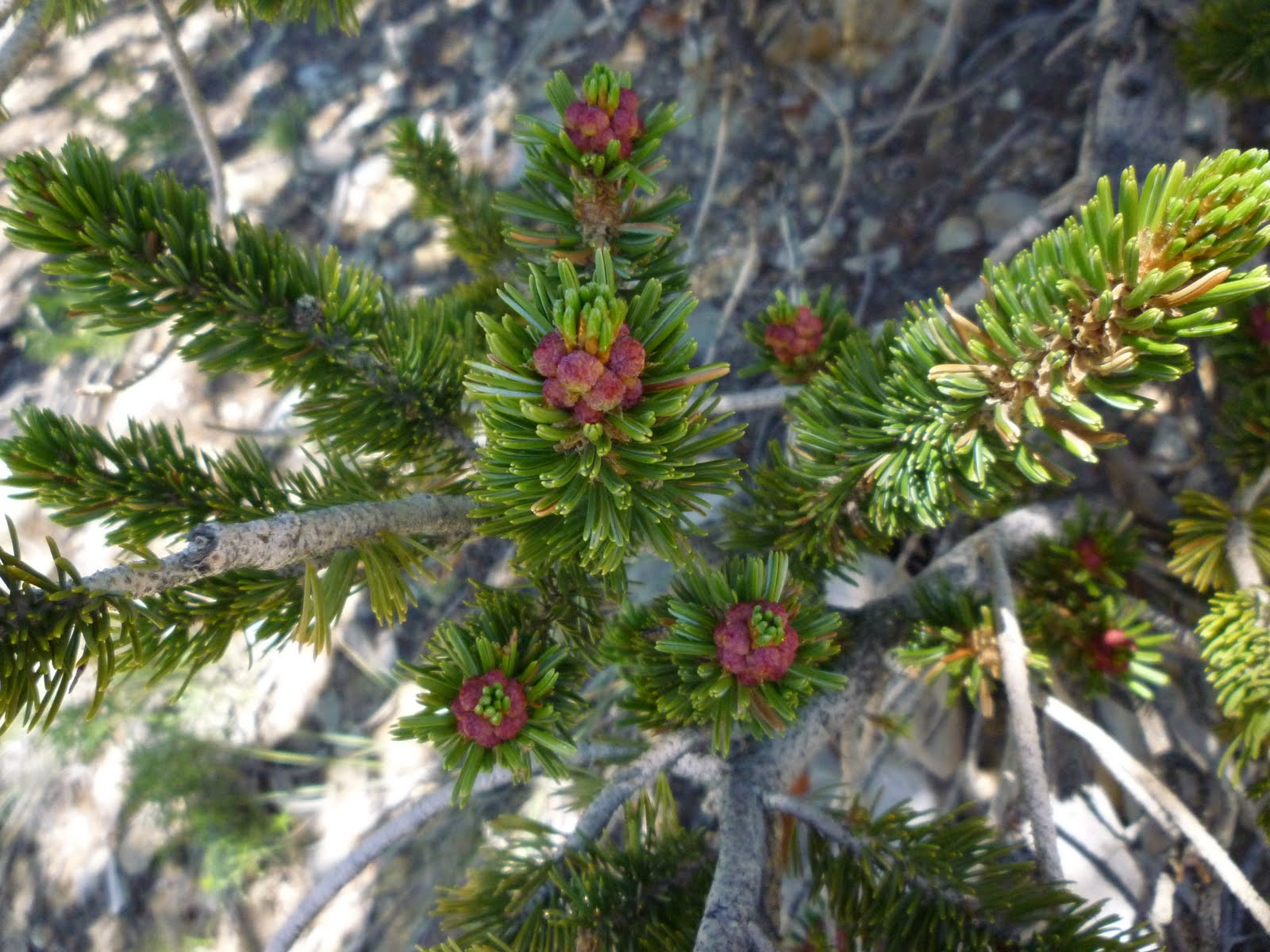
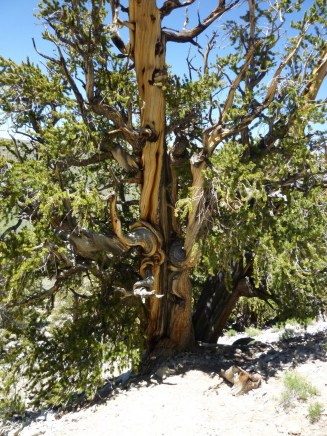
If the Bristlecone Pines were humans, I’m pretty sure they would be ascetic saints like Father Seraphim of Sarov or Mary of Egypt, people who lived in the wilderness and had “meat to eat that we know not of.”
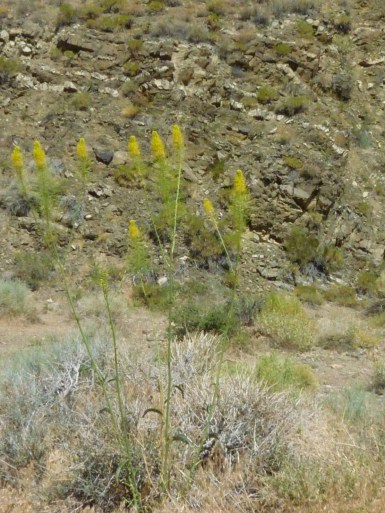
Stanleya pinnata; Desert Plume

It was to visit these inspiring creatures that Mr. Glad and I drove up into the White Mountains that rise up east of the Sierra Nevada on the other side of the Owens Valley. The climbing part was a repeat of the previous day’s experience of a quick uphill, and this time it took just 24 miles for us to traverse zones of desert and sagebrush steppe, and come to a land where alpine wildflowers live stunted lives.

Mormon Tea

On the way up through the forbiddingly dry and rugged desert region, waving yellow plumes were the first vegetation to get my attention. Now I know where Dr. Seuss got the images for some of his crazy drawings.
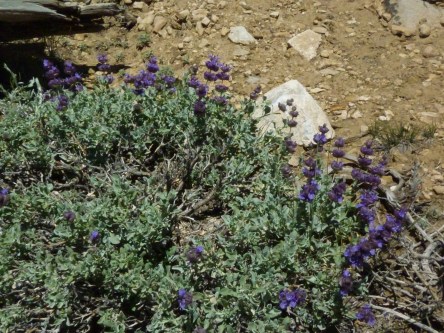
Purple Sage; Salvia dorri

Another drought-tolerant plant we ran across is called Mormon Tea, though it has other common names that aren’t as folksy. It’s a member of the Ephedra family of plants, perhaps milder — and safer? — than the Chinese herb. I didn’t collect any.

The uglier plants passed from view as we entered the steppe zone, and we began to get our eye-fill of gorgeous purple sage, the very flower referred to in the five movie versions of Zane Grey’s novel Riders of the Purple Sage; I haven’t seen the the movies or read the book, but just now learned that there is a Mormon element to that story. This area is geographically part of the Great Basin Desert that covers much of the state of Nevada, and of which Utah’s Great Salt Lake Desert is a part, so the Mormon connection to the natural history makes sense.

Bristlecone Pines grow in other areas of the Great Basin, too, and maybe on less steep roads. The ones in California aren’t on the way to anywhere, but they are well worth the worry of hearing your car’s engine groan a bit on the sharp inclines.

The longevity of these trees is the primary fact one learns right off. Except for cloning plants, the Bristlecones are the oldest living plants. The current oldest one is known to be 4,788 years old, and as many as 19 of them are over 4,000 years old.

Not only are they of great age, but they keep their vitality. While other trees show changes in their DNA or produce fewer cones, the Bristlecones are just as healthy and fruitful at 4,000 years as they were at 1,000.

They have ways of dealing with the severe climate, and with seasons that are harder than usual. How to determine what is a particularly hard year in their habitat seems to me difficult, seeing how they always have to do with very little water, and with freezing temperatures much of the year, and soil that is poor. Some of the oldest trees grow in “soil” that is a form of limestone called dolomite, shallow and infertile white rock. The sun is relentless in summer, and the winds are often brutal.
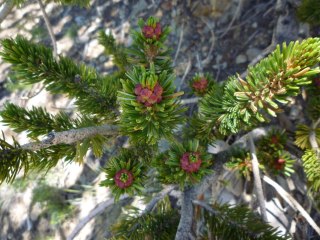
Clearly their youth is renewed not by superfoods and a friendly environment but by a meager diet and suffering — and yes, by their genetic predisposition to “behaviors” that conserve nutrients and strength. For example, instead of dropping needles and replacing them every year or two, they hold their needles for up to 45 years, and it requires less energy to renew the old ones than to grow completely new ones.

If they suffer unusually severe drought or stress, they put some limbs into dormancy so that they can keep producing the maximum number of cones. If we compare them to humans, they are fertile even longer than the biblical patriarchs, or our mother in the faith, Sarah.

The white rock actually reflects some of the sun so that more moisture is retained in the soil, and the trees tend to live relatively far apart from each other in their forests, so they don’t have to compete for light and food. In this way they are the opposite of redwood trees, which need the moisture that collects between trees in the grove if they are going to be their healthiest.

These trees make me think of Bible verses about youth being renewed, but also the ones about hoary heads and the dignity of age. The old and weather-worn patriarchs have a beauty of a sort we don’t see in young upstarts or in overfed and coddled 20-somethings. Even in death the wood is so dense that it remains for centuries and doesn’t decay, much as some saints’ bodies remain incorrupt.

I so love the Bristlecones! I can’t figure out all that they are telling me, but I know it’s something about God and the Christian life. Maybe if I grow really old I will understand more.

The main grove is at 10,000 ft. elevation. After walking the loop trail there we decided to get in the car again and crunch over gravel up another 1,000 feet in a cloud of dust to the Patriarch Grove. It’s only twelve miles, but takes at least 45 minutes. The next installment of this series will tell what I saw there.

California Mountains – Snow in Springtime

Spring was a happening thing in the high Sierra. Last winter extended well into June, and on at least one date that month the snowpack was the highest on record. This means that at the end of July when we were there, quite a bit of snow was still melting.

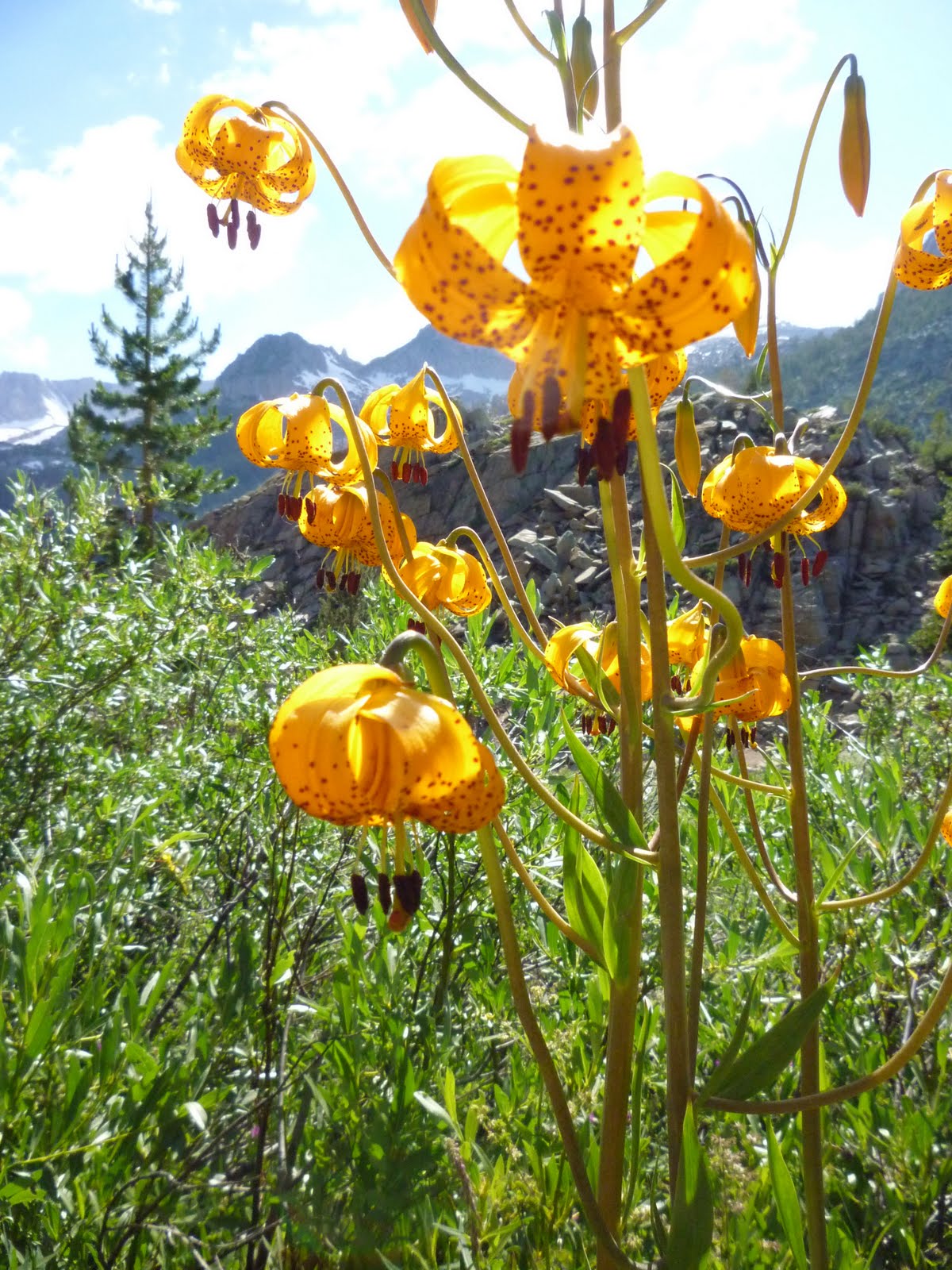
Leopard Lily

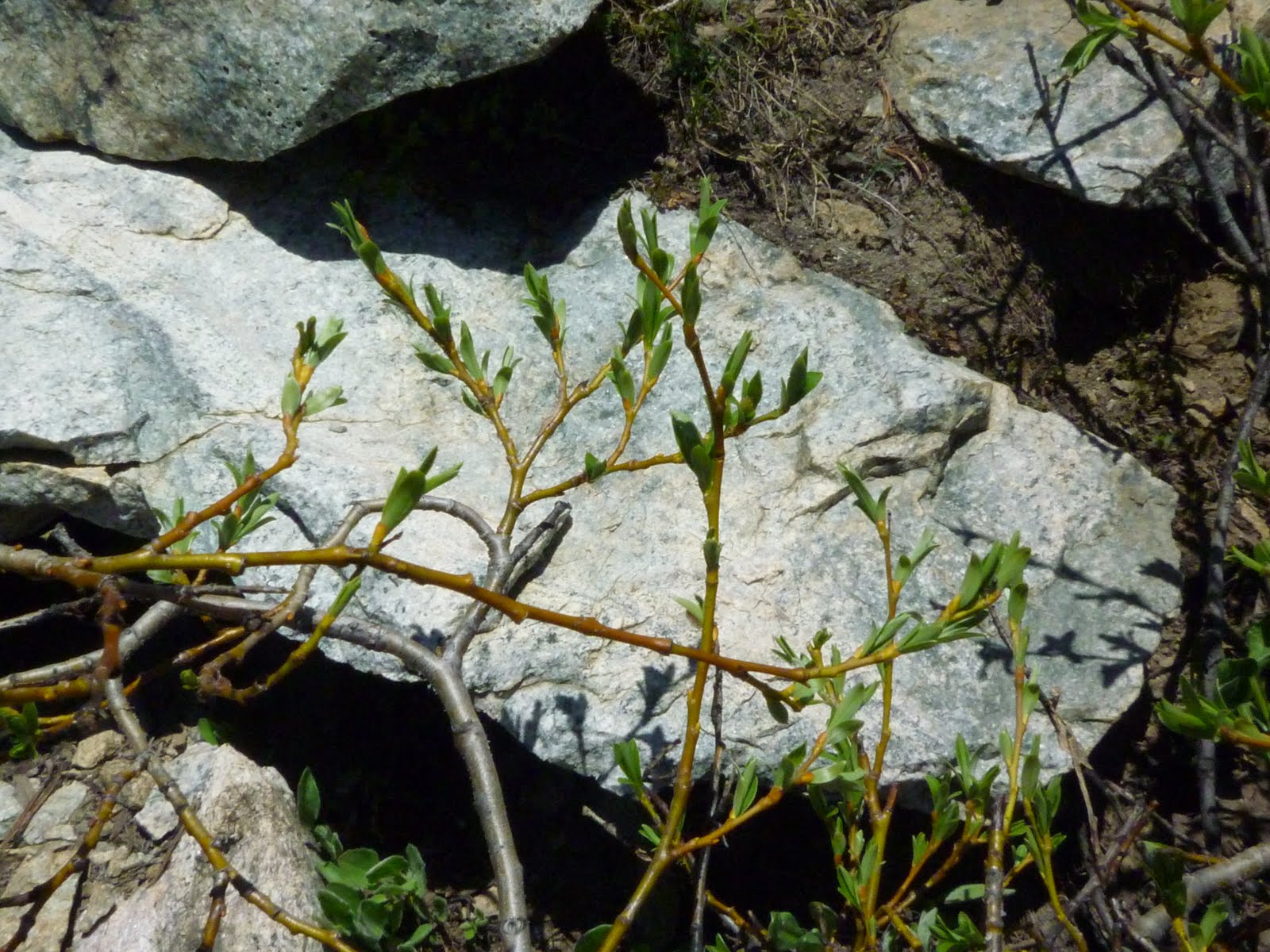
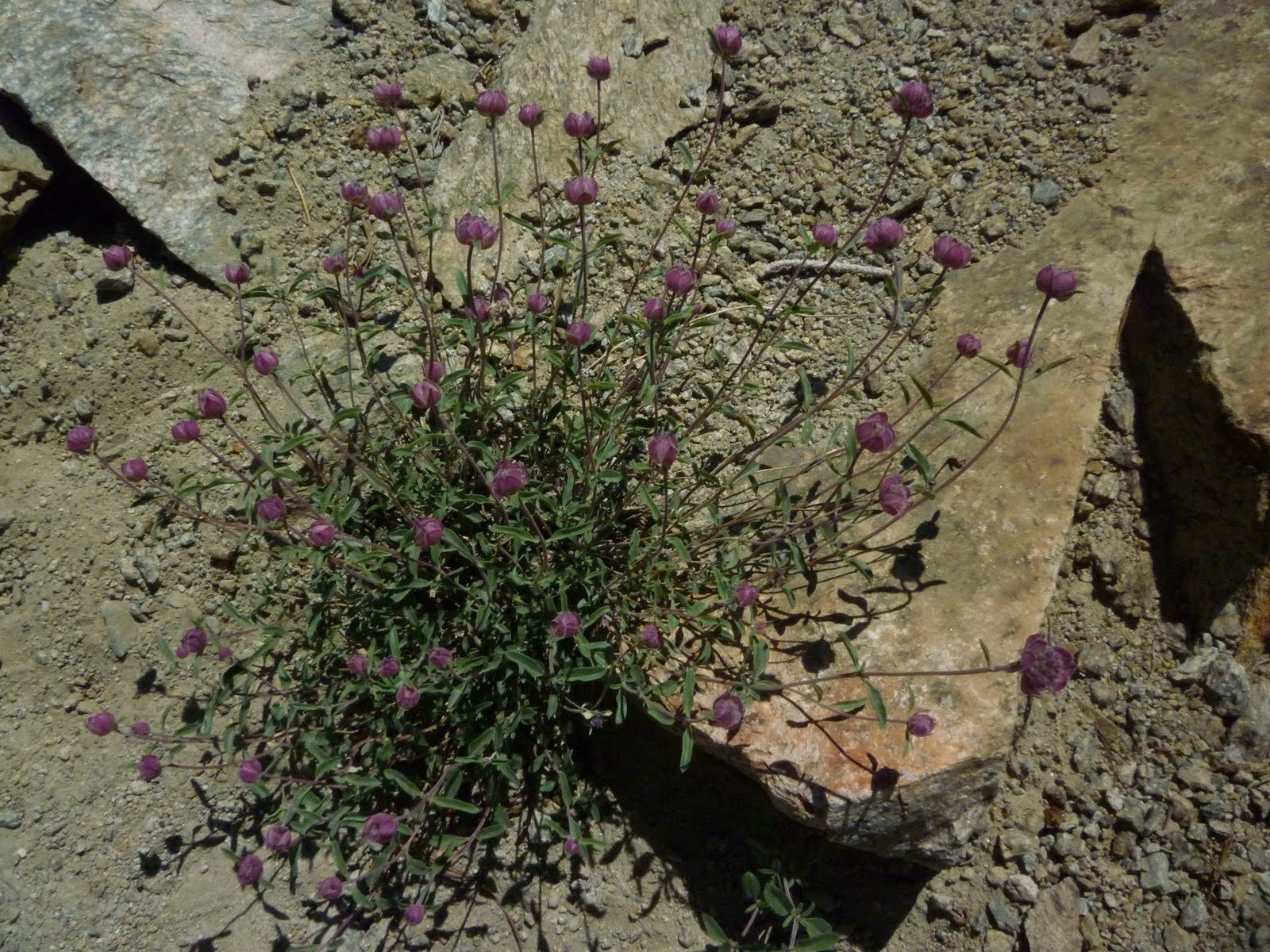
From our trailhead at nearly 10,000 feet, we only ascended another 1,000 feet or so, but the difference in the flora was notable. Higher up, the flowers and shrubs were still in bud; the snow hadn’t been gone long.

Willow buds
Mountain Pennyroyal in bud


The violent weight of snow had deformed this cluster of trees in such a symmetric way as to be artistic.


Spearhead Lake


Rosy Sedum with Buttercups

At the highest elevations, every lovely bloom seems like a miracle, when you consider how much of the year the plants are just roots or seeds under the snow, how quickly they are required to respond to the light and warmth and come into their glory.

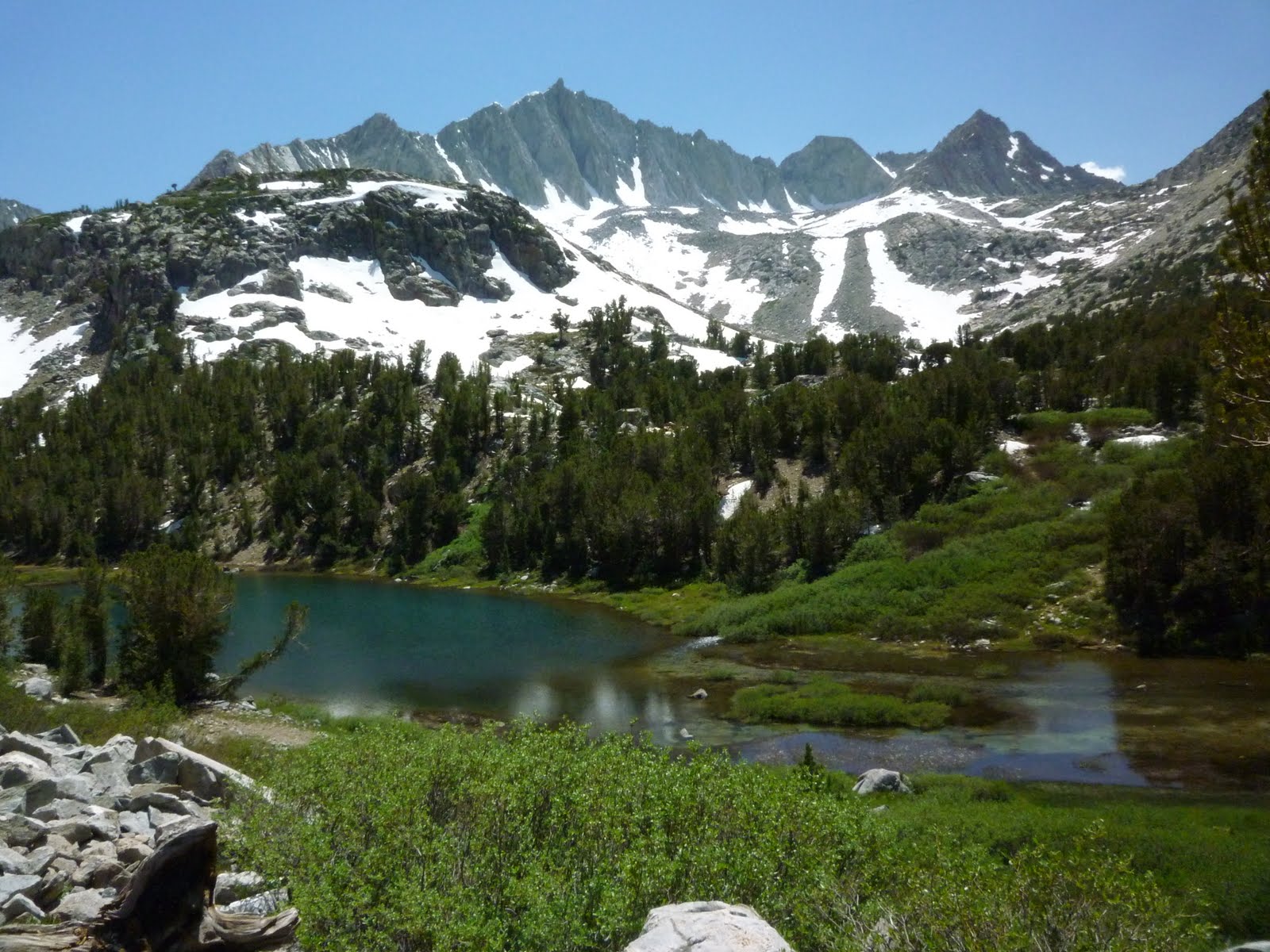
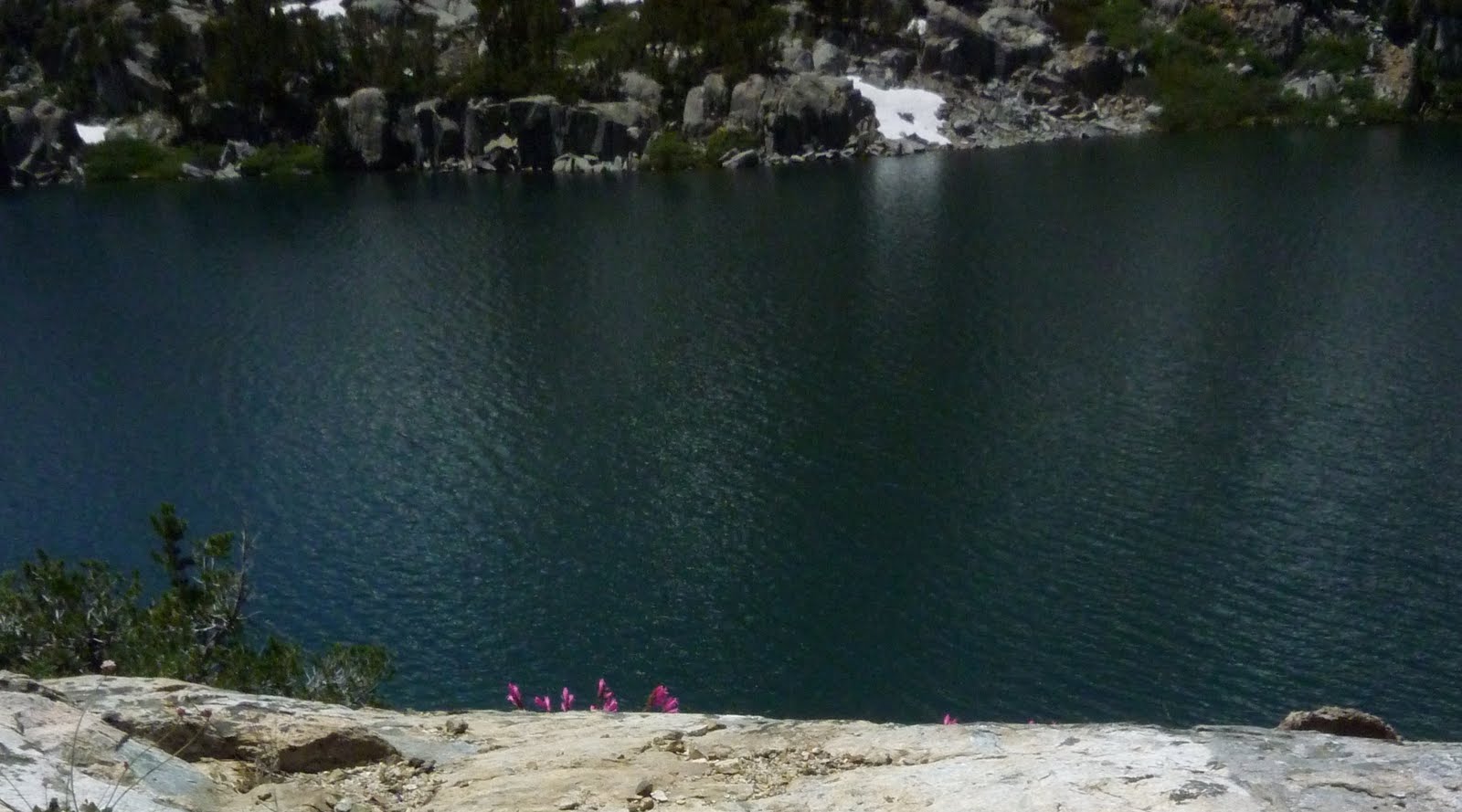
In some places they were sprouting out of a puddle where snow had likely been lying a few days previous, like in this low place I had to hop over to reach a spot overlooking Long Lake. You can see Mr. G. in the distance ready to spread out our picnic of cheese and crackers.

Around us and at our feet hot pink penstemon was making for a brilliant contrast with the midnight blue water and the granite rocks.