Monthly Archives: May 2009

Frittatas

The frittata is the easy way to make an omelette. I can’t remember the first recipe I ever saw for this dish, but I doubt it was authentically Italian, as the name might imply.

Over the years, in any case, I’ve evolved my own basic recipe, which is to fall back on if I go too long between frittatas and can’t remember the proportions.

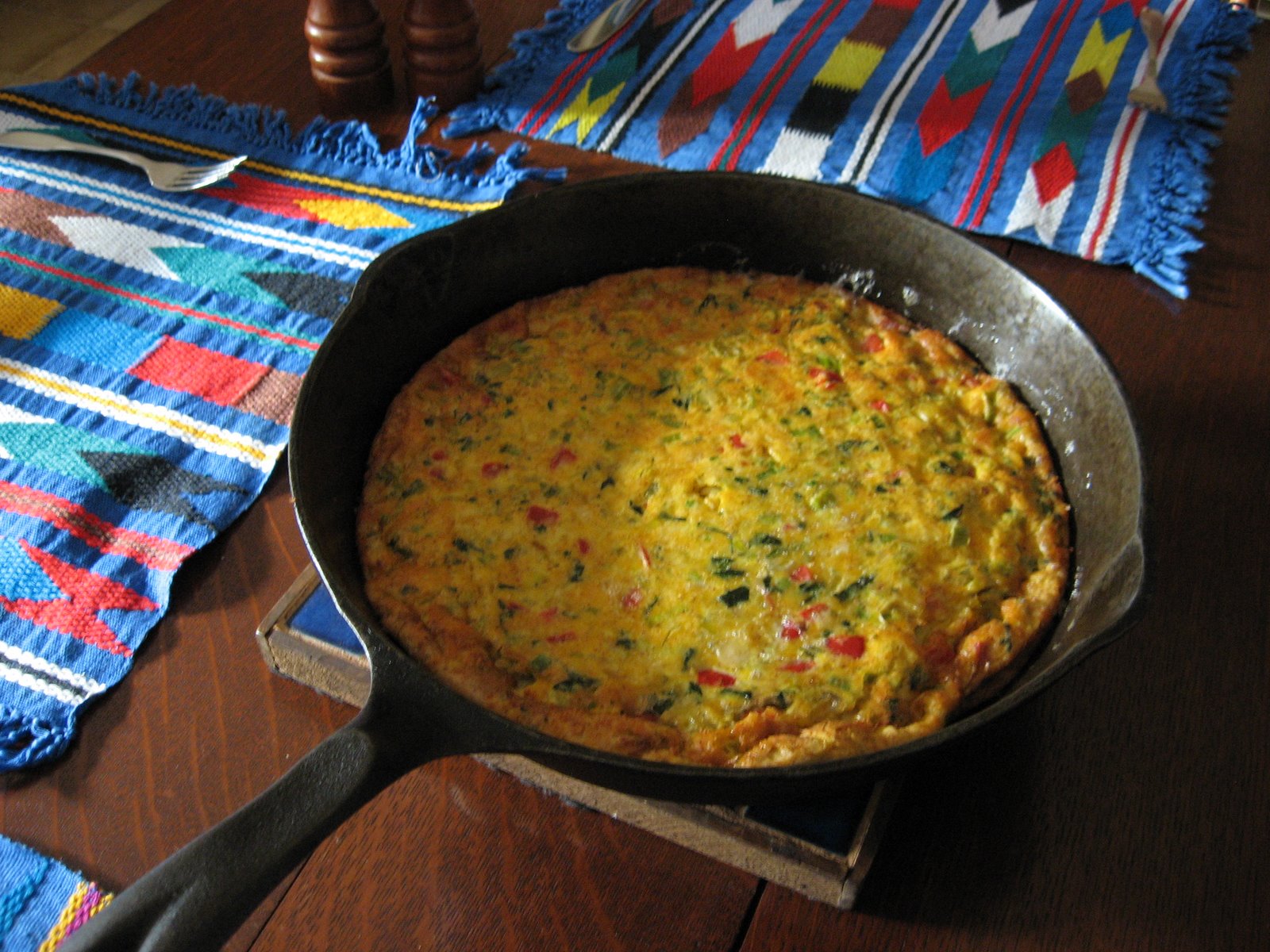
Today is Cinco de Mayo, so even though I’ve already published two posts today, I’ll try to get this one out there and be timely for once. I forgot about the holiday for most of the day; our family hasn’t usually celebrated it though the festivities are all around us here in California. It was pure happenstance that I decided that the frittata I was planning for dinner would be made with Tex-Mex flavors. Then after it was in the oven someone mentioned the holiday, and I was very pleased with my unconscious “choice.” When I saw how lovely the pie looked, I whipped out my placemats that might actually look more South American than Mexican…but in any case, they looked more fitting than the everyday ones.


But back to Italy, where they have this tradition of combining eggs with vegetables and cheese in an oven-baked pancake. If you use a cast-iron skillet the result is rustically beautiful, so I always like to put it on the table for everyone to see, and cut it into wedges there.

Eggs are so nutritious and inexpensive, I like to make an egg dish for dinner once every week or two at least. Most people who eat at our house these days don’t have eggs for breakfast very often, so it’s not redundant to eat them in the evening.

This recipe can easily be stretched for more people, or adapted to what you have and like, by adding more eggs or vegetables, cheese, cooked potato, herbs & spices, etc. It is hard to ruin it and I rarely measure out the ingredients, except for salt, which I keep consistent at 1/8 teaspoon for every 3 eggs. This example has an Italian flavor, but you could make it Mexican, Chinese, or Middle-Eastern with a few changes.

Spinach Frittata

1 10-oz. package frozen chopped spinach, thawed & drained
12-13 eggs, beaten
½ teaspoon salt
½ cup grated Parmesan cheese
½ teaspoon nutmeg
½ teaspoon oregano
black pepper to taste

Preheat oven to 400 degrees. Grease a 10-12” cast-iron skillet (or other pan of your choosing) with butter or olive oil and let it get hot in the oven, if you like, while you prepare the batter. Beat all ingredients together and pour into the pan. Bake until eggs are set and top is golden brown, 15-30 minutes depending on your pan, etc. Cut into wedges or squares to serve.

Obviously this makes enough for a big family. I usually incorporate 1-2 eggs per person, depending on their size or appetite, and sometimes add an extra one or two “for the pot,” because if there are leftovers I’m happy to eat a slice for breakfast. The amount of spinach is plenty for the quantity of egg, but sometimes I use just as much spinach with only eight eggs. As I said, it’s hard to ruin it. I’ve made versions with added ricotta cheese, crumbled bacon, and leftover greens that had been cooked with onion and garlic. And I served one at a tea party once so that we wouldn’t overdose on sugary stuff.

Tonight, for my Tex-Mex Frittata ( I think the Hispanics have something that uses similar ingredients but not baked in this form, so I don’t want to use their term) I used:

  • seven eggs
  • about a cup of shredded cheese, mixed jack and cheddar
  • about 2 oz. of canned diced green chiles
  • some vegetables I’d sautéed–sweet red pepper, garlic, scallions, cilantro
  • salt, chili powder and cumin to taste

After I’d heated some olive oil in an 8″ cast-iron skillet, I poured in the egg mixture and put it in the oven at 450° this time, because that’s the temperature that was dictated by the recipe I was trying out, Crash Hot Potatoes, thanks to Pioneer Woman at http://thepioneerwoman.com/cooking/ . The guys really liked these potatoes, which you can see in the photo above.

If, in addition to your veggie-laden egg pancake, you serve a steamed vegetable on the side and a tossed green salad, you might almost make up for the rest of the day when we tend to have so few vegetables. And as my husband is always reminding me: Though “experts” may debate about what is the healthiest diet, high-carb, low-carb, low-fat, low-sugar, etc., everyone but everyone agrees that we should all eat our vegetables.
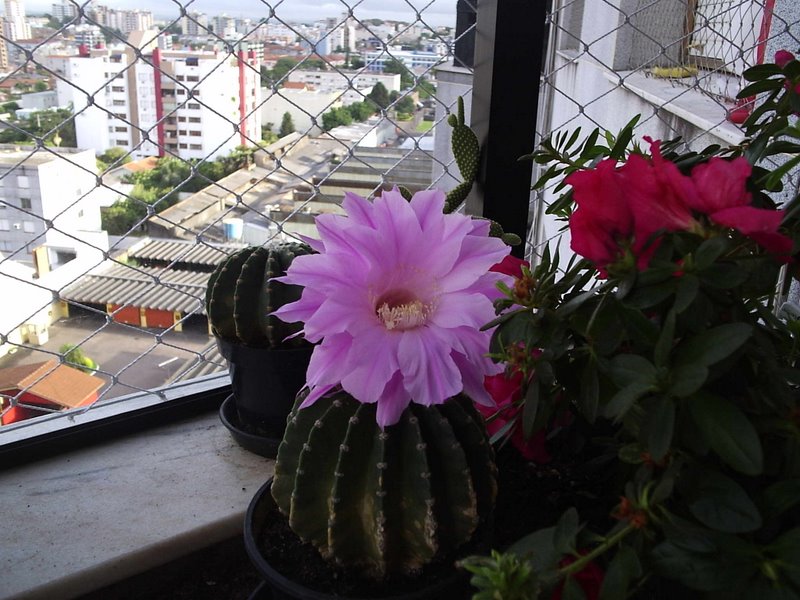
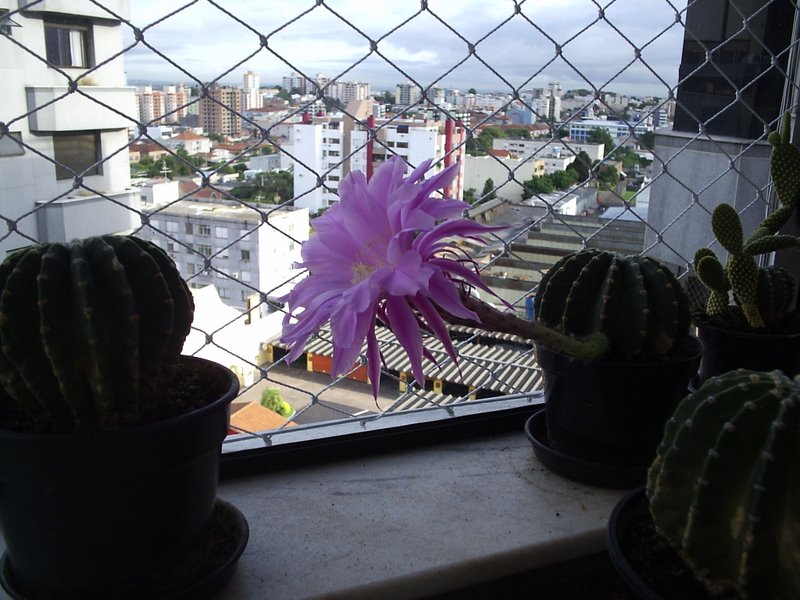
Short-lived Brazilian bloom

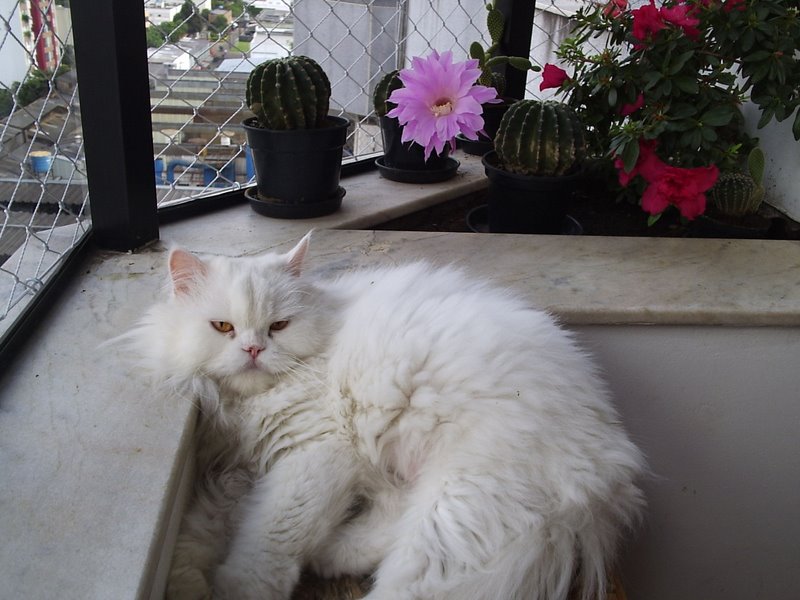
I have a Brazilian friend whom I first met when she was the American Field Service exchange student in my high school. So it’s been a long time! We were kindred spirits from the start. Nowadays we can enjoy our friendship online, and keep more current with one another. I can even enjoy her husband’s little window garden and this gorgeous cactus flower that blooms just once a year, and the flower lasts only 12 hours.

The cat’s name is Branco.
I get the feeling he doesn’t know that the flower is the focal point of this shot.

A Poet and Some Poetry

I’d like to tell about Dana Gioia, who has been a great blessing to me by dana gioia sitehis writings and other contributions to the human community. He is a poet and literary critic, and served for several years, until a few months ago, as Chairman of our National Endowment for the Arts. If you are interested in poetry or arts education you may already be familiar with him. If not, you can read more here: Dana Gioia . The way in which I first met him is best told through excerpts from the letter I wrote in the spring of 2002:

“Dear Mr. Gioia,

“I was driving down the street one day listening to a man on my Mars Hill Audio tape talk about poetry. When the man mentioned that he lived in [my county] I nearly ran through a stoplight, so great was my wonder. That man, of course, was you. Since that day I have borrowed two of your books from the library, and bought Can Poetry Matter?, which I am still reading. I am delighted to have you here, contributing to the literary wealth of the area, and even if I never get to meet you, I consider you a friend and teacher…

“We always had our children memorize poems as part of their lessons in humanity as well as in literature, spelling, and diction. One of our daughters took up this project on her own and memorized “Horatius at the Bridge” when she was about twelve. Recently on a long car trip my husband asked if one of us might have some poetry to recite, and she revealed that she had memorized “The Walrus and the Carpenter” while also working on her degree in biology.

“…I recently read an article by Steven Faulkner in an old Touchstone magazine, “The Workshop of Worship: On Recovering Poetry for Our Children.” In it he laments the loss of poetry as a way, as Plato said, “to bring order to their wild little souls.” Do you have children? If so, you no doubt make good use of this activity! I must admit I had never thought of it the way Plato does, but reading Faulkner’s essay relieved me of my guilty feelings for not doing much more than introducing our children to the sound of poetry.

“He points out that the youngest will have no idea of the meaning, anyway, but that is not important. It is the rhythm and music and dance of it that educate, and it is a shame, he says, if someone first learns poetry by way of analysis of its meaning. I am curious as to whether you know of Faulkner and of Touchstone magazine? I imagine a network of people in the poetry world who nurture and inspire one another, but I can’t know how wide-reaching it is. And how about Mars Hill—do you have a subscription to their audio magazine? It’s partly the chance to hear the audible voice of thinkers and writers that makes me love those recordings; it’s sort of like eavesdropping on some brainy people sitting at a café.

“Since that first discovery of you and your books, I have heard the Mars Hill segment you did on Longfellow, too, and I was encouraged to leaf through all the anthologies in the house to find his poems to read. Then I realized anew just how important it is to read poems aloud — I seemed unable to attend to them, just sitting alone and reading silently. So I must eat my dinners quickly and read to the rest of the family while they finish; and my younger daughter and I read aloud together during our “school time” in the mornings.

“I have always loved poetry, enough that it makes me sad to think how little I have read….I am glad you are boldly and eloquently bringing light to [the current disinterest in poetry in the general population], and even entering into discussion on the topic at [a local bookstore], I see! I hope to be there to hear a talk that will probably be way over my head, but will be exciting nonetheless.

“In the last few years I have become acquainted with the Eastern Orthodox Church and their richly poetic liturgy, as well as prayer-poems of some of their monastics. Perhaps that has influenced me to pursue poetry generally. This morning I read this, from Bishop Nikolai Velimirovich (translated from the Serbian):

I repent for all the slayers of men, who take the life of another to preserve their own. Forgive them, Most Merciful Lord, for they know not what they do. For they do not know that there are not two lives in the universe, but one, and that there are not two men in the universe, but one. Ah, how dead are those who cut the heart in half!

I repent for all those who bear false witness, for in reality they are homicides and suicides.
For all my brothers who are thieves and who are hoarders of unneeded wealth I weep and sigh, for they have buried their soul and have nothing with which to go forth before You.

“….Would you ever consider teaching a class on poetry appreciation? ….And do you have any ideas for me on the best way to organize my own reading of poetry? If you think nursery rhymes and such are foundational, I probably have that part under my belt!”

By the time he received my letter it was the afternoon of the mentioned event, and he phoned me right then to tell me that yes, he would be glad to help homeschoolers. Also, in answer to my last question, that I might like to read the poetry textbook he had co-authored with X.J. Kennedy, An Introduction to Poetry.

After that I met him a couple of times before he moved to Washington, D.C. in the service of the nation’s art programs, intending to come back to California in two years. The poetry appreciation group never materialized, because I couldn’t drum up enough interest.


Just last month Pippin gave me a book of Gioia’s poems, and as I read an old favorite, “California Hills in August,” I was reminded of part of another letter I wrote to Dana Gioia a bit later:

“Oh, I just noticed that your poem “California Hills in August” is in the Introduction to Poetry. I think it was the first of your poems I read. I love it because I grew up surrounded by those hills…, and I tromped around on that stickery grass and sledded down on old ladders, trying to avoid the cow pies. I think, though, that all the time I was gentled by it, as I think you convey. The child just gives in to the heat and drought and lives fairly contentedly as one more creature in the ecosystem.”

Here is the poem, from Daily Horoscope, which you can also read on his website:

California Hills in August

I can imagine someone who found
these fields unbearable, who climbed
the hillside in the heat, cursing the dust,
cracking the brittle weeds underfoot,
wishing a few more trees for shade.

An Easterner especially, who would scorn
the meagerness of summer, the dry
twisted shapes of black elm,
scrub oak, and chaparral, a landscape
August has already drained of green.

One who would hurry over the clinging
thistle, foxtail, golden poppy,
knowing everything was just a weed,
unable to conceive that these trees
and sparse brown bushes were alive.

And hate the bright stillness of the noon
without wind, without motion,
the only other living thing
a hawk, hungry for prey, suspended
in the blinding, sunlit blue.

And yet how gentle it seems to someone
raised in a landscape short of rain –
the skyline of a hill broken by no more
trees than one can count, the grass,
the empty sky, the wish for water.

©1986 Dana Gioia

Cat Under Utilitarian Art

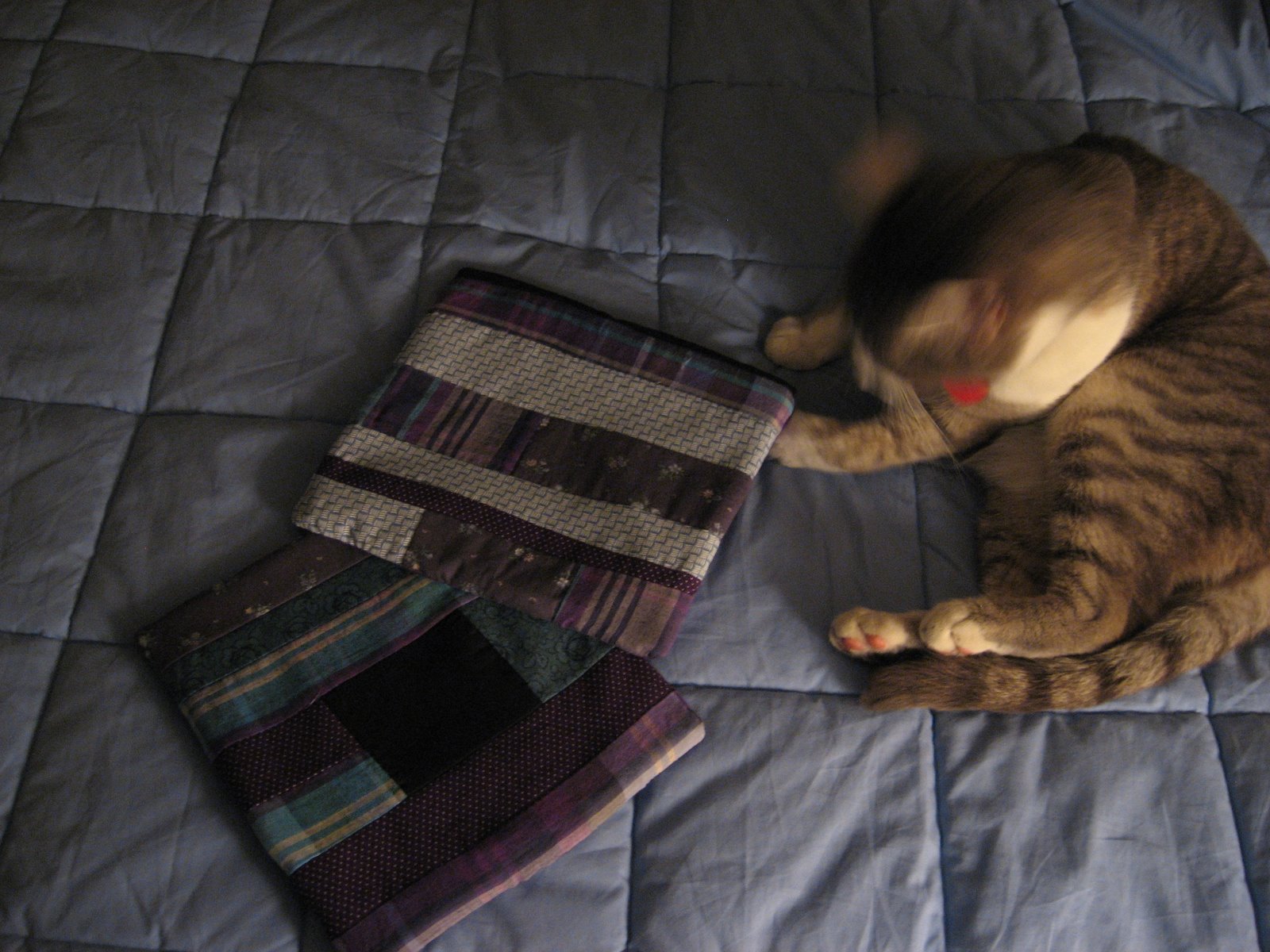
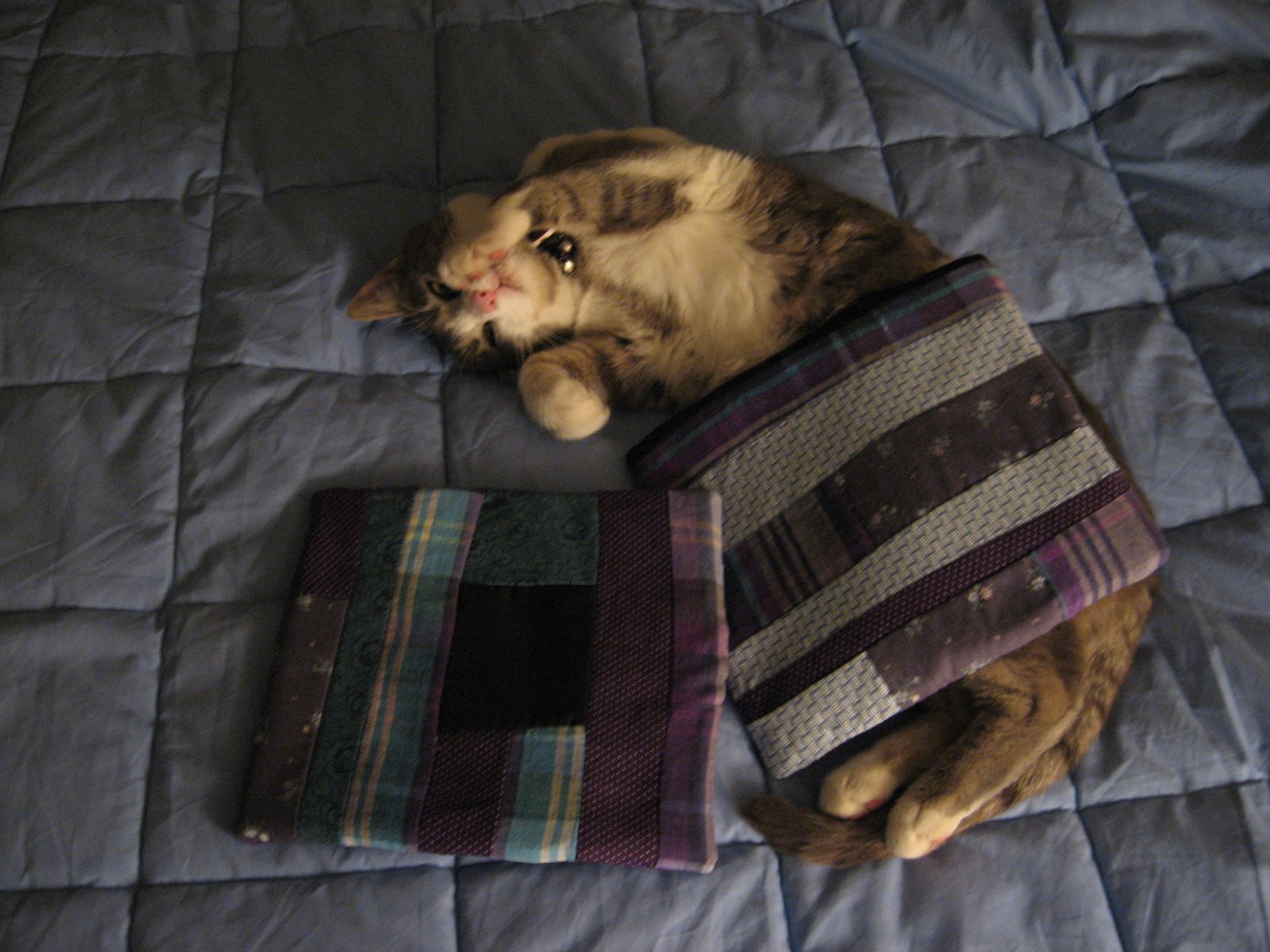
When I was taking pictures of the latest pair of potholders–these only took about five years to complete–Gus came to investigate, and struck a playful pose, so I decorated him with the artwork. I admit that I got the idea from the kitty over at Bread on the Water who was getting in on that art display.

Many years ago I was really in the potholder business. They were a perfect craft to work on while I sat at folk dance classes, drama lessons, Spanish classes…all those activities where I didn’t want to read a book when other mothers were chatting. Everyone needs potholders, so they made handy gifts, and I had plenty of leftover fabric from a lifetime of sewing.

Then for my 50th birthday a friend took me to the quilting shop and bought me some fabrics just for this purpose. I got excited and collected even more color-coordinated materials dedicated to potholders. Now I have a big plastic tub of the stuff, including many hotpads in process, and no likely time for working on them.