Monthly Archives: February 2014

Always looking for someone to devour.

In a Valentine’s Day e-mail letter, Touchstone Magazine editor James Kushiner comments on the news from Belgium. After the general greeting for the day, here is the rest of the letter:

…we live in time when the love of many has grown cold. How else to explain what has happened in the West? Most have heard that Belgium has passed a law [updated link 2023] allowing the ‘euthanization’ of children. With their kind permission, of course. We wish we did not have live in such times. But we do.

Many have seen such things coming, for decades. But warnings, debates, arguments have been to no avail. Books will continue to be written on why it has come to this and how to argue against the slide down the slippery slope (is there any doubt that this slide has been going on?).

Maybe it’s time to recognize that one cannot argue rationally with a demonic spirit. In the United States, some 55,000,000 children in utero have been murdered under the inspiration of this spirit–over the past 41 years, a biblical generation of death in the wilderness. There is no Promised Land waiting for this unrepentant generation. We’ve been killing children without their permission already. Now, Belgium wants to kill adolescents if they are persuaded it would be better for them to go to sleep and never wake up.

I write to name this as the spirit of iniquity that it is. I am reminded of a scene in one of the greatest American films, “The Night of the Hunter.” Two young children, John and Pearl, are running for their lives from a deranged and murderous false preacher, Harry Powell (played by Robert Mitchum). Escaping down the Ohio River, the exhausted children spend part of a night in a barn, but they are awakened by the approaching sounds of Powell on horseback. John says to his sister, “Don’t he ever sleep?”

Exactly. The devil stalking in our midst is a ravenous adversary, always looking for someone to devour. He does not sleep. And his staunch ally, Molech, has devoured little children since biblical times.

The Lord Jesus Christ, to whom all authority in heaven and on earth belongs, has said, “Woe to them who cause these little ones to stumble. It would be better for him to have a great millstone fastened to his neck and be cast into the depths of the sea.” Woe to the nation that does these things. One does not have to be a prophet to see this. God will not be mocked.

In the film, a courageous witness to the Lord delivers the children from death. She is a magnificent heroine, played by Lillian Gish. She loves truly, without fear, with courageous compassion. We must continue to shine the light, like the magnificent witness Valentine.

wintertime loves

We in the arid parts of the West have been exulting in rain the last week or so. It’s so comforting and even glorious to wake in the night and hear the rain still coming down. Then to wake in the morning and see it is still falling. We had puddles in the back yard! Thank you, Lord!
Mr. Glad and I do live in northern California, but daughter Pippin lives even farther north in the state, and we drove there early this week for a short visit. Often February is a very snowy month at her place, but this year they’ve had more dry weather and rain than snow, and even the rain stopped while we were there, so we could get outdoors easily for work and recreation.

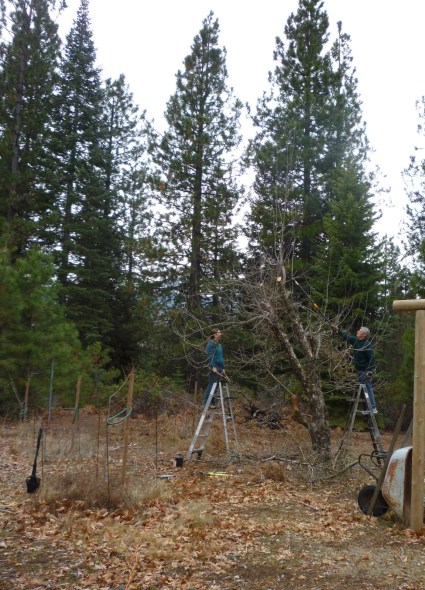
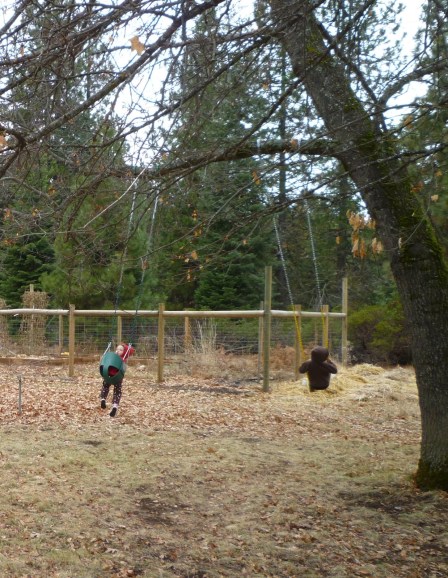
One day we made a family project out of pruning old apple trees that Pippin and The Professor are trying to revive from years of neglect. I floated back and forth between lopping branches and swinging the kids.

I would get Scout and Ivy going and then run over
to take a picture of the adults on ladders.

Another day we took a short trip to Castle Crags State Park and walked a trail alongside the Sacramento River. Considering the dryness of this year, I was amazed at the thick moss and ferns.

 A pale green, almost white lichen grew on rocks and tree stumps.

yew trees on the riverbank

Everything was wet from the recent rains, and many times our feet slipped on the invisible mosses — or was it algae? — growing on wooden bridges or river rocks.Ivy practiced throwing pebbles into the river, and once she got the hang of it she did not want to do anything else. The supply of rocks was endless.We went to the confluence of Castle Creek (in the foreground below) and the Sacramento River, from which you can get great views of the jagged rocks above, called the Castle Crags. They are high enough that the recent precipitation there was in the form of snow, and some was still unmelted and visible.


My dear husband showed me this large and artsy rock, which you can also see in the photo at the very top of this post, in its original setting. I wanted to take it home. It was a little too heavy for me to carry, so The Professor hauled it back to the car. It came with us on our journey home and is now living by our house. Mr. Glad classified it as a confluitic rock. 🙂

Winter days are short enough that at the end of our busy days there was plenty of time for cozy gatherings in the kitchen or by the wood stove. I read many books to the children. Scout’s current favorite, which I read about on a blog before Christmas and gave to him, is Bumblebee at Apple Tree Lane, and we read it several times.

Ivy likes The Little Fur Family best right now. We danced to the children’s favorite recordings, and also listened to bird calls on the Stokes Field Guide to Bird Songs CD. After ten minutes of loons and other waterfowl, Ivy must have deduced that those bird songs were some kind of dance music, too, and she started twisting and prancing around.

Hot soup is what you need on a winter’s night, so Pippin and I learned how to make French Onion Soup, using the recipe in The New Best Recipe: All-New Edition by Cook’s Illustrated Magazine. The secret that the Cook’s testers learned is that red onions give the best flavor. Our result was sooo good.

And cookies! Pippin had some dough left in the freezer from her Christmas Peppernuts, the recipe that I concocted a long time ago but haven’t made for years. We like our nuts to be nut-sized, so we always cut the frozen dough into little cubes and bake them long enough that they come out crispy. Next Christmas I’ll give the recipe.But for now, since I do love cookies, they make a good ending to my story of a wintry family visit that was warm and sweet.

peppernuts 13-14

RFC begins with the meat.

The book into which I am dipping to give you several tastes is Supper of the Lamb by Robert Farrar Capon. The title refers on one level to the four meals he will show us how to make, for eight people at each sitting, out of one leg of lamb. As I said in my first post, it’s not these recipes that most interested me about the book, but they form the loose structure around which the author gathers all his personality and wisdom.

He tells us that “Lamb for Eight Persons Four Times is not simply a recipe. It is a way of life.” A way that has us deliberately creating leftovers so that for most suppers we can use little bits of our meat and make it go a long way. I have a lot of experience with this kind of cooking, and I appreciate Capon’s undergirding philosophy, that there are times to feast, and they are not every day.

He has a term for the everyday: ferial eating. I found in the dictionary that it’s a church term for a weekday on which no feast is celebrated. Capon’s first principle for this ordinary type of eating is: Never serve anybody a whole anything. Because “appetite rises to meet food supply,” and we just don’t need to eat large amounts every day.

Every dish in the ferial cuisine, however, provides a double or treble delight: Not only is the body nourished and the palate pleased, the mind is intrigued by the triumph of ingenuity over scarcity — by the making of slight materials into a considerable matter.

I have to admit that in the days when our feasts were rare, it was easier for us all to stay slim and healthy. For several years now, cooking for only two people, I’ve probably been serving way too many whole items, and I also have so many leftovers from which to create more yummy meals that I hardly have enough cold storage for them. The type of lifestyle where the cook shops nearly every day and prepares what is fresh in the shops in that season seems to be what I should aim for.

Still, I very much appreciate that Capon introduces us early on to his idea of the creative and resourceful cook, who knows how to season and sauce her humble food so that it’s often more interesting and delectable than the festal roast.

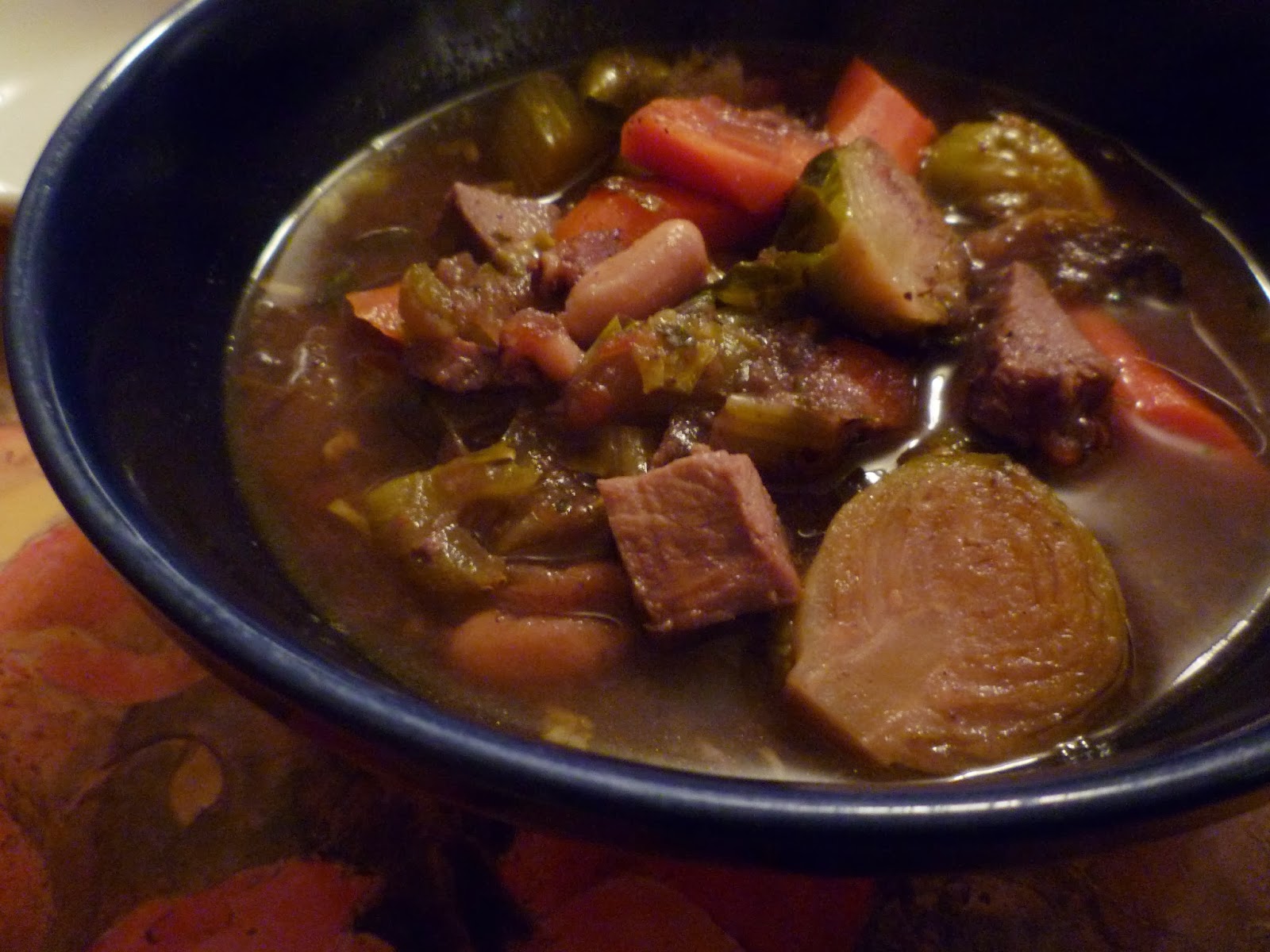
Just tonight my man and I enjoyed for the second time (as I’d ended up with a big potful) a soup that was made according to these methods, using the leftover lamb roast from Christmas as well as the leftover liquid it was cooked in, which included a good amount of wine, with rosemary and garlic. Not too much meat was left, but I added some lentils and vegetables, and Mr. Glad could not help feeling it quite unfair that he should be eating such amazing food when so many people never get stuff like this. (The stew in the photo is from a previous and different ferial meal.)

Our author chef carves his (large) leg of lamb into parts to make first a stew, and then three other ferial meals, including a casserole with spinach, a stir-fry, and a soup. His recipe for stew includes an injunction against flouring the meat before browning it:

…it is the point at which nine tenths of the stews in the world go wrong. The trouble is that few cooks realize how long it takes to brown meat thoroughly….People who flour their meat and brown it in butter are entitled to their religion….I think it fair to note, however, that such people have never gotten around to browning meat. All they have done is darkened some butter and scorched a little flour. The meat inside remains untouched. Accordingly, their stews never know the savor of the true burnt offering; in their haste they settle for the dubious pleasure of eating charred wheat.

Unfortunately my mother taught me to flour my meat and it was only a few years ago that I learned better. RFC also gives advice about liquid:

A word about the liquid itself. Unless you are physically prevented from doing so, always use stock or wine, especially in a ferial stew. We are working here with an admitted minimum of meat. To add water to it is to strain it, to demand of it a cruel exertion, to have it arrive at the table worn out with overwork. This is no festal dish with enough meat in it to make meals for a week. This is a poor dish, whose meat is to be pitied and spared. Accordingly, any liquid that goes into it should be of a charitable and kindly sort…which knows how much more blessed it is to give than to receive. Stock then; not water. And, no matter what else, wine. A gallon of good California red in the kitchen closet will do more for your cooking than all the books in the world.

Capon has more opinions about wine, and the philosophy of meat-eating, “little invisible spooks” (Can you guess what those might be??), and the “higher session” of The Supper of the Lamb, and that is why I need a few more posts to share my gleanings. Coming soon!

The first post in this series is RFC is the man you need.