Monthly Archives: February 2018

Food is fun!

Indian food is so diverse, and delicious to my taste, it’s hard not to eat too much of it. The ingredients, the processing and cooking and serving, all have new and strange aspects. This post is all about food, things I’ve learned about or eaten that didn’t fit into other posts on India.

1 – Veg and Non-Veg

These are the broad categories people refer to when they are telling what foods they eat, not with quite the same meaning as people in the U.S. who might define themselves as Vegetarian, Vegan, Paleo, Gluten-free, Meat and Potatoes, I Eat Everything, etc. Here, Hindus are often “Veg,” meaning they do not eat meat or eggs, because they are Hindus and not for any health-related reasons. Muslims are Non-Veg because they have no religious ban on eating meat in general.

Our family does eat meat and eggs, so we are in the Non-Veg category, but it seems strange to say that, since we do like and eat a lot of vegetables! Hindus who do eat meat would rarely eat beef, and Muslims do not eat pork. Chicken is in abundance, and water buffalo meat, and goat meat, known as mutton.

2 – An example of wonderful Veg food is the Gujarati Thali meal we enjoyed our first night in the mountains, a traditional spread of a variety of dishes taking its name from Gujarat, the Indian state just north of here. We were the only ones in the restaurant from the beginning of our meal until the end, because we arrived so early, 7:45.

You start out with a plate of empty stainless steel bowls, and then the waiters — we had four for the three of us — alternate bringing to the table pots of soups and stews and drinks which they ladle out, and plates of breads hot off the griddle, and as soon as you have eaten half of anything they are back to refill again and again. We found ourselves eating too fast, because they seemed to be urging us on.
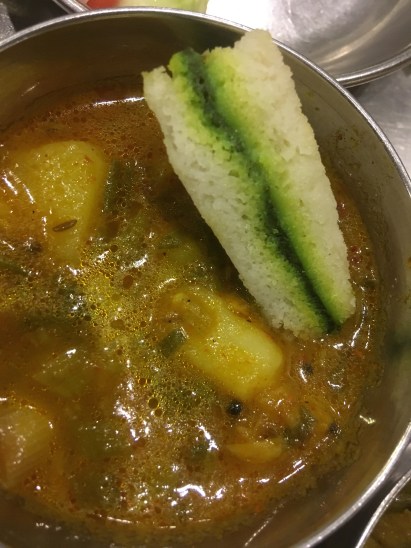
Not only did they bring us refills, but they brought new items after a while, which of course we must try, until we were so plumped out we had to turn our eager hosts away, and finally eat the sweet pudding that I failed to take a picture of. I was trying to figure out what was in it — surely those little red threads bleeding orange and yellow into the creamy white must be saffron, but our waiters said not. I still don’t believe them; there was a bit of a language barrier.

3 – Milk

If you are Veg, you can still enjoy dishes like that pudding, which contained a milk product, maybe yogurt. India has become the biggest producer of milk in the world, though the average dairy milks only four cows and/or water buffaloes. “One of the main reasons India is the highest producer of milk is that it imports a lot of European cows and cross-breeds them with local varieties. But the most crucial reason is that India has had a successful decades-long programme to source milk from small farmers through cooperatives.”
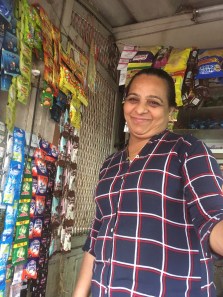
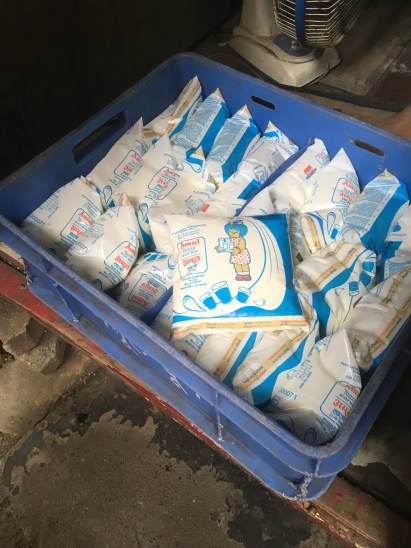
Because Kate doesn’t trust the regulators of these little dairies, she buys milk in aseptic boxes, or cartons of pasteurized. But most Indian households take milk home from little shops that get it fresh daily in half-liter plastic bags, such as I saw when I went out shopping with Kareena. This smiling lady was just receiving the morning’s shipment. Kareena says they boil the milk in a pot when they get it home, and store it in the fridge in the same pot, which they don’t use for any other foods, I think mostly so that the flavors of chili and cumin won’t get into the milk.
4 – Ice cream  I love ice cream, and Indian ice cream is all good, in my experience. In addition to ice cream in interesting flavors they have  kulfi, which is just slightly different, always served in a cone shape. I have eaten chickoo ice cream and sitafal, or custard apple ice cream. Which carries me into the topic of:

3 – Fruit

The chikoo, called sapodilla some places in the world, has been described as malt-y, and Kate and I agreed that the ice cream is so. I ate some fresh custard apple fruit and it was indeed creamy and custardy. I wanted to finish the whole thing. But be prepared for lots of finger-lickin’. As it’s mostly seeds, I think the idea of making ice cream from the pulp was inspired. Custard apple is the Indian version of the cherimoya.

5 – Rose and Pistachio

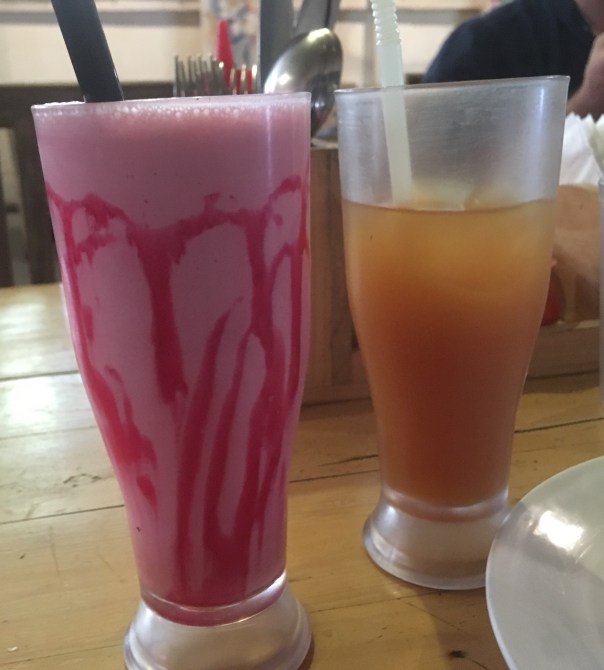
These are two of my favorite exotic flavors. Back home, I have made an Indian tapioca pudding flavored with both. So when I had a choice of kulfi flavors, I chose pistachio. And the same weekend, after our sweaty stairclimbing hike we stopped in an eclectic restaurant called The German Bakery, where I saw on the menu a Turkish Rose shake. Without a doubt I would order that! And I drank two lemon ginger iced teas as well — I was a little dehydrated and they were small, after all.
6 – Spicy food

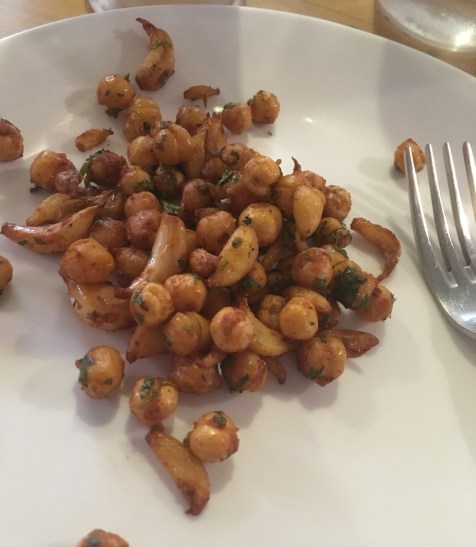
Yes, Indians do like to add the heat to many foods. At The German Bakery, Kate ordered a side of Garlic Chana, or chickpeas, for us to share. They were really hard to stop eating!
Not only do Indians like spicy flavors generally, but there are particularly Indian blends of spices that make things taste right to their palates. So they adjust western recipes to make them fit. For example, I was munching on some Sizzling Jalapeno Nacho Crisps that looked like many versions of tortilla chips you would find in the U.S. But they seemed a little odd… When I looked at the ingredient list I found that they had ginger in the spice mix. We would not think of that as a “nacho” flavor.

7 – Sweets

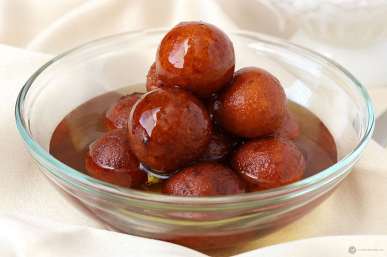
Gulab jamun are balls with a doughnut like consistency, swimming in syrup. They were offered as part of a buffet we ate recently, and we ladled a couple on to our dish of butterscotch ice cream — a pleasantly sticky experience. For once I had left my camera in my pocket, so I found a picture online of gulab jamun.
And for beauty of sweets, you can’t beat this collection that Kate bought at the same store where I was buying dried apricots. Lots of pistachio here, too:

8 – Salads

I did not expect to eat salad in India, because of the possibility of contamination of raw vegetables. At home, though, we do disinfect all of our produce as soon as it comes into the house, and when eating out or ordering in, it turns out that there are many restaurants with excellent reputations regarding the safety of their menu items. Word gets around among expats about the restaurants whose food has never been known to make anyone sick.

So I have eaten salads several times, and they were some of my favorites ever. The Indian chefs seem to be creative in ways that jive with my taste preferences. They don’t overuse the ingredients that I get tired of on the U.S. salad menus, like cranberries, red onion, and avocado.

One I ate was called “Bam Bam Thank You Lamb,” and was made of Romaine and iceberg lettuces, dried tomatoes, black rice, roasted cashews, feta cheese and braised lamb.

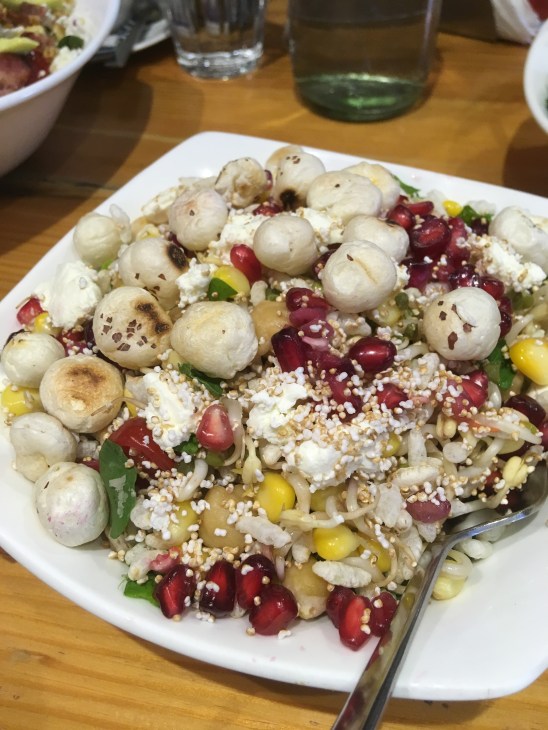
The salad below included arugula, chickpeas, puffed rice, amaranth, cherry tomatoes, sprouts, pomegranate, lotus seeds, and feta. Isn’t that wild?
9 – Vegetables, vegetables

I love visiting the neighborhood market and seeing every sort of vegetable imaginable. It’s kind of like this in California, but more expensive, and not as fun somehow. And it’s a joy to watch Kareena cook. She roasted eggplants completely on top of the stove, just turning them every half a minute for fifteen minutes or so.

Others have noted that Indian food is not beautiful or easily presentable as a visual work of art. There are lots of basically brown items. So I think the eye appeal often comes from the shapes and textures, and the aromas and tastes are definitely sensational! Kate and I were talking about this the other night as we lingered over dessert at a South Indian restaurant, a little bowl of creamy, golden brown pudding we shared, and mused over what the ingredients might be.

Eventually we learned from the waiter or figured out ourselves that they were chikoo fruit (photo below of the fresh fruit), millet, milk, ghee, about three golden raisins… a combination that added up to an externally drab affect. But oh, it was lovely, and we did not want it to end.

At home, I have been cooking so little since becoming a widow, compared to my life before that. I wonder if my stay in India will have any effect on my life in the kitchen once I am back again? If I do find that I have been inspired to create something interesting, I’ll let you know here, because food is fun!
a few churches

The Apostle Thomas first brought the Gospel of Christ to India, so the history of the faith here dates from way back. But in this area around Mumbai it’s the Portuguese influence that began in the 16th century that has resulted in many Catholic churches, schools, and convents. The history of Christianity in India is too vast a subject for me to delve into, much less write about, but I don’t want to leave Mumbai without mentioning a few churches I saw and my quite personal and random impressions.

I didn’t visit any of the churches in the uninterrupted line of St. Thomas, because they are not as convenient to get to, and my contact with Catholic churches was also minimal. Tom and I did see the Afghan Church briefly. Many times the old church buildings themselves are a blessing to me, when I consider all the generations of worshipers who have sung and prayed there.

On my first morning, when Tom took me on that two-hour walking tour, we visited St. Andrew’s Church, which was locked. The caretaker was glad to let us in, and we found that we were not the only visitors. A woman was sitting in a pew facing the altar. We sat in silence for a few minutes also, and then went out to see the graveyard.

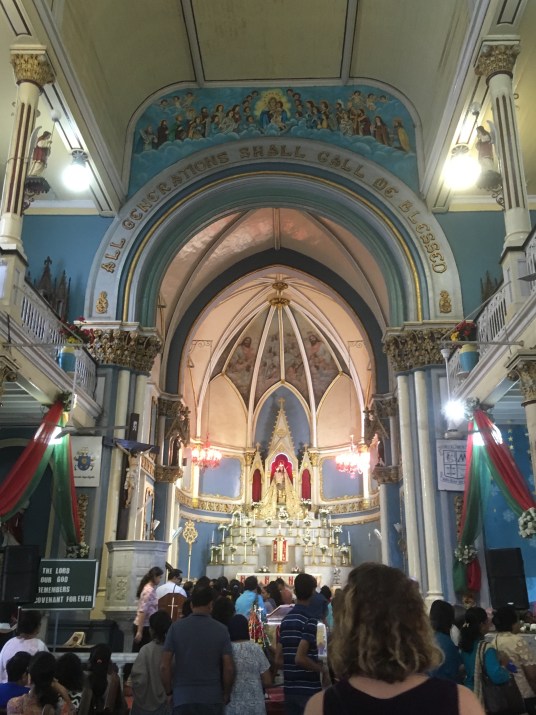
The most architecturally impressive church I’ve seen was The Basilica of our Lady of the Mount at Land’s End in Bandra, Mumbai. The current church was built in the 18th century, though a chapel in this spot had been built by the Portuguese in the 1500’s.

We made the trip in one of those black-and-yellow rickshaws such as you can see in front in this picture, and we came expecting that we might have to stand outside, because services are known to be crowded. But we were able to sit in the nave on bench pews, and when we came in there was singing already filling the church, very melodic and light.

People were indeed standing outside around the tall side doors that were open wide, and maybe that’s how birds would fly in and out. For a while only rock doves swooped silently across the altar and back, but soon they were joined by a very noisy crow who made it hard to hear the scripture readings. One dove changed course and flew up and down the length of the nave many times, and the crow eventually either flew out or merely fell silent just before the homily, which was a relief.

I enjoyed the outdoorsy feeling, though, and appreciated the simple and uncushioned, beautiful wooden pews. Just outside afterward we met an acquaintance whose photo with his cute niece I’ve been waiting weeks for a chance to post.

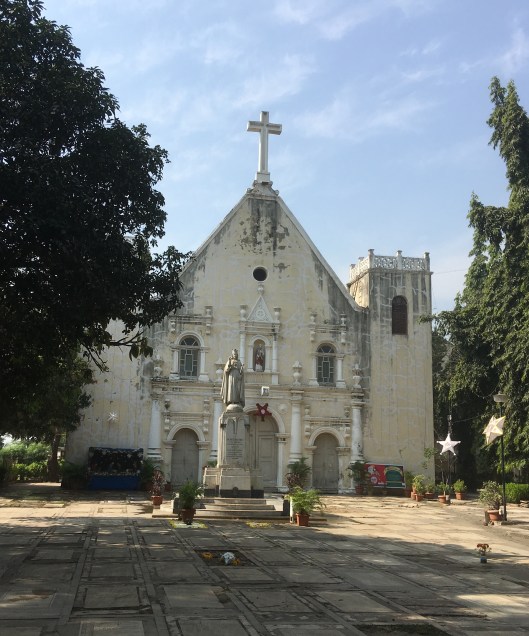
One church we attended in the neighborhood was new to Tom and Kate, as was the Basilica. We walked about ten minutes to get to St. Anne’s, including a walk down a very long driveway to accommodate the cars that weren’t planned for. Tom liked that the church was so old that it had been built before streets were needed, and later on they were not laid out so that they passed very near.

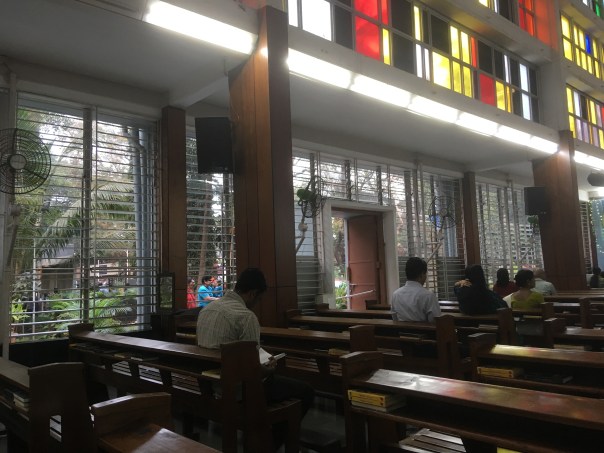
I liked the way the windows were open to the evening (We were at 6 o’clock mass.) and to the courtyard. After the service people hung around in the balmy air (winter is still warm!) to chat.

The atmosphere and the open windows reminded me of church summer camp, especially singing the sort of choruses that hearken back to an earlier period of Christian music in the U.S. at least, such as the ones I’ve copied here, sung out of a book or projected on a screen overhead.

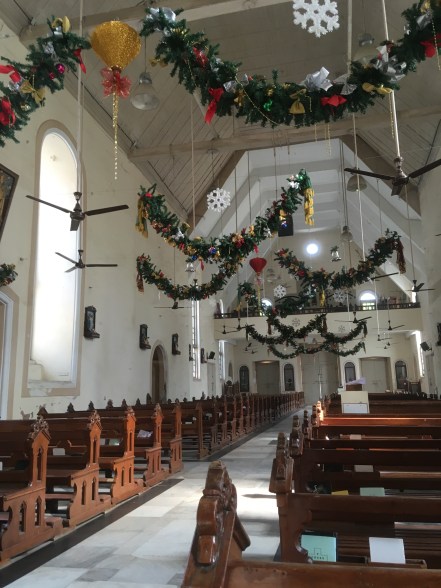
Kate and Tom’s usual parish down the street is newer, and even more accommodating to the weather, the extremes of which I know nothing about. The sides of the nave to a height of eight feet or so consist of louvered, unscreened windows. The louvers were completely open, and large oscillating fans set close blew the pleasantest breeze through the pews. Baby Raj was in the sling and seemed completely asleep through the whole service, but it could be he was listening with his spirit. He was blessed also by the hand of the priest.

I’ve been missing my Orthodox parish, no doubt about it. But it has been a joy to see the lasting effect of faithful witnesses down through the ages in this one community, and to receive through them gifts of grace such as I knew when I saw the sign on St. Peter’s Church here, shortly after Christmas:

JESUS THE FACE OF THE MERCIFUL GOD

snacks and addictions

If you see red stains on the sidewalk in an Indian city, it’s likely they are selling paan nearby. This snack is the only nasty one I am going to write about, so I’m getting it out of the way first. People use it after the manner of chewing tobacco, after they roll some betel or areca nut (Areca catechu) and perhaps tobacco and some other flavors and ingredients into a paan leaf, which is also called a betel leaf (Piper betle) although the plant it comes from is an entirely different species .

I found lots of information online about how healthy the paan leaf is; it is related to kava, so maybe that’s true. But I’m afraid that doesn’t make the whole concoction any less toxic. “Paan (under a variety of names) is … consumed in many other Asian countries and elsewhere in the world by some Asian emigrants, with or without tobacco. It is an addictive and euphoria-inducing formulation with adverse health effects.”

Kate pointed out these paan preparers to me and that made me curious enough to read more about the whole thing. In some places paan is outlawed because the chewers often spit on the sidewalk and it makes an unsightly red mess. It is possible to find recipes in which the betel nut part is optional, so you could eat a non-toxic version if you’re interested. Let me know and I will ask Kate where she found it. 🙂

So, that’s usually a bad sort of snack to be in the habit of eating, but Indians are great snackers all around, and you are in luck if you are looking for something spicy and crunchy. There must be a hundred snacks in this category that I haven’t tasted, but I’ll tell you about a small sample.
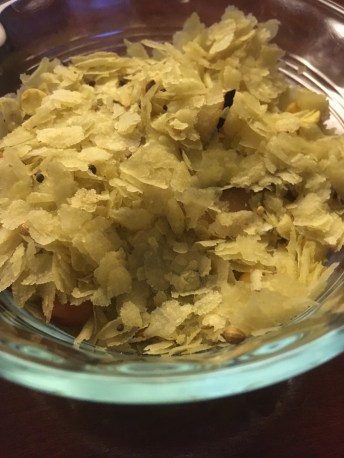
This flaky stuff below, poha chivda, is the first such food I encountered. The main ingredient is rice made into crisp flakes about the size of regular rolled oats, to which other very spicy ingredients are added. I can’t personally eat it tidily other than with a spoon out of a cup, but I think it must commonly be eaten out of hand, too. I found a recipe for it which I am linking to just so you can see a better photo of this snack that I love. The main ingredient would no doubt be hard to find in the U.S.:

Bitter gourd is battered and deep fried to make a food that is even more fiery than the above. Eating a whole 2″ diameter ring of this snack keeps me warm for quite a while:

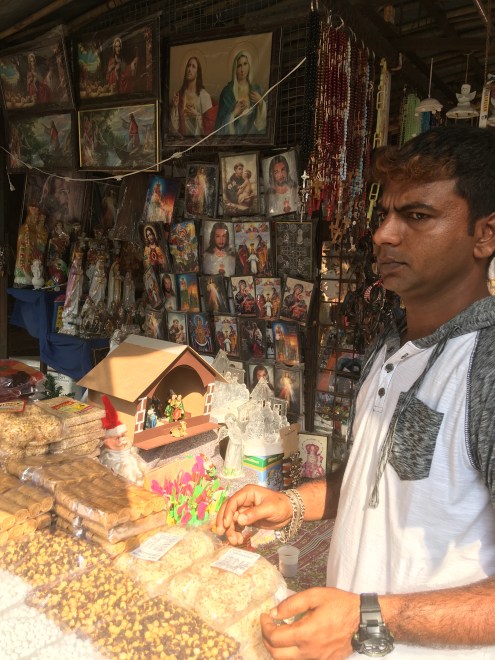
Outside the famous Mary Mount church at Bandra Fort is a snack stand that caters both to tourists and to church people who might need one thing or another as they go in to worship and/or come out hungry:

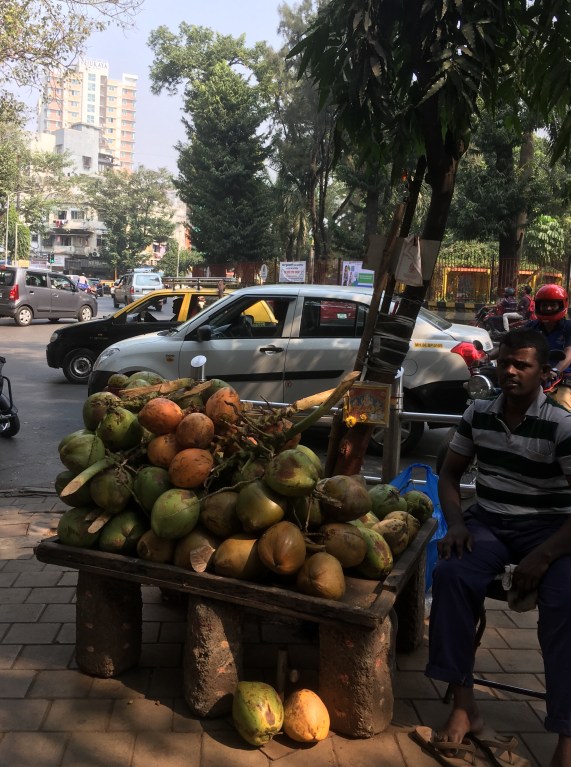
We came upon a coconut stand, and Tom bought a fresh coconut that was served with a straw. Then he was given a scoop made from a slice of the fruit, with which to scrape out the creamy pulp that was left after we drank the coconut water.

Another favorite of Tom’s is sev puri, which is sold at the same snack stands as pani puri which I mentioned before. I have eaten it two or three times, when we stop on the street and two or three of us stand at the counter and share one of these savory bowls. I know, it looks a mess, but you get to watch it be assembled from several ingredients that combine to deliver a flavor punch with crunch on top. Highly recommended!

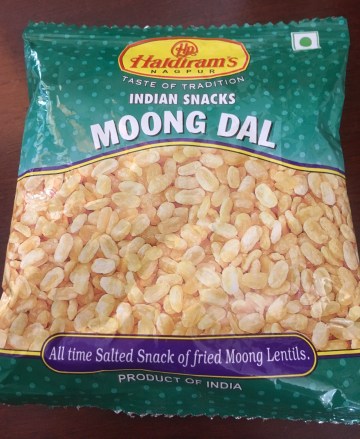
The moong dal snack below was offered in our hotel room last week and I have no idea what it is like because I’m saving it for something or other:

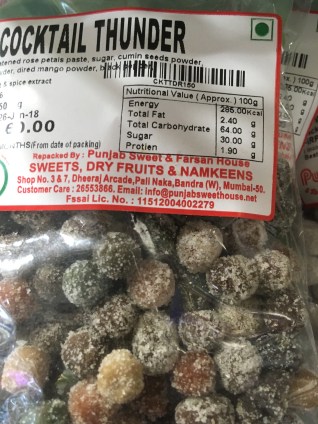
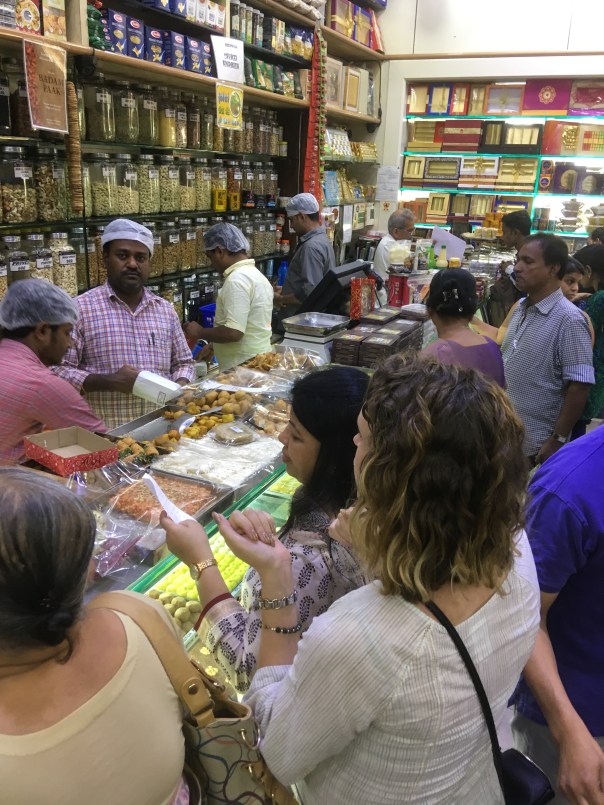
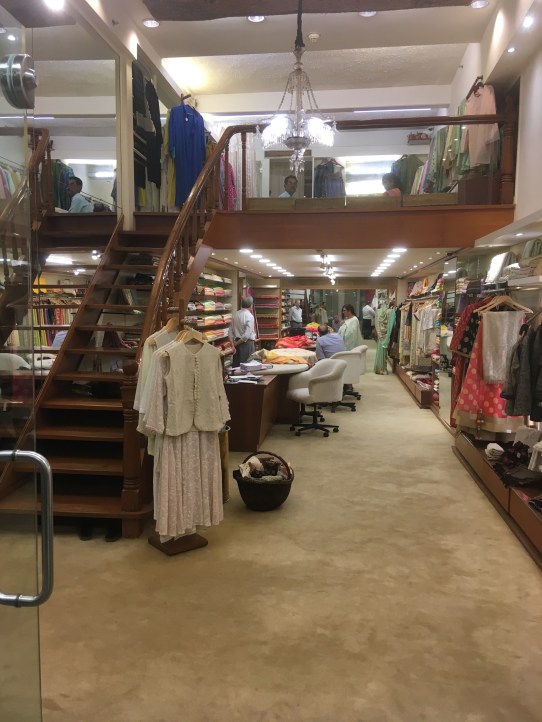
So far, the store pictured below was my favorite food shopping experience, for the large variety of dried fruit, snacks and sweets available there. Here Kate and friend Krishna are trying to get the attention of the busy clerks:

And it was at this store that I was introduced to the amazing dried apricots, no bigger than 1 1/2″, with pits intact. The flavor is sunshine bright, and they make a nice little nibble.

It would be easy to become addicted — but I’m counting them as health food!

The high and the low.

Kate took me to South Mumbai last week to visit some Must See sites, which I’m sure I could write a book about if I only had enough lives to live. I tell you truly, this exciting life with its realms of experience and knowledge that I can only manage to dip my little toe into is wearing me out. My understanding of many things I present here is slight, and my photos are not as good as you can find other places online. But they are what I’ve seen with my own eyes, and we had good reason for going to these spots, and I was so glad we did.

I’ll start my report with one of the High things, the Gateway of India, which is hard for someone as unskilled as I to photograph, looming as it does so huge at the edge of the sea. The British built this monument to commemorate the visit of King George V and Queen Mary to India in 1911, and it was completed in 1924. When the last British troops departed India, they passed through the arch, ceremoniously relinquishing power.

Kate and I walked all around, and she took my picture in front of this icon of Mumbai, under which one is no longer permitted to walk. We also had our picture taken with various groups of Indian tourists. But then we sped away, because there was so much to see…

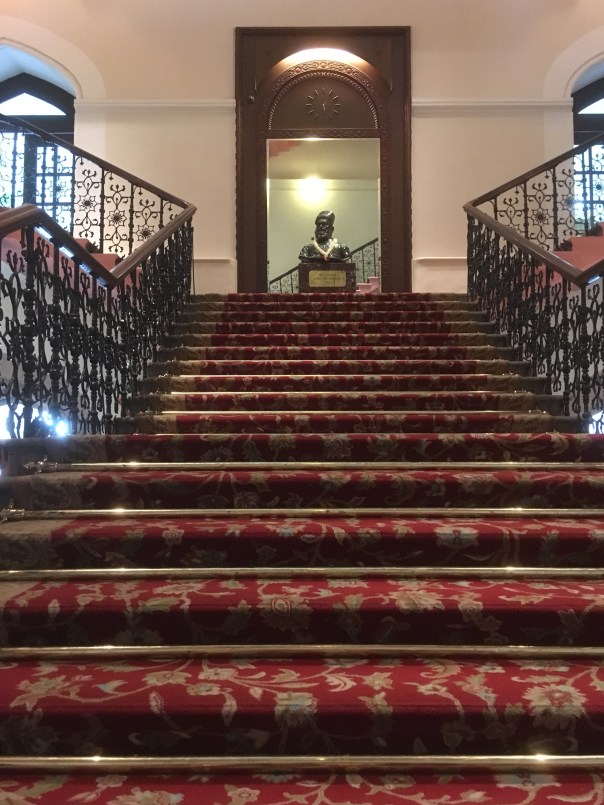
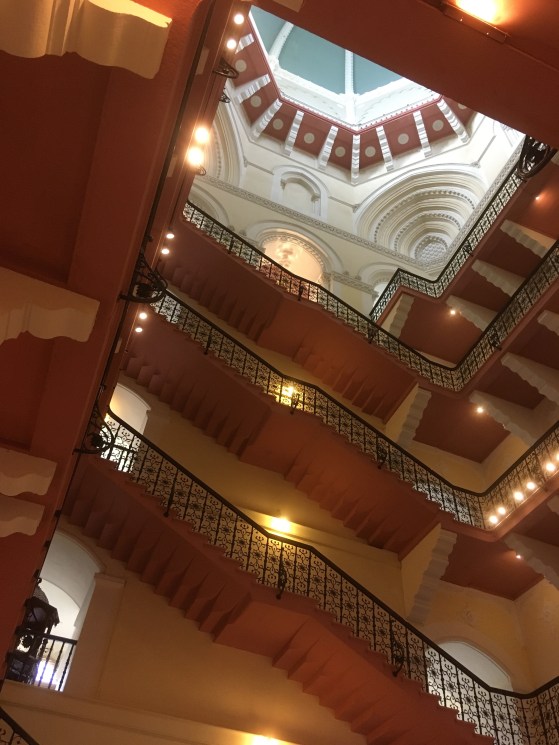
The next High thing on our agenda, which often appears in photos with the Gateway, was the Taj Mahal Palace Hotel. This five-star hotel opened twenty years before the Gateway was completed, having been commissioned by the Tata group, a conglomerate founded in 1868 by the man considered “The Father of Indian Industry,” Jamsetji Tata. A staircase leads up to a bust of this patriarchal figure.

I didn’t notice when I took my picture of the exterior that I was including a row of men posing for someone else, but I was happy to have them come along! That picture shows the original building and the tall addition, which between them have more than 600 rooms and suites. “The Taj” is the place where John Lennon, Oprah, and Queen Elizabeth stay when they are in town.

In 2008 a terrorist attack on Mumbai focused on the Taj, where the attackers holed up for days, and where many staff were killed. This garden, which has a waterfall not in the picture, memorializes those who lost their lives:

We wandered around for a little while, appreciating the artful opulence. In the restroom each patron has a clean and folded cloth napkin with which to dry her hands. Everything was elegant and serene and orderly.

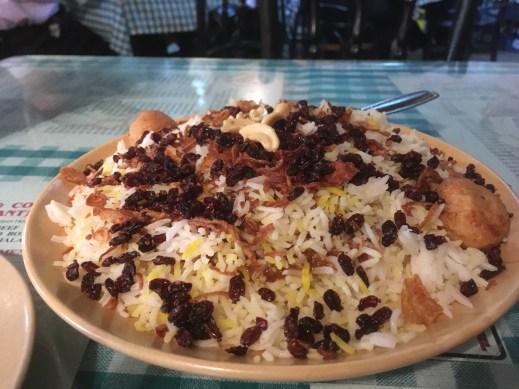
I could imagine the lovely dresses in the clothing shop, but I was concerned that Kate not get worn out, so we left The Taj pretty soon and went to lunch at a famous Parsi café called Britannia & Company. “Parsi” refers to the Zoroastrian Persians who emigrated to India centuries ago to escape persecution. There is a large Parsi community in the Mumbai area, from which the Tatas are descended, by the way, and much good Parsi food available. Pilau is probably the center of a good Parsi lunch:

In the rankings of high to low, our lunch was not high cuisine, but it was a high point of the day, and Parsi food ranks high on my list. The next places I’ll tell you about, though, are both low in different ways, which I dare not begin to muse on philosophically. It’s another book to be written.

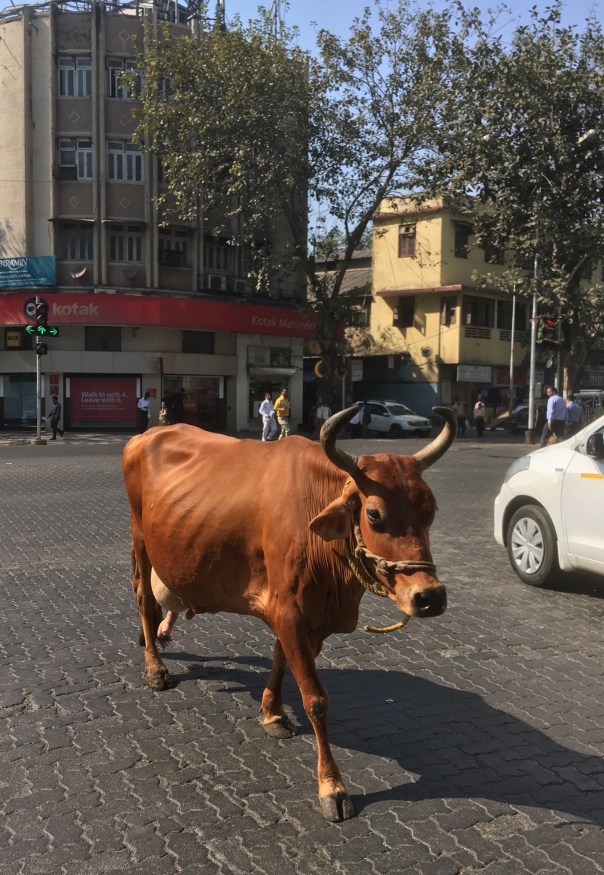
I have to mention that it was in this busiest part of the city that I saw the most cows, three strolling through one intersection alone.

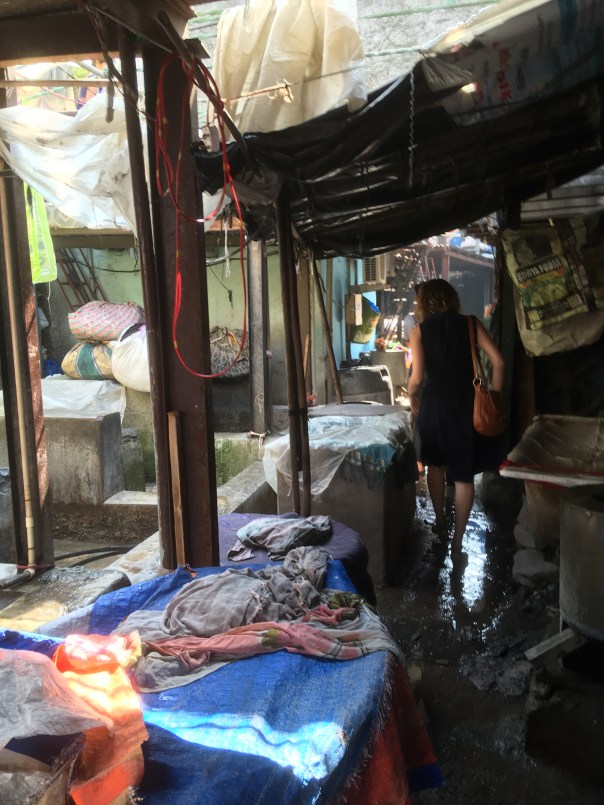
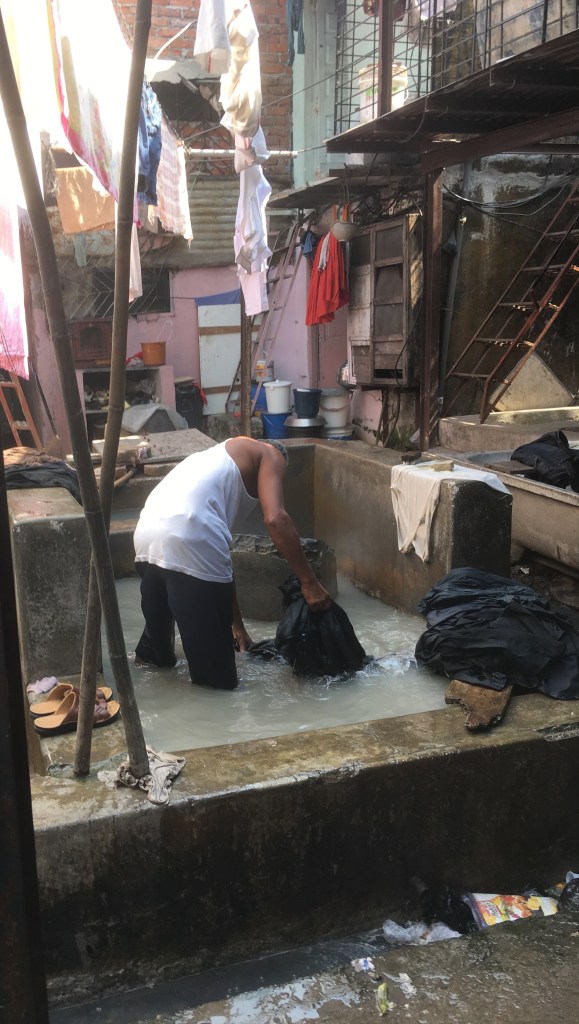
Dhobi Ghat… In Hindi, ghat means “steps leading down to a body of water.” (It also means “mountain,” as in my last post.) Dhobi is the name of a caste of washermen. Dhobi ghat can refer to any laundromat, but in Mumbai, Dhobi Ghat is the giant open-air laundry that Kate and I visited. My first picture above was part of the view as seen from the road on one side; after, we walked down into the area of washing pens and flogging stones, where drying laundry hung in close rows above us.

Our tour was very informal: we entered what in essence is a little village, started looking around, and a young man asked if we wanted a tour for 200 rupees, about $3, each. We said okay, and paid, and then he walked us through very fast and told us some things about the laundry. I missed much of what he said because I was hanging behind taking pictures, and just generally being overwhelmed and spacey from barely believing that I was in this place. I love doing laundry, but it seems ludicrous for me to say that in the context of Dhobi Ghat. These people take the task of washing clothes to a level that is outer space. But the whole affair lies so low as to be hardly noticeable as your gaze is carried upward by the skyscrapers all around.

Our guide told us that 400-500 people live here, and that he had been born at the “laundromat” himself. Internet articles say that their clients are “neighborhood laundries, wedding decorators, garment dealers, mid-sized hotels, clubs, and caterers.” I believe those things. But so much else that you can read, or even hear residents of Dhobi Ghat say in YouTube interviews, is contradictory or contrary to recorded history, so my questions only multiply and are unlikely to be answered to my satisfaction.

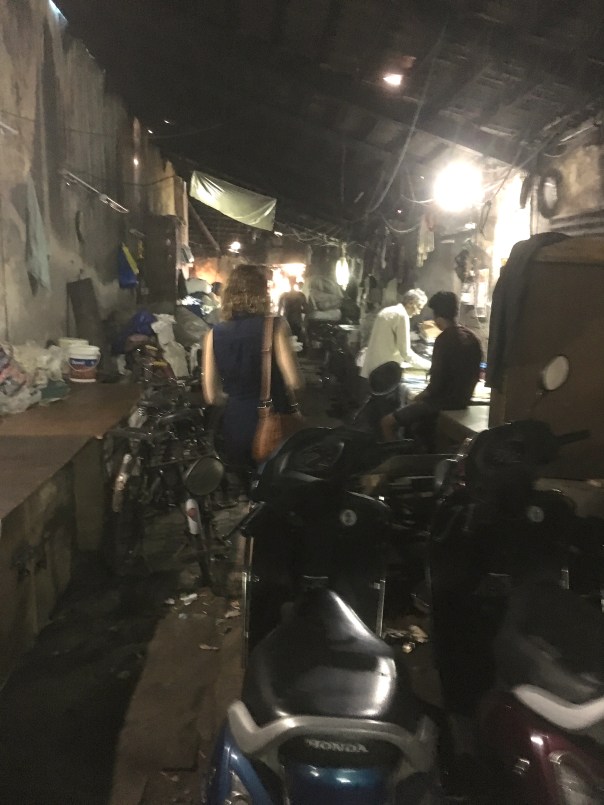
Some of my pictures are dark, because it was dark, especially in a passageway under tarps or some kind of roof, where in the space of five yards motorcycles and a bicycle were parked, a young man was cooking a big pan of potatoes, and an old man was pressing jeans with a vintage iron.

I came upon a man flogging a large wet item on a stone, his back to me, and when he lifted it each time to slap it down again, washwater fell in a shower behind him and on my path. So I timed my crossing, and managed to scoot past between slaps. In places there were little puddles or ditches to hop over, but we got through the busy laundry without getting wet.

It was noon, a clock in my photos tells me, and this man with one hand on the door of a big washer has a small glass of masala chai in the other hand. As we walked the lanes and streets we saw little apartments where the workers and their families live; some of them had a curtain pulled across, but in one doorway a woman was sitting on the floor preparing a salad. In the work area we walked past the occasional man stretched out sleeping on a wide shelf.


Dhobi Ghat was built by the British in 1890. Washermen own their wash pens and hand them down through the generations; some of them have installed modern washing machines and dryers. How they manage to keep track of the 10,000 items they collectively process every day is completely beyond me.

I thought the little girls I saw headed to school must be going off-site, but I learned in my research that the residents started their own school after one of their children was in an accident traveling to school elsewhere, and now they also have families from neighboring areas sending their children to the Dhobi Ghat school.

I count it a privilege to have had fifteen minutes in the presence of these hard-working people. When I am home again where I can hang my garments on the clothesline after letting my machines do almost all of the hard work, I will continue to think of them with admiration.

The last stop on our touristy outing was the lowest of all relative to sea level, because it was sea level, Girgaum Chowpatty or Chaupati Beach, a famous beach in Mumbai, but not for swimming. Festivities surrounding the favorite Hindu god Ganesh are held here, and at the end of the yearly celebrations effigies of Ganesh are plunged into the Arabian Sea, unfortunately adding to the trash problem. I found this photo online showing the event:

If I didn’t have a growing sand collection, I would not have taken the time to go to a beach in Mumbai, because a beach where the water is toxic is so disheartening. It’s not just trash, but sewage that pollutes these waters. And did I even want to collect sand from it? We had been trying to fit in a trip to an Indian beach ever since I arrived, and I was grateful to Kate that she insisted I not miss the opportunity.

We didn’t go on to the wet area of the wide beach. I theorized that the dry sand far away from the shore would have been washed by the last monsoons and not be the dirtiest. Nonetheless, when I got a sample home I washed and disinfected the sand with bleach, and then baked and dried it in the oven before filling my little bottle. 🙂

When you read here or elsewhere about all of the air pollution, water pollution, trash, you might think, “Why doesn’t someone do something?” The problems are complex, but sometimes simple baby steps can improve the situation.

We were only on the beach for a few minutes, during which time we were surprised to see big coppery urns — what could they be for? Kate asked a young man nearby, and he said they were waste bins! Many of the trash cans that have been installed all over the city are bright blue plastic barrels, but these elegant receptacles were both functional and beautiful. I did think of how a child would not be able to use them — oops! I guess that’s a design flaw.

While the government and environmentalists keep working on the source of the problems that humiliate the water and the sand, it makes me happy that someone has honored the beach with these trash urns. When I showed Tom my picture of Kate below he said, “Cute wife looking into the greatest trash can in India!”