Monthly Archives: January 2020

When blood is nipt, drink Hypocras.

When long ago I was beginning to explore the world of poetry for the sake of my children whom I was homeschooling, I ran across this poem by Shakespeare. It’s from the play, “Love’s Labour’s Lost,” and every time I read it, especially in winter, it drives the damp and chill right into my bones. That is poetic power!

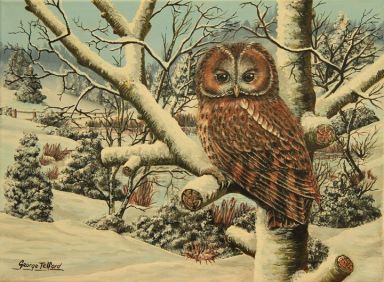
Notes on words and phrases: Dick is blowing into his hands, or on his fingernails. Joan is likely skimming the pot. The roasted Crabs are apples. People say the owl may well have been the common Tawny or Brown Owl, pictured below.

I’ve transcribed the poem as I found it originally in Walter de la Mare’s Come Hither. In his notes on this entry he gives a recipe for a warming drink such as Dick, Joan and Marian would have welcomed:

“To make Hypocras the best way.–Take 5 ounces of aqua vitae, 2 ounces of pepper, and 2 of ginger, of cloves and grains of paradice each 2 ounces, ambergrease three grains, and of musk two grains, infuse them 24 hours in a glass bottle on pretty warm embers and when your occasion requires to use it, put a pound of sugar into a quart of wine or cyder; dissolve it well, and then drop 3 or 4 drops of the infusion, and they will make it taste richly.”

That recipe doesn’t say that the ingredients are finally heated all together, but I would think so…? The one below, with an owlish theme, is on the rocks – brrr! A cup of Hypocras might feel pretty good today, as I am still “coffing” away, but lacking that I concocted my own steaming drink from ginger tea and Trader Joe’s Pumpkin Spice Almond Beverage. I hope all of you who are in winter are staying warm enough, and merry, too.

Tu-Whit To-Who

When Isicles hang by the wall,
   And Dicke the shepherd blows his naile,
And Tom beares Logges into the hall,
   And Milke comes frozen home in paile;
When blood is nipt, and waies be fowle,
Then nightly sings the staring Owle,
               Tu-whit to-who
               A merrie note,
While greasie Jone doth keele the pot.

When all aloud the winde doth blow,
   And coffing drownes the Parson's saw;
And birds sit brooding in the snow,
   And Marian's nose lookes red and raw;
When roasted Crabs hisse in the bowle,
Then nightly sings the staring Owle,
              Tu-whit to-who
              a merrie note,
While greasy Joan doth keel the pot.

-William Shakespeare
He should make use of water.

Could Philip Larkin have intuited something that he did not personally encounter, about faith and life? The images he presents in the poem below evoke the reality of the ancient and present sacramental church I know, which doesn’t need to be constructed, because it was born at Pentecost by a sousing of the Holy Spirit Himself.
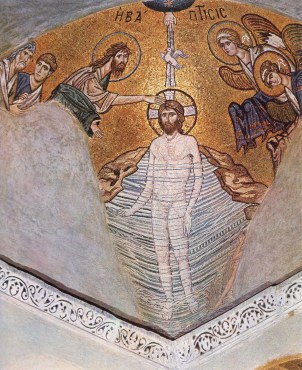
I’ve kept Larkin’s poem in my drafts for months, hoping to collect a few thoughts and sentences that would properly introduce it on the occasion of Theophany, that wonderful commemoration of water and light and the Incarnation. Here we are at the feast, so let’s just go to the poem:

WATER

If I were called in
To construct a religion
I should make use of water.

Going to church
Would entail a fording
To dry, different clothes;

My liturgy would employ
Images of sousing,
A furious devout drench,

And I should raise in the east
A glass of water
Where any-angled light
Would congregate endlessly.

-Philip Larkin

From bitter cold to laughter and light.

I know that the Feast of the Nativity of Christ has passed; the Leavetaking of Nativity was yesterday, so that we might enter fully into today’s feasts. So it may seem a bit odd for me to post the poem below, but for many reasons it seems most appropriate. (One practical reason is that I only now rose from my sick bed to look at my blog!) I might be hearkening back to the early church, about which we read:

“During the first centuries of Christianity, the Feast of Theophany was celebrated together with a number of observances as recorded in the Gospels. They are: the Annunciation of the archangel Gabriel to the Holy Virgin Mary; the Birth of our Lord Jesus Christ, with the glorification of the heavenly hosts, the veneration by the shepherds and the coming of the Magi; the Circumcision; the Naming of our Lord; the Presentation in the Temple; the Flight into Egypt and Return; the Baptism at the River Jordan; the Temptation in the Wilderness and the Testimony (Witness) of St. John the Forerunner.

“This group of feasts was celebrated from the 6th to the 13th of January, called the octave of Theophany; the most prominent being the Birth and Baptism of our Lord Jesus Christ, with special importance afforded to the Baptism. The church grouped the birth and baptism, together (called Theophany, “the revelation of God,”) on January the 6th because they were the first revelations of His divinity, incarnation, and the beginning of His ministry as Lord and Savior of mankind.”

I first read the poem last summer on Elizabeth’s blog, so she obviously thought it applicable at any time of the year. And for myself, I can’t imagine looking forward to a new calendar year with anything but foreboding, were it not for the fact that “God is with us.”

Do you count this the seventh or eighth day of Christmas? Most Christians count Christmas Day itself as the first day, so New Year’s Day is the Eighth Day. For us Orthodox, it is also the Feast of the Circumcision of Christ, and St. Basil’s Day. Soon we will arrive at the glorious Feast of Theophany.

So many feasts and commemorations! But they all flow from the astounding fact and reality that “The Word became flesh, and dwelt among us.” Happy New Year, Dear Friends!

NOËL

Grim was the world and grey last night:
The moon and stars were fled,
The hall was dark without song or light,
The fires were fallen dead.
The wind in the trees was like to the sea,
And over the mountains’ teeth
It whistled bitter-cold and free,
As a sword leapt from its sheath.

The lord of snows upreared his head;
His mantle long and pale
Upon the bitter blast was spread
And hung o’er hill and dale.
The world was blind, the boughs were bent,
All ways and paths were wild:
Then the veil of cloud apart was rent,
And here was born a Child.

The ancient dome of heaven sheer
Was pricked with distant light;
A star came shining white and clear
Alone above the night.
In the dale of dark in that hour of birth
One voice on a sudden sang:
Then all the bells in Heaven and Earth
Together at midnight rang.

Mary sang in this world below:
They heard her song arise
O’er mist and over mountain snow
To the walls of Paradise,
And the tongue of many bells was stirred
in Heaven’s towers to ring
When the voice of mortal maid was heard,
That was mother of Heaven’s King.

Glad is the world and fair this night
With stars about its head,
And the hall is filled with laughter and light,
And fires are burning red.
The bells of Paradise now ring
With bells of Christendom,
And Gloria, Gloria we will sing
That God on earth is come.

-J.R.R. Tolkien

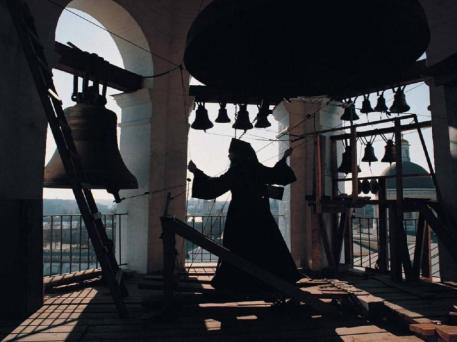
If your Christmas celebrations were lacking in bells, I recommend these videos of bell-ringing from New Jersey to California and abroad. Most of them start out slow and progress to very lively and joyous. Nothing compares to hearing them as you are leaving church after services of a Great Feast, but these are worthwhile substitutes. The bells of Paradise never stop ringing.

Bells of St. Nicholas

Brother Seraphim

St. Alexander Nevsky

Sf. Ioan Teologul

St. Alexander Nevsky (shorter)