Monthly Archives: February 2021

Tough love for birds.

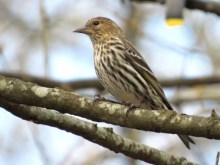
Healthy Pine Siskin

The local pine siskins are experiencing an epidemic, and I feel very bad about it for their sake and mine. Watching the birds at the feeders in my back yard, seeing the number of species increase every season, learning to identify and recognize most of them — it’s all been a steady comfort and joy. But now I need to encourage them to go elsewhere and find food in other, larger spaces.

It appears that in the case of the pine siskins, and in some places goldfinches, when they unnaturally congregate at feeders they keep spreading salmonella around. I’ve read news articles from British Columbia, Oregon, and California, all saying basically the same thing:

“Salmonellosis is an infection caused by bacteria of the genus Salmonella. These bacteria primarily attack the digestive system, notably the throat, making it difficult for the birds to feed. The symptoms are not always obvious in wild animals, but infected birds may appear thin, fluffed up, and lethargic.
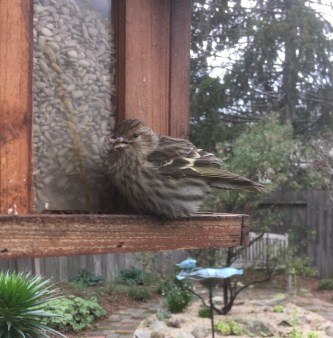
Pine Siskin at my feeder last week.

“How you can help birds avoid disease:

“Salmonellosis is primarily transmitted by fecal contamination of food and water by sick birds, although it can also be transmitted through bird-to-bird contact.

“High traffic spots, such as bird feeders, create a source point of transmission and can exacerbate the spread of this deadly disease. Removing the feeders completely is the best solution to encourage birds to disperse, thereby minimizing the potential for infection. If you choose to keep your feeders up, they must be properly maintained to foster a healthy bird environment.”

They make it sound as though the outbreak has developed this winter, but now that I’ve seen images and descriptions of sick birds compared with healthy, I’m pretty sure that last winter some of the pine siskins (which I thought then were sparrows) at my feeders were ill.

Just last week I encountered one at the tray feeder who I now understand was “lethargic.” At the time, and back in 2019, I only wondered at how calm and friendly they were. I also thought it strange that some of them would sit contemplatively on the hopper feeder, doing nothing. Now I get that they were too weak to fly away.
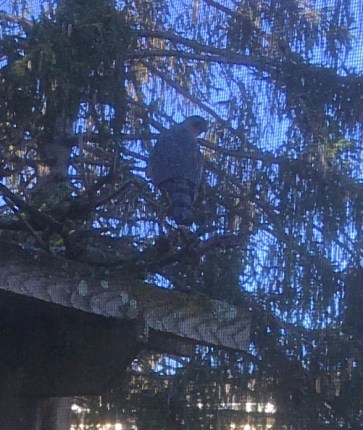
The Cooper’s Hawk that has been coming around more boldly all the time, taking advantage of the flocks of finches, will probably stop visiting. I plan to stop feeding the birds at least until next winter. I am not the tidiest housekeeper anywhere, and if I need to disinfect the birdbath, fountain and feeders regularly in order to be a good bird-feeding friend, I think it best to revert to nature.

How can I explain to these creatures about the changes? “This hurts me more than it does you!” I do have lots of plants with seeds or fruit that various birds can enjoy, and have been eating all along. Plus insects — yes, a good supply of those. Many birds pay little attention to my seed offerings.

And I still have the hummingbird feeder!

On another garden topic, the daphne by the front door is getting really big and is covered with blooms right now. When the sun shines on it in the morning the scent wafts up at me when I go in or out, and I swoon.


A reed with the reeds in the river.

In the middle of the night when I have lost my way back to the Land of Nod, I sometimes listen to a book that I wouldn’t mind falling asleep to; that usually indicates one I’ve already read. Recently I chose The Everlasting Man by G.K. Chesterton, which seems to work well enough. It’s been so long since I read it in print, I do hope I might go back and really pay attention again one day. The feeling of exhilaration that book gave me still lingers.

In the meantime, the nighttime stories remind me of my ample supply of quotations by the author that are always useful for the opposite purpose, to make me wake up and think. The one I chose for today is both by and about Chesterton, from a lecture by Dale Ahlquist, which I noted that I’d found on the Chesterton Society site, a lovely place to browse if you want to read more.

“Not only has no one expected him to write about religion in a secular newspaper, he writes about religion in a way no one expects. Not surprising then, that he says religion must be paradoxical. Chesterton was already becoming famous for his paradoxes, and many of his readers and admirers assumed that he was being merely paradoxical by defending religion in general and Christianity in particular. But the jovial Chesterton was quite serious even if he was quite funny.

‘All paradoxers,’ he writes, ‘if they be also honest men, are aiming joyfully at their own destruction. We have paradoxes, and it is our effort, day and night, to turn them into truisms.’ What he is striving to achieve is not the paradox, but the platitude. ‘Every man who is fighting for his own beliefs is fighting to take it away from himself.  He may be clever in dull places and important in mean places; but in the land that he desires he will be nothing—a reed with the reeds in the river.’ A truism is a popular truth, a paradox an unpopular one. But they are both true.”

Dale Ahlquist is President of the Society of Gilbert Keith Chesterton and has written five books about Chesterton.

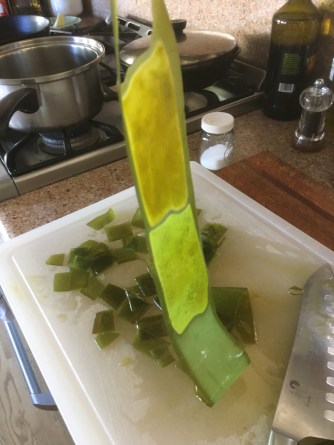
Stained glass sea vegetable.

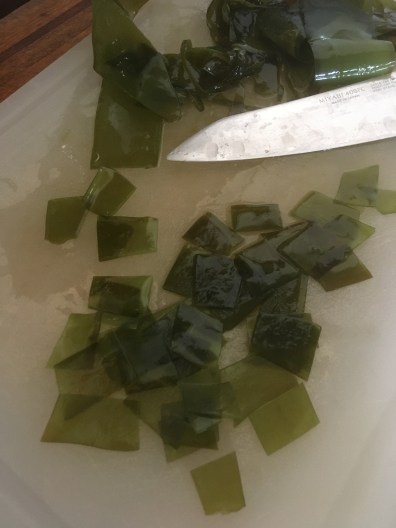
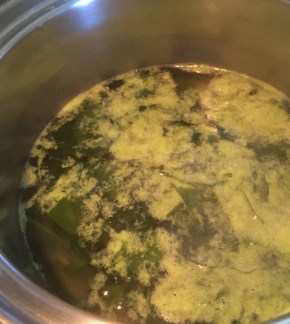
This morning I further prepared and ate my several leaves of kelp gathered yesterday. I had left them in water in the fridge overnight. First I drained the water into the cooking pot, and then cut up the leaves into bite-sized pieces.

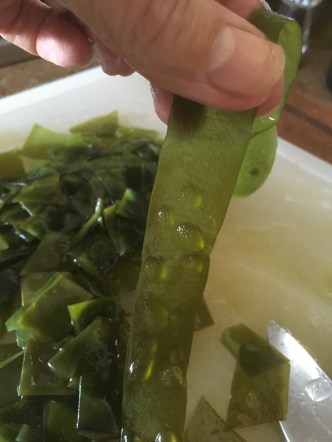
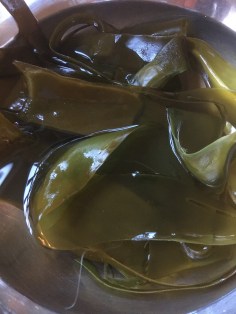
As I drew each long blade out of the tangle,
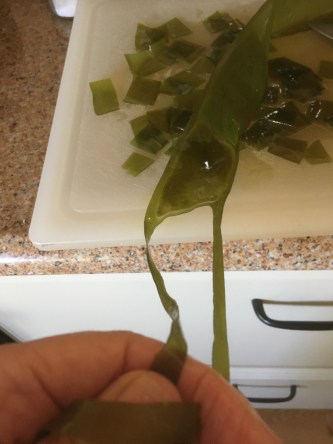
many configurations, colors and textures were revealed.

The “slimy” stuff that comes off or out of the seaweed is part of itself and its goodness. It gives the broth substance. I ate some of the fresh kelp to make sure it wasn’t already very salty; it wasn’t salty and the flavor was fairly bland, compared to other seaweed I have eaten. So I went ahead and cooked all the pieces in water with a little salt. I could have made a raw salad with some or all of it, but because I rarely eat cold salads in the winter, that didn’t occur to me until I was already in the process of cooking the vegetable.

I fried firm tofu with sesame oil and tamari,
and combined half of that with about half of the kelp
to make a yummy breakfast bowl.

Tomorrow I’ll eat the rest of the kelp in its broth, and call this a successful experiment. I’m planning to take a knife with me to the beach in the future, in addition to the plastic bag I had handy this time, so I’ll be equipped for whatever foraging opportunities.

Thank you, Bella!


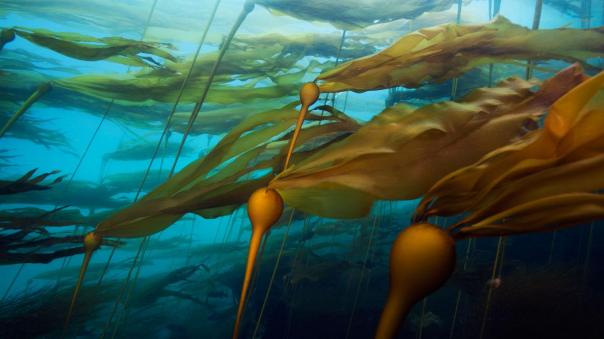
Bullwhip kelp on the beach.

Another beach day! I took my friend Bella this time, as a co-breather of that medicinal air, a person I knew would ooh and ahh and thank God along with me. The sky was clear blue, and there was barely a breeze. The dry sand under our feet was warm.

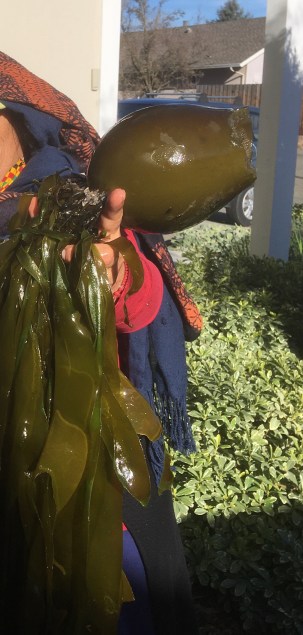
As soon as we arrived at the shore and Bella set her eyes on the bull kelp, she made plans to take some home to eat, because she was pretty sure it was edible. But we left it lying on the sand because it was too heavy to lug up and down the beach. After walking and picking up shells for a while, we sat on a log and ate lunch, including some gingerbread I’d baked, and apples wedges washed in lemon juice.

Then back to the kelp, where as neither of us had any other tool, Bella used a stick of driftwood to hack the bulb and leaves from the “rope” of the sea vegetable, and we put the parts we wanted in a plastic bag. We stopped by my house to wash the sand off outdoors, after checking online about the edibility of it. This Nereocystis is also known as bullwhip kelp, ribbon kelp, and bladder wrack.

I kept a few leaves here, but they are waiting in water until tomorrow, because I ran out of time tonight to experiment with making soup. What took priority was writing here about my latest beach adventure!