Monthly Archives: June 2022

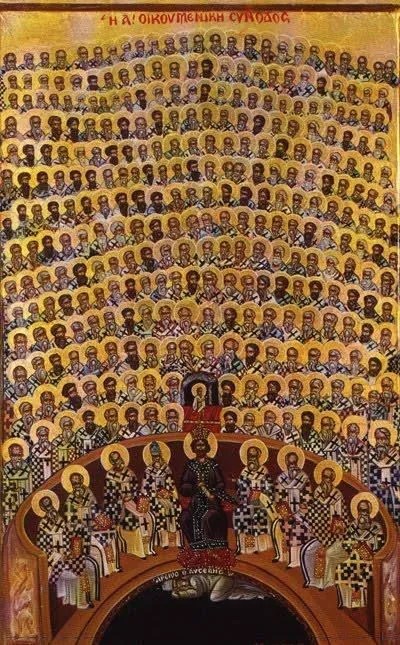
Fathers of the First Ecumenical Council

The Apostles’ preaching and the Fathers’ doctrines
have established one faith for the Church.
Adorned with the robe of truth, woven from heavenly theology,
it defines and glorifies the great mystery of Orthodoxy!
-Hymn for the feast

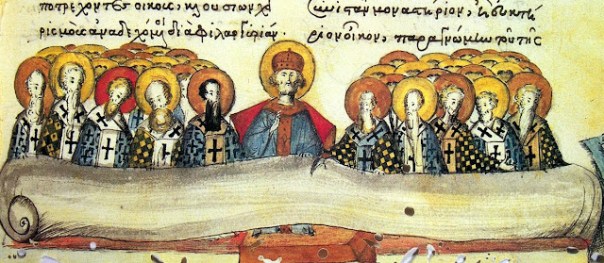
On the seventh Sunday of Pascha we Orthodox commemorate the Fathers of the First Ecumenical Council. This gathering was organized by the Emperor Constantine in 325. St. Nicholas of Myra and many others whom we now know as saints were present.

Arianism (not Aryanism) had been a recurring source of controversy in the early Church, and when Constantine called for a council, it was primarily out of a desire to settle the underlying theological questions. This was the Council at Nicea in Asia Minor, held in 325, where the major part of the Nicene Creed was formulated. Many of the hymns and readings for this feast are very theological, too.
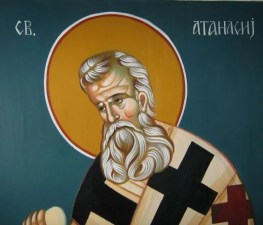
St. Athanasius

On the site linked above, we read, “A list of bishops at the council exists, including about 230 names, though there are indications that the signature lists are defective. St. Athanasius of Alexandria (Athanasius the Great) puts the number at 318, which is regarded as a mystically significant number, as in Genesis 14:14, the number of servants whom Abraham (then still named “Abram”) took with him to rescue his nephew Lot.”

Though we aren’t commemorating the Fathers of the second council today, those who completed the Creed as we know it, I wanted to post the full Symbol of Faith here, as we profess it in our daily prayers and in many services. The majesty and splendor of The Holy Trinity and of His loving plan of salvation captivate me from the first few lines, and by the time we get to “the Life of the age to come,” I am full of joy at being a participant in this Life. Here is some background:

The Creed as it now stands was formed in two stages, and the one in use today in the Orthodox Church reflects the revisions and additions made at the Second Ecumenical Council. Some centuries later, the Roman Catholic Church attempted a unilateral revision of the Creed by the addition of the Filioque, this being one of the causes of the Great Schism between Rome and the rest of the Church.”

THE CREED

We believe in one God, the Father Almighty, Maker of heaven and earth, and of all things visible and invisible;
And in one Lord Jesus Christ, the Son of God, the Only-begotten, Begotten of the Father before all ages, Light of Light, Very God of Very God, Begotten, not made; of one essence with the Father; by whom all things were made:
Who for us men and for our salvation came down from heaven, and was incarnate of the Holy Spirit and the Virgin Mary, and was made man;
And was crucified also for us under Pontius Pilate, and suffered and was buried;
And the third day He rose again, according to the Scriptures;
And ascended into heaven, and sits at the right hand of the Father;
And He shall come again with glory to judge the living and the dead, Whose kingdom shall have no end.
And we believe in the Holy Spirit, the Lord, and Giver of Life, Who proceeds from the Father, Who with the Father and the Son together is worshipped and glorified, Who spoke by the Prophets;
And we believe in one, holy, catholic, and apostolic Church.
We acknowledge one Baptism for the remission of sins.
We look for the Resurrection of the dead,
And the Life of the age to come. Amen.

You are most glorious, O Christ our God! 
You have established the Holy Fathers
as lights on the earth! 
Through them you have guided us to the true faith! 
O greatly Compassionate One, glory to You!
A gardener’s work and prayer.

I’ve been in the garden every day, at least a little, and often a lot. When I come downstairs in the morning and realize that it’s already warm enough that I can slide the glass door open, without thinking about it I slide open the screen door, too, and go out to have a look.
The bluebird parents can be seen flying back and forth to feed the peeping infants. Finches, sparrows, hummingbirds and even the flirty Bewick’s Wren fill the space with their songs. Oh, and crows. It is a new thing the last few years to have crows in my yard. I prefer the old way, and I politely ask them to leave. They leave but they come back.

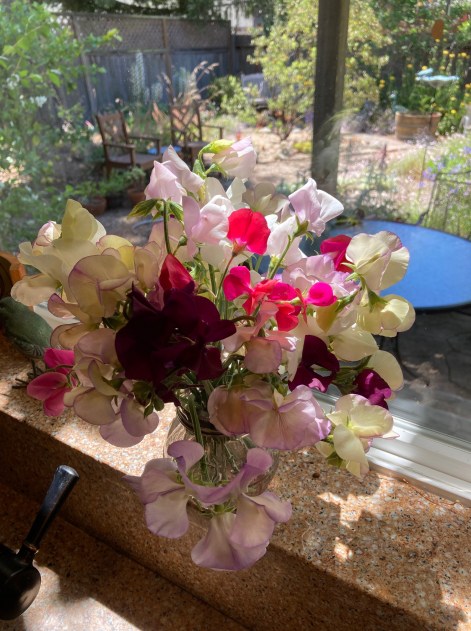
Often in the morning I will put water in the fountain, and trim a little here or pull a weed there. Most days I seem to spend quite a while picking sweet peas.

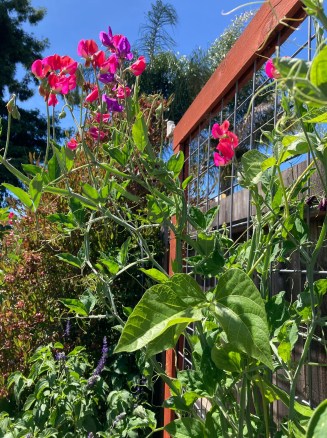
The sweet peas have become very intimate with the perennial runner beans. The sweet peas were up on the trellis months earlier, and were covered with flowers when the bean stems emerged at three corners of the planter boxes and started climbing. They mostly twist their stems around the pea vines as they climb, and quickly they have outclimbed the peas.

The pea vines responded in kind, continuing their reach for the sky by holding on to the beans. This relationship has to end, though, because the peas are expiring while the beans are only now putting out a few flowers. So, the last couple of days when I pick the flowers, I’m also going to a lot of trouble to break up this love affair without breaking the bean stems. Let’s hope I can plan better and not let this situation develop next spring.

When the sun gets too high and I start to droop, I go indoors and do housework. Or read poems. I’ve been bingeing on them in the last week, and hope to share my favorites here eventually. Maybe in the fall when I have finished my Big Sort, the organizing of all my Stuff: rooms, closets, cabinets, drawers and belongings to throw, give or put away. I hope the Big Sort will be done long before that, but there is the garden…

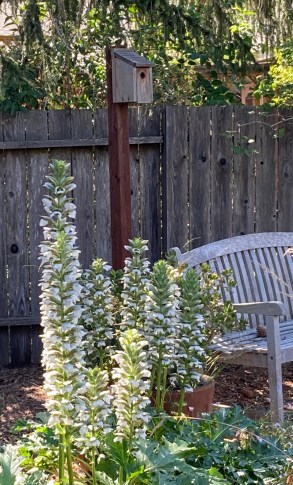
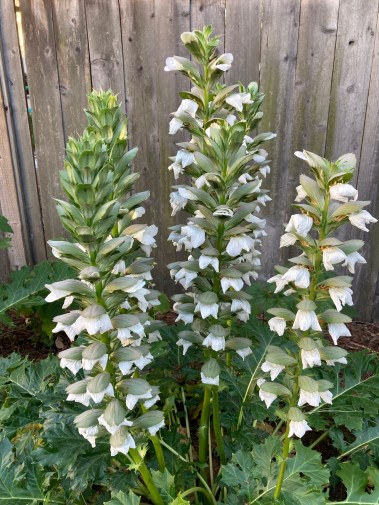
Acanthus
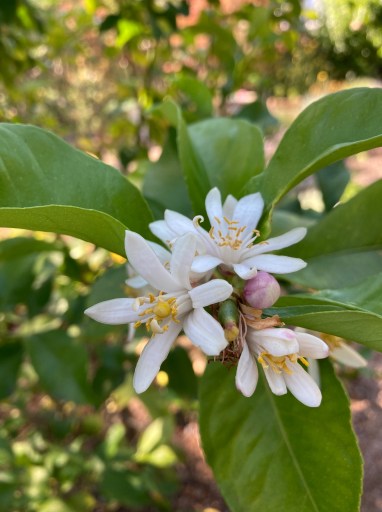
Lemon
Lavender

I mixed up some fish emulsion and fed the lemon tree today. I wanted to give it more iron, too, but I read on the bottle that you should not apply that until late evening. It was time for a break, anyway, so here I am. And here is a poem I read last night, which I hope you like:

GARDENER’S PRAYER

O Lord, grant that in some way
it may rain every day,
Say from about midnight until three o’clock
in the morning,
But, You see, it must be gentle and warm
so that it can soak in;
Grant that at the same time it would not rain on
campion, alyssum, helianthus, lavendar, and others which
You in Your infinite wisdom know
are drought-loving plants-
I will write their names on a bit of paper
if you like-
And grant that the sun may shine
the whole day long,
But not everywhere (not, for instance, on the
gentian, plantain lily, and rhododendron)
and not too much;
That there may be plenty of dew and little wind,
enough worms, no lice and snails, or mildew,
and that once a week thin liquid manure and guano
may fall from heaven.
Amen.

-Karel Matej Capek Chod
(1860 -1927) Czech Republic

The increase of Pascha.

From our parish bulletin:

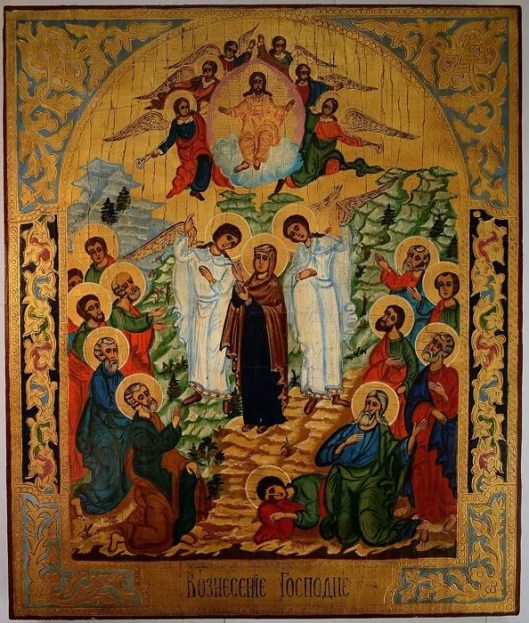
From the eve of the Ascension of the Lord (an event which we confess when we recite the Creed) until the following Friday, we sing this hymn:

Thou hast ascended in glory, O Christ our God,
and gladdened Thy Disciples with the promise of the Holy Spirit.
And they were assured by the blessing
that Thou art the Son of God and Redeemer of the world.

The Feast is always on a Thursday—Forty Days after the Resurrection (described in Acts 1). We are such materialists that it’s hard for us to conceive or understand this event. The Ascension is the vindication of the crucified, buried and risen Lord Jesus, the initiation of His reign— inauguration day—over all creation, and His power made present in us.

“Lo, I am with you, even to the end of the ages. Amen,” says the Lord as He ascends—that is, as He comes into His glory and sits upon the Throne at the Right Hand of the Father. He is with us—we are with Him too— because now, the One Who Is God AND man is in Heaven.

As St. Leo the Great, the Pope of Rome (+461) taught: “With all due solemnity we are commemorating that day on which our poor human nature was carried up, in Christ, above all the hosts of Heaven, above all the ranks of angels, beyond the highest Heavenly powers to the very throne of God the Father.”

This is simultaneously our ascension and our glorification, since we are united to Christ through holy Baptism as members of His Body. Therefore, St. Paul can further write: “For you have died, and your life is hidden with Christ in God.” (Col. 3:3) Out of our physical sight, we now “see” the glorified Christ through the eyes of faith.

St. Leo further explains how important this spiritual insight is: “For such is the power of great minds, such the light of truly believing souls, that they put unhesitating faith in what is not seen with the bodily eyes; they fix their desires on what is beyond sight. Such fidelity could never be born in our hearts, nor could anyone be justified by faith, if our salvation lay only in what is visible.”

The Feast of the Ascension is not a decline from the glory of Pascha. It is, rather, the increase of Pascha, and a movement upward toward the Kingdom of Heaven for those who are in Christ. It is the joyful revelation of our destiny in Christ.