More than two years ago I began to engage with Timothy Patitsas’s bookThe Ethics of Beauty. It’s an inconvenient book because of its unwieldiness, and I didn’t get very far into it until this summer, when I determined to read it on a regular basis, with its weight resting on my kitchen table and I hefting only a cup of tea.
Just in time for my trip earlier this month and the necessary sitting on airplanes, I discovered that the book is now on Kindle, Hallelujah! By the time I returned home I had made my way through 31% of its 729 pages, to page 224, in the middle of the chapter titled “Shame and Sacrifice.” I will start sharing my gleanings on that theme.
Father Stephen Freeman has written many times on his blog about shame, and until now I hadn’t read about it elsewhere. I particularly appreciated his explaining the toxic shame that cripples so many people in the modern world. In the last couple of years he’s written about healthy shame, too, as in the article “Can Shame Ever Be Healthy?” He credits the author John Bradshaw and his book Healing the Shame That Binds Us for clarifying the difference between the two, in an era when many people don’t want to acknowledge such a thing as the healthy version. But they are ignoring the science, according to Fr. Stephen:
“We are hard-wired for a response (one of the nine identified neuro-biological affects) that is accurately described as ‘shame.’ It is not a product of culture. It is universal, timeless, and biological. It can be compared to other effects such as the ‘surprise-startle’ effect, or the ‘distress-anguish’ effect, or the ‘interest-excitement’ effect. The ‘mechanism’ of the shame experience, whether toxic or healthy, is the same, differing only in its intensity and the issues that surround and embed themselves as complex, emotional triggers.”
Patitsas likewise sees the tendency of modern therapy to disbelieve in healthy shame, because:
“…it is so busy promoting self-regard and, ultimately, self-love, that it can’t possibly also teach us to look to the source of healthy shame outside ourselves. To replace the wrong kind of shame in us with the pure quality of shame, soul therapy must bring us face to face both with God and with other human beings who’ve seen what we’ve seen and yet have done better than us – that would be, in one person, Jesus Christ. Or, if you like, God and the saints…. Healthy shame is a fruit of deep organic processes; it is the glory upon the face of Moses when he descends from Mt. Sinai.”
It is interesting to put the insights of these two paragraphs together and begin to understand that to deal with our neurobiology and psyche, trying to create self-esteem without any reference to our Creator and Savior is a dead end, an unworthy goal. Yes, the inner man is essential, but the true self is only revealed by the Kingdom of God within, after “deep organic processes.”
To replace toxic or unhealthy shame with healthy shame, Patitsas continues,
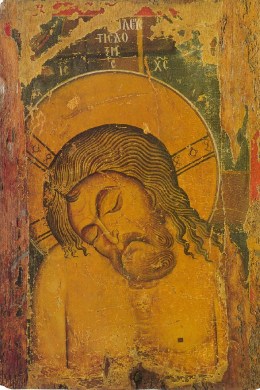
“…we must also see Christ crucified, or else we will never overcome our false ideas about what is and isn’t shameful. Without seeing ‘the King of Glory’ hanging from the cross, a person will never be able to understand those times when accepting to be shamed by others is a necessary part of receiving God’s glory.”
Fr. Stephen points out a scriptural reference to shame that lines up with this, from Sirach 4:21:
“For there is a shame that leads to sin, and there is a shame that is glory and grace.”
May the Lord strengthen us in the latter direction!
“The death of the spirit is the price of progress. Nietzsche revealed this mystery of the Western apocalypse when he announced that God was dead and that He had been murdered. This Gnostic murder is constantly committed by the men who sacrificed God to civilization. The more fervently all human energies are thrown into the great enterprise of salvation through world–immanent action, the farther the human beings who engage in this enterprise move away from the life of the spirit. And since the life the spirit is the source of order in man and society, the very success of a Gnostic civilization is the cause of its decline.
“A civilization can, indeed, advance and decline at the same time—but not forever. There is a limit toward which this ambiguous process moves; the limit is reached when an activist sect which represents the Gnostic truth organizes the civilization into an empire under its rule. Totalitarianism, defined as the existential rule of Gnostic activists, is the end form of progressive civilization.”
― Eric Voegelin, The New Science of Politics: An Introduction
Prayer is like watching for the Kingfisher. All you can do is Be where he is likely to appear, and Wait. Often, nothing much happens; There is space, silence and Expectancy. No visible sign, only the Knowledge that he’s been there And may come again. Seeing or not seeing cease to matter, You have been prepared. But when you’ve almost stopped Expecting it, a flash of brightness Gives encouragement.
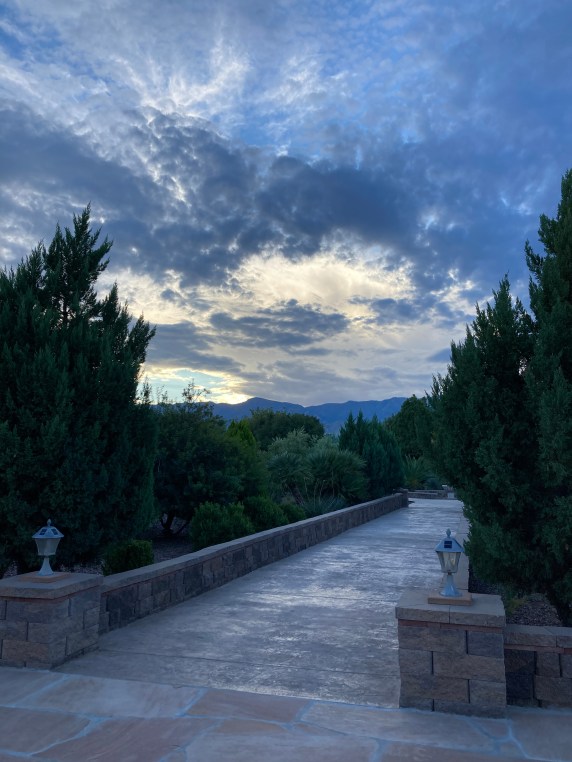
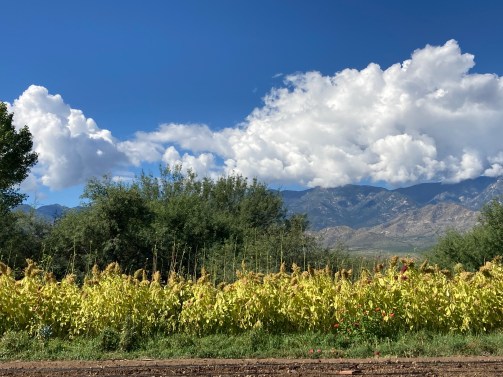
The monsoon season officially ended in Arizona on September 30, but at least one rainstorm was not keeping to that calendar. The evening that we arrived at the high-desert monastery we enjoyed a loud thunderstorm and showers that continued through the morning.
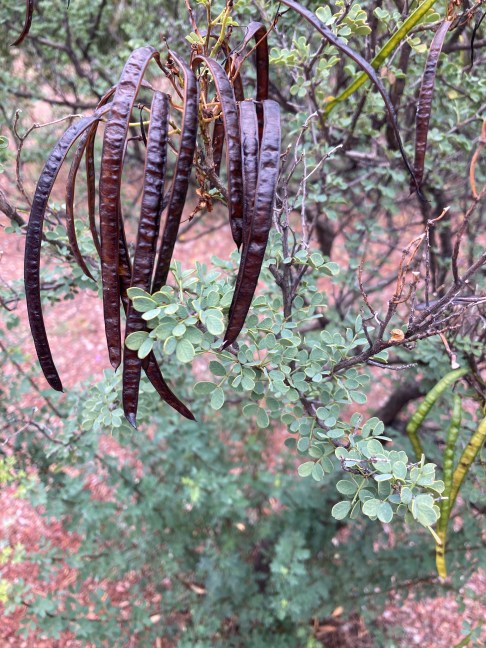
Velvet Ash
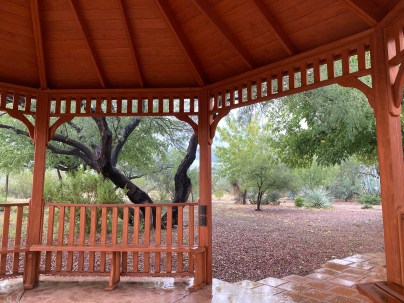
When I got caught in a shower while taking a walk I discovered this gazebo near at hand, where I waited a few minutes until the rain lessened.
Now that I have returned to northern California (where we are still waiting for our own wet season to begin in force) I feel that the spiritual watering I received is liable to evaporate to nothing if I don’t take more time than I have so far, to process what seems like a deluge of impressions and experiences.
I’ve been thinking about an article from Father Stephen Freeman, about Living in the Real World. Here is an excerpt:
A monk lives in a monastery. He rises early in the morning and prays. He concentrates his mind in his heart and dwells in the presence of God. He will offer prayers for those who have requested it. He will eat and tend to the work assigned for him to do. And so he lives his day. He works. He prays.
And someone will say, “But what does he know about the real world?” But what can they possibly mean? He walks on the earth. He breathes the same air as we do. He eats as we do and sleeps as we do. How is his world any less real than that of anyone else on the planet?
A man lives in a city. He wakes in the morning, turns on the TV as he gets ready for the day. He dashes out the door (he’s running late). He gets to his car, listens to the news on the radio, takes a couple of calls on his cell phone. He gets to work and for every minute he does something that he thinks of as “work,” he spends at least another checking his email, looking quickly at Facebook, and maybe checking the news. He gets into an argument at lunch about what should be done somewhere else in the world and who should do it. Angry and distracted, he is frustrated with himself because he swore he was not going to have that same argument today. He goes back to work with the same routine. After work he drops by a bar, has a couple of drinks and decides to stay and watch some of the game. He gets home late and heads to bed.
Who is living in the real world? The man-in-the-city’s life is “real,” it actually happens. But he is distracted all day from everything at hand. He never notices himself breathing unless he’s out of breath. He swallows his food as quickly as possible. Even the beers he has at the bar are as much for the buzz as for the taste.
If the man refrained from these things his friends might taunt him, “What are you? Some kind of monk?”
What is the “real” that we should live in?
The sisters at the monastery demonstrate a quality of life that is closely grounded in the earthly, incarnated existence that God has given us, with all its limitations and glories. Their orderly life, hard work and continual prayer create an oasis of beauty and holiness.
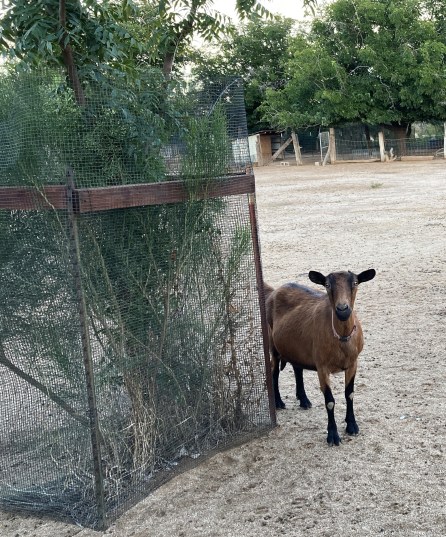
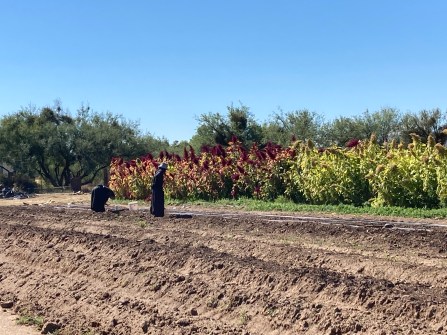
From their chickens, ducks and guinea fowl they collect eggs. From a little herd of goats they get plenty of milk for their own use and to sell to soap-makers. Pomegranate and apple orchards and vineyards supply more fruit; and they take the fruit of 850 olive trees to press into oil and cure into olives for eating. Over the years they’ve learned to drive tractors and do construction of their buildings, among dozens of other skills.
Guest quarters and bookstore are in this building.Goat milk feta was available to guests for breakfast.
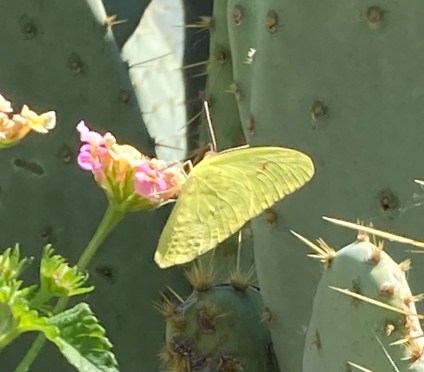
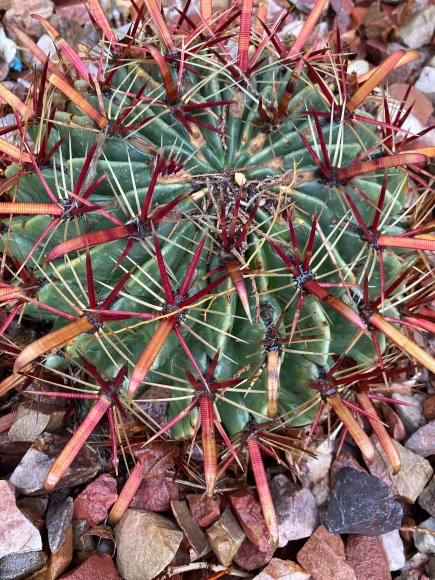
I took many pictures of plants and butterflies! Lantana is interspersed with prickly pear cactus in the landscape, and we saw several species of swallowtail butterflies, skippers, this Cloudless Sulphur, and Queen Butterflies feasting on those flowers.
While at the monastery our group of women woke in time for Matins at 5:30. Vespers was at 3:50 and Compline after dinner. One morning of our visit Divine Liturgy was served soon after Matins. (The sisters have more services in the night, just for them.) Standing and praying in church (and sitting when we couldn’t stand any longer) was a huge shower of blessing, of course.
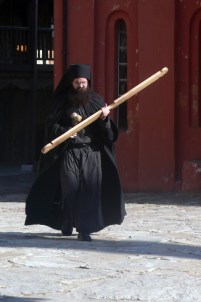
One of the sisters walks around the property beating the hand-held talanton (semantron) to announce both services and meals. This picture of the talanton is from Mt. Athos; St. Paisius Monastery tries to keep the monastic rule and tradition of Athonite monasteries.
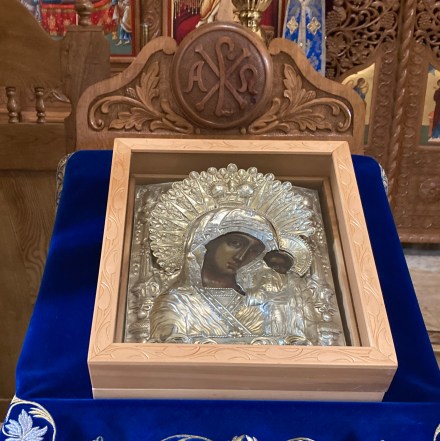
When we arrived they were coming to the end of the Feast of the Cross, with the accompanying red altar cloths. Soon the cloths had been changed to blue, which is the default color, in honor of Christ’s mother, the Theotokos.
One image that comes to mind regarding the idea of pilgrimage is from the novel Kristin Lavransdatter, set in medieval Norway. Kristin sets off on foot with only her infant child for company, and walks to a holy site far enough away that she has to sleep outdoors on the way, I don’t remember how many nights. Her food is whatever she has brought in her bag.
Such a pilgrimage that takes serious commitment and protracted journeying would no doubt lend a different flavor to the experience, compared to our group’s monastery visit that was so easy and comfortable, and quick. Do I even qualify to be called a pilgrim?
One afternoon I sat on a bench next to this quiet moth, about an inch across, and I felt some camaraderie with his dull color. (He was much more “boring” in his actual size.) Maybe I, too, could just cling to the monastery for a time, blending in as much as possible with its unique color, the way the moth clung to the bench, and soak up the grace by clinging.
My friend Lorica comes into my story at this point. She was in our group, and had compiled a booklet of songs for us, titled “Spiritual Songs for a Pilgrim Journey.” We sang from it in the van on our drive from the Tucson airport.
Whither goest thou, oh pilgrim, with thy staff in hand? Though the wondrous mercy of the Lord go I to a better land.
The lines above remind me that my whole life’s journey might be called a pilgrimage, and this too-brief trip was a reminder of what my Real Life consists of. I want one day to return to St. Paisius or to visit another monastery to help me further on my way — if I do I hope it is for a much longer visit! — but in any case, it is through God’s wondrous mercy that I travel in the right direction moment by moment, wherever I find myself.
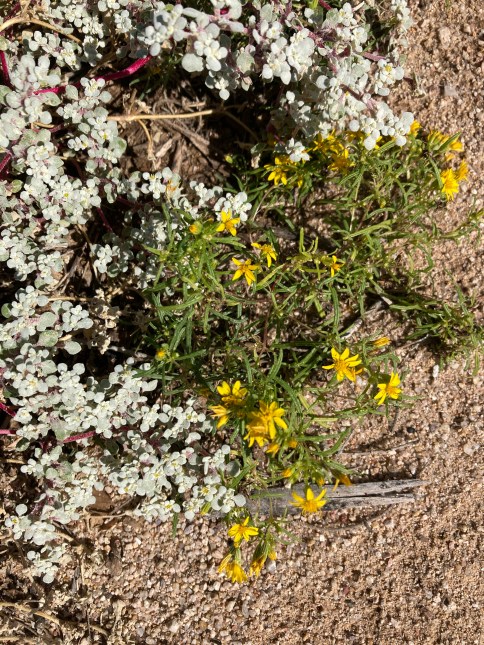
Lorica helped me in another way, on our first full day of our visit. As we were having a tour around the property, she said, “Something that we are walking on is very aromatic.” I hadn’t noticed, but I looked down and saw these little yellow daisies growing like weeds along and in the path. I broke off a stem and we knew that that was the aromatic plant. It was delicious to my own senses, and new.
I learned that it is the Southwestern native pectis papposa, or chinchweed, and they say it can sometimes be found in Mexican markets sold as limoncillo.
On the day of our departure, I was standing by the van waiting for the others and watching the butterflies again, when I noticed a big clump of chinchweed right there. A stem of it just fit into a pocket of my backpack, so I brought it home as a memento of the visit. It is sitting near me now on the sideboard, dried up and having lost not quite all of its spiciness.
The intangible things that I brought home from the monastery — I pray those stay with me longer, whatever they are. Because the aroma is sweet, and powerful. I think it’s the scent of holiness.
 It is interesting to put the insights of these two paragraphs together and begin to understand that to deal with our neurobiology and psyche, trying to create self-esteem without any reference to our Creator and Savior is a dead end, an unworthy goal. Yes, the inner man is essential, but the true self is only revealed by the Kingdom of God within, after “deep organic processes.”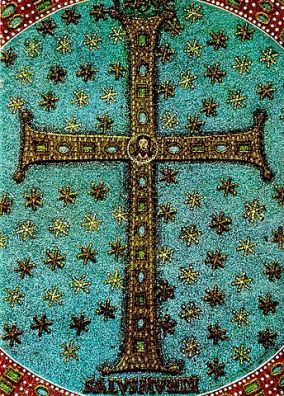
 “The death of the spirit is the price of progress. Nietzsche revealed this mystery of the Western apocalypse when he announced that God was dead and that He had been murdered. This Gnostic murder is constantly committed by the men who sacrificed God to civilization. The more fervently all human energies are thrown into the great enterprise of salvation through world–immanent action, the farther the human beings who engage in this enterprise move away from the life of the spirit. And since the life the spirit is the source of order in man and society, the very success of a Gnostic civilization is the cause of its decline.











 Such a pilgrimage that takes serious commitment and protracted journeying would no doubt lend a different flavor to the experience, compared to our group’s monastery visit that was so easy and comfortable, and quick. Do I even qualify to be called a pilgrim?
 I learned that it is the Southwestern native pectis papposa, or chinchweed, and they say it can sometimes be found in Mexican markets sold as limoncillo.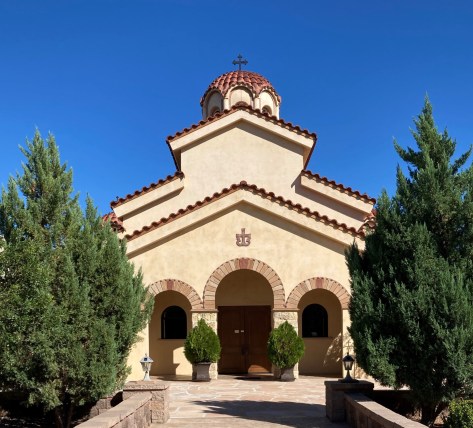
 Gladsome Lights