 St. Polycarp was born in the first century and was burned at the stake in the second. Because of an early and well known document, The Martyrdom of Polycarp, thought to be the oldest authentic account of an early Christian martyr’s death, he is one of the most famous who have refused to deny Christ in the face of extreme threats.
His life is connected to several other notable saints, earlier and later, starting with St. John the Apostle and Evangelist, whom he knew and talked with; St. Ignatius, who met him and afterward sent a long letter of exhortation to him; and St. Irenaeus of Lyons, who was baptized by Bishop Polycarp when a youth and was sent by him as a missionary to Gaul.
The Letter of St. Ignatius to St. Polycarp resonates with life and the vibrant faith of the writer and the churches of Christ in those early centuries. An excerpt:
“Stand firm, as does an anvil which is beaten. It is the part of a noble athlete to be wounded, and yet to conquer. And especially, we ought to bear all things for the sake of God, that He also may bear with us. Be ever becoming more zealous than what you are. Weigh carefully the times. Look for Him, who is above all time, eternal and invisible, yet who became visible for our sakes; impalpable and impassible, yet who became passible on our account, and who in every kind of way suffered for our sakes.”
The author of “The Martyrdom of Polycarp” is unknown, but it was sent to the church in Philomelium, Asia Minor, from the church in Smyrna. Here is one paragraph from the letter:
“And as the flame blazed forth in great fury, we, to whom it was given to witness it, beheld a great miracle, and have been preserved that we might report to others what then took place. For the fire, shaping itself into the form of an arch, like the sail of a ship when filled with the wind, encompassed as by a circle the body of the martyr. And he appeared within not like flesh which is burnt, but as bread that is baked, or as gold and silver glowing in a furnace. Moreover, we perceived such a sweet odour, as if frankincense or some such precious spices had been smoking there.”

In a letter to his friend Florinus, after the death of Polycarp, St. Irenaeus writes fondly of his elder in the faith:
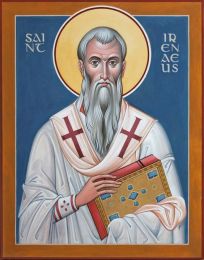 “I can even describe the place where the blessed Polycarp used to sit and discourse — his going out, too, and his coming in — his general mode of life and personal appearance, together with the discourses which he delivered to the people; also how he would speak of his familiar intercourse with John, and with the rest of those who had seen the Lord; and how he would call their words to remembrance. Whatsoever things he had heard from them respecting the Lord, both with regard to His miracles and His teaching, Polycarp having thus received from the eye-witnesses of the Word of life, would recount them all in harmony with the Scriptures. These things, through God’s mercy which was upon me, I then listened to attentively, and treasured them up not on paper, but in my heart; and I am continually, by God’s grace, revolving these things accurately in my mind.”
On this day on which we commemorate St. Polycarp, I will be listening to a sonata composed in his honor by Heinrich Biber (1644-1704): “Sancti Polycarpi”, and “revolving these things” I’ve been learning about these men in my own mind — their struggle to stand firm, as St Ignatius exhorted, and to “Weigh carefully the times. Look for Him, who is above all time….” Thank you, Lord, for the ever encouraging testimony of your saints, and on this day, especially that of Saint Polycarp of Smyrna. +
 Probably I saw a recipe online that inspired this creation, which was prompted by great quantities of Swiss chard growing in my garden a year ago. I never wrote down amounts of ingredients, but at the request of a commenter yesterday, I can tell you how I made the dish.
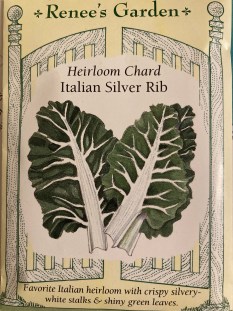 occasionally to distribute the garlic, until the chard is tender. Uncover at the end if it is soupy, to let some of the liquid cook off. Drain and rinse one or two cans of cannellini beans and add them, generous grindings of black pepper — and bits of dried tomato if you like. Adjust for salt.


 One day I spent experimenting with red dye to color eggs for Pascha. As some of you know, because I asked you directly for advice, I offered to take on the project this year for our Orthodox parish, which gives out about 200 red eggs on Pascha night. I wanted to try different dyes, colors of eggs and methods ahead of time so that during Holy Week I would have my plan firmly in mind, and the best dye on hand. I have yet to write up all that I learned so far, but I accomplished my goal that day, and also ended up with quite a few eggs, in various shades of red and pink, to eat in the next week.
 It’s Cheesefare Week, a.k.a. Butter Week, for Orthodox Christians, this week before Lent. That prompts me to post this recipe again, for Brazilian Cheese Rolls. Maybe you have found them in the freezer aisle of Trader Joe’s or elsewhere in recent years, but they are easy to make at home. They are full of eggs and cheese, and gluten-free, because the starchy component is tapioca flour. I am fond of the mochi texture, and will likely enjoy a few this week.
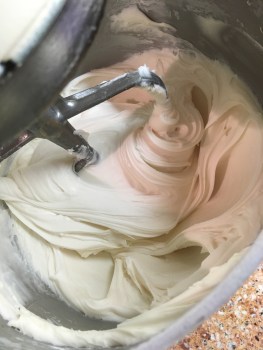 In the bowl of your heavy-duty stand mixer* combine the salt and tapioca starch. In a saucepan combine the milk and butter and bring to a boil, stirring occasionally to prevent scorching. Fit your mixer with the paddle attachment, turn on medium-low, and begin drizzling in the hot milk mixture. At first it will all clump up, but keep drizzling in, stopping and scraping down the bowl and paddle as necessary, until it comes together and forms a smooth, thick, gluey dough. Beat for a minute or two, then turn the mixer off, cover the bowl with a cloth and let rest for 15 minutes, or until just warm to the touch.
 Gladsome Lights