Monthly Archives: March 2023

A feast of fasting guidelines.

More Fasting Guidelines,
from Abbot Tryphon’s The Morning Offering:

FAST from self-concern and FEAST on compassion for others.
FAST from discouragement and FEAST on hope.
FAST from lethargy and FEAST on enthusiasm.
FAST from suspicion and FEAST on truth.
FAST from thoughts that weaken and FEAST on promises that inspire.
FAST from shadows of sorrow and FEAST on the sunlight of serenity.
FAST from idle gossip and FEAST on purposeful silence.
FAST from problems that overwhelm you and FEAST on prayer that sustains.
FAST from criticism and FEAST on praise.
FAST from self-pity and FEAST on joy.
FAST from ill-temper and FEAST on peace.
FAST from resentment and FEAST on contentment.
FAST from jealousy and FEAST on love.
FAST from pride and FEAST on humility.
FAST from selfishness and FEAST on service.

Celebrating March with bread and blossoms.

Over the years since I planted two Elephant Heart plum trees in my back yard garden, I have begun to notice a pattern: In February or March the trees begin to put out their blooms, and in the same months we get hailstorms. Then I say something on my blog, like, “I worry about my plum blossoms!”

This is the eighth springtime that these trees have found themselves in my garden when they woke from dormancy. Every summer I get more fruit, so I guess things are pretty good. This particular first day of March is still very cold and windy, but the sun is shining in a blue sky, and it looks like we’ll have three days of sunshine before we welcome the rain again.

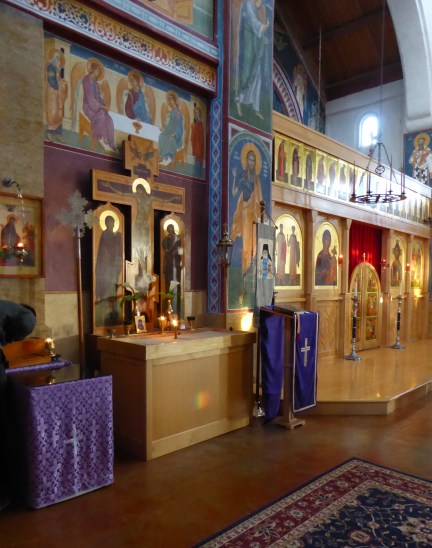
I’m almost out of firewood, and it doesn’t look like I’ll get any more for this season; but I have a good furnace, which I wouldn’t mind using even more than I do if it weren’t so noisy. When I get tired of its roar I turn down the thermostat and put on a coat. Today I have time to build a fire before going to a Lenten service in the evening, and it will be nice to come home to a cozy and quiet house.

What’s another cozy and homey thing? Baking bread! Even if it’s done in the big church kitchen. Three of us made that kitchen nice and comfortable yesterday when we made these loaves of Communion bread together.

My computer guy came yesterday afternoon to do a check-up on my desktop; he hadn’t been here for so long, we had a lot to catch up on. His happiest news was all the sourdough bread baking he has been doing for his family, of which he showed me photos of the sort they put on the covers of artisan bread cookbooks. He is going to leave a jar of his starter on my doorstep tomorrow! I have been thinking for a few months that I want to come out of my bread-baking retirement. It’s just too severe a cutting away of my former self, not baking bread, and I’m going to try to graft that branch back in.

One reason I gave it up was that so many people are eating gluten-free, and it seemed a challenge to find people to give my (mostly excess) bread to; I feel differently about that part now, for some reason. Yesterday we ended up with two little bits of dough left over, and made them into two “buns” that we baked along with the regular loaves. You can see the smaller one at the top left of the photo above. I took that one home and ate it for lunch, and it was the most delicious thing. Bread is a wonder.

The ladder and the toil.

During Lent we Orthodox sing the Great Canon of St. Andrew of Crete, a long penitential hymn composed in the seventh century. It is divided into four parts, which are sung in four different services in the first week.

“A basic distinguishing feature of the Great Canon is its extremely broad use of images and subjects taken both from the Old and New Testaments. As the Canon progresses, the congregation encounters many biblical examples of sin and repentance. The Bible (and therefore, the Canon) speaks of some individuals in a positive light, and about others in a negative one—the penitents are expected to emulate the positive examples of sanctity and repentance, and to learn from and avoid the negative examples of sin, fallen nature and pride.” -Orthodox Wiki

One of the exhortations which caught my attention this year was regarding the lessons that might be learned from the life of the patriarch Jacob:

The ladder which the great Patriarch Jacob saw of old is an example, O my soul,
of approach through action and of ascent in knowledge. If then thou dost wish to live rightly in action and knowledge and contemplation, be thou made new. (Genesis 28:12; Rom. 12:2; Titus 3:5)

In privation Jacob the Patriarch endured the burning heat by day and the frost by night, making daily gains of sheep and cattle, shepherding, wrestling and serving, to win his two wives. (Genesis 29:16-30; 31-40)

By the two wives, understand action and knowledge in contemplation. Leah is action, for she had many children; and Rachel as knowledge, for she endured great toil. For without toil, O my soul, neither action nor contemplation will succeed.

May God strengthen us!