Monthly Archives: September 2023

Mountain Sourdough

When I was getting ready to come up here to my high mountain cabin for several days, I didn’t like the idea of leaving my sourdough starter at home with no one to feed it for most of a week. Then I realized, I could bring it with me. That is what is great about road trips — you have lots of flexibility and options. Every experience of air travel makes me love road-tripping more.

So I did bring my jar of starter, and along with it the likelihood that I would cook something with it, too. Because even if I only fed it every other day, it might outgrow the half-gallon jar I use. I didn’t want to have to throw out, or actually discard, the discard.

I really dislike the thought of throwing away good food such as sourdough starter, which is one reason I keep mine in a big jar, and why I have developed my current bread recipe so that it uses 1 1/2 cups of starter for one loaf. Many people use their discard to make pancakes or biscuits in between bread-bakings, but that is not convenient for me.

I didn’t have a plan for what I would cook, but I knew I could accomplish something like pancakes or even a loaf of bread without reference to a recipe, because I’ve had lots of experience adapting or creating recipes, and nearly all the results were at least edible and nutritious. Last night when I was browsing ideas for sourdough biscuits (which I made a lot of for a big family, but long ago), I ran across a recipe for flatbread, and as I’ve been wanting for a long time to experiment with flatbreads, I went with that.

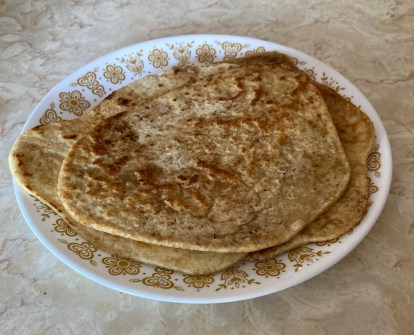
Last night before bed I mixed the simple dough, of 1 cup starter, 2 cups flour, 1 teaspoon salt and 1/2 cup of milk. I covered it to further ferment overnight, and this afternoon made eight flatbreads with it, in a cast iron skillet. There was frost on the deck this morning, and it was 32 degrees when I checked at 7:00, so it was a good day for baking, whether in the stove or on top. And the first day of autumn. ❤
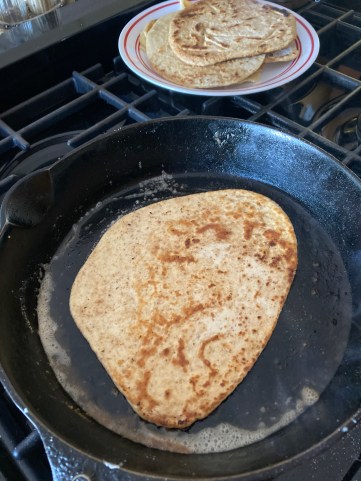
First I cooked them with a little olive oil in the pan. Then I tried each one in half a pat of butter, and the last few lumps dough I sprinkled with cinnamon and sugar as I folded and rolled them out, so that I ended up with a cinnamon sourdough flatbread. If I were to try this again, I might use water instead of milk, and hope to get a chewier bread; the cinnamon-sugar version wasn’t worth repeating. I’m already half-planning, though, that next summer I will bake a simple loaf of sourdough bread in the Dutch oven I saw in the cupboard.

Other than one pie I baked at the cabin, I have little experience baking at high altitudes; my son-in-law made a great pizza here at 8200 feet. Is it mostly cakes that are tricky, up where water turns to steam at 195 degrees? If any of you has personal  experience you’d like to share, I’d be interested.
 

In the weeds and happy about it.

On my way up the mountain earlier in the week I came across several plants whose common names include the word weed: Two tarweeds and two vinegarweeds. They all got my attention by the way they added color to the drying-out landscape of late summer.

When I was still only approaching the foothills, I saw bluish plants dotting the yellow-brown expanse stretching out away from the road, and it didn’t look like anything I had ever noticed before.

It may be that in the past they were not as tall and visible from the road, and that this year’s extra rainfall helped Trichostema lanceolatum to thrive. It was hard to get a picture of it without my socks attracting various stickers waiting in ambush, but this closeup on Wikipedia shows what a graceful flower form is hidden in the overall unimpressive bush:

“The plant is an important pollen source for native bees and other insects. When a pollinating insect alights on the lower lobes of the corolla, and inserts its mouth parts into the nectar-containing lower section of the same tube, the narrow corolla portion above is straightened and snaps rapidly downward brushing pollen onto the insect’s back.

“The volatile oils make it unpalatable to grazing and foraging animals.

“The indigenous peoples of California used this as a traditional medicinal plant, as a cold and fever remedy, a pain reliever, and a flea insect repellent.”

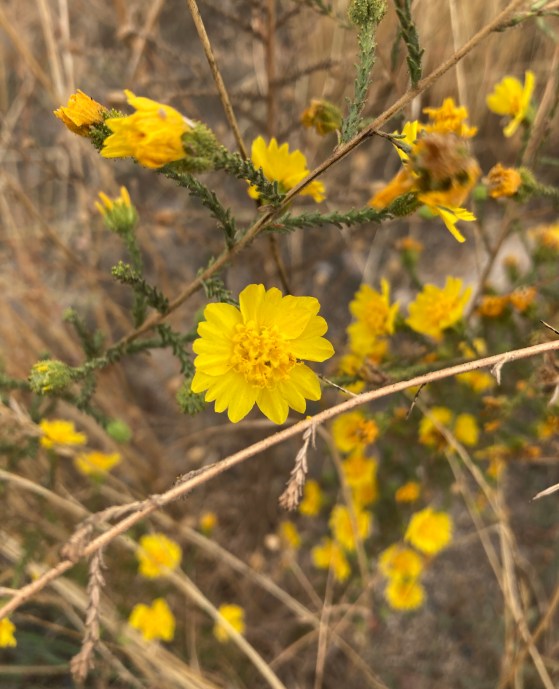
The two species of tarweeds caught my eye a little further on. I think it was mostly Fitch’s Tarweed, Centromadia fitchii, that had turned the slopes and flatlands gold in large swaths on either side of the highway.

But the more photogenic plant I managed to get close to was Heermann’s Tarweed (according to my Seek app), Holocarpha heermannii. Both of these plants are in the Aster Family, but different genera. A lot of tarweeds are in the Madia Family, but it seems that Heermann’s is irregular.

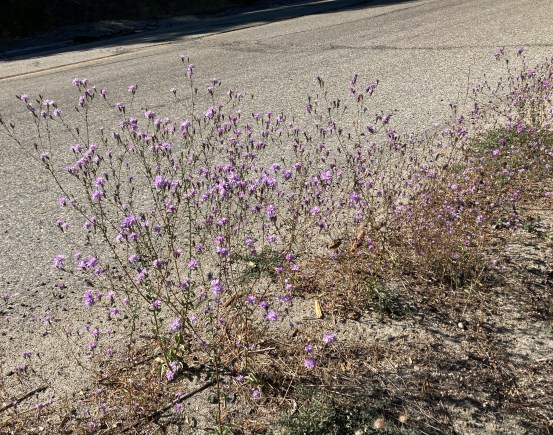
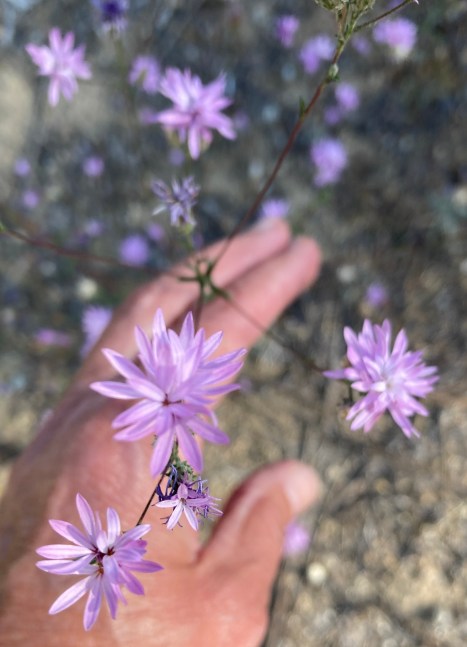
The second plant called vinegarweed grows along the roads in the High-er Sierra. When I first met it in 2009, it didn’t occur to me to taste it; maybe if I had, the idea of vinegar would have been uppermost? But my mind immediately wanted to call it Purple Haze, or Lavender Mist.

It typically gets my attention as I come  around a curve in the road, floating as a long pastel smudge on the shoulder. That first sighting was long before I had any kind of nature identification app, and when I eventually found someone who could tell me what it was (Sierra Vinegarweed or Lessingia leptoclada), that amateur botanist told me that if it had been up to her, she’d have named it Lavender Groundsmoke. The hope of encountering these flowers again would alone be enough to bring me up to the mountains every summer.

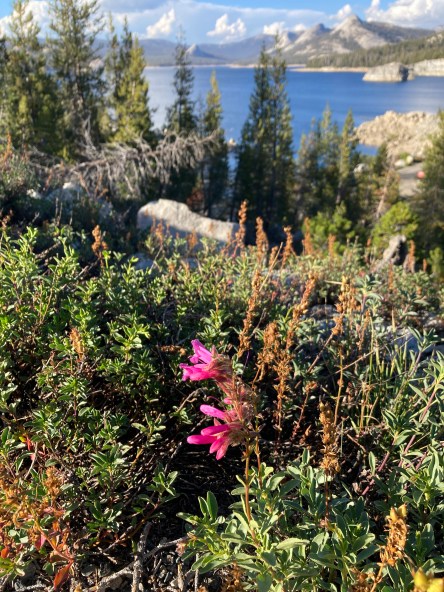
The last plant I will share has no connections to vinegar or tar; it is the favorite Mountain Pride, or Newberry’s Penstemon. In an average year, its flowers would have faded to brown by now, and in fact most of them have. But the snow hung on so late here this summer, till the end of July, that the earliest wildflowers had to wait at least a couple of weeks longer to emerge. I was happy to find one bloom of Mountain Pride still fresh and bright. These plants that sit overlooking the lake are a landmark for me, announcing at the end of my journey to the cabin, You have arrived!

Blue lake and golden squirrels.

I stood on the cabin deck watching the critters on the slope below, where they scrambled about, doing their work. After a while I pulled up a chair to the railing and watched some more. Squirrels and chipmunks had found the recent offering I’d made, seeds scattered in the little neighborhood as though from their heaven.
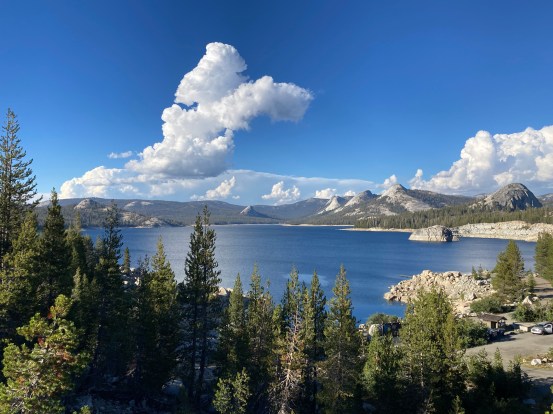
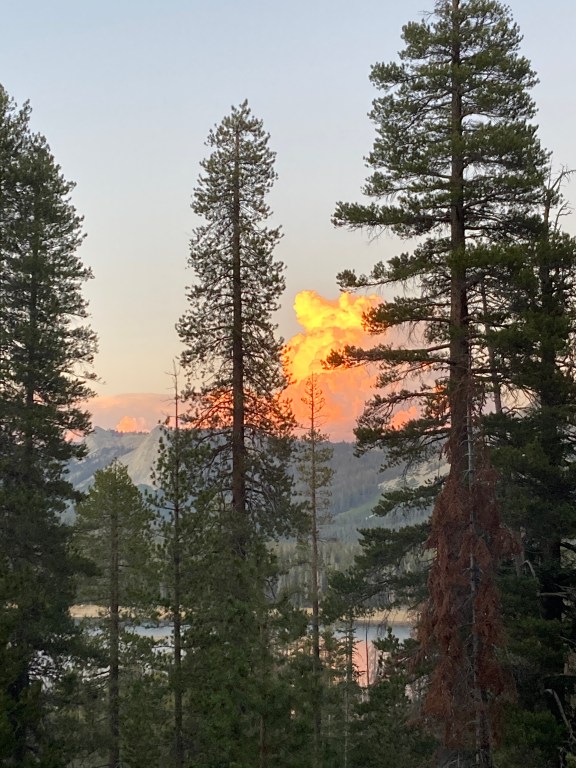
For several days I’m enjoying the mountain air at the family cabin in the High Sierra, over 8,000 feet in elevation. It’s cold this week, and the animals are no doubt storing food in their winter homes.

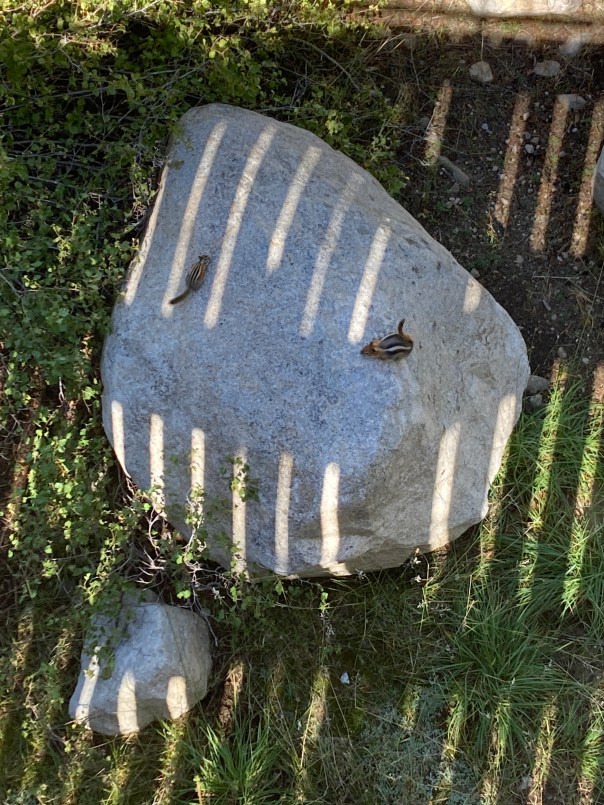
Right away I noticed that two species of small animals were present there, and I remembered the name of one, because of the many times my children and I had studied about them in the nature guides; any time our yearly camping trips took us to these Sierra Nevada Mountains, we would encounter them. The Golden-mantled Squirrel is the larger of the two, and the smaller is the chipmunk, likely the Lodgepole or Sierra Chipmunk.

Even after they discovered the seeds, the chipmunks spent time in the middle of the gooseberry bushes, hidden from view but making the branches rustle and sway. They must have been eating the dried remains of the berries. And the chipmunks especially like to play chase over and around the boulders, occasionally stopping for a second to tempt me to take their picture. I did get one blurry shot including both species.

Other than watching their fun, I’ve been taking in the cloud show that is ever fascinating, and I succumbed to the requisite first-day-at-the-lake nap. I’ve already thought of more things I want to share here, from my thoughts and observations, so probably you will hear from me again soon.

Prayers rise like incense from funerals.

Last week, I returned from Washington and my grandson’s wedding. On that travel day, before I left my Airbnb for the airport, I learned that a beloved sister in Christ, C., only 40 years old, had passed from this life after many years of suffering. It was arranged via texts while I was going through security at Sea-Tac that a friend of hers named Tia, who was coming from New York for the funeral, would stay at my house.

I’d left my place fairly disorderly, but as soon as I got in the house I changed the sheets on the guest bed, and made sure that a table was cleared, where we might sit to eat. I remembered to restore the setting on the water heater to normal. A brief glance out at the garden gave me hope that it could wait to be tended to. Soon came bedtime and I was very glad.

Tia and I met for the first time at the funeral the next morning. It was a typically lengthy Orthodox funeral, but it didn’t feel long, maybe because all the many and repetitive prayers seemed necessary to satisfy our hearts, and to proclaim the conquering light of the Resurrection in the face of death. Friends from three different parishes met that morning to pray at C.’s funeral, and it was comforting to be with so many people with whom we shared a love for this dear woman. If more time had been given, I wouldn’t have been surprised to see some of them pulling up chairs near the casket, just to sit a while with her sweet spirit. But that’s not the tradition. Instead, we will pray especially for her for 40 days, and be with her that way…

“For Thou art the Resurrection, the Life, and the Repose of Thy servants who have fallen asleep, O Christ our God, and unto Thee we ascribe glory, together with Thy Father, who is from everlasting, and Thine all-holy, good, and life-creating Spirit, now and ever unto ages of ages. Amen.” -From the Prayer for the Departed

The evening of her funeral happened to be the beginning of our celebration of the Feast of the Cross. Tia and I attended the Vigil for the feast, after a busy afternoon visiting with church friends. She was suffering jet lag, and I a more general travel fatigue, but we lasted till the end of the beautiful service. I still hadn’t been out to water the garden when we came home and crashed; I finally got to that after she departed the next morning.

The repose of such a young wife and mother, who had been a bright light in the world, was hard to feel easy about, even though we were glad that her suffering was ended. Not a month before, we’d said good-bye to a man in his 80’s who also had been ill for a while, and who no doubt is happy to have finished his race; but he had found the Church and a wife late in life, and it wasn’t comfortable in his case, either, for her or for any of us to let go of him. Is any human death insignificant, that we who are left behind can be left unchanged?
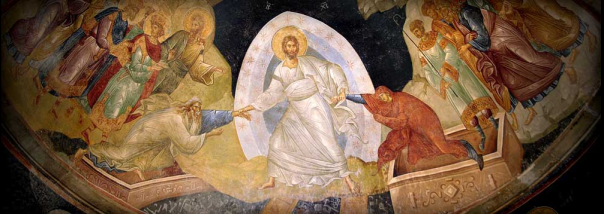
The day after the feast, another death in the parish. Lord, have mercy! Stephen’s passing has affected me the most, I think, of any since I became a part of this parish, because the total time the two of us were worshiping together in church far exceeds that of anyone else who has died. I heard early in the morning that he had died, and the whole day my mind and heart were so full of him, I could not attend to anything else. He was a good example of a living icon of Christ, always ready, “instant in season and out of season,” (II Timothy) to sing, to pray, to help anyone in need. And he loved my late husband, which means a lot. “He had love in his veins,” our rector said.

Last night the church was filled, for the singing of the first panikhida service for this brother. The gathering in God’s temple of our communal love, grief and Blessed Hope was a powerful experience for me, in a way I hadn’t known in the hundred other panikhidas I’ve sung in the past.

I realized that I was joining my heart – and my tears – with my late husband too, by my prayers, and with every soul whom God loves, no matter which side of death they are on. It made me oh so thankful for the Church and her traditions that impart these vital realities to us. Metropolitan Anthony Bloom expresses it very well:

“The life of each one of us does not end at death on this earth and birth into heaven. We place a seal on everyone we meet. This responsibility continues after death, and the living are related to the dead for whom they pray. In the dead we no longer belong completely to the world; in us the dead still belong to history. Prayer for the dead is vital; it expresses the totality of our common life.”

My grief is being changed into joy.