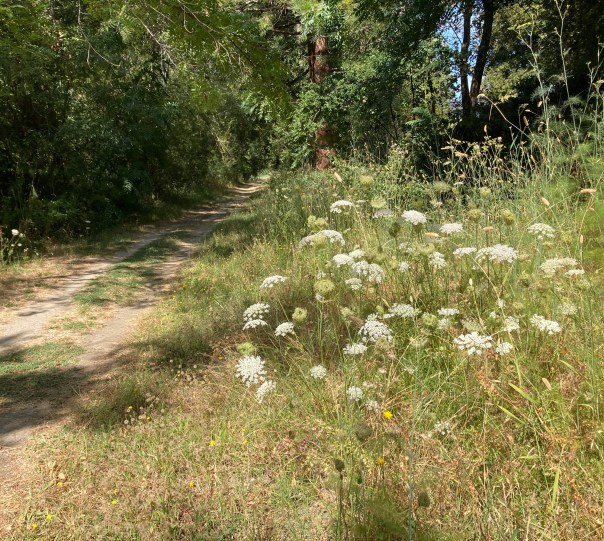
This morning I switched my walking route to the less-frequented, unpaved path by the creek, and I was alone down there. But for a minute I could hear above me on the paved path, behind the trees, a woman talking on her mobile phone. She had it set on speaker, and I could hear both sides of the conversation. The woman near me said, “How is your diet? Are you eating the right things?” and I caught the Woman-on-Speaker saying, “I just can’t eat salad,” after which Woman No. 1 said, “I know people think Special K tastes like cardboard, but I eat a bowl of it every night before bed. It helps me sleep good!” And then they were out of range….

That conversation is slightly connected, by being about things we do or do not eat, to the title I almost gave to this post, something about “Bristly Oxtongue” — but it was a little too rough. Now that I think about it, I do see why the plant was given that name, though when I have cooked beef (ox) tongue, I never thought of the bumps as bristly. And the botanical one I saw on the path was in its glory, such as that is, with prolific flowers on a 4-ft high plant. I have identified it in the past, but lately don’t tend to pay attention to the various thistly and bristly plants out there.
Another plant that is not my favorite, and which I wish I could keep far away from my garden, is Bermuda Grass. When I was growing up, the birds brought its seeds to the lawn my father had planted around our new house, and from then on it was a Bermuda Grass lawn, which has a lot to say for it in the dry and hot Central Valley of California. It needed watering less than weekly. It was a scratchy and coarse kind of grass to play on, and in the winter it goes dormant and brown, but it’s very hardy in every way. This plant has been encroaching from my neighbor’s back yard to mine for as long as I’ve lived here, and I am forever fighting its advance.

Today I realized that one reason this stretch of path is surprisingly green, is that it has a healthy crop of Bermuda Grass growing on the sides.
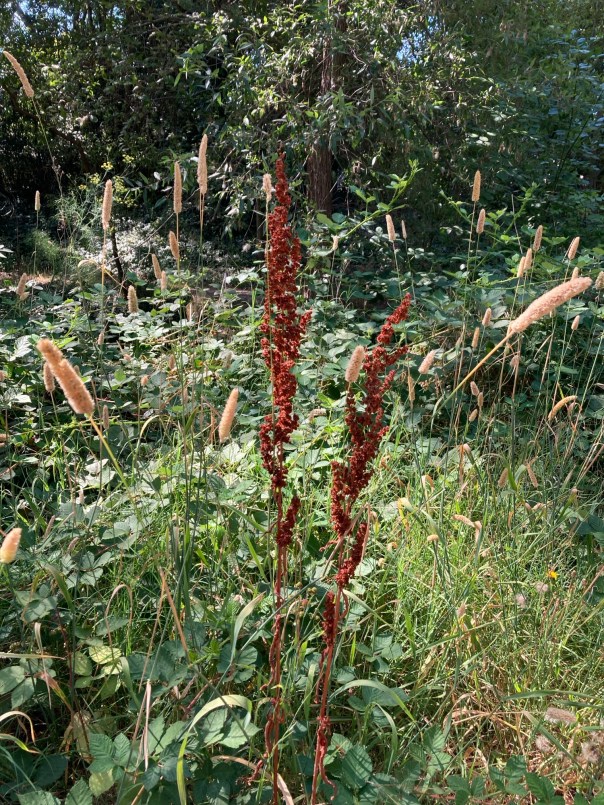
I saw quite a few other plants along the way. Curly dock reminds me of the rural bus stop of my childhood, where that plant was always growing.
Back in the home garden, my cultivated species are filling my cup of contentment. I have strawflowers for the first time, which the skippers love. If I didn’t have the ability to put a big digital photo here, I wouldn’t be able to see the long but miniature tongue the skipper is dipping down into that flower. Drink up, little skipper! Be my guest!


The plant you have been waiting for is the African Blue Basil — at least, that’s what the tag on the little pot said, that I brought home from the nursery. I just read about it online, and it says that the leaves are purple when they first sprout, and mine aren’t… It also is supposedly a perennial, which would be nice. It’s magnificent, and I saw two species of honeybees among the dozen or more were working it. It’s the latest dish that the pollinators are tasting on the smorgasbord in the Glad Garden.

 Gladsome Lights
It is sometimes interesting to catch snippets of conversations. I have enjoyed your thoughts and reminisinces about different plants – a bit like listening to another conversation 🙂
LikeLiked by 1 person
Speaker phone conversations…not sure how that fits out in nature. 🙂
It’s nice that you know the names of things you see growing. I do remember Bermuda grass in the past in Southern Cali. It does sound quite hardy!
Have a beautiful Sunday!
LikeLiked by 1 person
I have what I think is African blue basil. It’s got a basil-like scent, but flavor is a bit more muted and less of the anise note in Italian sweet basil. Your plant looks to me like Thai basil with its smoother smaller leaves.
What a fantastic shot of that sipping skipper!
LikeLike
Hmmm… you probably have more experience with various basils, but I did grow Thai basil once or twice, and this one is nothing like. I guess if it turns out to be a perennial, that will prove one aspect of its identity. Is yours perennial? (Maybe an annual in your location could act like a perennial?) This one bush is also much bigger and more compact than the Thai basil I had. If I had them in the garden at the same time, I might be able to compare the flavor, but right now this is the only one I have. I haven’t been using basil much in the last years, so I don’t plant rows of it the way I used to.
Wikipedia: African blue basil (Ocimum kilimandscharicum × basilicum ‘Dark Opal’) is a hybrid basil variety, a cross between camphor basil and dark opal basil. It is one of a few types of basil that are perennial. African blue basil plants are sterile, unable to produce seeds of their own, and can only be propagated by cuttings.
This particular breed of basil has a strong camphor scent, inherited from Ocimum kilimandscharicum (camphor basil), its East African parent. The concentration of camphor is 22% (compared with 61% for O. kilimandscharicum). The concentration of the other major aroma compounds, linalool (55%), and 1,8-cineole (15%) is comparable to many basil cultivars.
LikeLike
This is my first season with the African Blue Basil (got it at a plant share) so am not sure if it is perennial — it certainly is behaving like it.
On the other hand, I’ve kept an Italian Sweet Basil alive for three years by growing it in dappled light (bright shade) and plucking blooms as often as possible.
Here’s a photo of my Thai basil from a few years ago.
Maybe you have a unique hybrid of sorts!
LikeLiked by 1 person
Thank you for identifying Curly Dock, which I have often seen and wondered what it was. As for Strawflowers…they always remind me of my Mom who grew them in her garden and kept them in a bouquet all winter.
I haven’t heard of African Blue Basil but it sounds lovely. I just grow the regular Basil which I sowed much too early because it has grown lanky while no tomatoes have ripened as yet.
Bermuda grass sounds as invasive as Bamboo! In either case I think the only product that will kill them is Round-Up.
LikeLiked by 1 person
Oh, I do miss the wild black raspberries that used to grow in our yard! They seem to be gone the past couple of years.
I used to like Special K; it wasn’t one of the sugary ones.
LikeLiked by 1 person
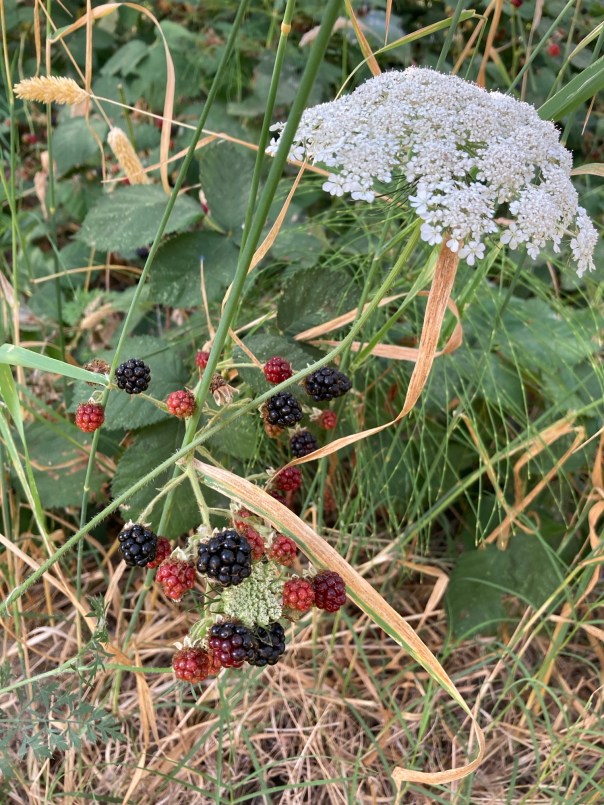
The berries that grow wild around here are Himalayan blackberries and are very invasive. We have a lot of them all over northern California, and we make good use of them! On our previous property, the back fence looked like in this short video https://www.youtube.com/watch?v=9VaoZ-UhhMI
and we had to dig out a lot of little starts before we could plant a garden. Even where I am now, I get an occasional plant sprouting up.
I haven’t seen any wild raspberries in my area, but I know they grow farther north in the same environment as redwood forests.
LikeLike
I think I would be tempted to take the unpaved path down by the creek quite often. The curly dock is a nice accent, don’t you think? My phone just recently identified the fiery skipper for me. I have much to learn!
LikeLiked by 1 person
Your bristly oxtail looks like our dandelion! So many pretty wild things. It’s interesting, isn’t it, how certain plants remind of us certain places or people. I never see dahlias without thinking of my mom or irises without thinking of my aunt. The phone conversation would be jarring when you think you are all alone (but when I’m walking alone with my phone, I do the same thing!)
LikeLiked by 1 person