All posts by GretchenJoanna

Unknown's avatar

About GretchenJoanna

Orthodox Christian, widowed in 2015; mother, grandmother. Love to read, garden, cook, write letters and a hundred other home-making activities.

They become resplendent.

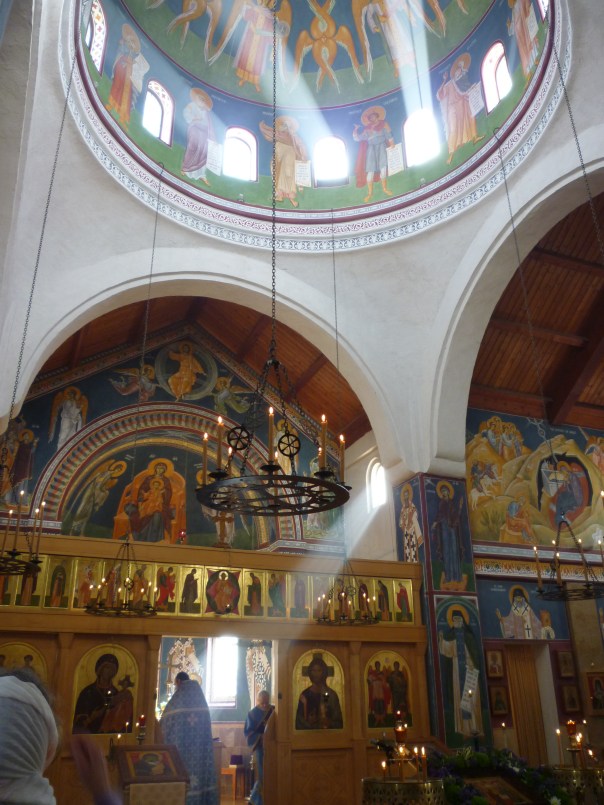
At the Feast of the Presentation of Christ in the Temple, we bless candles in church. I liked this letter from Abbot Tryphon in which he reminds us that the Light of Christ is what our lamps and candles represent, and what makes the saints shine:

“Vigil lights are placed before the icons of the saints, according to Saint Symeon the New Theologian, as a way of showing that without the Light, Who is Christ, the saints are nothing. It is only as the light of Christ shines on them that they become alive and resplendent.
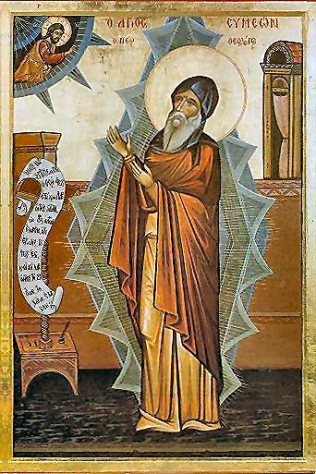
St. Symeon the New Theologian

“The saints show us what a glorious destiny we have in God, and through the example of their lives, point the way to our becoming ‘partakers of divine nature.’ The saints, as the cloud of witnesses in heaven, are present in the divine services, worshiping the Holy Trinity with us. They, as our friends, intercede before the Throne of God on our behalf, having won the good fight, and we are encouraged by the memory and example of their lives, as we struggle on our own path to God.

“It has been said that there are two kinds of people in the world: sinners who think they are saints, and saints who know they are sinners. A saint is a Christian who lets God’s light shine through, and whose life has been transformed by the power of the Holy Spirit.

“We venerate the saints as we seek their intercession with God, but we adore and worship only God in Trinity, the Father, the Son, and the Holy Spirit. We venerate the images (icons) as well as the relics of the saints and martyrs. Yet according to the decisions and Canons of the Seventh Ecumenical Council, this veneration relates not to the icons as such, but to their prototypes, or to the persons whom they represent.

“The interior walls of our temples are adorned with the icons and frescoes of the saints as a reminder that we are surrounded by the cloud of witnesses, the saints, and that the Church Militant (here on earth) is not separated from the Church Triumphant (in heaven). In Christ, death does not divide us, for the saints are not dead, but alive in Christ Jesus.

“Glory to Jesus Christ, Who is glorified in His saints.

“With love in Christ,
Abbot Tryphon”
What the birds do in January.

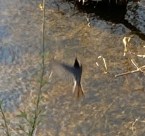
This afternoon I stood on a bridge overlooking the creek, and watched a Black Phoebe for about ten minutes. He would briefly perch on a branch near the surface of the water, and then fly up, do a quick whirl of an aerial pirouette, and come down on the same or a nearby twig. Over and over again… he must have been catching insects.
It took me a while to be sure that he was a phoebe. I had only seen those birds in my garden one other winter, some years ago. I tried taking pictures but that didn’t work out too well, as you can see.

Just down the path from the bridge, about half of the town’s wild turkey flock were grazing — eight of them to be exact. I took their picture, too, but they kept their heads down in the grass, and I really only got this presentable shot.

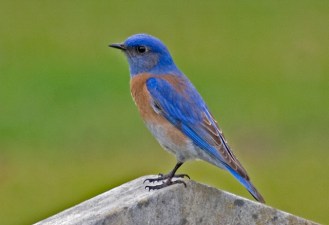
The birds that gave me a rush recently were bluebirds. Three of them were checking out my birdhouse several days in a row. First there was a pair: they flew back and forth  from the trees to what was designed to be a Bluebird House, but which chickadees have used most often; they sat on top briefly, they flew back to the tree. The girl went in the house, then the boy. Then a second boy showed up! He also went in the house to look. I can see they have some decisions to make, about their relationships and about where the family will start out. They all three sat on the fence for a bit, but it didn’t seem long enough to have the necessary conversations.

Our Western Bluebird, from the Internet

I hope the girl makes her choices before the chickadees show up to take a tour of my lodgings, and most of all I hope she decides on my place, and that it’s not too late. Though, come to think of it, the other time bluebirds hatched in there it was midsummer. Anyway, I’d love to see something like this again:

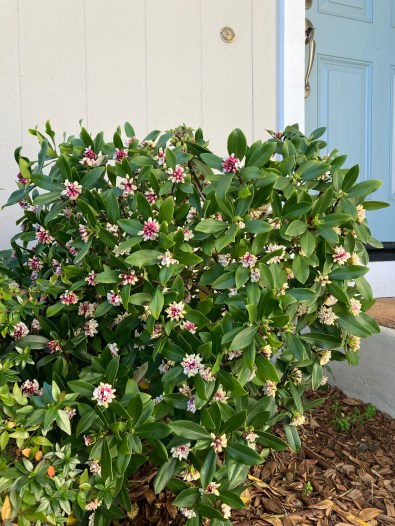
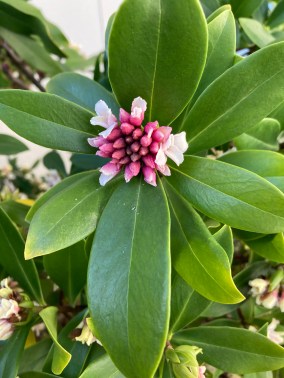
The daphne by my front door has been blooming like crazy this year; twice as big and flowery as last year, which means a double dose of its heady scent every time I come and go.

Tomorrow is the last day of January I will be doing that, but February is a good daphne month, too. It was in February many years ago now that my neighbor brought me daphne blooms at the birth of my dear Pippin. Who would have guessed that her bouquet back then would make me remember her so often, this far away in time, as I do nearly every day… The sweetness of the memory and the scent of the flowers by my door get mixed up together, and make winter delicious.

What is night will soon be day.

Ogden Nash makes me rejoice in the English language as it presents itself to his peculiar, playful mind. I liked this galloping poem, and won’t argue with it, because that’s not what humor is for. But I will say that the line I chose for the title of my post led me from laughing to silent theologizing…

TIME MARCHES ON

You ask me, brothers, why I flinch.
Well, I will tell you, inch by inch.
Is it not proper cause for fright
That what is day will soon be night?
Evenings I flinch the selfsame way,
For what is night will soon be day.
At five o’clock it chills my gore
Simply to know it isn’t four.
How Sunday into Monday melts!
And every month is something else.
If Summer on the ladder lingers,
Autumn tramples upon her fingers,
Fleeing before the jostling train
Of Winter, and Spring, and Summer again.
Year swallows year and licks its lips,
Then down the gullet of next year slips.
We chip at time with clocks and watches;
We flee him in love and double scotches;
Even as we scatter in alarm
He marches with us, arm in arm;
Though while we sleep, he forward rides,
Yet when we wake, he’s at our sides.
Let men walk straight or let them err,
He never leaves them as they were.
While ladies draw their stockings on
The ladies they were are up and gone.
I pen my lines, I finish, I scan them,
I’m not the poet who began them.
Each moment Time, the lord of changers,
Stuffs our skins with ephemeral strangers.
Good heavens, how remote from me
The billion people I used to be!
Flinch with me, brothers, why not flinch,
Shirts caught in the eternal winch?
Come, let us flinch till Time stands still;
Although I do not think he will.
Hark, brothers, to the dismal proof:
The seconds spattering on the roof!

-Ogden Nash

Hope is not a program for reform.

What is the difference between optimism and hope? One difference is that the word “optimism” is not in the Bible, and the word “hope” is. They are two distinct words and at least one of them is worth contemplating. I like to quote Fr. Alexander Schmemann on this topic:

“If there are two heretical words in the Christian vocabulary, they would be ‘optimism’ and ‘pessimism.’ These two things are utterly anti-biblical and anti-Christian…. Our faith is not based on anything except on these two fundamental revelations: God so loved the world, and: The fallen world has been secretly, mysteriously redeemed.”

Hope is one of the three foundational virtues of the Christian life, as this article, “Hope,” explains. Its description of the absence of hope tells us:

“The opposite of hope is despondency and despair. According to the spiritual tradition of the Church, the state of despondency and despair is the most grievous and horrible condition that a person can be in. It is the worst and most harmful of the sinful states possible for the soul.”

That’s why the title of an article in the current issue of The New Atlantis got my attention: “How Tech Despair Can Set You Free” by Samuel Matlack.

The author of this article discusses the philosophy of Jacques Ellul, and quotes him as saying, in Hope in Time of Abandonment, “You cannot talk about hope. The question is how to live it.”

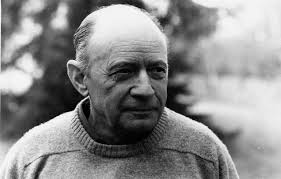
Jacques Ellul, 1912-1994

Matlack comments, “The reason you cannot talk about hope — or rather, cannot describe the action it takes — is this: Hope is not a program for reform, a solution to implement, or a prescription to follow. To borrow from the farmer and writer Wendell Berry, hope means ‘work for the present,’ whereas optimism means ‘making up a version of the future.'”

“What we do know is that Ellul’s own life bears ample testimony to hope. Here is one episode of many. Having lost his university position during the Nazi occupation of France, Ellul and his wife Yvette settled on a farm in a small village near the demarcation line, opening their door to Resistance fighters and Russians escaping German prison camps. With the help of neighbors — since Ellul knew nothing about farming — he grew potatoes and corn, with his wife raising chickens. As he once told the story, “I spent most of my time helping people get across into the free French zone. I was in cahoots with an organization that dealt in forged papers. So I was able to provide a whole series of people with forged identity cards.’”

About their own aims the editors of the journal from which I quote write: “Dystopian dread is the shadow of utopian dreams. The hope of The New Atlantis is to help steer away from both — and instead toward a culture in which science and technology work for, not on, human beings.”

In another article on this general subject, of how to live in a technological age, Alan Jacobs wrote in last winter’s issue; he also mentions Jacques Ellul as one of the early critics of the technological society in “From Tech Critique to Ways of Living.” It is accessible to read right now. And Samuel Matlack has written previously about Ellul, in 2014: “Confronting the Technological Society.”

There he writes, after Ellul: “What is needed is a true revolution, which Christianity by its essence is uniquely equipped to effect — being in the world but not of it, living the hope of a kingdom already here but not yet.”

True revolution is not a change in the political order, but has to be something far beyond that realm, and deeper; may the Lord show us the basis for our true Hope, and teach us how to live it.

Our soul waits for the Lord; He is our help and shield.
Yea, our hearts are glad in Him, because we trust in His holy name.
Let Thy steadfast love, O Lord, be upon us, even as we hope in Thee.

-Psalm 33