Orthodox Christian, widowed in 2015; mother, grandmother. Love to read, garden, cook, write letters and a hundred other home-making activities.
View all posts by GretchenJoanna →
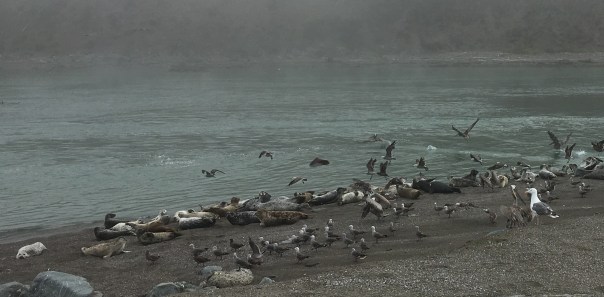
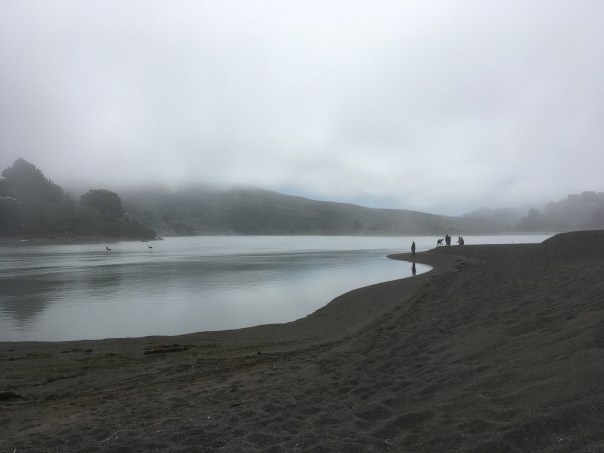
At least, that’s what it seemed to me they were doing. At Jenner-by-the-Sea so many Pacific Harbor Seals give birth and rear their young on the sand spits that they call it a rookery or a nursery. It’s where the Russian River opens into the Pacific along the North Coast of California, and the beach there is called Goat Rock. This photo shows them on both sides of the river, the town hidden by fog above the farthest shore.
My friend and I had made the drive to the beach pretty early in the morning, having been told by the weather people that it would be mostly sunny. It was not — but 60° and not windy is pretty good for this coastline, where beaches are not consistently sunny until August or September.
You’re not supposed to get closer than 50 feet to the seals; I think we were a little closer than that, but we stood quietly staring and none of the animals seemed to mind us or change what they were doing. The seals didn’t move much, but their various colors were interesting, and they would go in and come out of the water occasionally, or look up at us.
The pelicans were more thrilling, and even more numerous, flying back and forth or just hanging with the sea gulls and seals. But they were also harder to photograph! In the middle of the middle picture below, it’s pelicans who are forming a flotilla in the river. We didn’t see any diving to fish.
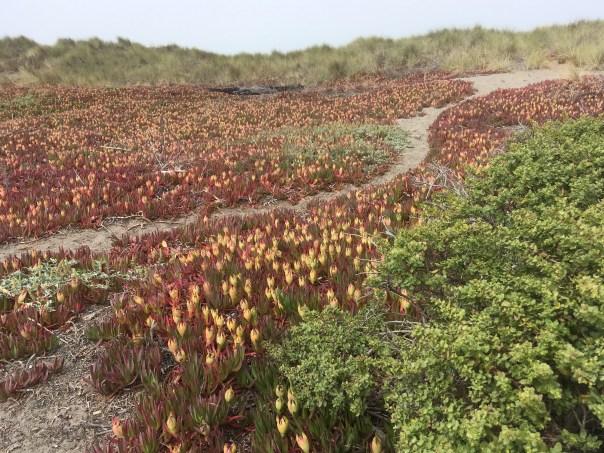
After stopping by another beach where we enjoyed some of that “mostly sun,” we took a slightly different route back inland along a narrow road where bright patches of wildflowers caught my attention, springing up through the dry grass.
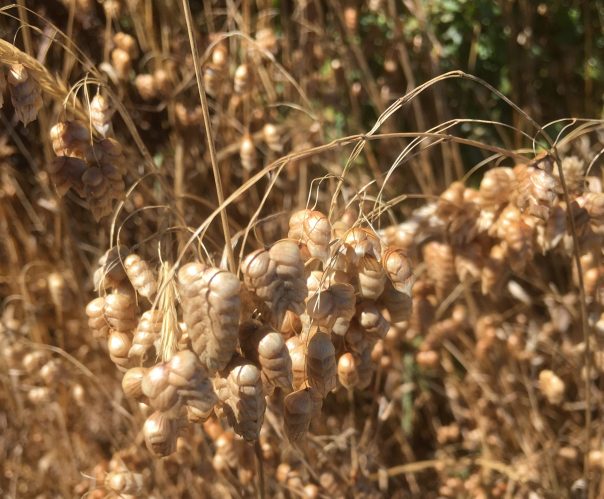
clarkiarattlesnake grass
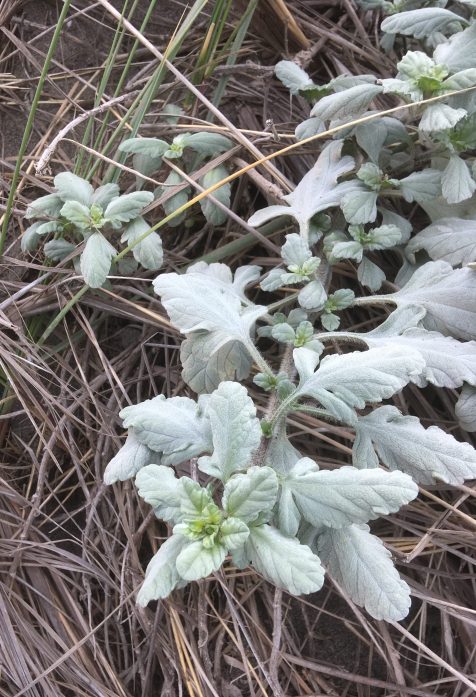
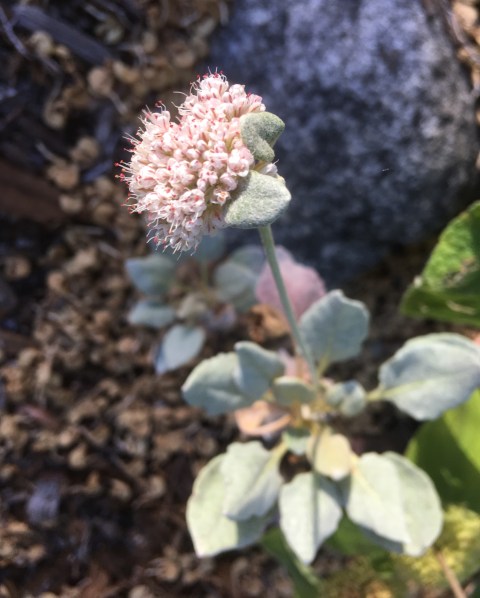
I especially noticed the leaves on the one just above, because they resembled those of the little native beach plant in my garden, Eriogonum latifolium or seaside buckwheat, that I bought at a local nursery three years ago. It has never bloomed, or even grown very much.
When I got home, I went out back to take a picture to compare, and what do you know? It is blooming right now!! And I do believe…
…it’s magic. Or if you will, a gracious gift of God.
toadflax
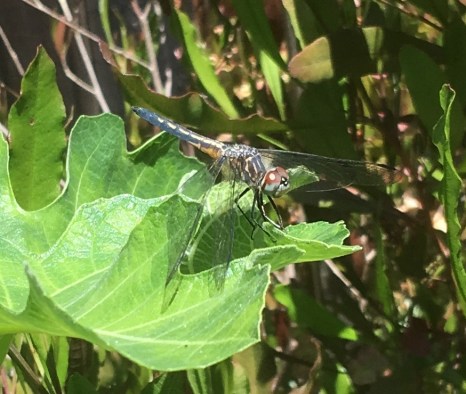
Wild animals frequent this space. In the past, I’d seen only the orange type of dragonflies on the property, but now, a different guy was just relaxing on a fig leaf. I walked all around the insect and talked to him, and he didn’t appear to flinch, so I stood right in front and met him face-to-face. His giant eyes did move about cartoon-like, seemingly trying to focus on my face, and his head side to side. Evidently I did not pose a threat; he remained calm, and I went back to work.
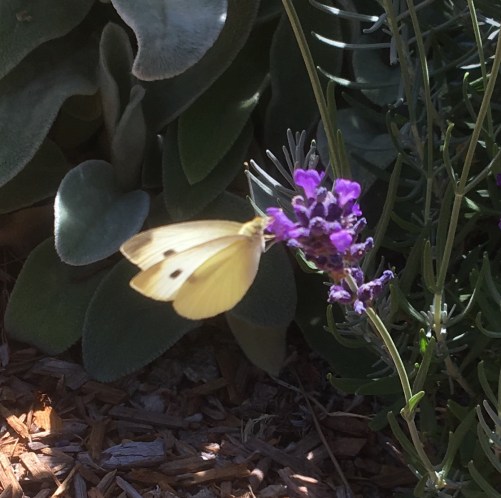
But then there was my own cabbage white hanging on a stem of lavender:
tarragon
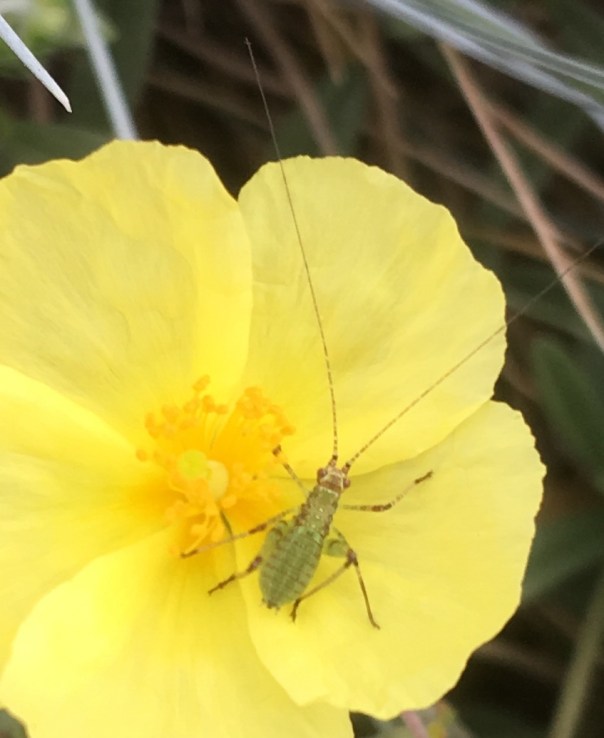
This next garden animal is so tiny, I am amazed that I even noticed him perched on a helianthemum flower that was an inch across. He came into focus once the photo was saved on my phone.
The birds are not tame. This morning, we were sitting or standing by the kitchen windows when Clunk! a smallish bird flew into the slider, and we looked up to see only a flash of vast patterned wings, as a raptor swooped under the patio arbor and with a whoosh carried off the little bird. That is the wildest event ever.
I was a gardener long before I had a blog — still, it’s surprising I didn’t tell my magic bean story here before. [Hmm… well, I did tell it, as the “related article” boxes below just revealed to me!] It started with friend Elsie… A Long Long Time Ago she and I used to share garden lore and harvest, and mysteries. The biggest mystery was how the special bean ever came to be growing in her vegetable plot.
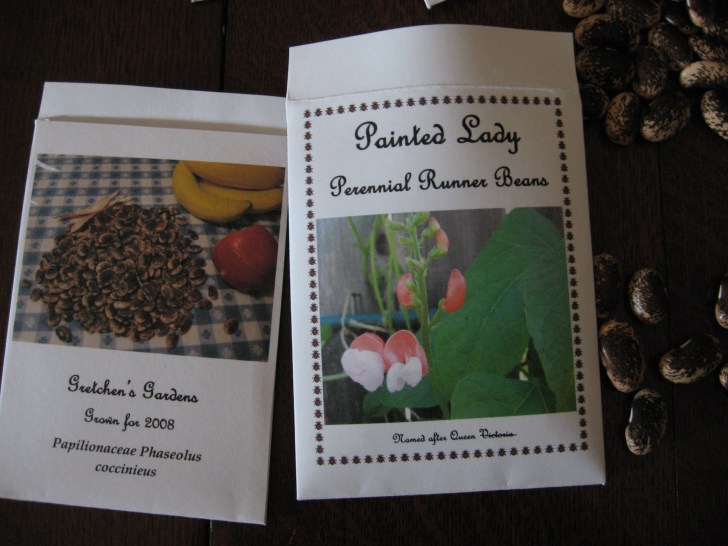
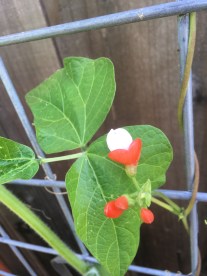
It must have been in 2006 at her house that she led me to a bed of earth next to a fence, to show me runner beans with big pods and pretty flowers. “Maybe you can tell me what this bean is,” she hoped. She always thought I might have the answers to any garden question. She hadn’t planted it, and her neighbors had no garden. I was clueless, but I went home and tried to find its picture online. It didn’t take long, even though at the time you could not easily find the seeds to buy. I read that only one runner bean has a bicolor flower, and this definitely matched the pictures of that variety called “Painted Lady.” Baker Creek Seeds in 2018 has this to say about it:
Traditional English bi-color grown since 1596! The name had mention to Queen Elizabeth I, ‘who was heavily made up with rouge and white chalk.’ The gorgeous flowers of red and white are among the most beautiful of flowering beans. The large beans are also good as snaps, freshly shelled or as dry beans, which are chocolate and tan mottled in color.
Just today I read on Wikipedia that this is a cultivar of the plain old Scarlet Runner Bean. They are all perennial, which is a great boon for someone like me who takes forever to get around to planting in the spring. The beans are pretty large, not the sort of seed you would imagine a bird dropping into the soil… Its appearance in our neighborhood and these other special features of the plant made it seem magic indeed, admittedly in a different way from those in the story “Jack and the Beanstalk;” but Elsie gave me seeds that fall, I planted them the following spring, and in a few months I had lots to give to friends in these packets I made, with an error in the name of the associated queen. Oops.
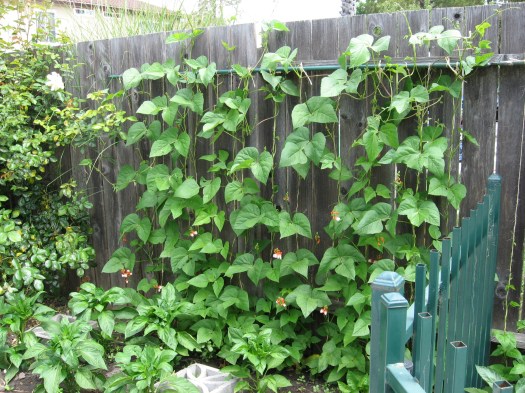
2007butternut,basil, and pole beans right now2018
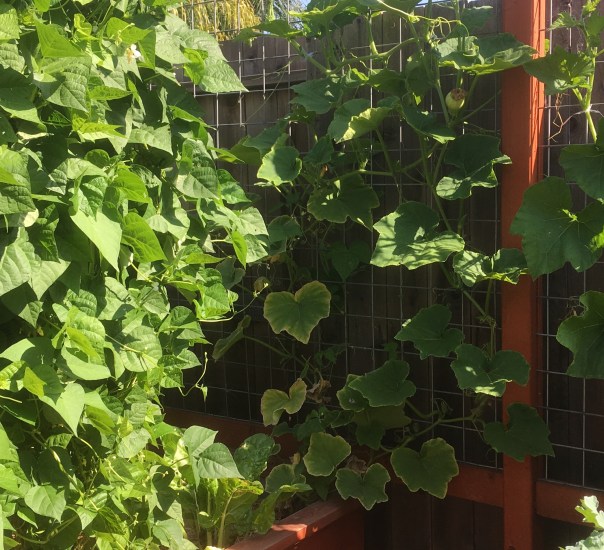
It’s been many years since these beans have been given a spot in my garden, but I found a handful of seeds of uncertain age to try training along with the butternut squash on my sturdy trellis — and they sprouted!
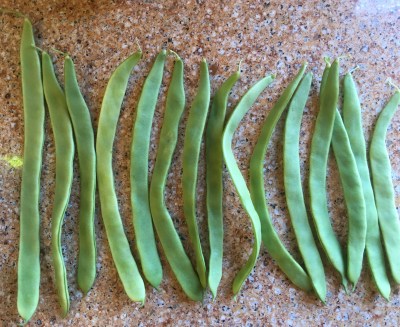
Nearby, the green beans named Blue Lake and Spanish Musica are reaching for the sky. I was lying in bed last night letting the poetry of bean names evoke images of Spanish ladies swimming in blue lakes, and composing a blog post about my wealth of beans. I had already made three pickings of the Spanish Musica, and Soldier came by to eat them with me — after I’d taken a picture of the last bunch, one of which was 11 inches long! They were very good eating, and their being stringless made them quick to prepare for the pot.
This morning at church the Gospel was the story of the Feeding of the Five Thousand. Father James’s homily ranged over the whole Bible and the goodness of God to feed us: The manna in the wilderness was a type of Christ, as He explained to His disciples at the Last Supper when they said,
Our fathers did eat manna in the desert; as it is written, He gave them bread from heaven to eat.
Then Jesus said unto them, Verily, verily, I say unto you, Moses gave you not that bread from heaven; but my Father gives you the true bread from heaven. For the bread of God is he which comes down from heaven, and gives life unto the world.
Then said they unto him, Lord, evermore give us this bread.
And Jesus said unto them, I am the bread of life: he that comes to me shall never hunger; and he that believes on me shall never thirst….Verily, verily, I say unto you, He that believes on me has everlasting life. I am that bread of life. Your fathers did eat manna in the wilderness, and are dead. This is the bread which comes down from heaven, that a man may eat thereof, and not die. I am the living bread which came down from heaven: if any man eat of this bread, he shall live for ever: and the bread that I will give is my flesh, which I will give for the life of the world.
Now we have the body and blood of Christ in the Eucharist week by week, imparting Christ the Bread of Life to us. Our homilist reminded us of the prayers that many people pray at meals, including those going back many millennia such as Jewish prayers like “Blessed art thou, O Lord our God, King of the universe, who bringest forth bread from the earth,” and “Blessed art Thou, O Lord, who feeds the world.”
When the theme of bread was added to the swirl in my head, a song popped up (naturally, because of Musica!) and joined in, one that our family used to sing as a grace before meals, part of Johnny Appleseed’s song adapted to the theme of dinner:
The Lord is good to me
and so I thank the Lord
for giving me the things I need:
the bread and the milk
and the bowl of beans;
the Lord is good to me!
It just so happens that I made bread last week, too, part of my ongoing project of combining “artisan no-knead” technique with my sourdough starter and experience. This latest effort was very satisfying, and makes me want to get another batch going tomorrow.
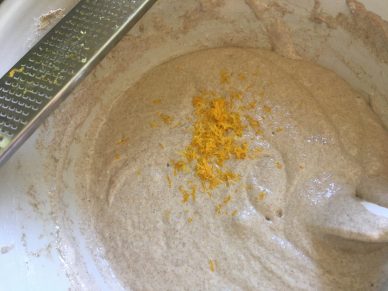
I assembled the ingredients for the Swedish Sourdough Rye on Tuesday…
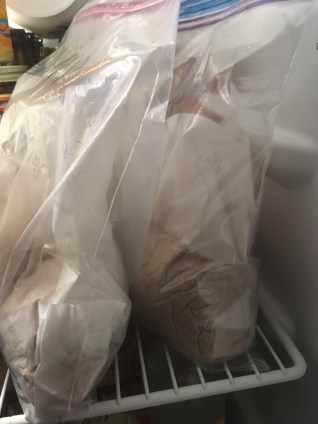
…and put two lumps of wet dough in the fridge in plastic bags.
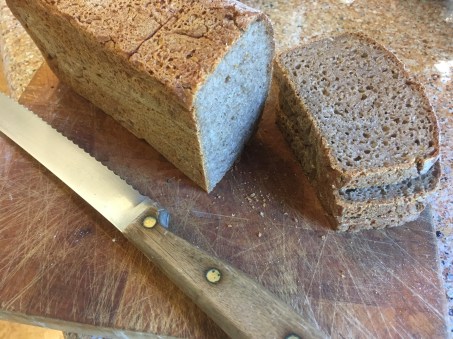
On Friday I baked one as a boule in the Dutch oven, and Saturday I baked the other in a bread pan, resulting in this 2-pound loaf:
It is incredibly moist, what they call a custardy crumb, and nice and sour, with the anise and caraway and orange peel I got the idea for from Mabel last fall in Tucson. I sort of forgot to put any white flour in this batch, though it has whole wheat flour with the rye, and it is therefore dense, but it’s not doughy or heavy.
I bought the book at right but have read only a couple of pages. Before it arrived I had perused many recipes online but was too intimidated by all the details to follow any of them. After you’ve baked bread in a rather relaxed (a.k.a. sloppy) fashion for 40+ years the idea of completely starting over step-by-step was paralyzing. So I picked up some general principles and hoped that I might learn by experimentation; I’ve been keeping notes on my own trials and results. But I don’t know if I will ever have a real recipe to share with you all. I do know what is working for me currently:
1) Keep the dough wet and loose, more runny than biscuit dough.
2) Let it spend a good amount of time in the refrigerator.
3) When you take a lump out to bake it, handle it gently and don’t knead.
4) Bake it hot, at 450° or 500°F, and for longer than seems reasonable.
It’s not easy to see, but in the center of the photo below the Spanish Musicas are reaching across the space to hold hands with the trellis climbers. The poem that is being played out in my garden is too elaborate a ballad for me to follow easily (though Albert will likely jump at the chance to translate it), but tomorrow I’ll go out in the garden and try to soak up a few more lines.
“I am quite convinced that the fundamental error of the contemporary man is his belief that thanks to technology –(telephone, Xerox, etc.)– he can squeeze into a given time much more than before, whereas it’s really impossible. Man becomes the slave of his always growing work. There is a need for rhythm, detachment, slowness.
Why can’t students grasp all they’re taught? Because they do not have time to become conscious of, to come back to, what they heard, to let it really enter their minds. A contemporary student registers knowledge, but does not assimilate it; therefore that knowledge does not ‘produce’ anything. A downpour of rain is immeasurably less useful for a drought than a thin, constant drizzle! But we are all the time under a thunderous downpour – of information, reports, knowledge, discussions, etc. And all of these flow around us, never sticking to us, immediately pushed away by the next deluge.”






 …it’s magic. Or if you will, a gracious gift of God.



 The Lord is good to me