Orthodox Christian, widowed in 2015; mother, grandmother. Love to read, garden, cook, write letters and a hundred other home-making activities.
View all posts by GretchenJoanna →
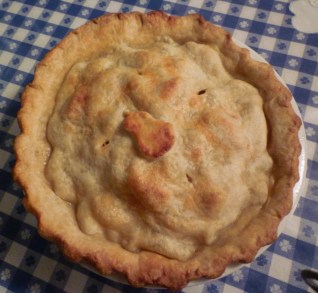
As I looked forward to National Pie Day — today, January 23rd — I’m afraid I let my thoughts swirl into heady daydreams that were like gusts of wind that pick up bits and pieces of litter here and there and then suddenly drop the lot in an untidy jumble.
First thought: Oh, Pie Day is coming again! I must bake a pie!
Thought #2: If I am going to all the trouble to make a pie, I might as well do more than one kind.
Harold and the Purple Crayon
#3: If I am baking more than one pie, I better invite some guests to help me eat them.
#4: Why not plan for 3-4 kinds of pie, and have a Pie Open House, say from 4-7 p.m. on Pie Day, to accommodate the schedules of several friends.
Another chain of events and thoughts brought me to my senses. Last week at our agape meal I was served a big slice of cheesecake, enough pie to last me a month at least. And this morning I reviewed my short-term goals and realized that Pie Day does not facilitate them…
Goals? Since when do I have goals? I am certainly not the goal-oriented type, but I am trying some wintertime goals this year that involve: 1) spending time in a large room that needs a thorough sorting and organizing, and it’s not the kitchen; and 2) ramping up my exercise to recover strength I’ve lost in the last two years or so — also not going to happen in the kitchen.
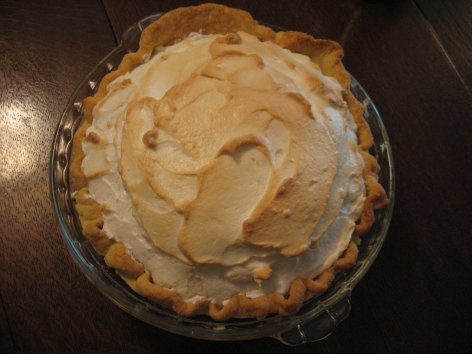
Leek Tart
If you let me count the ways I love pie, it might be that I love the idea and history and symbolism of pies more than the eating of them. I remember my grandma and a friend named Kris, either of whom could put together a pie and have it in the oven as easily as some of us butter a piece of bread. There was the time we watched my daughter Pippin form the first rustic galette I ever saw made, one of the select few pies ever to come out of the difficult oven in our mountain cabin. I recall happy days in the kitchen with the counters — and sometimes floors — white with flour, when I would revel in being able to accomplish this kind of nourishment for the body and soul.
In later years it has been easy to take pictures of these pastries, each one a unique event. When Mr. Glad was still my fiancé we never thought of taking a picture of the first pie either of us had made, as we worked together on it and laughed (afterward) about the Pie Predicament we ran into. But it is the one part of that Thanksgiving feast that remains in my mind.
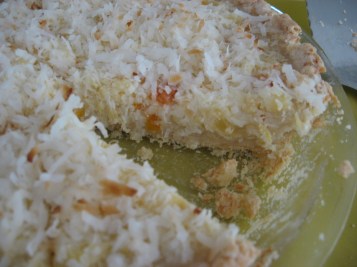
Vegan Pineapple Coconut Pie
When I am reading the recipes and remembering pies of the past, or rolling out the crust — or especially admiring one fresh from the oven! — I’m energized with creative joy and the idealism of family love and tradition. When I sit down to eat my pie, I am faced with — my weakness. I am one of those people for whom the wholesome enjoyment of that first bite quickly turns into a passion of the wrong kind.
Pie as an ideal and as memories brought me to the creative satisfaction of writing this post. Pie as a reality becomes something I too often consume with a lack of reverence. It’s not too late for repentance, you say? That is true; we must never stop repenting. 🙂 I won’t refuse gifts of pie, but this year at least I will let my celebration be mostly in words and pictures, without spending a whole day at it.
One thing I might like to do today is look around Blogland and see if any of you are baking and/or eating a special pie today. I will love to look at your pictures and celebrate together!
Only a few pages into Anthony Doerr’s Four Seasons in Rome, and I was enthralled; I began to want very much to make my own visit to that most historic and colorful city. But a chapter in, I realized that Doerr had brought me with him, and that my vicarious travels were so much more exciting and satisfying than anything I could accomplish in real life — all without the huge expense and strain of international travel.
“Energy pours off the traffic, off the sidewalks; it feels as if we are pumping through the interior of a living cell, mitochondria careering around, charged ions bouncing off membranes, everything arranging and rearranging. Here is a pair of stone lions with crossed paws; here is a Gypsy sleeping on a square of cardboard. Down the white throat of a street a church floats atop stairs.”
Stone Pines, aka Umbrella Pines, of Rome (internet)
Doerr’s year in Rome was certainly stressful, but he was young and strong, and was able to take his adventures, which any of us might know in the present moment as anxieties,dilemmas,pain and suffering, and turn them into prose that conveys not just a complainy travelogue, but his own engagement with the sensory overload of living in Rome, combined with being a new father. Fatherhood alone is such a transformative experience, it would give such a writer plenty of material for a book, but to have twins, and then to take them at six months of age to live in Rome, where you don’t even know the language, is exciting to the point of crazy.
“What did Columbus write in his log as he set out from Spain? ‘Above all, it is fitting that I forget about sleeping and devote much attention to navigation in order to accomplish this.’ Henry wakes again at two. Owen is up at three. Each time, rising out of a half sleep, it takes a full minute to remember what I have forgotten: I am a father; we have moved to Italy. All night I carry one crying baby or the other onto the terrace. The air is warm and sweet. Stars burn here and there. In the distance little strands of glitter climb the hills.”
Last year I read Doerr’s 2014 novel All the Light We Cannot See. All I did was run my eyes along the words and lines, and the author did all the magic of transporting me to another place and time, to rooms in Germany and houses in France, to the beach and along streets and into human hearts beating with fear and hope. I couldn’t help but love them, we were that close – and it was the writer who had brought us together.
It seems that he was already working on All the Light ten years earlier, while in Rome on a literature fellowship at the American Academy. It was a good thing he didn’t have to show anyone a progress report, because Rome and twins were all-consuming. He did write a lot of journal entries, which eventually became this delightful book.
During the Doerr Family’s year in Rome the twins didn’t let their parents sleep much. They also were very sick for weeks, and then Doerr’s wife Shauna ended up in the hospital. Pope John Paul II died, and a new pope was elected. The seasons changed, the husband and wife went on outings to Umbria, and the babies learned to walk. They watched the pines out the window:
“Mediterranean pines, stone pines, parasol pines, and umbrella pines—all the same thing: Pinus pinea. Regal trees, astounding trees, trees both unruly and composed at once, like princes who sleep stock-still but dream swarming dreams.”
In another place I read that Anthony Doerr likes to quote Victor Shklovsky, who wrote 100 years ago: “Art exists that one may recover the sensation of life; it exists to make one feel things, to make the stone stony. The purpose of art is to impart the sensation of things as they are perceived and not as they are known.”
And this is what Doerr tries to do – but first he must shake himself out of the habit of not seeing, this habit that he explains is quite necessary:
“Without habit, the beauty of the world would overwhelm us. We’d pass out every time we saw—actually saw—a flower. Imagine if we only got to see a cumulonimbus cloud or Cassiopeia or a snowfall once a century: there’d be pandemonium in the streets. People would lie by the thousands in the fields on their backs…..
“’Habitualization,’ a Russian army-commissar-turned-literary-critic named Viktor Shklovsky wrote in 1917, ‘devours works, clothes, furniture, one’s wife, and the fear of war.’ What he argued is that, over time, we stop perceiving familiar things—words, friends, apartments—as they truly are.”
If I did go to Rome, I’m sure I would be shaken out of my everyday way of seeing things. This has happened to me many times, being in a new place without The Usual surroundings and schedule and people in my life. Even the air smells different, and seems to wake up the brain. Reading Doerr makes me want to take off the blinders more often and really be attentive to what is bombarding my senses.
It could be scary, I know – or exhausting, as he warns:
“The gaze widens and drifts; the eye is insatiable. The brain drowns.”
“The Big Fountain” near the Doerrs’ apartment. Completed 1690.
So Anthony Doerr is very good at what he does, but he is more than a skilled observer and wordsmith; as he imparts to the reader what he receives from the world, his own warmth and humanity come with the package. He is a grateful and caring man who reveals his humble likableness in this very personal account. As he tells you what he sees, he can’t help but tell you who he is. When he looks at his little son:
“…his entire four-pound body motionless except his eyelids, it seemed he understood everything I was working so hard to understand: his mother’s love, his brother’s ceaseless crying; he was already forgiving me for my shortcomings as a father; he was the distillation of a dozen generations, my grandpa’s grandpa’s grandpa, all stripped into a single flame and stowed still-burning inside the thin slip of his ribs.”
When it is time for the Doerrs to return to their Idaho home, Anthony tries to put the experience of leaving Rome into words:
“I know nothing. I lived in Rome four seasons. I never made it through the gates between myself and the Italians. I cannot claim to have become, in even the smallest manner, Roman. And yet I can’t stop myself: a pen, a notebook, the urge to circumscribe experience. Roma, they say, non basta una vita. One life is not enough.”
I was grateful to visit Rome by means of this book, but of course, it was enough for me. I don’t have a bucket list of books or places to see or experiences to have, because if I ever start to think like that, I am reminded of the example of our Lord’s earthly life that was on the surface quite confined — He didn’t go to Rome, either — but was the expression of the best human life ever lived.
I could also be content not reading another book for the rest of my life, but I did just order Doerr’s collection of short stories, The Shell Collector, and in that way hope to see more wide views through his brain-drowning gaze.
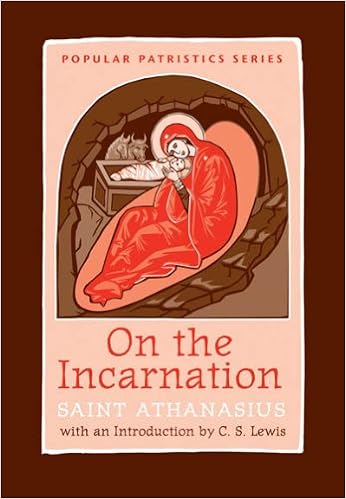
Athanasius of Alexandria has been highly regarded throughout Christian history, East and West. Today is one of his feast days In the Orthodox Church. I first heard of Athanasius when I was a Protestant, because his treatise On the Incarnation was recommended to me many times. I finally read it a few years ago at Christmastime, and found it very encouraging. I notice lots of discussion of Athanasius still going on in the blogosphere in this century.
Athanasius was born about 297 and was present as a deacon at the Council of Nicea in 325. It was he who suggested the word “consubstantial” (homoousion) to describe Christ’s relationship to the Father, in opposition to the Arians who believed Christ to be a creature. The word was immediately adopted and became an important point of sound doctrine from then on.
When Bishop Alexander of Alexandria died, Athanasius reluctantly consented to take the bishopric, and he remained bishop for 43 years, though he spent a total of 17 of those years in exile at the command of four different emperors, and was many times forced to leave the city under threats to his life. These incidents led to the phrase “Athanasius contra mundum” or “Athanasius against the world.”
I don’t need to repeat what I have written before, or tell you things about St. Athanasius that you can easily discover online, but I wanted to remember this important saint here. Here is are some excerpts from St. Nicolai in his Prologue for today:
Only for a while before his death did he live peacefully, as a good shepherd among his good flock, who truly loved him. Few are the saints who were so mercilessly slandered and so criminally persecuted as was St. Athanasius. His great soul patiently endured all for the love of Christ and, in the end, emerged victorious from this entire terrible and long-lasting struggle.
For counsel, for comfort and for moral support, Athanasius often visited St. Anthony the Great, whom he respected as his spiritual father. A man who formulated the greatest truth, Athanasius had much to suffer for that truth–until the Lord gave him repose in His kingdom as His faithful servant, in the year 373 A.D.
Through Athanasius, wisdom shone,
And the truth of God enlightened men.
The people recognized that wisdom is not bitter,
But, to all who drink it to the bottom, it is sweet;
To all who suffer for it, it is dear.
This looks like a ball of moss growing on a broken brick, but I think that the moss is growing all over something small and lumpish. I don’t know what. Maybe I will find out in the summertime. But it was a pretty thing I saw in the garden this afternoon.
After I finally got outdoors — the second time, after I came back inside for a hat and scarf — I found lots to see and do. I have resisted even going near the plum trees because I knew they wanted me to prune them and I didn’t feel ready, somehow.
First I had to hunt around in stacks of papers to find the directions and pictures that helped me last year. I did that yesterday. When I took the instructions out there this afternoon I still lacked courage, so I came back in a second time to watch some YouTube videos on pruning. I liked hearing nice men tell me I would not kill the tree so just go ahead. Some men threatened that I might actually damage the tree, but I didn’t listen to them.
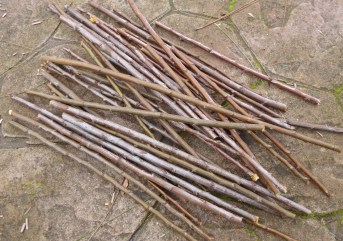
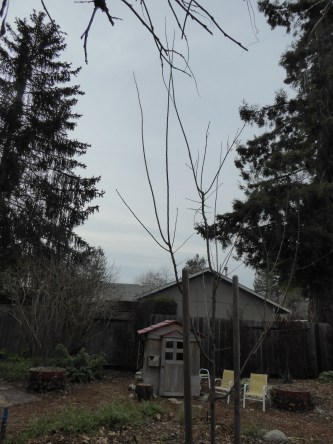
I’m only showing you the before picture of one plum tree, because I would rather no one sees my trees now until the blossoms beautify them. I saved the straight pieces of prunings for – something. They might come in handy.
A couple of weeks ago I spread a too-huge tarp over my little lemon tree to protect it against the frost, and when the danger was past I took it off so the tree could get light and rain. Of course I just left the tarp crumpled on the path. Today I decided to fold it up. It was too huge for me to wrestle by myself, but with the help of the patio table to spread it on I finally pinned it down. Unfortunately, it is wet. I’ll have to air it out on the driveway after the next spell of rain, but for now it’s tidied up.
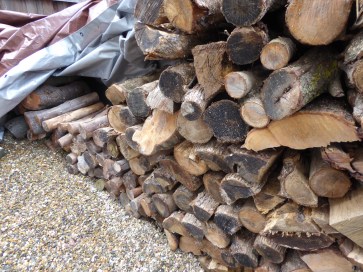
We weren’t allowed to burn wood today, but a storm is coming in tonight, and while it is raining the air quality is almost always good, and we can have wood fires. I’m expecting to be enjoying the woodstove for the next few days. My firewood is under tarps outside, to keep it somewhat dry, so I uncovered it enough to bring wood into the garage to stock the rack there. Right now I have oak, almond, and eucalyptus for fuel.
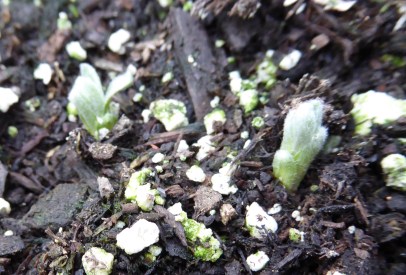
The cold and dark greenhouse is keeping some plants alive. I have been leaving the door open so that it doesn’t get too damp. The tarragon is little sprouts in a pot.
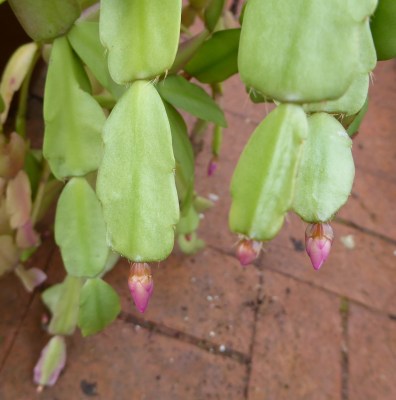
And the Christmas cactus is almost ready to bloom…
When it does, maybe that will be a sign for me to take down my Christmas tree!

 As I looked forward to National Pie Day — today, January 23rd — I’m afraid I let my thoughts swirl into heady daydreams that were like gusts of wind that pick up bits and pieces of litter here and there and then suddenly drop the lot in an untidy jumble.
 Thought #2: If I am going to all the trouble to make a pie, I might as well do more than one kind.



 It seems that he was already working on All the Light ten years earlier, while in Rome on a literature fellowship at the American Academy. It was a good thing he didn’t have to show anyone a progress report, because Rome and twins were all-consuming. He did write a lot of journal entries, which eventually became this delightful book.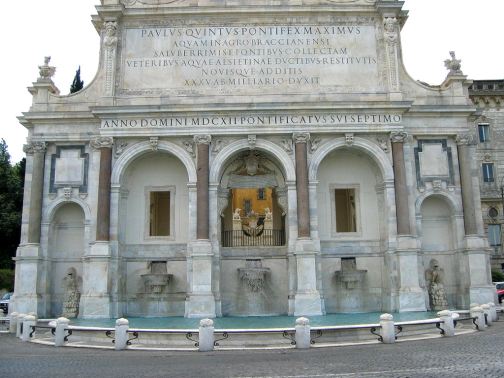
 Athanasius of Alexandria has been highly regarded throughout Christian history, East and West. Today is one of his feast days In the Orthodox Church. I first heard of Athanasius when I was a Protestant, because his treatise On the Incarnation was recommended to me many times. I finally read it a few years ago at Christmastime, and found it very encouraging. I notice lots of discussion of Athanasius still going on in the blogosphere in this century.
 sius that you can easily discover online, but I wanted to remember this important saint here. Here is are some excerpts from St. Nicolai in his Prologue for today:

 First I had to hunt around in stacks of papers to find the directions and pictures that helped me last year. I did that yesterday. When I took the instructions out there this afternoon I still lacked courage, so I came back in a second time to watch some YouTube videos on pruning. I liked hearing nice men tell me I would not kill the tree so just go ahead. Some men threatened that I might actually damage the tree, but I didn’t listen to them.