Orthodox Christian, widowed in 2015; mother, grandmother. Love to read, garden, cook, write letters and a hundred other home-making activities.
View all posts by GretchenJoanna →
The most dangerous thing to do on the spiritual ladder is to look back and see how far you have come. There is no room for “tracking your progress” here, for if you were to experience success, you would soon also experience self-satisfaction, which would completely negate all previous efforts. You must consider yourself always to be on the first step. God can raise you up to the tenth step at any time.
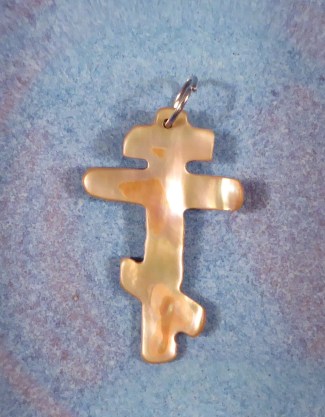
Today near the beginning of Liturgy I found myself standing close to my dear friends Mr. and Mrs. Bread. Mr. Bread whispered, “I have something for you,” and he put this gift into my hand, a little cross he had carved from abalone shell. I’ve been trying for an hour to take a photograph that shows all the colors that shimmer from it, and this is the best I could do.
It is so much more than a visual thing – I held it for a half hour before I could bring myself to put it away in my bag. So smooth and cool on its face, with gentle contours… I felt the need to keep stroking it with my fingers that were suddenly clumsy and large. I don’t usually have anything in my hands during worship, but its natural beauty and Christian meaning fit right in with the smell of beeswax candles and the chanting of prayers, and of course the icons.
Maybe next week I’ll be wearing it around my neck. 🙂
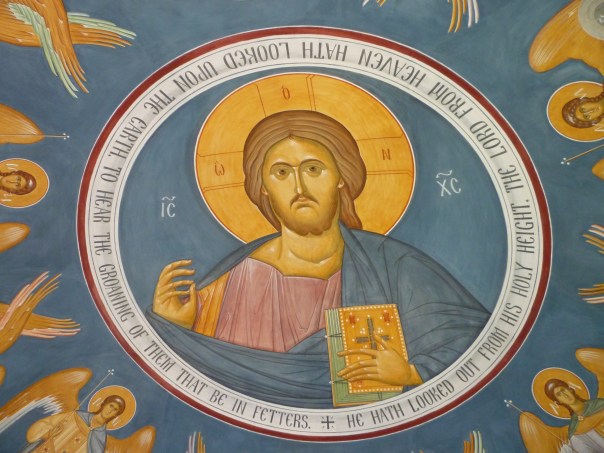
When the Fathers used the word “symbol,” they understood that something was actually, really and truly made present. A symbol makes present that which it represents. This is fundamental in the doctrine of the Holy Icons. In our modern world, a symbol represents something that is not there, it is a sign of absence. Indeed, because our modern world-view is essentially one of nominalism, we believe that the ancient notion of symbol is simply impossible. It feels like superstition to the modern consciousness. ….. But this brings us to my description of sin as not being a “legal problem.” St. Justin says that “sin defiles a man and his being.” This is not contemporary language. He means exactly what he is saying. It is of a piece with St. Athanasius’ description of sin as death, corruption and non-being. Sin is something, not just a thought in the mind of God. It kills us, and not because God is doing the killing. Sin is death itself. The “lawlessness” of I John 3:4 is the anarchy, chaos, and disorder of death and corruption. Sin is utterly contrary to the life that is the gift of God.
This is why St. Justin (and the Church) can say that the remedy of sin is holiness, the “synthesis and unity of all the holy virtues and grace-filled energies.” When we partake of the holy mysteries of Christ’s Body and Blood, they “cleanse us from all sin.” This is not a simple change of our status in the mind of God. His Body and Blood are life. They are the antidote to death, decay, corruption and non-being. They destroy the lawlessness that is the anarchy, chaos and disorder of death and corruption.
I first read this poem on Malcolm Guite’s blog – he included it in his anthology Waiting on the Word: A Poem a Day for Advent, Christmas and Epiphany, into which I dipped recently. It makes me think of my late husband, because we enjoyed, as most married couples must, that sweet and simple privilege of having someone at hand to whom we could say things like, “Honey, come out here and look at the moon!”
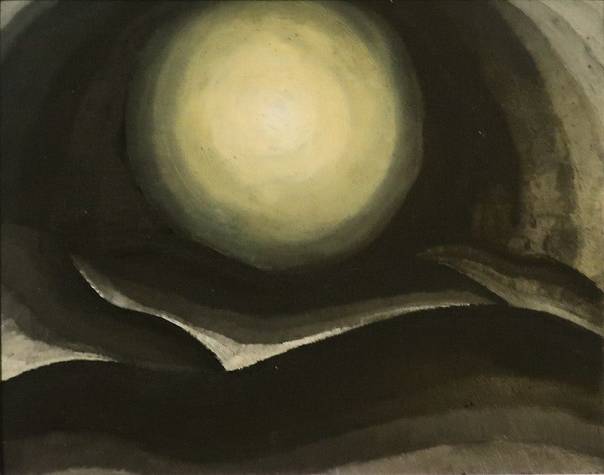
The Moon – by Arthur Dove
Tonight I was driving home from a meeting — the skies were clear midnight blue for the first time in ten days, just in time for me to get a view as long as my journey, of the “silvercoin full” moon hanging there. I wished that I could turn on my jets and angle straight up to talk to the Man who was smiling at me. I remembered the poem, and without thinking whether it made any sense, I said, “Mr. Glad, will you look at this moon!”
You might want to read on the poet’s own website, Grevel Lindop, from which he also links to Malcolm Guite’s presentation. Both of them feature evocative images to accompany the poem.
THE MOONS
Too many moons to fill an almanac:
the half, the quarters, and the slices between
black new and silvercoin full –
pearl tossed and netted in webs of cloud,
thread of light with the dull disc in its loop,
gold shaving afloat on the horizon of harvest –
How many times did you call me from the house,
or from my desk to the window, just to see?
Should I string them all on a necklace for you?
Impossible, though you gave them all to me.
Still some of their light reflects from memory.
Here it is, distant gleam on the page of a book.

 Today near the beginning of Liturgy I found myself standing close to my dear friends Mr. and Mrs. Bread. Mr. Bread whispered, “I have something for you,” and he put this gift into my hand, a little cross he had carved from abalone shell. I’ve been trying for an hour to take a photograph that shows all the colors that shimmer from it, and this is the best I could do.