All posts by GretchenJoanna

Unknown's avatar

About GretchenJoanna

Orthodox Christian, widowed in 2015; mother, grandmother. Love to read, garden, cook, write letters and a hundred other home-making activities.

A cookie might be a little seedy bun cake.

By the time I came into my husband’s family, Seedy Buns were only a memory in the minds of the older generations. My father-in-law said they were cookies featuring caraway seeds and a treat eaten at Christmas, but perhaps he got them mixed up with Seedy Biscuits? Because a bun is bread, we all know that, whereas a biscuit can be a cookie if it is in the British Isles. But what if you take a bun and sweeten and shorten it up? Might it be like a little cake?

I never thought of a cookie as being a little cake until I read The Little Book to my children very long ago. “A cookie is a little cake,” it says right there. I know that type of cookie, and I don’t really care for them. I like mine chewy or crispy, but not cake-y.

In my joyful Christmas cookie project, which is my art at this time of year, I had the idea to make a modern Seedy Bun that would hearken back to the ancestors who brought their Cornish traditions to California.

Once a cousin had taken a box of sugar cookie mix and thrown in a can of caraway seeds to create a simple reenactment, and I scoured the Internet to see what else might be out there as inspiration.


A fascinating collection of recipes from newspapers dating 1891 to 1981 gave a hint as to the possibilities, and included two poems mentioning a grandma or an aunt making caraway cookies. Here’s one of the recipes that even claims to make a crisp cookie:

It was published in Lincoln, Nebraska in 1919, and I think is interesting for its use of the word “butterine,” which I’d never seen before.

Early American cooks also used seeds liberally in their cookies, often coriander or caraway, and I liked the looks of a glazed cookie based on one from the first American cookbook published in 1796.

Cooks are like folk-singers, changing and adapting their material freely, and it’s not as though I am looking for The Original Seedy Bun recipe to cook myself, but it would be nice to know what those cookies were like, that my husband’s grandma made.

In the meantime I decided to try this recipe for lemony cookies, calling for ground caraway seeds which I didn’t have. I tried grinding some in the blender, but they only burned from the heat, so I used whole seeds.

Some of the baked cookies were a little skimpy on seeds, like the one I picture below. I’ll have to see how everyone receives them before I decide whether to make these the same way another time. If I make a different Seedy Bun, I might bake these again as well, without the caraway, because I agree with their creator about their appealing “depth and intensity” from the lemon juice and zest.


After my Seedy Lemon Biscuits were put away in the freezer, I heard from an older grandchild of my husband’s grandmother who, I was so happy to hear, had made a collection of Grandma’s recipes, and the first cookie in the collection was indeed called Seedy Buns.

Grandma’s Recipes

COOKIES:

Seedie Buns – 5 doz. These are similar to sugar cookies.

Sift and set aside: 3 C flour, 1 t baking powder, 1/4 tsp t salt

Cream in bowl: 1 1/4 C butter

Beat in until fluffy: 1 1/4 C sugar

Add: 3 eggs one at a time, beat well after each.

Blend in: 1 t grated orange peel, 1 t vanilla, 2 T caraway seeds

Chill several hours.

To form cookies take about 1 T dough and roll into ball.

Place on lightly greased baking sheet

Flatten to 1/4″ with bottom of a glass dipped in sugar.

Bake at 375 degrees for 8-10 min., or until lightly browned.

If any of my readers have favorite seedy cookie recipes, I’d love to hear about them. It’s not too early to start brainstorming for next year!

There He is!

Until I read the article below, I didn’t know that anyone considered the Bethlehem star to be something other than a “dead astronomical body.” I copied here a rich kind of Advent food, from our recent church bulletin, a meditation on light and stars.

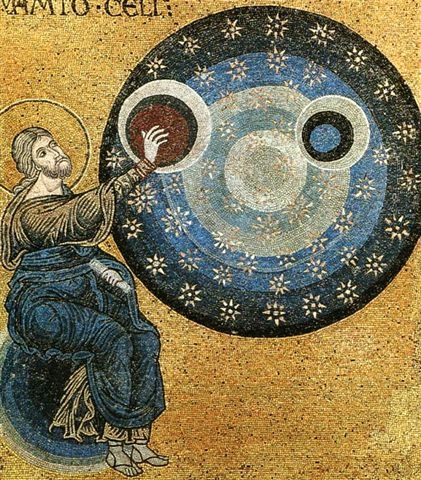
One of the pictures I found was of a “variable star,” which I had also not heard of before. That name got me thinking about how constant our Light of the World is by contrast, and never waning.

Though the stars we see in our skies are only dead shadows of the living realities, they too have their glory, which is only faintly conveyed by these pictures, though they do decorate this post nicely. We often hear that God is the True Light; this is not theoretical or a mere intellectual fact. Fr. Artemy exhorts us to know a taste of that Reality even in this life, in prayer:

The closer we come to the end of the [Nativity] fast, the brighter the wondrous Bethlehem star is enkindled above our heads, proclaiming to the Magi the time of the Infant’s birth, and the place where He lay…The rays of this rational star (according to the holy fathers, this star was actually an angelic power, and not a dead astronomical body) illumine with their incorruptible, unfading light the twilight in the Cave — the rib cage encasing each of our hearts…

The rays of this star bring the soul, which has but scarcely touched it, to inexplicable trembling and joy, the likes of which we shall not find here on this sinful world with its sensuous, quickly passing pleasures, disappearing like smoke.

I am…the bright and morning star (Rev. 22:16), testifies the Lord. And he that overcometh, and keepeth my works unto the end, to him will I give…the morning star. He that hath an ear to hear, let him hear what the Spirit saith unto the churches (Revelations 2:26, 28-29). 


Ye do well, repeats the Apostle Peter, that ye take heed, as unto a light that shineth in a dark place, until the day dawn, and the day star arise in your hearts (2 Peter 1:19). The morning star is hidden prayer of the heart! It is made not with lips or fingers, but with the mind and heart; it turns all of man’s existence to the Lord, and places the disciple before the most radiant face of his Teacher…

Illumined by the unwaning light of the Nativity star, let us pass…under the canopy of the very cave in Bethlehem…There He is, the Angel of Great Counsel, the King of the world, the Father of the age to come, as the “Old Testament Evangelist,” the Holy Prophet Isaiah, exclaimed in prophetic, sober inebriation. There He is, the Yearning of the nations, the Expectation of all peoples, the Great Light that has come into the world to enlighten those sitting in darkness! Already celebrating the Forefeast of the Nativity night that is bright as day, let us sing…with the whole Church, “Christ is born, give ye glory…Christ is on earth, let us be exalted. Sing unto the Lord all the earth…” [Nativity hymn].

–Father Artemy Vladimirov

variable star

It cheers my heart like spirit’l wine.

I have just discovered the 18th-century hymn “Jesus Christ the Apple Tree,” on this G.K. Chesterton site., where you can read good meditations on its meaning. It is thought to have been written by a New Englander, and has been set to various tunes. The most common seems to be the one by Elizabeth Poston, of which this video records a nice rendition.

The hymn has become associated with Christmas, and I’d like to add it to our own family’s collection of carols, at least by next Christmas. “Under the shadow I will be, Of Jesus Christ the apple tree. ”


Not a single place dark or unhappy.

We have been ill around our house, and could not get going on the Christmas tree project until this week. Now we managed to get it up and decorated.

I cut off our homemade wood-shaving angel in the picture so I’m showing a close-up in the next. Mr. Glad did nearly all the tree-trimming this time, after he went all by himself to get the tree, a Noble Fir grown in Oregon.


Anna wrote last week about various Advent and Christmas trees she has known, and it made me want to remember some trees of the past. Her post includes a photograph of a large and dramatic Christmas tree in Norway.


I don’t have anything that old, but at right is a picture of me in a red sweater in front of a 1950’s tree. And at the bottom of the page, a little tree that the sister in the photograph gave me more recently. I like best to have birds and fruit and pine cones on my tree, and I never did like tinsel.

The boy at left (now our Soldier) is posing by a tree from a minimalist era, when a friend let us cut from his property a wild and untamed specimen, on which we don’t appear to have strung lights. But how strange and exciting for young children to have a tree in the house for a while, even undecorated.

Below, this year’s tree before trimming, to go with a sweet poem e.e. cummings wrote.

little tree
little silent Christmas tree
you are so little
you are more like a flower

who found you in the green forest
and were you very sorry to come away?
see i will comfort you
because you smell so sweetly

i will kiss your cool bark
and hug you safe and tight
just as your mother would,
only don’t be afraid

look the spangles
that sleep all the year in a dark box
dreaming of being taken out and allowed to shine,
the balls the chains red and gold the fluffy threads,

put up your little arms
and i’ll give them all to you to hold
every finger shall have its ring
and there won’t be a single place dark or unhappy

then when you’re quite dressed
you’ll stand in the window for everyone to see
and how they’ll stare!
oh but you’ll be very proud

and my little sister and i will take hands
and looking up at our beautiful tree
we’ll dance and sing
“Noel Noel”

–e.e. cummings