The charming children we get to know in the recent documentary “Babies” are, at the end of the film, struggling to become toddlers, persons enjoying the upright posture that is a mark of homo erectus. They don’t even think about it, because it seems to be a given that children want very much to stand up and walk.
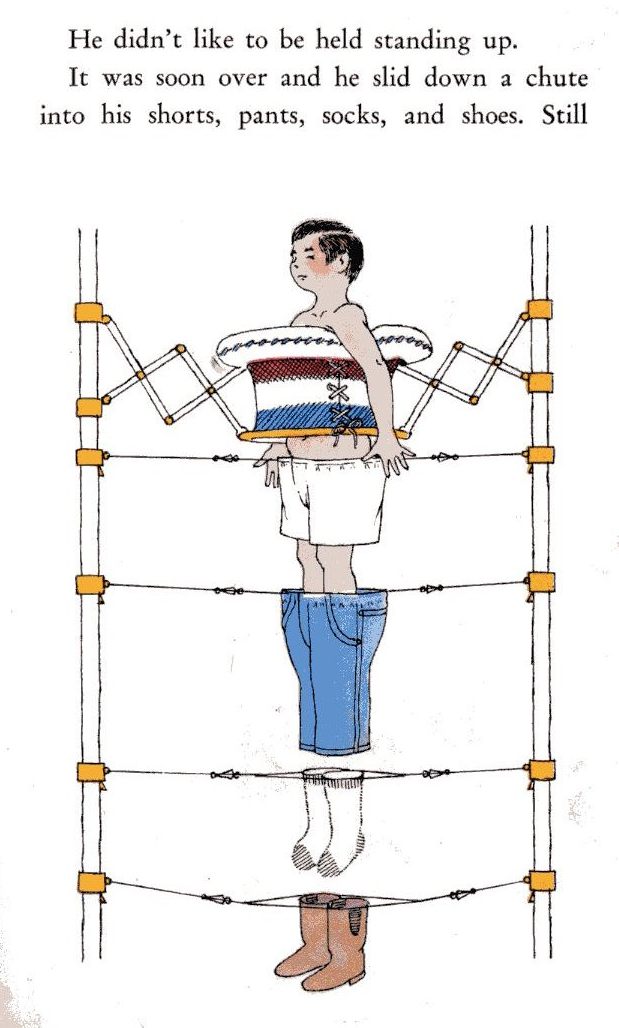
That is, unless you are Lazy Tommy Pumpkinhead, who lives in an electric house that does everything for him; Tommy can’t bring himself to get out of bed or even stand up without assistance. But his story is meant to teach any self-respecting child to be self-respecting, to be human, and not lazy. He is the hero of a children’s book I liked to read to our children.
In the chapter on “The Human Form,” in his book The Hungry Soul: Eating and the Perfecting of our Nature, Leon Kass examines how the erect and forward-facing posture that distinguishes us from most of the animal world contributes to our outlook and coordinates with our calling to be lords of creation, as it were. He takes many of his foundational ideas on this subject from the neurologist-psychologist Erwin Straus, and from his essay titled “The Upright Posture.”
In my reviews I’m skipping around in the book, but I should explain that the first chapters make a case for the primacy of form. That is, all living beings are more than a collection of the same kinds of particles. Even though absolutely all our material is replaced during our lifetime, we retain the same recognizable form. And as this is a book about the human soul, the subject is next narrowed to the human form. From there the author goes on to discuss what humans do with these bodies.
The uprightness of our form is what I am trying to stick to in this post. I think of this a lot now, when I wake up in the mornings and am lying in bed for at least a few seconds. Rarely do I have to get up with an alarm clock, for which I am grateful. And at this time of my life no baby is demanding that I get up to feed her and no child will be late for school if I linger a bit. This morning when I woke I realized that God had answered my prayer to be wakened in time to go to Bridegroom Matins, so I hopped out of bed.
But it isn’t always so easy. Wouldn’t it be lovely if we could keep that verve that children have, that makes them get up, or cry to be let out of their cribs, as soon as they wake up? It seems that God gives us a special grace, when we are new to the world, to work hard at standing before we know what work is.
Though upright posture characterizes the human species, each of us must struggle to attain it. Our birthright includes standing, but we cannot stand at birth. Feral children who have survived in the wild were not found upright but were able to become so. As with other distinctively human traits (speech, for example), human beings must work to make themselves do or become what nature prepares them to be or do. Upright posture is a human, and humanizing, accomplishment.
Kass quotes Straus:
Before reflection or self-reflection start, but as if they were a prelude to it, work makes its appearance within the realm of the elemental biological functions of man. In getting up, in reaching the upright posture, man must oppose the forces of gravity. It seems to be his nature to oppose nature in its impersonal, fundamental aspects with natural means. However, gravity is never fully overcome; upright posture always maintains its character of counteraction.
And Kass elaborates:
Effort does not cease with rising up; it is required to maintain our uprightness. Automatic regulation does not suffice; staying up takes continuous attention and activity, as well it should, inasmuch as our very existence is at stake. Awakeness is necessary for uprightness; uprightness is necessary for survival. Yet our standing in the world is always precarious; we are always in danger of falling. Our natural stance is, therefore, one of ‘resistance,’ of “withstanding,’ of becoming constant, stable.
It doesn’t get any easier, does it? As we get older and weaker, the temptation is to sit down more often. I notice that tendency in church, where in my tradition we stand during the services, which means for one or two hours at a time we stand. What better attitude could we take toward The Holy Con-substantial Life-Creating Trinity?
Yes, we can prostrate ourselves, and I know people who do that when their ailing backs prevent their standing in prayer. But I notice in the Bible that after people fall on their faces before messengers of God, they are told to stand up. The Psalms speak of standing in His presence, and in the New Testament we are told, “…having done all, to stand.”
Stand firm, stand in the gap, stand still and see the salvation of the Lord…The posture is both a metaphor for and a support to our efforts, the whole Christian life being a struggle against laziness, even to the point of, “Let us labor therefore to enter into that rest.” (Hebrews 4) Perhaps if I stand a little longer than is comfortable in church, or work a few more minutes at my household chores before sitting down, it will make me call out to God and ask for help to be the kind of person He wants.
And if I doubt my ability, let me remind myself, “You’ve been doing this your whole life, resisting gravity, walking this precarious walk against natural forces that want to pull you down. You can keep doing it, you can!” I will call to mind the words of T.S. Eliot: “Only those who will risk going too far can possibly find out how far one can go.” And not forgetting the difference between the metaphor and the reality, I’m only too aware that some people who are no longer able to stand with their bodies are standing in the gap for me.
As to lying in bed, for most of us it is a near necessity, though the saints’ lives testify that some of them avoided it like the plague. One wants to avoid the condition described in Proverbs 26, “As a door turns on its hinges, so a sluggard turns on his bed.” I haven’t yet figured out how exactly it fits in without spoiling my thesis, but I have to mention my dear G.K. Chesterton’s delightful essay, “On Lying in Bed,” in which he cautions tongue-in-cheek against legalism and hypocrisy, mostly about how early one rises:
A man can get used to getting up at five o’clock in the morning. A man cannot very well get used to being burnt for his opinions; the first experiment is commonly fatal. Let us pay a little more attention to these possibilities of the heroic and the unexpected. I dare say that when I get out of this bed I shall do some deed of an almost terrible virtue.
 This drawing of Lazy Tommy illustrates what happens after he is all dressed and fed, and the long afternoon stretches ahead of him with nothing to do but propel himself up the stairs — not walking, but crawling, it should be noted — but his bed is the attraction that gives him that much energy.
I like this picture, only because it shows that even Tommy is capable of struggling. Maybe we could think of him as a late bloomer, crawling when he should have learned to walk — but at least he is showing some spunk. At the end of the book he experiences enough discomfort resulting from an electrical outage and the failure of technology that he resolves to “turn over a new leaf.”
As I finish this post we are in Holy Week. All through Lent I wanted to write something about the wonderful midweek services that we have (and at which I hope to worship tonight), but it seemed to be beyond my ability to capture even a bit of the sweetness in words. One thing I love about them is that all the Psalms that are called Songs of Ascent are read at each service. And the last of those, Psalm 134, provides a fitting picture of our souls’ posture before our God.
Behold, bless ye the LORD,all ye servants of the LORD,which by night standin the house of the LORD.Lift up your hands in the sanctuary,and bless the LORD.The LORD that made heaven and earthbless thee out of Zion.
Other posts on this book: The Hungry Soul — Intro (Why I love this book) and The Hungry Soul – How Science Disappoints