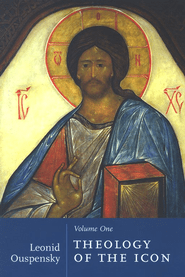
 In church to commemorate St. Herman of Alaska today, we also remembered the iconographer Leonid Ouspensky who died in 1987. He was born in Russia in 1902 and while still a teenager began to be an activist for the cause of Communism, going about preaching atheism and destroying icons. He joined the Red Army in 1918 and was captured by the White Army and forced into their service; after the war he ended up in Paris in a community of artists. The following tells what happened there that changed the course of his life:
“Looking at [a collection of icons], Ouspensky understood that the icon was something that had no equivalent whatsoever…. Ouspensky…made a bet with Krug that he could easily paint an icon even though he was a non-believer. He painted an icon of the Mother of God in a fortnight. But while he was working on it, he understood that it was holy and could not be the object o f a bet and burned it. From that moment, he would regularly settle down at Grinberg’s place to contemplate the icons at length, trying to penetrate the mystery and understand how they were made. This is how little by little he became a Christian and an iconographer. We can rightly say that the icons themselves led him to faith.”
His life story has many twists and turns with elements of suffering and adventure, and obvious interventions of God’s grace and mercy. He went on to paint many icons and to teach others, and write books on the subject. You can read more about Ouspensky here: orthodox wiki and here: iconeorthodoxe .

 To convey to our imagination an abiding sense of the world’s goodness and givenness, artists require a vocabulary capable of such representation. Many of the conventional aesthetic resources of the contemporary arts are well suited to expressing anxiety, alienation, chaos and violence, but are not as capable of evoking innocence, simple purity, or quiet delight. (I’m more and more convinced that the omnipresence of relentless rhythm sections, even in love songs, is an expression of the mechanistic and brutish presuppositions of a culture convinced that all life forms are the end-result of a mindlessly competitive process of mere survival.)

 Gladsome Lights