




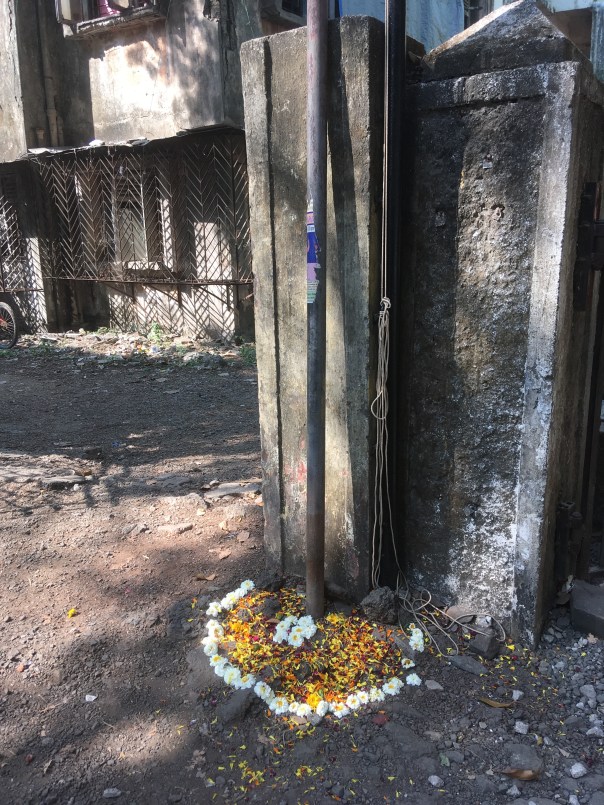
 My first few days in India, I told Kate and Tom that one of the top things on my list of things to do was to buy picture postcards to mail back home to my old-fashioned friends. Wait — it’s not just the old-fashioned who like that, but even people who themselves never resort to paper correspondence or postage stamps are normally more than glad to discover a postcard from a faraway place in their mailboxes.
Neither of them had noticed postcards for sale anywhere during the many months they’ve been in India, but we read online that the huge General Post Office has them; you might have read in a previous post about my failure to find any there. But Tom did buy stamps that day.
Last week a visitor to our new baby suggested The Bombay Store closer to home, so a few days ago Kate and I took the baby in the car and spent a long while shopping there, but they didn’t sell postcards, either. They told us to go to the local post office, which we actually tried to do immediately after, but couldn’t locate it where the driver remembered it had been….
So Friday Kate suggested we go and check out the post office on foot; Tom had the car and driver on business. She had found a different such office on her phone and it looked like a short walk. Since it would be such a brief outing we left fed-and-sleeping Raj with Kareena. It was the hottest time of day, and temperate winter weather for these parts, i.e. about 90 degrees. We felt it.
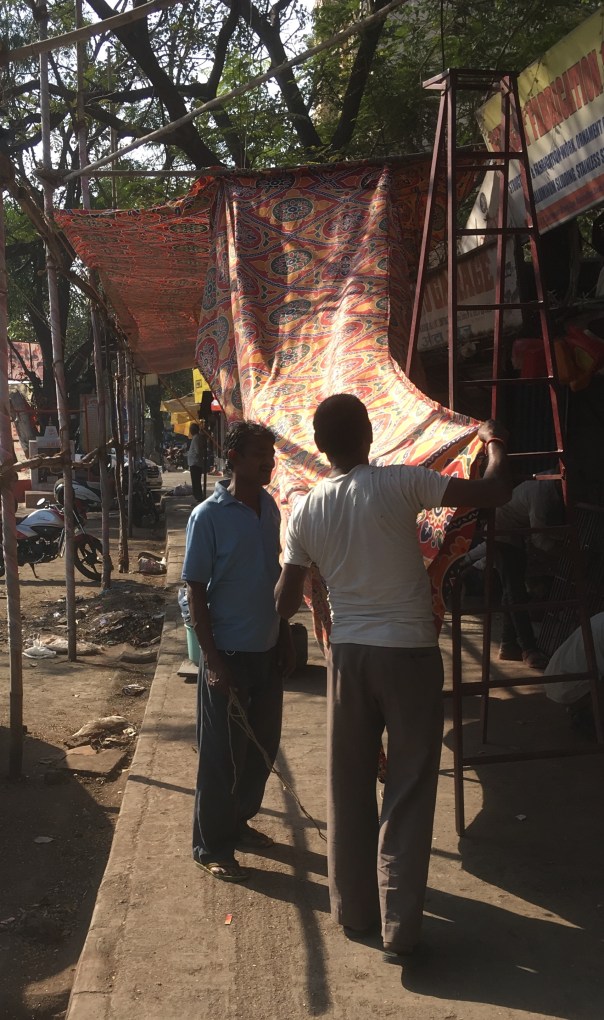
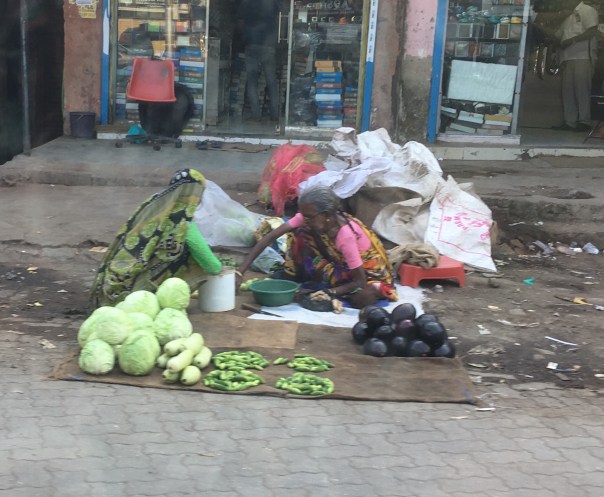
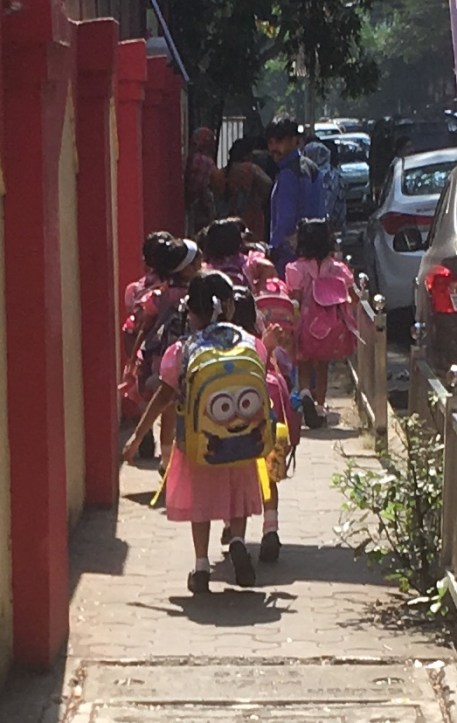
We maneuvered in traffic and squeezed between parked motorcycles. We picked our way over broken sidewalks and walked alongside the moving rickshaws and buses in places where the sidewalk was missing. Early afternoon, the sidewalks were crowded with people, including schoolchildren like these in pink uniforms who were about to enter the gate of the convent school down the block.
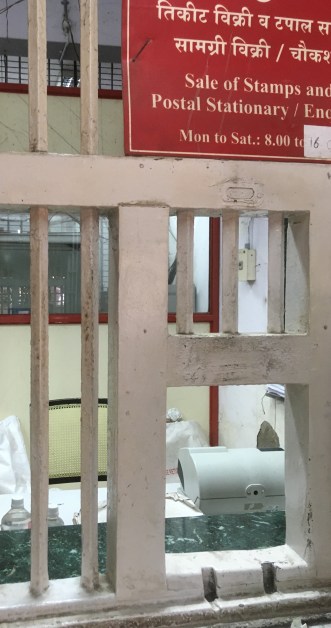
The post office was pretty easy to find. We walked up to the window that said Stamps and Stationary [sic]. The woman behind the grille said, No, they did not have postcards. She asked another patron nearby whose English was better to help us, and he gave us vague directions, waving with his arm, to a bookstore down the street “on this side,” where he assured us we would find what we were searching for.

I decided to buy stamps while we were there, on faith that I would eventually have something to stick them on. I laid rupees enough for ten stamps on the green marble counter, and was handed three bills in change. Then we waited. The postal lady was eating her lunch.
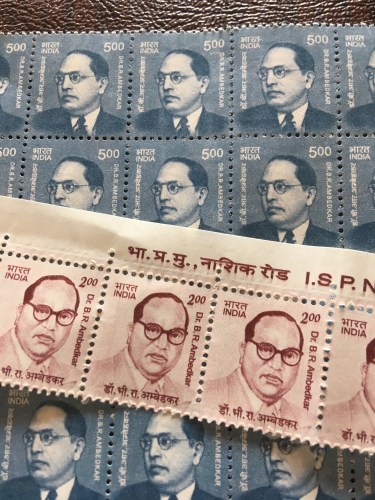
When she had eaten the last bite, she cleaned up her desk and had one more swig from her pink water bottle. After another few minutes she passed my stamps through, with instructions to put “one of these, and four of these, on each postcard.”

On we went to look for the bookshop. Kate was also on the lookout for a chemist to see if they had diapers. We did find a chemist on the way, where the packages contained too few diapers, but I bought four shrink-wrapped pills for 12 rupees. A rupee is worth about one and a half American cents.
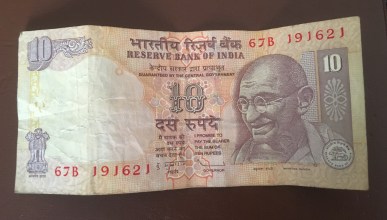
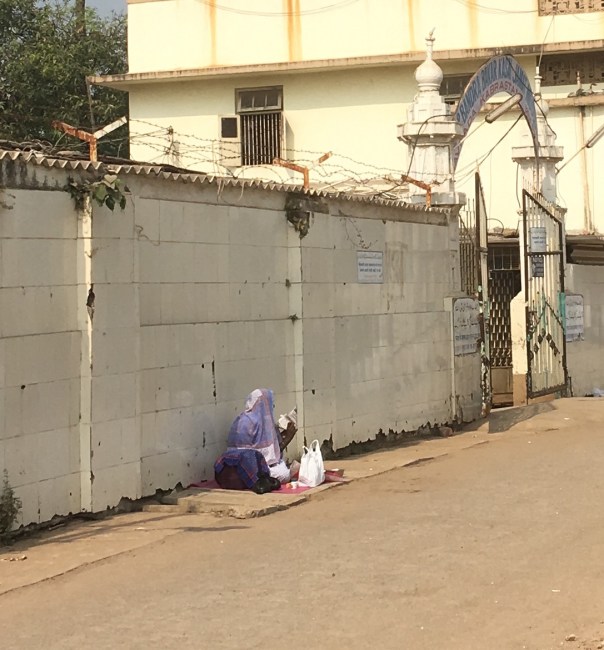
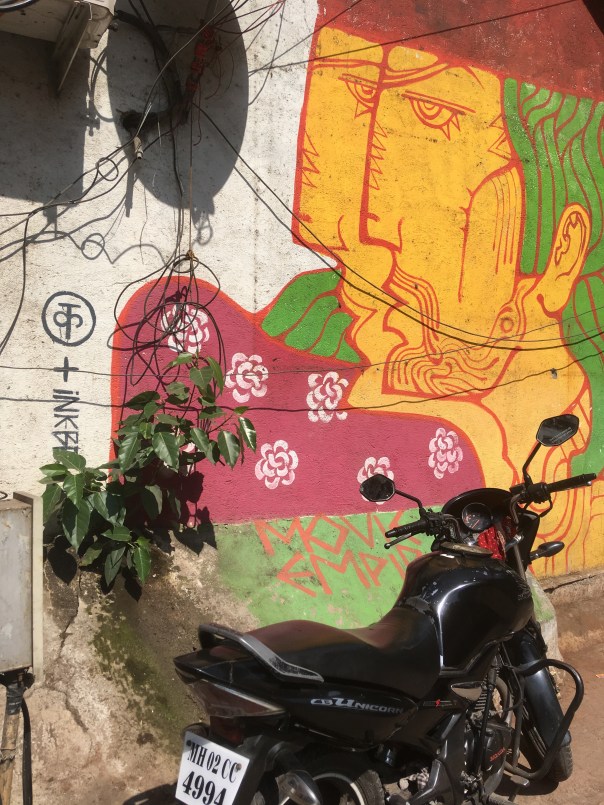
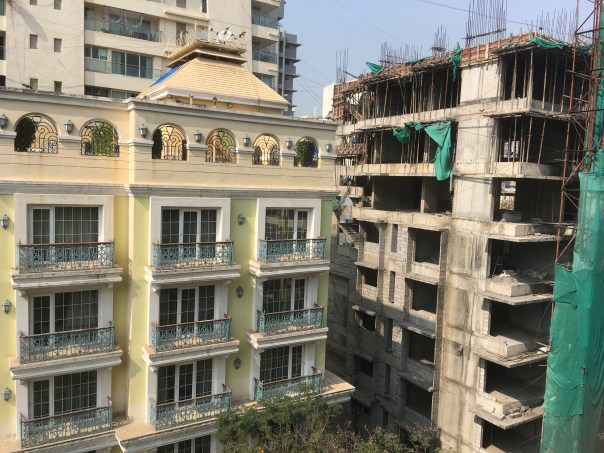
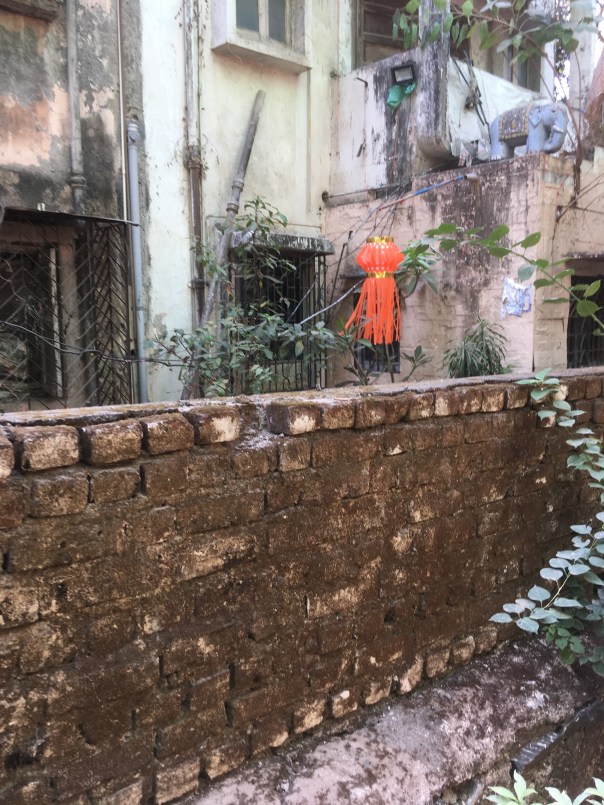
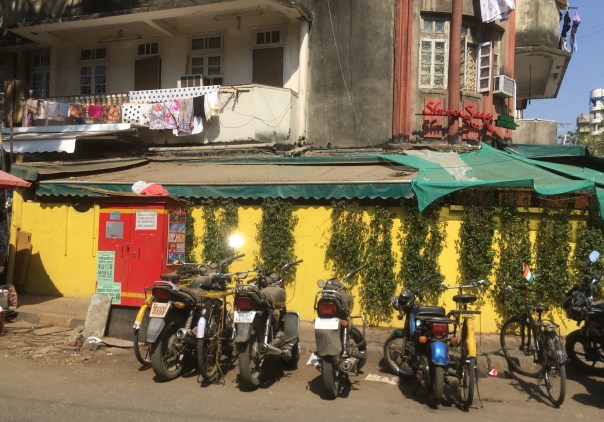
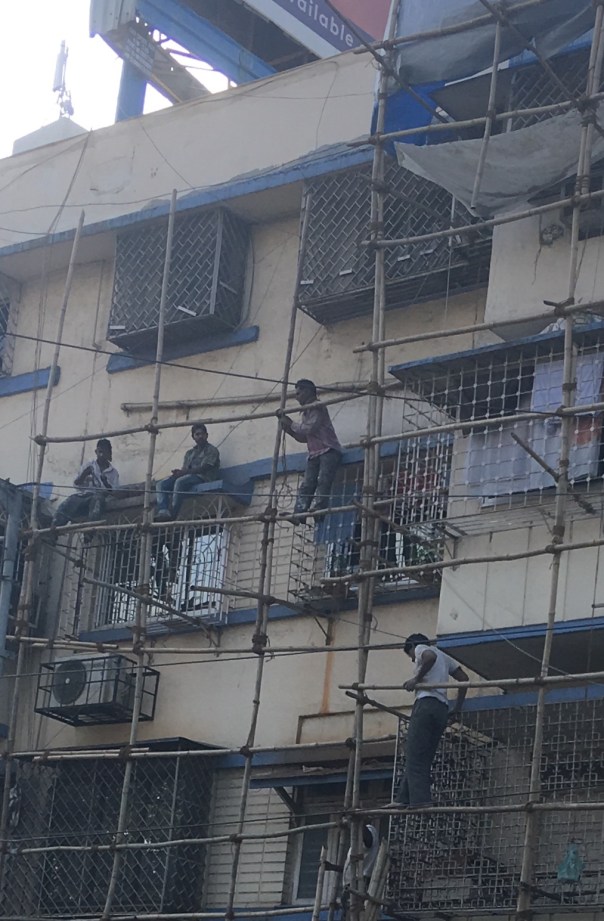
Oh, and the ATM: we stopped by the little room off the main bank building, staffed by two attendants/guards, and used our U.S. debit cards to pull out rupees, a limit of 5,000 rupees per transaction. Along every sidewalk I saw sights that made me glad I had my camera ready.

Now, where was that bookshop? Crossing back and forth through busy intersections — there were some helpful traffic lights on this street! — and with Kate following her Google map, we finally found it, and entered. Why of course, the bookseller had postcards; a new supply had just arrived in the shop the morning before. His business is to make his customers happy, he emphasized, as he took a few packets from a small stack behind the counter.
Kate deliberated with me over which collections to choose, based on the subjects listed on the back of the package, and not able to see any of the actual cards. I wanted pictures of everyday scenes such as I have actually experienced, and not the big tourist spots, most of which I won’t see.

It seemed clear from the brief text and the covers that these were the sort of postcards I was looking for, and I bought two packs of 20 each, Wallahs (merchants) and Mumbai Buzz, just to be sure that I would find a few that I actually wanted to send, once I saw them. I noticed then that the name of the shop printed on the bag was The Happy Book Stall.
When at home we all examined all the cards, we were amazed at the “vintage” quality. The photos appear to have been taken about 25 years ago, and the print quality is worse than that. The word art would not be associated with most of the pictures in any way, except of the sort of interesting framing that can randomly happen when you give a camera to a five-year-old.
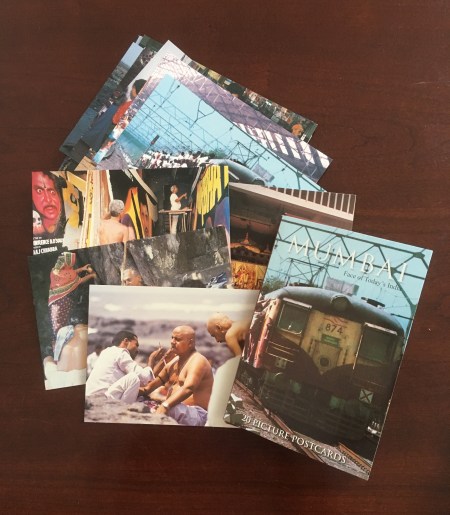
But I’m very pleased! I’d still like to see if any others exist in town, so I will keep my eyes open, but now I’m ready to start my picture postcard correspondence. And I saw so many sights on this short outing; if I had my printer and my card stock paper, etc. I would make my own postcards. But then I would be missing something I can’t put my finger or my words on — because there’s no doubt this collection I have acquired is accidentally telling a story about India.
 Today near the beginning of Liturgy I found myself standing close to my dear friends Mr. and Mrs. Bread. Mr. Bread whispered, “I have something for you,” and he put this gift into my hand, a little cross he had carved from abalone shell. I’ve been trying for an hour to take a photograph that shows all the colors that shimmer from it, and this is the best I could do.
It is so much more than a visual thing – I held it for a half hour before I could bring myself to put it away in my bag. So smooth and cool on its face, with gentle contours… I felt the need to keep stroking it with my fingers that were suddenly clumsy and large. I don’t usually have anything in my hands during worship, but its natural beauty and Christian meaning fit right in with the smell of beeswax candles and the chanting of prayers, and of course the icons.
Maybe next week I’ll be wearing it around my neck. 🙂 
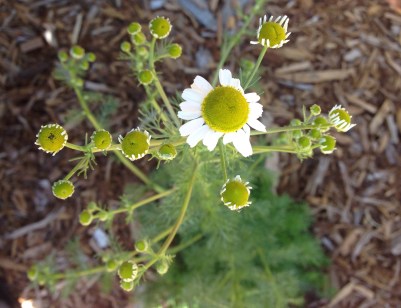 I got confused about my chamomile. All I could remember was that one is perennial and the other annual. When I noticed that they are both starting to bloom now, I had to try to figure out which was which again. This is what I’ve found.
<< The annual German or Hungarian chamomile is the taller of the two, to 24″. From what I read it often self-sows, and I hope it will do that in my yard.
German: Chamomilla recutita syn Matricaria chamomilla
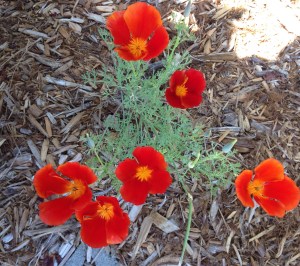
It’s growing near the red California poppy that I planted from a nursery pot, and whose flowers just opened this week. The white variety of this plant that I put in at the same time bloomed a couple of months ago, much less enthusiastically.
That makes me think about something I read in the Summer book I mentioned last week, a quote from Chesterton, from “A Piece of Chalk,” in which he gives an account of how he reluctantly tore himself away “from the task of doing nothing in particular,” and set off into “the great downs” of England with his brown paper and his brightly colored chalks, all on a summer’s day.
To his dismay he had neglected to bring any white chalk — and he begins to hold forth on how the color white, in art and in morals, is essential:
One of the wise and awful truths which this brown-paper art reveals is this, that white is a colour….a shining and affirmative thing, as fierce as red, as definite as black. When, so to speak, your pencil grows red-hot, it draws roses; when it grows white-hot, it draws stars….Virtue is not the absence of vices or the avoidance of moral dangers; virtue is a vivid and separate thing, like pain or a particular smell. Mercy does not mean not being cruel or sparing people revenge or punishment; it means a plain and positive thing like the sun, which one has either seen or not seen.
Perhaps my spindly white wildflowers, just starting out and blooming faintly without any other color around them to contrast with (even their foliage was already faded when the buds opened), do not provide a fitting metaphor to match this principle, but it did seem like a good place to tuck in that quote about something I do believe in.
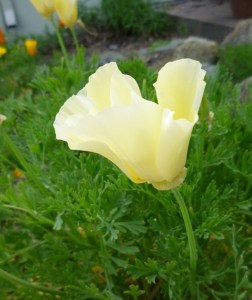 So far I haven’t sown any seed for the standard orange color of our state flower because I am a little afraid of them taking over. The other colors are not as vigorous, but some of them are really special in their rarity and subtlety, and when I have had one re-seed itself or, more often, go dormant and hidden for the winter only to surprise me the next spring, I am thrilled. This pale yellow one did just that for several years in my old garden, but could not be saved. >>
The red ones are my first variety that are both rare and bright. I hope they self-sow — but much of the garden is experimental. I’ll see over the next months what likes growing in this environment, and not fuss over the things that aren’t thriving.
Back to the chamomile… Just in case the Germans don’t bear children next year, I planted a perennial type, the Roman or Nobile. It grows half as tall and is sometimes used as a walkable ground cover, or part of an herbal lawn mix.

<< Roman: Chamaemelum nobile syn Anthemis nobilis
An hour after I took this picture, I strolled past again and noticed that ten more buds had swelled enough to be noticeable. History in the making!
I had a house guest for two nights and a day – we spent a nourishing and relaxing time, even though we did no artwork or gardening or poetry-reading. We did eat and shop and update our family birthday lists. But now I have lots of garden work that needs to be done, before I go to see brand-new Baby Brodie next week. Here’s a yarrow bloom for you to look at while I am out tending to my beds.


