
I’m still in Colorado, a little longer than planned, because of a change in my airline ticket; I decided to rebook with a different airline for my return trip, to reduce the risk of being affected by the recent spate of flight cancellations and chaos at airports. My new reservation is for a later date.
 The family here is happy to have me a couple more days, and I’m quite content to be pampered by the family generally, to have extended cuddling, reading and game time, and two outings I’d otherwise have missed. Plus, we watched the TinTin movie together tonight. Laddie and I sat together scrunched into a recliner, with the kitten Clyde occasionally jumping on the back and trying to get us to play.
It was an action packed film, of the sword fighting, metal crashing and body-flinging sort, and little Clara worried at times for the safety of Snowy and TinTin especially, but she was too brave to want to leave and go to bed.
The three boys are very fond of their collection of TinTin books, and enjoyed seeing favorite characters and story elements recombined in the movie. Last week, shortly after Kate arrived here, I found her animatedly reading the Spanish version of this rare tale of Tin Tin en el Congo to Raj, found on the shelf here. I don’t think I’ve ever read an entire story of TinTin from beginning to end, but all my children became fond of them over the years, and we have become a multigenerational TinTin fan club.

Yesterday I went with Soldier and the boys on one of their favorite short hikes, to the Siamese Twins rocks up the mountains from Colorado Springs. The boys have favorite places to scramble there, and I found plants my Seek app was able to identify: Colorado Pinon, Utah Juniper, and Rocky Mountain Juniper.

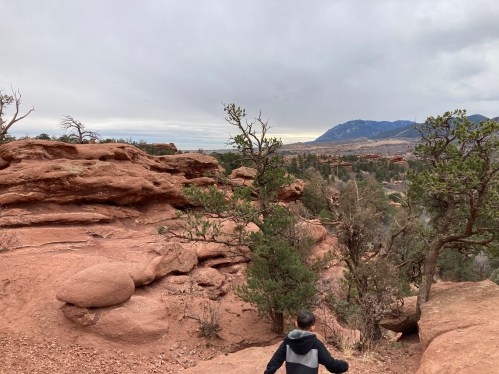
Soldier pointed out to me that you can see Pikes Peak through the gap between the Twins.

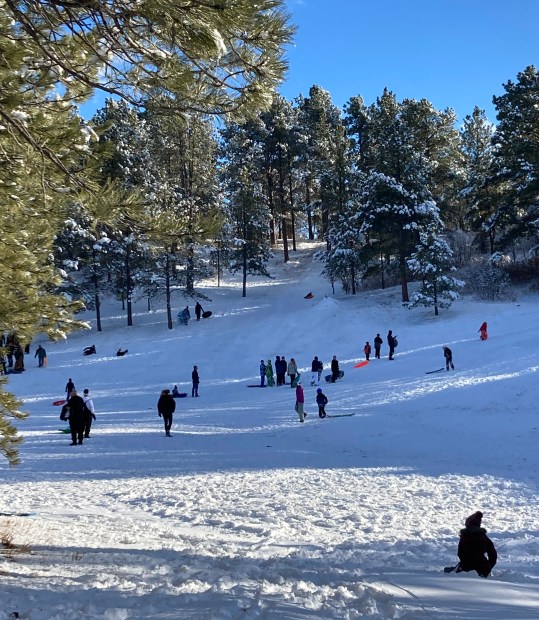
We woke this morning to a new, thick blanket of snow, much more than had fallen last week. I actually helped Joy and Liam to shovel the driveway clear, and then Soldier and I took a nice walk up the hill where the trees are tall and thick.


In the afternoon Joy and I took the boys to the neighborhood hill that is most famous for good sledding. Brodie and I made a snowman, and all the boys hiked up and sledded down the several runs for a couple of hours. It was fun to watch them from a place under pines where scattered slushy drops blew down from the trees on to my head. When the sun went down along with the temperature, we went home and ate popcorn.

Every day we spend hours reading aloud, and the boys all read to themselves, too. When Brodie unwrapped Old Yeller on Christmas morning he started in right away and hasn’t stopped. Liam received several volumes in the Redwall series which he is devouring.
This anthology of Christmas stories from Plough, Home for Christmas, has blessed us immensely. Last night while others were cooking dinner, I read “The Christmas Lie,” and could barely finish for choking up. Joy read “The Empty Cup” aloud at the breakfast table this morning; it is a story about a particular “Rachel weeping for her children” at the time of Christ; the Rachel in the story did find comfort. I have also read to the children “The Guest” and “The Chess Player,” both of which are stories of hearts changed by divine Love, so that they can enter into “the Spirit of Christmas.”
In the collection are selections from Henry Van Dyke, Elizabeth Goudge, Madeleine L’Engle, and Pearl S. Buck, in addition to many writers I was not familiar with before. I haven’t read half of them yet, but every one has pleased.
Likely this is my last post from Colorado, this year. By the time I get back to this site, it will be 2023. Dear Readers and Friends: Happy New Year!






 The middle section of Lost in the Cosmos is a lesson in semiotics, and it was my favorite part, once I put my mind to it. I have wanted to learn about this field of study which someone has described as “an investigation into how meaning is created and how meaning is communicated.” So that was another opportunity not to pass up.



 Gladsome Lights