Category Archives: books

I do like a little hen indeed.

“We kept good hens out in the back, brown and white, and some good layers from my father’s sisters that were black. There is happy our hens. All day they peck for sweet bits in the ground, twice they come for corn, and in the mornings they shout the roof off to have you come and see their eggs. And no trouble to anybody.

“I do like a little hen indeed. A minder of her own business always, and very dainty in her walk and ways….”
That is a clipping from How Green Was my Valley, by Richard Llewellyn, which I am currently reading/listening to. The narrator is Ralph Cosham, whose rich British voice perfectly accompanies the author’s prose to double the amount of atmosphere evoked. What a wonderful story! I’d never read the book before, and I’m not sure I ever saw the movie. I have probably seen fewer movies than anyone I know.

Many such short passages make me wish that I were reading the novel in print, so that I could underline them, and have an easier time copying them to share. But I’m not, so I won’t. Instead, I hit the replay button from time to time and pause whatever I’m doing to listen more carefully, in love with the sentences and the scenes and the Morgan Family.

Probably because of all the people I know who during the pandemic especially enjoyed their chickens, or started keeping chickens for the first time, I also began longing to have chickens again. I walked around my property eyeing every nook and cranny, but concluded once again, sadly, that every spot is taken. Any ground not being used by plants or furniture or greenhouse did not qualify on account of being sweltering hot, or too close to the clothesline, where I wouldn’t want chicken dust.

If I had found room I could have taken quick possession of the healthiest year-old hens you ever saw, Rhode Island Reds and Barred Rocks, that one friend had to give away, a flock of ten that he had acquired as day-old chicks during covid. I did get to eat eighteen of their eggs; they were the best I’d ever tasted, and I have tasted lots of home-raised eggs.

Instead, I sent word to friends all over the county (and into the next county), everyone I could think of going back 40 years that I’d ever known to keep livestock. I finally found a good home for those girls. And for myself, I will go back to my dream and plan of raising worms. I do have the perfect spot for them, whom I imagine are the tiniest breed of livestock….
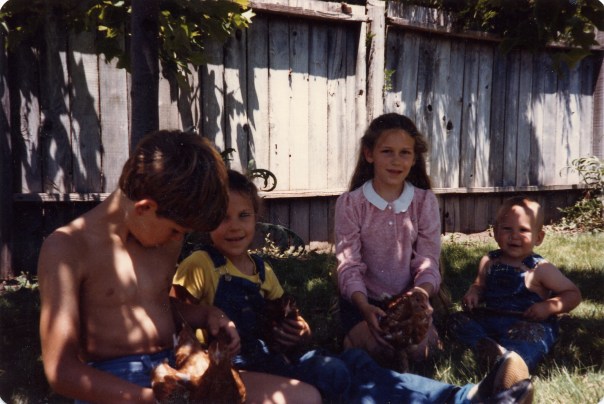
You would think that in thirteen years of keeping chickens I would have a few good photos of them, but it was in the days before digital cameras, and I couldn’t waste film on targets that moved the way chickens are likely to do. But I did locate this one above, the three older children in the 80’s, each holding one of their pullets. It’s almost the opposite of the kind of picture I wish I had, because adolescent chickens are inelegant, and these that you can barely see in the shade are definitely in the gawky stage. But it does show that we enjoyed our hens.

Until yesterday our area of California had been miraculously, blessedly free of wildfire smoke. Smoke from our fires out West was drifting all the way to the East Coast, and plaguing most of my children and many friends on the way — but not coming here. But yesterday it arrived. I don’t know which fire it is from. Once again, I have friends who lost their home, this time in the Dixie Fire 200 miles north of me. I’m sure that the personal connection increases weight that was already on my heart; I’m finding it hard to focus on anything and apply myself. It is some sweet relief to see in my mind’s eye the dainty hens in the Green Valley, when I visit vicariously in the coal mining town in Wales.
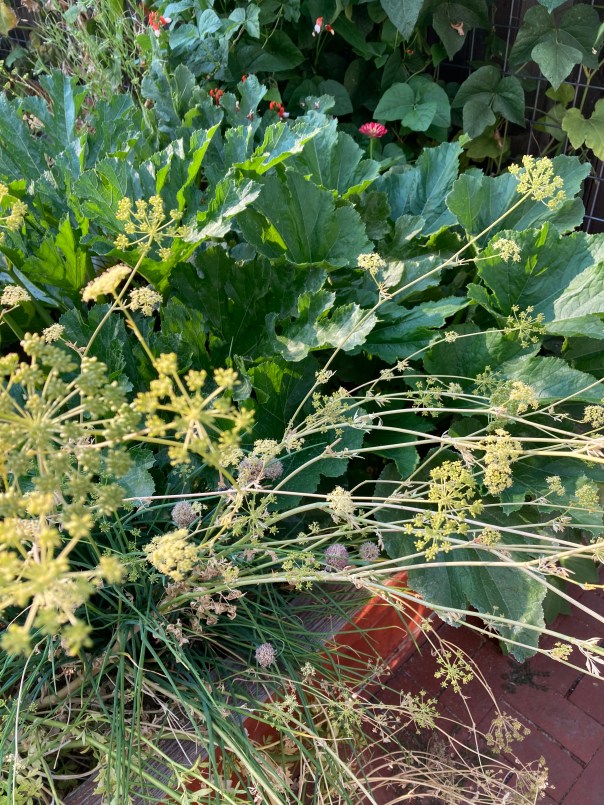
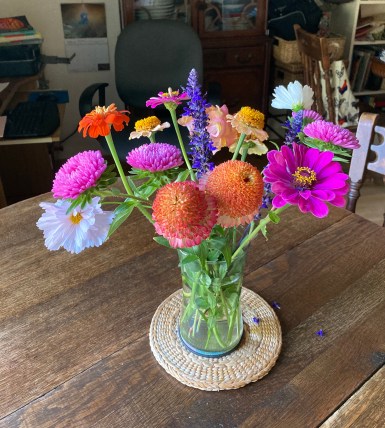
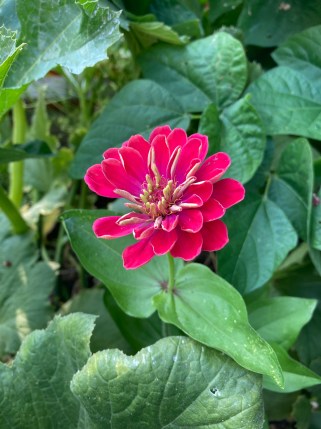
Another heartening little thing that surprised me today was a volunteer zinnia. I still haven’t cleaned up my planter boxes where most of my vegetables usually grow. In one box the parsley, hyssop and chamomile have all grown into a seedy jungle, and in the other a single zinnia plant sprouted in secret under the squashes and Painted Lady beans and grew up spindly toward the light.
May the Lord’s grace light our way and warm our souls.

But for you who fear my name,
the sun of righteousness shall rise with healing in its wings.
You shall go out leaping like calves from the stall.

Malachi 4

The Crystal Palace Unmanned.

I came to the end of Irrational Man: A Study in Existential Philosophy, and feel that my engagement with the author and his theses has barely begun. The insights about eternal human longings down through the ages, and even small details about the lives of individual thinkers, will be rattling around in my mind for a long time to come, and I hope to refer to some of them in the future.
In the meantime, I wanted to share here a few paragraphs from the concluding Part 4, “Integral vs. Rational Man.” The goal of the existentialists is here named as integration; not irrationality, as the book’s title might have led us to think. I’m sure the title Integrated Man would not have been nearly as memorable, and unfortunately, at least a couple of existentialists have descended into such irrationality that they were certainly insane.

William Barrett

“Existentialism is the counter—Enlightenment come at last to philosophic expression; and it demonstrates beyond anything else that the ideology of the Enlightenment is thin, abstract, and therefore dangerous. (I say its “ideology,” for the practical task of the Enlightenment is still with us: In everyday life we must continue to be critics of a social order that is still based everywhere on oppression, injustice, and even savagery—such being the peculiar tension of mind that we as responsible human beings have to maintain today.)

Martin Heidegger

“The finitude of man, as established by Heidegger, is perhaps the death blow to the ideology of the Enlightenment, for to recognize this finitude is to acknowledge that man will always exist in untruth as well as truth. Utopians who still look forward to a future when all shadows will be dispersed and mankind will dwell in a resplendent Crystal Palace will find this recognition disheartening. But on second thought, it may not be such a bad thing to free ourselves once and for all from the worship of the idol of progress; for utopianism — whether the brand of Marx or of Nietzsche — by locating the meaning of man in the future leaves human beings here and now, as well as all mankind up to this point, without their own meaning.

“If man is to be given meaning, the Existentialists have shown us, it must be here and now; and to think this insight through is to recast the whole tradition of Western thought. The realization that all human truth must not only shine against an enveloping darkness, but that such truth is even shot through with its own darkness may be depressing, and not only to utopians. But it has the virtue of restoring to man his sense of the primal mystery surrounding all things, a sense of mystery from which the glittering world of his technology estranges him, but without which he is not truly human.”

-William Barrett in Irrational Man, 1958

A good portion of the book can be found: here.

Touring a house of endless rooms.

BOOKS

From the heart of this dark, evacuated campus
I can hear the library humming in the night;
a choir of authors murmuring inside their books
along the unlit, alphabetical shelves,
Giovanni Pontano next to Pope, Dumas next to his son,
each one stitched into his own private coat,
together forming a low, gigantic chord of language.

I picture a figure in the act of reading,
shoes on a desk, head tilted into the wind of a book,
a man in two worlds, holding the rope of his tie
as the suicide of lovers saturates a page,
or lighting a cigarette in the middle of a theorem.
He moves from paragraph to paragraph
as if touring a house of endless, paneled rooms.

I hear the voice of my mother reading to me
from a chair facing the bed, books about horses and dogs,
and inside her voice lie other distant sounds,
the horrors of a stable ablaze in the night,
a bark that is moving toward the brink of speech.

I watch myself building bookshelves in college,
walls within walls, as rain soaks New England,
or standing in a bookstore in a trench coat.

I see all of us reading ourselves away from ourselves,
straining in circles of light to find more light
until the line of words becomes a trail of crumbs
that we follow across a page of fresh snow;
when evening is shadowing the forest
and small birds flutter down to consume the crumbs,
we have to listen hard to hear the voices
of the boys and his sister receding into the words.

-Billy Collins

Johan van Hell – Boekenstalletje

This poem was the perfect one for me to find right now, because I myself have been acting out all the verbs: following, straining, hearing and touring… and listening hard, to the humming of a choir. This choir of authors aren’t all consciously “singing” in harmony, or even intending to write about the same things, but their voices, the sounds, the crumbs I am following “across a page of fresh snow” all seem to be parts of a whole. The rooms I am touring are all in one house; it must be the place where the human soul lives.

My “circles of light” sometimes seem like a 60’s light show, beautiful and confusing, when I am waiting rather for illumination and clarity. So many authors have shined their little lights out into the world, but how many reveal the reality of things?

Over the last several months I have been reading a lot, with no resulting book reviews and few even small illuminations of the sort I might write about here. The Eucharist was very focused and wonderful and I do want to say some things about it eventually, but instead of stopping for that I kept working my way through Irrational Man, which is such a tour de force that it’s hard to know what to say about — everything.  It mostly makes me want to read more books that William Barrett reminds me of.

Like Flight From Woman by Karl Stern, which I read some years ago and thought brilliant; but at the time I knew I needed to read it a second time to digest it. Barrett explains the duality of selves in Sartre’s philosophy, how he considers not the “fruitful, excessive, fruitful blooming nature” to be the true self, but only that of the radically free and active man who has projects. Now I want to go back and read Stern on this topic.

But I am determined to finish a couple more books first. The Rise and Triumph of the Modern Self is like another long chapter, maybe the closing chapter, of Western Philosophy, so it will be good if I can move right on to finishing it after Barrett.

On my recent road trip I listened to Come on Shore and We Will Kill and Eat You All: A New Zealand Story, by Christina Thompson, a title so embarrassing on several fronts that I considered leaving this accomplishment unrecorded. But even this book, which was about as deep as I could go on all that freeway driving, provided a few revealing glimpses of how ideas from the other books I mentioned play out in real life, especially the central one: What is the self?

About halfway through The Cross of Loneliness I began to have a difficult time knowing what these two men were talking about, but I will finish that book, too, before long. My really easy, small book to read under the covers right now is The Bookshop by Penelope Fitzgerald, which I found in the little free library up at the lake.

And then, the sweetest, which will be easy to finish, as it’s like swimming slowly through a small and refreshing pond to the other side: The Scent of Water, which our book club is reading together. It is coming to an end way too fast.

Oh, yes, there are a dozen more sitting nearby, that I plan to continue with eventually, but they are not at the moment as current as these, these rooms full of delicious crumbs that I trust are leading me always to brighter places.

In regard to my own life and reading, I don’t relate to the progression of Collins’s poem, in its hearkening back to the experiences of childhood and youth, and the mood of evening and shadow descending. I am just very thankful for all the good writers I have at my disposal, and for the lovely song that they are trying to learn and to sing.

Joanna and the sleeping bees.

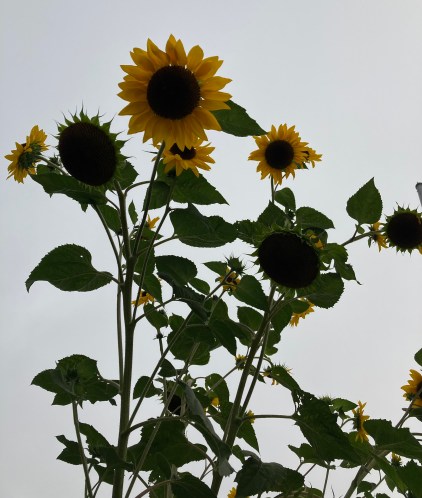
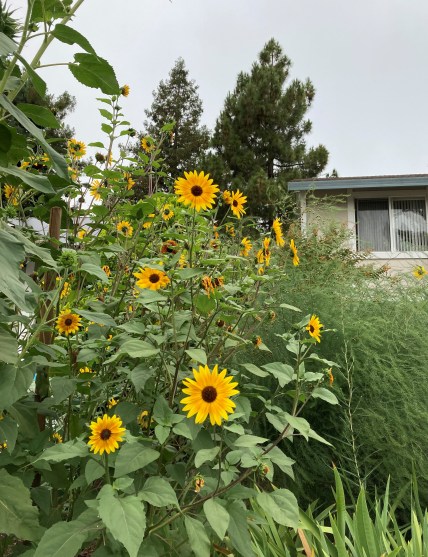
It felt very coastal this morning with high fog and chill breeze. Along the front walk where I have allowed a volunteer sunflower to grow in the middle of the germander, one flower was close enough for me to notice the cluster of bees.

How did they happen to all bed down for the night on that one flower? Were they even alive? A half-hour later on my way to the car to drive to church I stopped by again; one or two had left, and the others had shifted position, but were quite motionless. About noon, not one remained. [Update: the next morning they were back, and after watching them off and on for an hour, I think they are not bees, but hoverflies. I’ve mistaken them for bees before.] [UPDATE No. 2: I was right the first time. They are bees. They fold their wings over each other, but flies leave theirs splayed out. I think I’ve learned this more than once, on a site such as Beekeeping Like a Girl. And other differences…]

Today was the day we celebrated St. Joanna, and it was also the meeting of our parish women’s book group — in my garden! The weather was as perfect as could be for that. Our group of six included several gardeners who didn’t sit down until we’d discussed borage and the borage flowers hanging into the pathway. The bees draw your attention to them! I quickly dug up a few of the many little borage volunteers for a couple of women to take home later.

It just so happened I had made two trays of borage ice cubes and it was time for me to add them to the lemonade so we could start talking about Frankenstein.

The table where we sat is near my garden icon stand with the stone icon of Christ’s mother; for the day’s commemoration I nestled a TV tray under the olive tree to hold a few more icons. You can read here why I included St. John the Baptist among them.

Early in our talk about Frankenstein I showed the group this adaptation of the novel that had been given to me, and it got passed around the table so that everyone could take a look at the illustrations.

We had a lively discussion about elements of the story, and also concerning ethical questions about the uses of science that are still pertinent in our day. I read only a few lines to the group from this article in the current issue of The New Atlantis about recent questionable experiments.

Various of the readers in our group knew more than I about the historical and philosophical context in which Frankenstein was written, which made it a pleasure to be with them and muse about much more than what had impressed me personally. I think we all were glad to have read the book, especially those who before had only known the movies, but no one exactly loved it.

It didn’t have a satisfying ending, in that, as our moderator said, she had hoped for redemption and there was none. We all agreed it was too long and repetitive. Several women said they definitely wanted to read something “lighter” next time. What constitutes a light novel? Here are the (not necessarily light) possibilities we had brought with us. As we went around the table making our suggestions, it seemed to me that the enthusiasm mounted with each one.

  1. A Long Walk with Mary by Brandi Schreiber
  2. My Cousin Rachel by Daphne De Maurier
  3. The Giver by Lois Lowry
  4. Shades of Milk and Honey
  5. The Guernsey Literary and Potato Peel Pie Society
  6. The Scent of Water by Elizabeth Goudge

My Cousin Rachel and The Giver were deemed too heavy. Milk and Honey didn’t engender any discussion, and I was personally torn between Potato Peel Society and Scent. Several had already read Potato Peel so they were leaning toward Scent; I was the only one who had read it, and I told them what I loved about Goudge’s books generally. A Long Walk with Mary seemed like a good one to read during our Orthodox Dormition Fast.

So, we voted in a very informal way, and decided that in six weeks we will meet again and discuss two books: The Scent of Water and A Long Walk with Mary.

Before everyone went home, we toured the other side of my garden, and I told them about acanthus and why I used to not like it, but now I do. The acanthus is more beautiful than ever, its spires taller, and in their prime right now. My 24 lavender bushes are at the height of bloom, too. We got to hear from our sheep farmer lady how she made lavender simple syrup to use in cool summer drinks.

How sweet it was to have these friends to be with me for my name day. After they were gone, there was still lemonade left in the pitcher, and floating among the melting ice cubes, the lemon-bleached borage blossoms.