I’ve read Death Comes for the Archbishop by Willa Cather three times, including an audio recording narrated by David Ackroyd which I only recently completed. These three readings were so far apart that each time seemed a fresh introduction to the characters and the setting. And yet, I do think that the first two readings helped to form a love in my soul for the Southwest territories of the United States, so that this third time I found it there waiting for me, like the warm sand beneath a red rock butte, a place where I might bed down for the night under the stars and feel whole.

Ackroyd’s voice and narrative style seem perfect for the story. There is a steadiness and a lack of hurry that aligns with the faithful dailiness of the lives of the two missionary priests as they try to meet the spiritual needs of a vast diocese that had just enlarged by nearly 30,000 square miles with the Gadsden Purchase.

They are based in Santa Fe, New Mexico, but make frequent trips by horse or mule of hundreds and thousands of miles, even into Old Mexico, to take care of ecclesiastical affairs, to baptize babies and perform marriages, and to serve Mass. Their characters are sympathetic and rich; the story of their friendship over the decades is a thread woven through the novel, made up of small stories scattered through the years.
 I’m using this audio book now the way I have two or three others in the last years since I sleep alone, for the times when I don’t sleep. I put a well-known story to play on my phone, set the timer for 30 minutes, and let David or another nice person read me to sleep. This only works with voices that do not draw attention to themselves in various ways, usually by being overly dramatic.
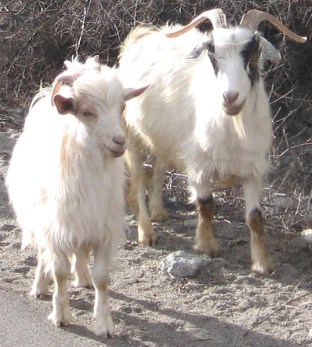
That means I am reading/listening to the book, based on a true story by the way, a fourth time. Because every anecdote and scene seems more luminous and meaningful than ever when it is told or described by a warm human voice, I may post here some passages that appear plain and dry to you poor people who may never have breathed the air of New Mexico or seen the Arizona desert in bloom. But today, it’s only goats we will consider, and I imagine that they are goat-ish the world over.
“After the feast the sleepy children were taken home, the men gathered in the plaza to smoke under the great cottonwood trees. The Bishop, feeling a need of solitude, had gone forth to walk, firmly refusing an escort. On his way he passed the earthen threshing-floor, where these people beat out their grain and winnowed it in the wind, like the Children of Israel.
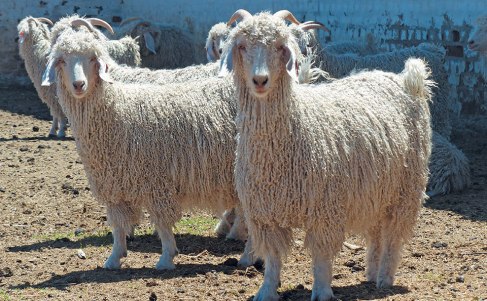
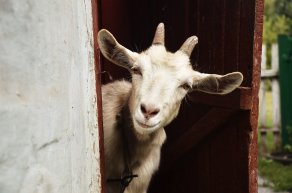 “He heard a frantic bleating behind him, and was overtaken by Pedro with the great flock of goats, indignant at their day’s confinement, and wild to be in the fringe of pasture along the hills. They leaped the stream like arrows speeding from the bow, and regarded the Bishop as they passed him with their mocking, humanly intelligent smile. The young bucks were light and elegant in figure, with their pointed chins and polished tilted horns. There was great variety in their faces, but in nearly all something supercilious and sardonic. The angoras had long silky hair of a dazzling whiteness.
“As they leaped through the sunlight they brought to mind the chapter in the Apocalypse, about the whiteness of them that were washed in the blood of the Lamb. The young Bishop smiled at his mixed theology. But though the goat had always been the symbol of pagan lewdness, he told himself that their fleece had warmed many a good Christian, and their rich milk nourished sickly children.”
-Willa Cather in Death Comes for the Archbishop
 Pippin just sent me this picture of a tortilla that was found in a library book; it looks like the tortilla came with salsa and cheese, too. She remembered an article I’d passed on years ago from the Abe Books Community page: “

 I read on dictionary.com that this is National Read a Book Day. Do they want us to read an entire book? I might be able to do that if it’s one I picked up at the library yesterday, Phineas L. MacGuire Gets Cooking, by Frances O’Roark Dowell. I think I need to read at least a book per year by this author, to keep me grounded in the reality of middle schoolers. I’ve been slipping, though, probably because there is a gap right now in the ages of my seventeen grandchildren. The youngest of the older bunch is sixteen, and the oldest of the younger bunch is ten. The ten-year-old does love science and cooking, and would probably enjoy Phineas, and it’s always fun for me to read a title or two from the latest book loves of the children.
 Finn Family Moomintroll. According to the recommended age it was too advanced for them, but I went with my tendency to give the children material they might have to stretch a bit to appreciate, and to read books that I personally love. That time I don’t think they had to stretch at all to find a lot of “fruit” that was very tasty, and all the more so for being enjoyed together.
 Gladsome Lights