
Category Archives: books

Caleb’s my man.

I came to the last page of Middlemarch, and it’s not even the last day of June! Ah, but now begins the work that is harder than the reading: sifting and organizing my thoughts about the story and stories of that novel so as to write some of them here in a way that might edify.

In the meantime, I have to say that I love the character of Caleb Garth more than anyone. His kind of “business” is not at all what people think of these days who are majoring in Business in college. They often think mostly of making a living somehow, but Caleb is intent on improving the land and doing good by people, the livestock and the earth. He often forgets to make provision for his own financial needs, and loves nothing better, as he says to his wife, than:

“…to have a chance of getting a bit of the country into good fettle, as they say, and putting men into the right way with their farming, and getting a bit of good contriving and solid building done — that those who are living and those who come after will be the better for. I’d sooner have it than a fortune. I hold it the most honourable work that is.” … “It’s a great gift of God, Susan.”

“That it is, Caleb,” said his wife, with answering fervor. “And it will be a blessing to your children to have had a father who did such work: a father whose good work remains though his name may be forgotten.”

A good man or woman adorns the earth by his presence alone, but if in addition he is able to oversee the wise management of farms and estates, with honesty and without greed, it is satisfying and holy work.

The last two weeks I’ve been working at less enduring tasks, but I’m still pleased with the results. Of course, there is always my garden which I tend. In the third year of being on my own I became acutely aware of the importance to my heart and psyche of my house as well, of the whole property that is mine alone now, and which I manage and am responsible for. The changes in my feelings are complicated and subtle; I see how God and His angels carried me through the time when I seemed to have little strength of will to apply. Now we will see how He guides me in this new phase when I am ready to participate more fully in my own affairs!

I’m working on the sourdough bread experiments again — yes, and they result in very short-lived products of my efforts, being highly desirable consumables. Today a Swedish seeded sourdough rye boule that is still rising will be cooked in the Dutch oven. Last week, these loaves:
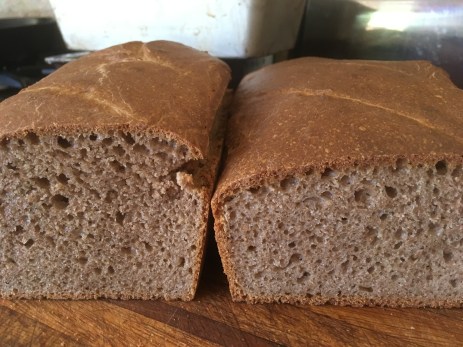
But no time yet, to dwell on details of dough and ovens, or on great themes of Middlemarch, because Pippin (who took the photo in England above, by the way) is arriving with two grandchildren for a few days. I’ll be taking care of Ivy (almost 6) and Jamie (3) while she attends a conference for work nearby. Scout won’t be in the group because he is backpacking with his father.

I’ve joined a book group of women in my parish. I didn’t finish the recent read, but I’m confident that I’ll have time to read Fidelity by Wendell Berry before our next discussion this summer.

My computer is giving me fits as usual, and the Computer Guy is on his way, so I will get back to my real, tangible work now, and give him this space, and see you next week! May your summer reading and work be satisfying.
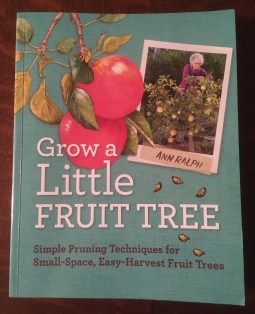
Growing a littler fruit tree.

Ann Ralph does make it seem easy. She is all about the backyard gardener being the one in control, managing the tree, and not letting it decide on its own how big to get.
If you didn’t have to climb a ladder to tend your fruit trees or pick the fruit, wouldn’t you find it simpler to keep up with the maintenance and to enjoy the harvest? Most of us don’t need bushels of fruit from one tree, so it’s good stewardship to reduce the quantity of fruit likely to go unused anyway.

I read her book in the fall, and wished I had known about it when we were choosing trees at the nursery two years ago, because you can make the most of this method if you start with a specimen that has a couple of lower-than-average limbs to begin with. Mine are not ideal that way, but I think I can still be the boss. I pruned my plum trees severely before Christmas; but at the summer solstice, according to her plan, they should get their second pruning. I did that a day late, this morning. It took me exactly 50 minutes – I know, because I had set my timer so I wouldn’t be late for an appointment.

I had reviewed the pertinent paragraphs right before I set to work, so as I walked around the tree and made some preliminary cuts, and circled around to the other side to look from that perspective, and on and on in that fashion, I had some  phrases lingering in my mind to guide me and give me confidence:

If you see something that cries to be corrected or pruned away, prune it. As always, prune out limbs that annoy you. Picture the height of the tree you have in mind. Don’t allow the tree to get taller. As Scenic Nursery’s Jim Rogers would remind us, “insist.”

Limbs that annoy me? Well, yes, I did find a few of those, that were angled down, or toward the center of the tree; maybe there were a couple that just seemed a little pushy in the wrong direction and not beautiful…. Must we analyze every annoyance?

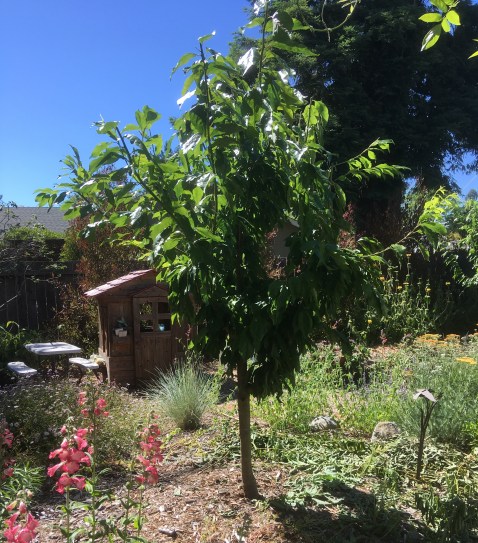
I wish I had taken a Before picture. In this After picture you can see I hadn’t really finished, because the clippings are lying all over. But I have just hired someone to help me in the garden on a continuing basis — my heart is dancing for joy about it — and will let him do that part (as well as trim the wisteria vines which are coming into the picture from above, hoping to twist on down into the tree).

In the foreground below are yarrow, lavender, and hummingbird mint, favorites of the birds and bees. The picture is taken from a different angle on the same tree. Both of these pictures make me wonder if I shaped my trees enough… those gangly limbs… I trimmed them less because they had the nice curve and direction I am encouraging. They are small and not getting out of hand, so I thought they could wait until the main pruning in winter.

I’m feeling so relieved and restful about the garden now that I’ve engaged my Helper Gardener, cleaned the greenhouse, and pruned the plums. I can think about tackling a few other categories of projects and tasks on my to-do list. And also, sit down in the garden with a book, listening to the hum of contented pollinators.

a contributor to the hum, on the teucrium

Small, hungry and shivering.

Continuing with my mini-miniseries on the men of Middlemarch, I give you an exemplary passage in which the author explains Casaubon to us. The metaphors she uses to convey the intricacies of his stunted self are many but not too many for me. Even with their being descriptive of a truly pitiable man, my own soul can’t help but “thrill into passionate delight” over George Eliot’s imagination and skill.

He had not had much foretaste of happiness in his previous life. To know intense joy without a strong bodily frame, one must have an enthusiastic soul. Mr. Casaubon had never had a strong bodily frame, and his soul was sensitive without being enthusiastic; it was too languid to thrill out of self-consciousness into passionate delight; it went on fluttering in the swampy ground where it was hatched, thinking of its wings and never flying. His experience was of that pitiable kind which shrinks from pity, and fears most of all that it should be known: it was that proud narrow sensitiveness which has not mass enough to spare for transformation into sympathy, and quivers thread-like in small currents of self-preoccupation or at best of an egoistic scrupulosity.

…even his religious faith wavered with his wavering trust in his own authorship, and the consolations of the Christian hope in immortality seemed to lean on the immortality of the still unwritten Key to Mythologies. For my part I am very sorry for him. It is an uneasy lot at best, to be what we call highly taught and yet not to enjoy: to be present at this great spectacle of life and never to be liberated from a small hungry shivering self – never to be fully possessed by the glory we behold, never to have our consciousness rapturously transformed into the vividness of a thought, the ardour of passion, the energy of an action, but always to be scholarly and uninspired, ambitious and timid, scrupulous and dim-sighted.

From the movie I’ve not seen.

If Dorothea could only have seen into Casusbon’s mind and heart the way his creator does, then she would have realized that he is not a man prepared to be a husband — maybe. But more on Dorothea later.

My tendency to be flippant or dismissive of Casaubon flows from his being fictional. (In the earlier version of this post I wrote fictitious, but then I realized that fictitious connotes false to me, which is reason enough not to use that word for a book character who is drawn so clearly in the shape of reality.) We can examine him closely and analyze each of his parts and guess at his destiny without being gossips. He is an archetype of one form of Lost Soul, and thinking about him and his engagement with other characters can enrich our understanding of humanity, and perhaps even instruct us in love.

Celia hasn’t the ability to debate the “notions” and idealism that are leading her sister toward marriage to Casaubon, but her instincts tell her that something is not right about this “death’s head warmed over.” That her beloved sister is planning to join her life with his disturbs her greatly.

“O Mrs. Cadwallader, I don’t think it can be nice to marry a man with a great soul.”

“Well, my dear, take warning. You know the look of one now: when the next comes and wants to marry you, don’t you accept him.”

Men of Middlemarch

Before buying an audio recording of Middlemarch I listened to many samples from different readers, most of them women. I chose the one I did because I didn’t mind the voice and diction of the reader, and it was less than half the price of some of the newer ones. It happens to be read by the English actor Gabriel Woolf, and I had not listened for a half-hour before I was very glad to have accidentally chosen this recording. The voices and Middlemarch audiobook cover artaccents and even chuckles he gives to the various characters are wonderful — and with so many interesting men as main characters, it now seems quite the best thing to have a male voice to bring them alive.

The reviews point out that this is a “vintage” recording, and that the production quality may not be up to snuff. There are actually some background noises occasionally that don’t fit the time period, but they didn’t bother me. Woolf trips over a word now and then, too, but his overall dramatic gifts more than compensate for his lack of constancy.

And speaking of flaws, our Middlemarch characters certainly have them. Eliot delves deep into their personalities and motivations, and knows what primitive weaknesses are the reasons for their peculiar behaviors as though she were God Himself. And like God, she urges us to be kind and to forgive.

I already shared one excerpt that gives a glimpse into Will Ladislaw’s character. (On a side note, why do you think that he is always called “Will” or ” Will Ladislaw,” while most of the men, including Lydgate, are referred to by only their last name? Is it age, or social standing? Fred Vincy is also in this category of naming, and he is like Will in that he isn’t established in a profession or even a direction yet.)

Some of the people in the town are more disagreeable than others, but then they might be ridiculous in their pride, and make me laugh; it’s easier to be patient with them, especially when I don’t have them in my own real life. (Mrs. Cadwallader is best left in someone else’s neighborhood!) Lydgate the young doctor takes himself too seriously to be lovable in that way, though, and I tend to not like him. In talking about this man Eliot writes:

…character too is a process and an unfolding. The man was still in the making, as much as the Middlemarch doctor and immortal discoverer, and there were both virtues and faults capable of shrinking or expanding. The faults will not, I hope, be a reason for the withdrawl of your interest in him. Among our valued friends is there not some one or other who is a little too self-confident and disdainful; whose distinguished mind is a little spotted with commonness; who is a little pinched here and protuberant there with native prejudices; or whose better energies are liable to lapse down the wrong channel under the influence of transient solicitations? …. Our vanities differ as our noses do: all conceit is not the same conceit, but varies in correspondence with the minutiae of mental make in which one of us differs from another. Lydgate’s conceit was the arrogant sort, never simpering, never impertinent, but massive in its claims and benevolently contemptuous. He would do a great deal for noodles, being sorry for them, and feeling quite sure that they could have no power over him.

Noodle was 19th-century slang for “dummy.” I’m afraid my own attitude toward Lydgate might fall into the category of “benevolently contemptuous,” and I hate that, so here’s hoping I can develop more real sympathy for him soon. He didn’t know how fast he would get into deep water when he stepped into the pond of Middlemarch life!

photo credit: Pippin