LIVING
The fire in leaf and grass
so green it seems
each summer the last summer.
The wind blowing, the leaves
shivering in the sun,
each day the last day.
A red salamander
so cold and so
easy to catch, dreamily
moves his delicate feet
and long tail. I hold
my hand open for him to go.
Each minute the last minute.
–Denise Levertov from Summer: A Spiritual Biography of the Season
This book, edited by Schmidt & Felch, is helping me to remember to treasure these days I have with my grandchildren again this week; this time they are staying at my house. I have a few photos, too, that show glimpses of peaceful moments, which seem way too few.

Yesterday I made play dough for the first time in decades, and the pot of sludge simmering on the stove was just one of the most interesting things that I forgot in the constantly distracted state in which I live these Grandchildren Days, and I went outside to help someone with something. The one other adult in the house smelled the same aroma of burnt toast I was smelling and turned it off. Kit departed an hour later for the summer so now I am back to being the only adult.
I was able to salvage at least two-thirds of the play dough, and made four pastel colors with it. I added scents using some essential oils. I don’t know if it might have been less sticky if I had paid closer attention to my project, but Scout and Laramie had a lot of fun with the dough. They also got it all over two sets of clothing each, plus a fair amount on the floor, and I am content to buy the store kind from now on.

<< Chairs to discourage Jamie from climbing the stairs.
The children are enjoying all the birds that come and go throughout the day now that I have the kind of garden birds like. When we sit at the dining table we can watch them at the feeders and fountain — and one good thing is that on this visit, there has been no testing of the rule against children playing in the fountain. It’s not to be touched. “It is for the birds, and for us to look at and listen to.” I emphasize how yucky the water actually is, from the birds, even though it looks clear.
We walked to the library yesterday — that is, Scout and I walked, and Ivy perched on the front of the BOB stroller where Jamie was strapped in. It’s about a half-mile away, which was just about right for our entourage. The warm air carried the scent of the juniper that lined our path, and we stopped to pick off needles of the different forms to compare.
My town’s library has a stellar children’s area, which these country children much appreciated, for its size and design. Ivy took a turn on each of the horses as reading chairs. We spent some time in the the outdoor area with a giant granite boulder for climbing, and wished we had brought our lunch, and swimsuits for the water play area. Maybe we will go back tomorrow for our non-book activities.

Children always want to drop things from my open hallway upstairs, which wraps around and looks down on the entry below. Through the decades the rule has been the same: the only approved droppables are paper flying machines or balloons. So today, lacking any grandpas or uncles, I had to learn how to make a paper airplane. Internet to the rescue! And I did a really good job! Even Scout was super-grateful.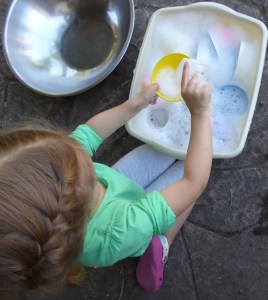
That was just this morning, and afterward Scout went with his other grandmother for the day, which is why I have a little mental space to think and write. The children who remain are, miraculously, napping at the same time.
But earlier, it was the perfect opportunity for Ivy to do some housekeeping just the way she likes it, in and for the playhouse that she considers Her House. To practice cutting with scissors, to have some water play, and reading with Grandma, all without big brother interference.
One thing I loved about Seventeenth Summer, which I recently finished reading, was the way no one in the story felt the need to be doing Special Things every week, in order to enjoy the season and the time off school and regular routines. People have jobs and housework, and the tomatoes need to be picked. Many of us like to be home washing the dishes these evenings when a breeze is blowing through the open window, and the sun sets late. And of course, working in the garden in the cool of the mornings, and sitting under a leafy arbor in the afternoons.
Margarita Manzanita is in her peeling season. >>
Ivy and Scout like to notice all the trees and flowers and even ask me the names of them. I’ve told them they may pick anything in the front yard, because it’s all coming out soon, but nothing in the back, except the lettuce that has bolted. So they have played with lettuce. And I did give Ivy a calla lily stem to use as a gasoline hose for filling up the tank of “her” Little Tikes Cozy Car.

This toy with four bouncing men is one of Jamie’s favorites, and it has been a favorite of dozens of children in my house over the last 28 years or so. It actually belongs to Kate, and was one of the few things that she as our fifth baby received new. I am so glad I found it for her back then, and that somehow we have preserved the set, because now I don’t think the Toy Police would allow it; a child might shove a little man down his windpipe.
I’ll leave you with a few more words from the introduction to Summer‘s collection of stories, Psalms and readings on this blessed time of year. I’m certain that children have some perspective on leisure that I have completely lost and probably can’t relate to, so I do not try to write from their perspective, even if they are a big part of my summer.
“The Psalms themselves declare the pleasures of leisure, in which we may sing songs and play music in moments when we are not in our work routines….to step back for a moment from our self-importance and our drivenness to provide a larger perspective.”
“…It is delight; it is merriment. It is a pause in the action, a moment to let this thought come: maybe I am not so critical to the world after all… a humbling time when we might dare to believe that stopping and looking round us might be more important than driving toward the distant horizon.”

 , because they live on the earth with us and can be observed as they really are. But still….
 the one children’s book by Nye that I wanted…. and then I found a few more children’s poetry books to take with me; that’s probably the level that I am most likely to access currently.