Category Archives: books

Two books of summer.

Tove Jansson is an author I only recently became acquainted with on Anna’s Peacocks and Sunflowers blog. The way Anna wrote about Jansson’s books makes you want to go to a Finnish island with a few volumes of this writer’s work in your suitcase. In the summer, naturally. It’s going to take me a long time to tell all I want about two little books, so if you are jealous of your last hours and days of summer, don’t waste them here. Come back later, in the winter perhaps, and go play outdoors now!

As soon as I learned about Tove Jansson I visited my local library and came home with a couple of books, to look at briefly to see if I wanted to order them. When I try to read borrowed books I feel the time pressure so heavily it too often squelches my interest and I end up returning the books unread. moominmamma
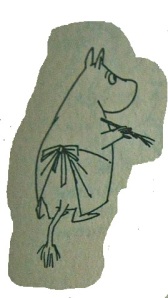
But in the first pages of Finn Family Moomintroll (c. 1954, 55) I met a character to whom in my ideal self I could instantly relate: Moominmamma, “The center of the family, highly moral but broad-minded.” This is her picture at left, with the distinctive Moomin physique.

She soon demonstrates what is meant by her character description, in the preface when the whole lot of these creatures are bedding down for winter, at the first snowfall. “All Moomintrolls go to sleep about November. This is a good idea, too, if you don’t like the cold and the long winter darkness.”

Moominmamma makes the bed assignments, to her own children and to all the friends their family has hospitably collected. Son Moomintroll objects, “But Sniff snores so horribly; couldn’t I sleep with Snufkin [his best friend] instead?”

“As you like, dear,” said Moominmamma. She changes Sniff’s assignment. Now isn’t that gracious of her? In my early years of parenting, I remember people telling us, Don’t be quick to say “No” to your children. In other words, be liberal. Is that the same as “broad-minded”?

I suppose it’s not surprising that Moominmamma was my favorite character in this children’s book. Many other creatures, after they wake up in Spring, in Chapter 1, populate the pages and have adventures together all over the forest and in the water, the kids sleeping in a cave and everyone sailing to an island for a camping trip that is made more exciting by wild weather.

A magic hat causes things to randomly change identity or grow to horror-movie proportions, as when the mamma wakes to find that tendrils and shoots of a “poisonous pink perennial” have invaded her house and “In the damp air flowers came out and fruit began to ripen, and huge leafy shoots blotted out the stairs, pushed their way between the legs of the furniture, and hung in festoons from the chandelier.”

This is the kind of plot element that gets my attention, mixing up horticulture and housekeeping. When Moominmamma first sees the room “full of small, white flowers, hanging down from the ceiling in leafy garlands…’Oh, how beautiful,’ she said.”

The story is full of goodwill and good sports, and the characters show great patience and kindness in problem-solving and relational issues. I would be happy to read this to my grandchildren, and I wouldn’t mind exploring some of the other Moomintroll books.

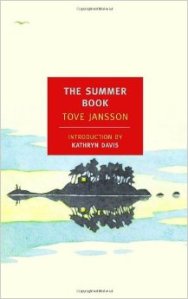
So far, though, I’ve only read one other book by Jansson, and that was The Summer Book, which is a short one for adults, as I assume, as one of the two main characters is the grandmother who is not your typical storybook grandma, nor one that my grandchildren could appreciate. She serves very well as the needed grandmother in this story, however.

We get introduced to Grandmother and Sophia quickly; on the first page Grandmother has lost her false teeth in the grass and when Sophia finds them she won’t give them back until Grandmother promises to let her watch her put them in her mouth. Then Grandmother refuses to continue a discussion about when she is going to die, and starts walking toward the ravine.

“We’re not allowed out there!” Sophia screamed.summer book image
“I know,” the old woman answered disdainfully. “Your father won’t let either one of us go out to the ravine, but we’re going anyway, because your father is asleep and he won’t know.”

When they walk out on a promontory Sophia is surprised when her grandmother doesn’t oppose the idea of swimming, and she gets in up to her waist. “‘Swim,’ her grandmother said. ‘You can swim.'” When Sophia notices how deep the water is, she thinks, “She forgets I’ve never swum in deep water unless somebody was with me.”

Sophia, the book cover says, is six years old, but I didn’t read that until after I’d completed the book. All through the book I was trying to figure out how old the granddaughter is; much of the time she seems younger than six, and sometimes not younger than ten. We learn that Sophia’s mother has recently died, and she and Grandmother and her father — mostly absent in the story — are on an island off the coast of Finland in their summer house.

So her anger and confusion are understandable. Spending a summer with a no-nonsense grandmother who’s trying to deal with her own issues at the other end of a lifespan seems not to be a bad thing. Grandmother is usually willing to answer the girl’s questions about God or anything else, to put up with Sophia’s screaming and disrespect, and to be her companion all over the island.

It’s hard to say just what is bothering Grandmother. Probably lots of things. She will not get old without a fight. Once Sophia says, Don’t go to sleep; you have to tell me about being a Scout. “A very long time ago, Grandmother had wanted to tell about all the things they did, but no one had bothered to ask. And now she had lost the urge. ‘We had campfires,” she answered briefly, and suddenly she felt sad.'”

finland wikipedia

Grandmother does tend to take naps if she and Sophia are waiting on the beach for Sophia’s father to come back from setting fishing nets or something like that. When they visit another island Sophia asks, “When are we going to walk around the island? Do we get to eat and go swimming, or don’t you ever do anything but sleep?”

Soon both adults are asleep outdoors in the warm and heavy air, and Sophia has to walk by herself around the shoreline. When she returns, “‘Dear God, let something happen,’ Sophia prayed. “God, if you love me. I’m bored to death. Amen.’

“Perhaps the change began when the swallows went silent. The shimmering sky was suddenly empty, and there were no more birds. Sophia waited. The answer to her prayers was in the air. She looked out to sea and saw the horizon turn black. The blackness spread, and the water shivered in dread and expectation. It came closer. The wind reached the island in a high, sighing whisper and swept on by. It was quiet again. Sophia stood waiting on the shore, where the grass lay stretched on the ground like a light-colored pelt. And now a new darkness came sweeping over the water — the great storm itself! She ran toward it and was embraced by the wind. She was cold and fiery at the same time, and she shouted loudly, ‘It’s the wind! It’s the wind!’ God had sent her a storm of her own. In His immense benevolence, He thrust huge masses of water in toward land, and they rose above the rocky shore and the grass and the moss and roared in among the junipers, and Sophia’s hard summer feet thumped across the ground as she ran back and forth praising God! The world was quick and sharp again. Finally, something was happening.”

There is a lot of weather and botany and wildlife in this book, with which the characters interact and which forms the backdrop of their quiet drama. After that storm, Sophia said, “I always feel like such a nice girl whenever there’s a storm.” Which makes her grandmother muse to herself, “I’m certainly not nice. The best you could say of me is that I’m interested.”

The grandmother in me, the camper, and the horticulturalist in me found plenty of interest in this book. I share just one more favorite passage:

“A small island…takes care of itself. It drinks melting snow and spring rain and, finally, dew, and if there is a drought, the island waits for the next summer and grows its flowers then instead. The flowers are used to it, and wait quietly in their roots. There’s no need to feel sorry for the flowers, Grandmother said.”

Nor for the humans. Patience. Bravery. Family. These will help us to persevere through our own storms and to remain fully alive.
The Secret Language of Girls

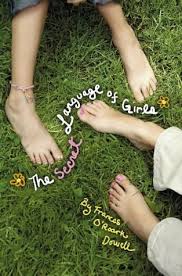
I listened to The Secret Language of Girls in the car on my trip to Nevada earlier this summer. It had been on my Amazon wish list for a year, so when I saw it at the librarsecret languagey it was an easy decision to grab that one off the shelf. I had started my browsing in the section with the adult CD’s, but so many of those would be longer than I could finish on most of the trips I take.

This is the story of a year in the lives of some middle-school girls, which is not something I would normally like to read about. But I’ve appreciated the author’s voice in other books I’ve read by her, notably Chicken Boy, which I reviewed here.

I’m comforted knowing that Dowell’s books are on the shelves as a wholesome alternative to the slime that is oozing ever lower into nihilism, and into the younger age-range, the kind of thing Meghan Cox-Gurdon critiques in this article: Darkness Too Visible. Through her characters’ stories Dowell explores the issues that are common to every generation of modern adolescents, without any of it feeling antiquated. I assume that this is how the children themselves feel about the books — if they are still on the library shelves after ten years, is it not because they are actively in circulation?

Dowell captures the self-conscious angst of adolescent girls, revealing the cattiness, unkindness, confusion and downright meanness, without passing judgment on what is a difficult time for everyone. She wrote this book about ten years ago, when perhaps it was all too fresh in her own memory. Girls are best friends in 5th Grade, and then because of their personalities and choices they grow apart, sometimes so distant that they forget to treat each other as fellow humans.

“Let’s humiliate someone,” says one girl to Marilyn, and one of our heroines reluctantly agrees to humiliate the girl who not long before was her best friend. It’s because she feels trapped by the choice she’s made to be in the popular group and pay obeisance to the leaders of that pack. Otherwise they may turn against her….

Boys are often what comes between friends. Although I’m dismayed at the sexualizing of our society to the point where this most wholesome book has to include events  such as kissing games between eleven-year-olds, this (and much worse) is the reality many children have to deal with, and Dowell does everyone a favor by showing us what goes on in Marilyn’s mind and heart at a barely-chaperoned party, and how she gains self-understanding.

The older brother of the party-giver is an amputee, and all the other girls say, in effect, “Oooh, that’s creepy.” They are disgusted, while Marilyn finds him very nice. But of course it’s her peers, the gangly adolescent boys, who end up awkwardly pecking her cheek or lips when the spinning bottle stops and points to her. She finds it very unsatisfying.

“She decided she didn’t like this game very much. She wanted to choose whom she got to kiss. Other people shouldn’t be able to choose for her.”

“She also knew that legs didn’t have anything to do with kissing. In fact she was starting to think lips didn’t have much to do with kissing either. Kissing was about hearts….As far as Marilyn was concerned, she was still waiting for her first kiss.”

Considering the likelihood these days of young girls getting physically involved with boys way too early for their good, there is a need for this kind of vicarious lesson. Girls can go with Marilyn to the party and leave smarter. They will be further on their way to knowing the truth that sex and all that leads up to it are about more than recreation and experimentation.

I remember how it was at that age — you fall in love with boys right and left, because you are falling in love with the whole experience of falling in love. It’s hard to be true friends when all that is going on, but in this book there is a new girl in school who is an little unconventional, and  also refreshingly sensible and kind, as she tries to help another confused protagonist.

“Paisley laughed. ‘Why don’t you quit thinking about love and boyfriends and girlfriends? Why don’t you just think about Andrew O’Shea, the human being?'” Out of the mouth of babes! Isn’t that what we all should do, what it means to grow up — to think of the other person as he is in himself, not just as someone useful for our own ego or enjoyment?

My listening to this book in audio instead of print format added an extra level of complexity to my response. I kept wondering if the narrator’s interpretation of the characters was in line with the author’s. Michelle Santopietro narrated this Random House audio edition, and I found it hard to believe that the young people spoke in a sarcastic tone half the time.

Some of the mothers in the story are obviously so consumed with their own drama that they can’t shift their focus and notice what is going on with their children. I also recall from that age the vague feeling that I was on my own. But the voices that Santopietro gives to the mothers make them sound stupid to me, not just out of touch.

Just the other day I read Arti’s thoughts on what makes a good audiobook narrator, and another post on how different the experience of reading the text yourself is, from that of listening to a recording. I know I was very aware of the narrator coming between me and the author in this case, and I didn’t enjoy that aspect at all. I began to wonder all sorts of things about the narrator, while normally I’d aim my extra curiosity toward the author. “Is Santopietro a mother herself?” was one of the central questions raised.

The box of CD’s of The Secret Language of Girls says that it’s “Recommended for listeners ages 13 and up,” which is odd for a book about 11- and 12-yr-olds. I thought perhaps that was a strategy for getting the intended age group to be more curious about it. But on Amazon the book info says for age range 8-12 yrs., or grades 4-6. That’s more like it.

So far my granddaughters are homeschooling and I can’t see them having time or need for this kind of story. They have wise mothers who are paying close attention. I wish I had found a book like this on the shelf when I was young, and if I get to know some distracted or overwhelmed mothers of pre-teens, I’ll be buying a few copies for their daughters.

Enduring and Truthful Fictions

Today is Book Lovers’ Day, my friend Myriah just informed me, and I’m so glad she did. It’s actually one of two days that are celebrated for and by people like us. To mark the day I am re-posting an old book review I wrote, from 2009. It’s a response to three books, so we could think of it as a triple treat for our readers’ party:

Three Truthful Fictions

In early summer I read three works of fiction in a short space of time:

Ah, But Your Land is Beautiful by Alan Paton
A Thousand Splendid Suns by Khaled Hosseini
The Folding Cliffs by W.S. Merwin

These were all pretty dramatic stories of historical fiction. Paton’s book follows closely the events in South Africa mid-20th century. Hosseini writes about Afghanistan in the last 30 years, and Merwin’s book is an epic poem about Hawaii, mostly in the 19th century.

I was sitting around after surgery with my foot up, and that was what had made it possible for me spend more time reading and thinking. Some things I thought about: How funny that the settings of these thr3 truthful fictions picee books were at three corners of the globe. Obviously they were not part of any theme. So were there some ways they were alike? What made them all worth reading to the end, when so many books I’ve tried lately were not?

Suffering was a large part of all the stories. The Afrikaners in Ah, But Your Land is Beautiful were treating all people of color unjustly and inhumanely. Whites who did otherwise suffered along with the oppressed, and often sacrificed their careers, homes, and reputations.

All the women suffer miserably in A Thousand Splendid Suns. War and famine, selfish and sinful men and women supported by bad cultural traditions, all combine to keep the women trapped in complicated and painful predicaments. Factions of Muslims hate one another.

The Folding Cliffs makes vivid the way conquering peoples oppress the vanquished, all the while thinking it is “for their own good.”

What benefit is there in dwelling on Man’s Inhumanity to Man? Don’t we already know how wretched we are? If that were all one gets from these stories, I don’t think they would be worth reading, but there is another bigger part to all of them, and that is Man’s Love. Just as Christ gave His life in love for us suffering humans, so He gives grace to men to rise above their suffering, show compassion to their fellow man, and do deeds of mercy.

“Courage is not simply one of the virtues but the form of every virtue at the testing point, which means at the point of highest reality,” said C.S. Lewis, and it is this courage that is shown by the young parents in Cliffs who flee to the hills and fight off government agents who are shooting at them, rather than have their family torn apart by the health officials who are shipping lepers off to Molokai like so many unclean animals. Their love is demonstrated in the test of courage.

In Land, the author and his companions find joy and fellowship in realizing the sacrificial, mercy-giving aspect of their humanity as they fight what seems to be a losing battle against political power. Perhaps they were living what Winston Churchill was talking about when he said, “We shall draw from the heart of suffering itself the means of inspiration and survival.”

Alan Paton in his autobiography Towards the Mountain writes of the experience:

“…the inhumanity of man to man could be made endurable for us only when we manifested in our lives the humanity of man to man….there is a wound in the creation and…the greatest use we could make of our lives was to ask to be made a healer of it.”

I haven’t lived with the kinds of suffering I read about, and that is partly why I think these writings are valuable, for as we read we take as our companions in mind and heart characters who are historically real or fictionally true, who can train us in Christian virtue.

Khaled Hosseini has given his countrymen and all of us a wonderful gift in the two books of his I am familiar with. In Kite Runner and in A Thousand Splendid Suns he paints a backdrop of horror, including much personal moral failure. Kite Runner exposed my own innate cowardice as I empathized with the protagonist, and as he was able to find healing and hope after repentance, I was also comforted.

In Suns the author gives a tender role model to women everywhere who are beaten down by life. The character of Miriam is the ultimate in misery, as she has no friends and no family who care about her, and she is barren, so her husband hates her. Then a young woman comes into her life, a woman who could easily slide into being another tormentor. But instead she shows kindness and becomes a true friend, and Miriam finds hope and courage, as well as other parts of her humanity and womanhood that had been obscured. She is transformed from a passive recipient of abuse into a woman who can return love, and she is happy, even in the face of continued abuse.

These stories have the potential to become part of the collective consciousness of a people, and help us to live more humanly, more humanely. I hope that Suns in particular can give vision to the women of Afghanistan, a vision of themselves as able to rise above their circumstances by means of love toward others.

We won’t eliminate the oppressors; our hope does not consist of that, as Father Alexander Schmemann has summarized:

“The fundamental Christian eschatology has been destroyed by either the optimism leading to the Utopia, or by the pessimism leading to the Escape. If there are two heretical words in the Christian vocabulary, they would be ‘optimism’ and ‘pessimism.’ These two things are utterly anti-biblical and anti-Christian…. It is for us, Christians, to reconstruct this unique faith, in which there are no illusions, no illusions at all, about the evil.”

Keeping with the theme of inspiring fiction, I’ll end with a quote by Whittaker Chambers from Witness (which book I love, but it is not fiction) about a novel that was formative for him. I haven’t read Les Miserables, but I noticed a few years ago that at least three important writers I knew of had mentioned they read it more than once as children. Sorry, I can’t remember who the others were. Chambers describes what can happen when a good writer connects with the reader:les miz pic

“I read and reread Les Miserables many times in its entirety. It taught me two seemingly irreconcilable things–Christianity and revolution. It taught me first of all that the basic virtue of life is humility, that before humility, ambition, arrogance, pride and power are seen for what they are, the stigmata of littleness, the betrayal by the mind of the soul, a betrayal which continually fails against a humility that is authentic and consistent. It taught me justice and compassion, not a justice of the law, or as we say, human justice, but a justice that transcends human justice whenever humanity transcends itself to reach that summit where justice and compassion are one….”

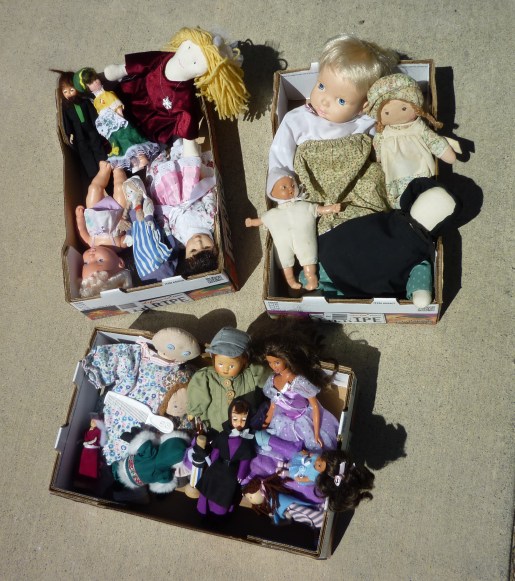
We find old book and doll friends.

P1100825 dolls one box

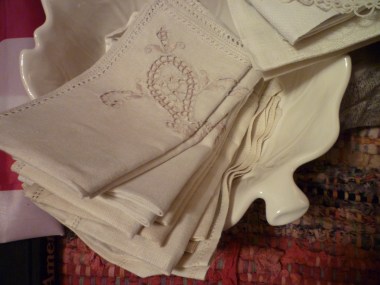
When Kate was here last month she did a lot of plowing through her childhood stuff — Well, to be truthful, that doesn’t really describe what happened. She lovingly looked through boxes of books and toys she’d collected in her first 18 years, and household items like linen napkins and unP1100683used potholders that had been passed down to her from her grandmother. She had in mind the usual sorting categories of Keep, Give, and Toss.
With her wedding fast approaching, it blessed me that she took the time to enjoy the task. She hasn’t lived in our house for many years, but she was remembering what she said was a very rich childhood, surrounded with so many books which she always knew were part of the household because they had some value. This made the finding of a book worth reading much more likely than if she looked in a bookstore or library.

P1100686

P1100685crp


Of course I find my children fascinating, and this peek into Kate’s memories interested me because it revealed that the development of her love for books and reading had an aspect I hadn’t even thought about. I was also pleased because it was a part of a success story. (I’m thankful that my kids don’t tell me about all the failings that I can’t change at this point.)P1100674

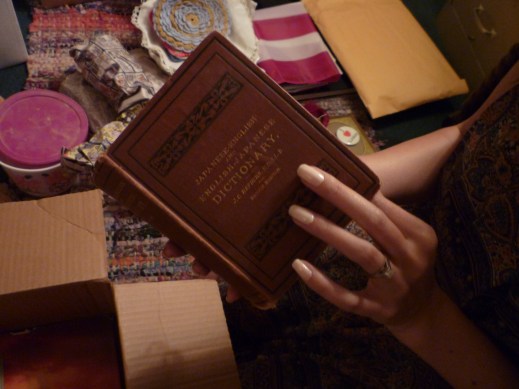
Kate used to collect dual-language dictionaries, even for languages she didn’t plan to study anytime soon, like this Japanese one above. And she had an assortment of dolls, most of which she has now bestowed on me to do with what I like.

I’ve been trying to figure out why grown women often like dolls and play with them, in adultish ways of course. Is it because we miss our children who have grown up? I find it hard to turn down a doll who needs a home, the way some people can’t say no to cats or dogs. I have a drawer full of dolls that I want to make new clothes for or mend in some way, and a suitcase full of really old broken dolls that belonged to our mothers and which I am even now gathering the will power and good sense to get rid of.

But I am quite thrilled to suddenly have so many new doll children who still have a lot of life in them. Before I decide how to distribute them, which ones to let the grandchildren play with, etc., I had to do something about the stink they had acquired by sitting in a plastic container for years.

P1100824

I set them out in the hot sun for a couple of days, and that did the trick. Maybe they didn’t even need the sunshine; perhaps the fresh air would have been enough therapy. But the ones with faces look happy enough to get the full outdoor experience.

P1100826crp

I used to love to read the Raggedy Ann and Andy stories to my children. Probably getting to know the personalities of the storybook dolls and following their secret adventures has contributed to my feelings about dolls generally. I can imagine that Kate’s dolls, over the years that they were ignored in that corner of the house, were sneaking out of their box and into the book boxes nearby to have fun improving their little minds. It sounds like something my children would do.