Category Archives: books

RFC begins with the meat.

The book into which I am dipping to give you several tastes is Supper of the Lamb by Robert Farrar Capon. The title refers on one level to the four meals he will show us how to make, for eight people at each sitting, out of one leg of lamb. As I said in my first post, it’s not these recipes that most interested me about the book, but they form the loose structure around which the author gathers all his personality and wisdom.

He tells us that “Lamb for Eight Persons Four Times is not simply a recipe. It is a way of life.” A way that has us deliberately creating leftovers so that for most suppers we can use little bits of our meat and make it go a long way. I have a lot of experience with this kind of cooking, and I appreciate Capon’s undergirding philosophy, that there are times to feast, and they are not every day.

He has a term for the everyday: ferial eating. I found in the dictionary that it’s a church term for a weekday on which no feast is celebrated. Capon’s first principle for this ordinary type of eating is: Never serve anybody a whole anything. Because “appetite rises to meet food supply,” and we just don’t need to eat large amounts every day.

Every dish in the ferial cuisine, however, provides a double or treble delight: Not only is the body nourished and the palate pleased, the mind is intrigued by the triumph of ingenuity over scarcity — by the making of slight materials into a considerable matter.

I have to admit that in the days when our feasts were rare, it was easier for us all to stay slim and healthy. For several years now, cooking for only two people, I’ve probably been serving way too many whole items, and I also have so many leftovers from which to create more yummy meals that I hardly have enough cold storage for them. The type of lifestyle where the cook shops nearly every day and prepares what is fresh in the shops in that season seems to be what I should aim for.
Still, I very much appreciate that Capon introduces us early on to his idea of the creative and resourceful cook, who knows how to season and sauce her humble food so that it’s often more interesting and delectable than the festal roast.

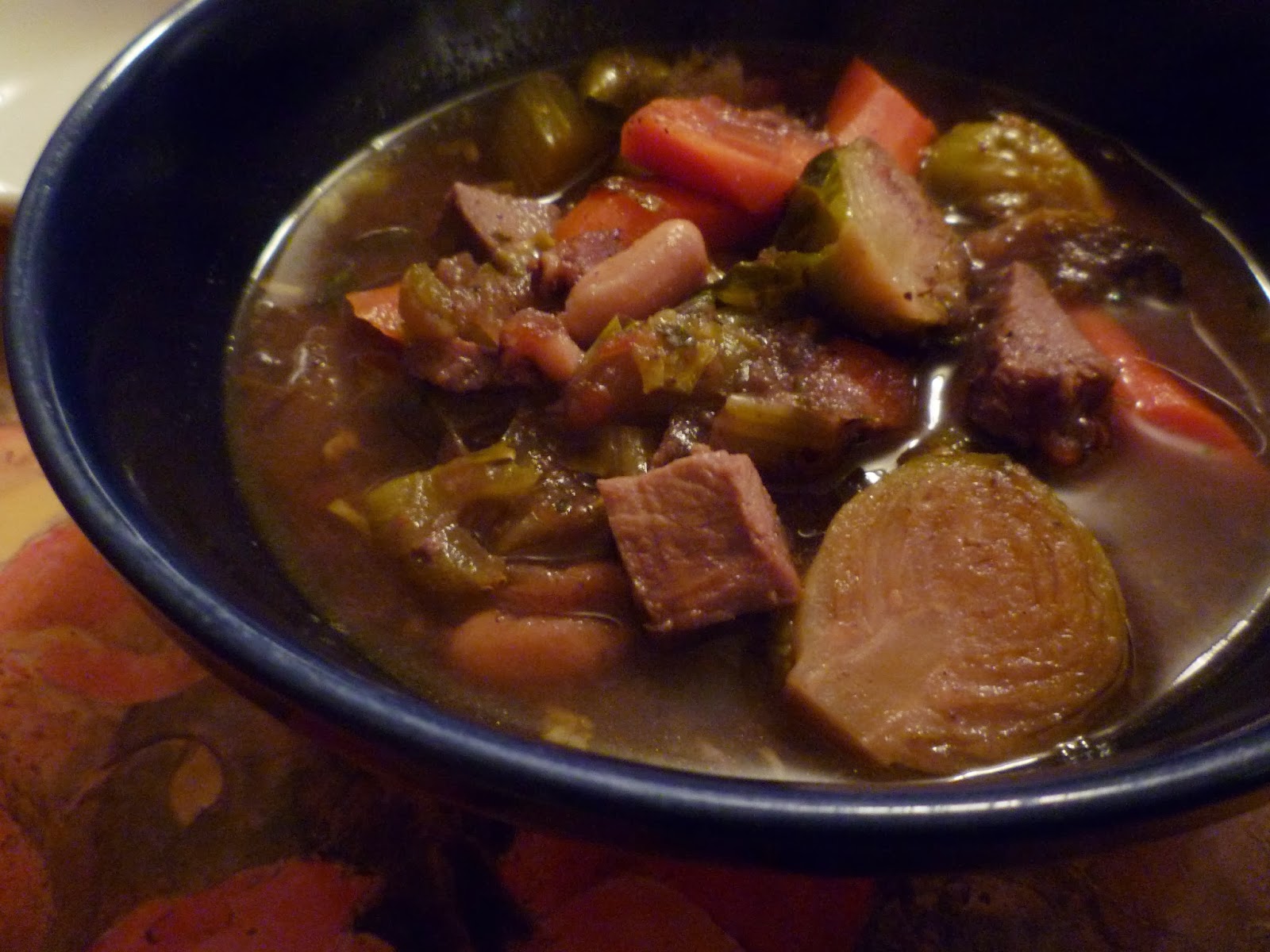
Just tonight my man and I enjoyed for the second time (as I’d ended up with a big potful) a soup that was made according to these methods, using the leftover lamb roast from Christmas as well as the leftover liquid it was cooked in, which included a good amount of wine, with rosemary and garlic. Not too much meat was left, but I added some lentils and vegetables, and Mr. Glad could not help feeling it quite unfair that he should be eating such amazing food when so many people never get stuff like this. (The stew in the photo is from a previous and different ferial meal.)

Our author chef carves his (large) leg of lamb into parts to make first a stew, and then three other ferial meals, including a casserole with spinach, a stir-fry, and a soup. His recipe for stew includes an injunction against flouring the meat before browning it:

…it is the point at which nine tenths of the stews in the world go wrong. The trouble is that few cooks realize how long it takes to brown meat thoroughly….People who flour their meat and brown it in butter are entitled to their religion….I think it fair to note, however, that such people have never gotten around to browning meat. All they have done is darkened some butter and scorched a little flour. The meat inside remains untouched. Accordingly, their stews never know the savor of the true burnt offering; in their haste they settle for the dubious pleasure of eating charred wheat.

Unfortunately my mother taught me to flour my meat and it was only a few years ago that I learned better. RFC also gives advice about liquid:

A word about the liquid itself. Unless you are physically prevented from doing so, always use stock or wine, especially in a ferial stew. We are working here with an admitted minimum of meat. To add water to it is to strain it, to demand of it a cruel exertion, to have it arrive at the table worn out with overwork. This is no festal dish with enough meat in it to make meals for a week. This is a poor dish, whose meat is to be pitied and spared. Accordingly, any liquid that goes into it should be of a charitable and kindly sort…which knows how much more blessed it is to give than to receive. Stock then; not water. And, no matter what else, wine. A gallon of good California red in the kitchen closet will do more for your cooking than all the books in the world.

Capon has more opinions about wine, and the philosophy of meat-eating, “little invisible spooks” (Can you guess what those might be??), and the “higher session” of The Supper of the Lamb, and that is why I need a few more posts to share my gleanings. Coming soon!

The first post in this series is RFC is the man you need.

RFC is the man we need.

A few months ago I read The Supper of the Lamb: A Culinary Reflection by Robert Farrar Capon, and knew before I’d got halfway through the book that I’d want to write a series of posts on this man’s extraordinary perspective. But then the Nativity Fast arrived, and it was unhelpful during that period to focus on food and its delights, so I put off the project until the new year, which for me seems to have begun in earnest only this month.

At the speed I customarily do anything, if I begin now I still won’t finish before Lent has arrived, but I am going to start anyway. For me the recipes and food itself are not the main thing in Capon’s book, and there are parts that tie in very well with transcendent aspects of food and even with fasting.

His thoughts and words are often so charming in themselves, I might not always have anything to add to the quotes I share. But the topics collaborate with a couple of other books that I find very provocative as well, so I’m hoping to bring more writers into the discussion. In the blog titles I will refer to Robert Farrar Capon as RFC so as to make room there for words other than his long name.

Though the first chapter starts right off with a list of ingredients, for me the recipes included in the book serve primarily to illustrate and demonstrate the author’s philosophy and love. He was an Episcopal priest who wrote other books as well, but this is the first one I have met, and I just now discovered that he died last fall, probably when I was just coming to the end of The Supper of the Lamb.

Also in the first chapter, he answers critics who might disregard him because he is not a professional cook, by pointing out that amateur is not exactly the same thing as non-professional. And he clarifies here at the outset that he is, more than anything, a Lover:

The world may or may not need another cookbook, but it needs all the lovers — amateurs — it can get. It is a gorgeous old place, full of clownish graces and beautiful drolleries, and it has enough textures, tastes, and smells to keep us intrigued for more time than we have. Unfortunately, however, our response to its loveliness is not always delight: It is, far more often than it should be, boredom. And that is not only odd, it is tragic; for boredom is not neutral — It is the fertilizing principle of unloveliness.

In such a situation, the amateur — the lover, the man who thinks heedlessness a sin and boredom a heresy — is just the man you need.

And I ask you, with an intro like that, how can I not love him?


More posts on this book:

RFC begins with the meat. 

RFC considers blood and sacrifice. 

RFC makes one of nature’s marvels.

RFC drinks in graces.


My encounter with Churchill’s friend.

Almost nine years ago I was in the middle of a Winston Churchill immersion experience, in England with my daughter who is a big fan of the man. We visited the Churchill War Rooms museum in London, his country estate at Chartwell, his birthplace at Blenheim Palace, and his grave.

One of my favorite parts of the museum was a huge collection of quotes, unfortunately displayed in an “interactive” touchscreen format so that I couldn’t easily or thoroughly access them, and I didn’t have the time to write any down, but the essence of one stuck in my mind the way a tasty seed lodges between the teeth and surprises you later on with its savor. I counted on the trusty Internet to help me find the quote after I returned home.

From London we’d taken a side trip to Chartwell, Churchill’s beloved country estate in Kent. We were in his very library, with his own books and furniture. I could just imagine him sitting there enjoying some book that had nothing to do with the government or war; this was the place he came to when he needed to decompress from the strain of his usual days.

from the Internet

I told the docent about the quote I had read the day before, in which Churchill had advised us to think of our books as our friends, and if we couldn’t read them all, at least we could take them off the shelves and touch the pages, and perhaps read a line or two. She didn’t know of this quote, but it was permitted to handle the books on the library shelves, so I did take one down and try to follow his advice.

It was one of those times when I just want to sit down and be there. I’d have liked to read a few lines from several books, or a chapter from one book, or see how they all were organized.  But I was so nervous about meeting this book friend that I didn’t even catch his name. I was trying to keep up a conversation with the docent, and we needed to get through the house to the grounds before the rain started….Now it seems like a fairy story that I was ever there at all.

It’s the anniversary of the death of Winston Churchill, Anna reminded me on her blog that is a compilation of “Seven Quick Takes” on him today. I was going to leave a comment on her blog about how I never could find that quote — and I had tried so hard. But then I thought, it’s been a couple of years since I searched; maybe, just maybe if I look again….

And it came up in flash, on Goodreads. One of these experiences that makes you love the Internet.

If you cannot read all your books…fondle them—peer into them, let them fall open where they will, read from the first sentence that arrests the eye, set them back on the shelves with your own hands, arrange them on your own plan so that you at least know where they are. Let them be your friends; let them, at any rate, be your acquaintances.

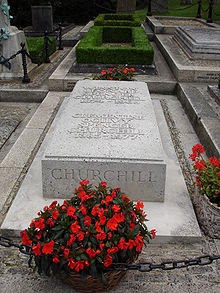
The last Churchill place we saw was his humble grave not far from Blenheim Palace, at St. Martin’s Church, Bladon. It was more humble then than now, as it was renovated in 2006.

Mr. Churchill, I honor you on the day of your death; may you rest in peace. One day I hope to get back and spend an hour soaking up your library and making friends with your books.

It takes wisdom to be content – or discontent.

Comforts that were rare among our forefathers are now multiplied in factories and handed out wholesale; and indeed, nobody nowadays, so long as he is content to go without air, space, quiet, decency and good manners, need be without anything whatever he wants; or at least a reasonably cheap imitation of it.

–G.K. Chesterton in Commonwealth, 1933

I don’t know that my comments on this ironic statement can add much, but for my own sake I will think while I type, and ramble as I think. GKC’s words startle me out of feeling guilty for complaining about modern life — after all, “We are so well off!” We have (noisy) leaf blowers so we don’t have to spend so much time raking. We can stop for fast food on our mad trips up the interstate, and while we eat off paper plates at dirty tables and lick our fingers we can be thankful we didn’t have to go to the trouble of finding a picnic spot by the river.

My first encouragement to question the amassing of things we don’t really want was 40 years ago, in the La Leche League’s Womanly Art of Breastfeeding. The motive was to help women cultivate a peaceful home in which they would have the time to leisurely nurse their babies; that goal would require sorting out one’s priorities concerning what we now call lifestyle choices. Do you really want your tabletop cluttered with knick-knacks, the author wrote, or might you enjoy having clear surfaces that are easier to keep clean and will ultimately be, in their simplicity, more pleasing to the soul?

The whole concept of More With Less has gained ground in the last decades, but Chesterton’s words reveal how easy it is to lose, bit by bit, the most valuable and wholesome “comforts” that our poorer forebears had in abundance, and not even notice what we have given in trade. Note that intangibles such as decency and good manners are on the list, to remind us that civilization is more than physical comforts.

The book Margin by Richard Swenson comes to mind here. He writes (first in 1995) about how the  people he doctored in third-world countries were by-and-large happier than the Americans back home, and he analyzes the reasons why. Even without health care and modern technology, they enjoyed several of the things mentioned in the quote, in good measure.

My own life provides the leisure that Josef Pieper calls the Basis of Culture, enough of it that I can take the time to ruminate on several facets of Chesterton’s clever jibe. At this stage, for myself, I can’t complain. But I pray that I’ll always have the wisdom to know what I want and need to go without, for the sake of being content.


 Linking up to Weekends with Chesterton.