Category Archives: books

Creating jokes and clean streets.

I picked up Paul’s Johnson’s book Creators the other day and am enjoying it three years after my first encounter. This is from the opening page:

Creativity, I believe, is inherent in all of us. We are the progeny of almighty God…. He created the universe, and those who inhabit it; and, in creating us, he made us in his own image, so that his personality and capacities, however feebly, are reflected in our minds, bodies, and immortal spirits. So we are, by our nature, creators as well. All of us can, and most of us do, create in one way or another. We are undoubtedly at our happiest when creating, however humbly and inconspicuously.

Johnson mentions some of the many creations humans produce, such as written works, farms, and businesses. Some of these wonderful works are not lasting, though they are valuable for as short as a season or as long as centuries.

Some forms of creativity, no less important, are immaterial as well as transient. One of the most important is to make people laugh. We live in a vale of tears, which begins with the crying of a babe and does not become any less doleful as we age. Humor, which lifts our spirits for a spell, is one of the most valuable of human solaces, and the gift of inciting it rare and inestimable. Whoever makes a new joke, which circulates, translates, globalizes itself, and lives on through generations, perhaps millennia, is a creative genius, and a benefactor of humankind almost without compare.

I transcribed the above about jokes because that form of creativity is worlds removed from anything I can imagine drumming up. I am fascinated by the art of making or even telling jokes; the chapter in Annie Dillard’s An American Childhood in which she relates how her parents worked their art of joke-telling describes an exotic land to which I could never go.

I’m more familiar — quite familiar — with the type of art Johnson also appreciates in this account:

I sometimes talk to a jovial sweeper, who does my street, and who comes from Isfahan, in Persia, wherein lies the grandest and most beautiful square in the world, the work of many architects and craftsmen over centuries, but chiefly of the sixteenth. I asked him if he felt himself creative, and he said, “Oh, yes. Each day they give me a dirty street, and I make it into a clean one, thanks be to God.”


Esthetics and Agriculture


We made at least two wrong turns getting to the mountains last month, and they helped put me in touch with my farming roots. In the middle of August the fields are lush with the bounty that gives California’s Central Valley the name of The Greatest Garden in the World. Tomatoes, corn, cotton, walnuts, tree fruits, grapes… Wikipedia says that every non-tropical crop is grown here.
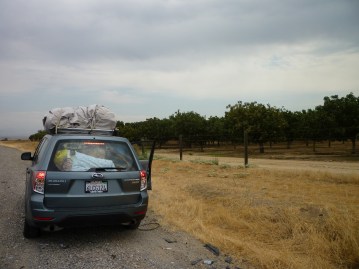
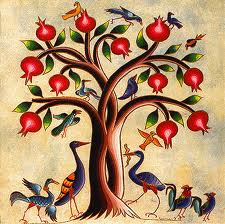
On our second meander, in the northeasterly instead of southeasterly direction, we were surprised to see fig orchards on one side and pomegranates on the other. What could be more exotic or impossible? William Saroyan describes the impossibility in his 1930’s story “The Pomegranate Trees” that Mr. Glad and I have laughed over a few times:


“My uncle Melik was just the worst farmer that ever lived. He was too imaginative and poetic for his own good. What he wanted was beauty. He wanted to plant it and see it grow. I myself planted over one hundred pomegranate trees for my uncle one year back there in the good old days of poetry and youth in the world. I drove a John Deere tractor too, and so did my uncle. It was all pure esthetics, not agriculture. My uncle just liked the idea of planting trees and watching them grow.

“Only they wouldn’t grow. It was on account of the soil. The soil was desert soil. It was dry. My uncle waved at the six hundred and eighty acres of desert he had bought and he said in the most poetic Armenian anybody ever heard, Here in this awful desolation a garden shall flower, fountains of cold water shall bubble out of the earth, and all things of beauty shall come into being.”

Melik plans to have apricots, peaches, figs and olives too, but he never gets beyond planting the pomegranates, which eventually fail, because instead of a fountain there is only a trickle of water flowing from the many wells he digs.
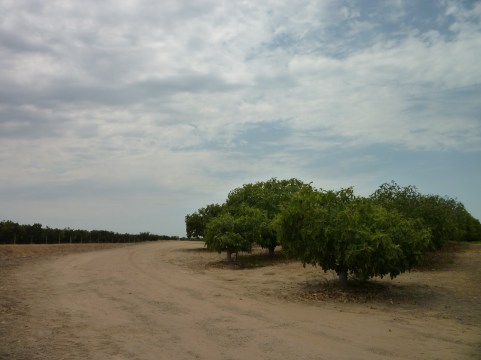
Fig orchard in Madera Co.

But since the 1930’s, state-funded irrigation projects have increased the available farmland to such a degree that in the present day about one-sixth of the irrigated land in the nation is in our Central Valley. The pomegranate trees we saw with their ripening red fruits were not far from where the fictional Uncle Melik farmed.

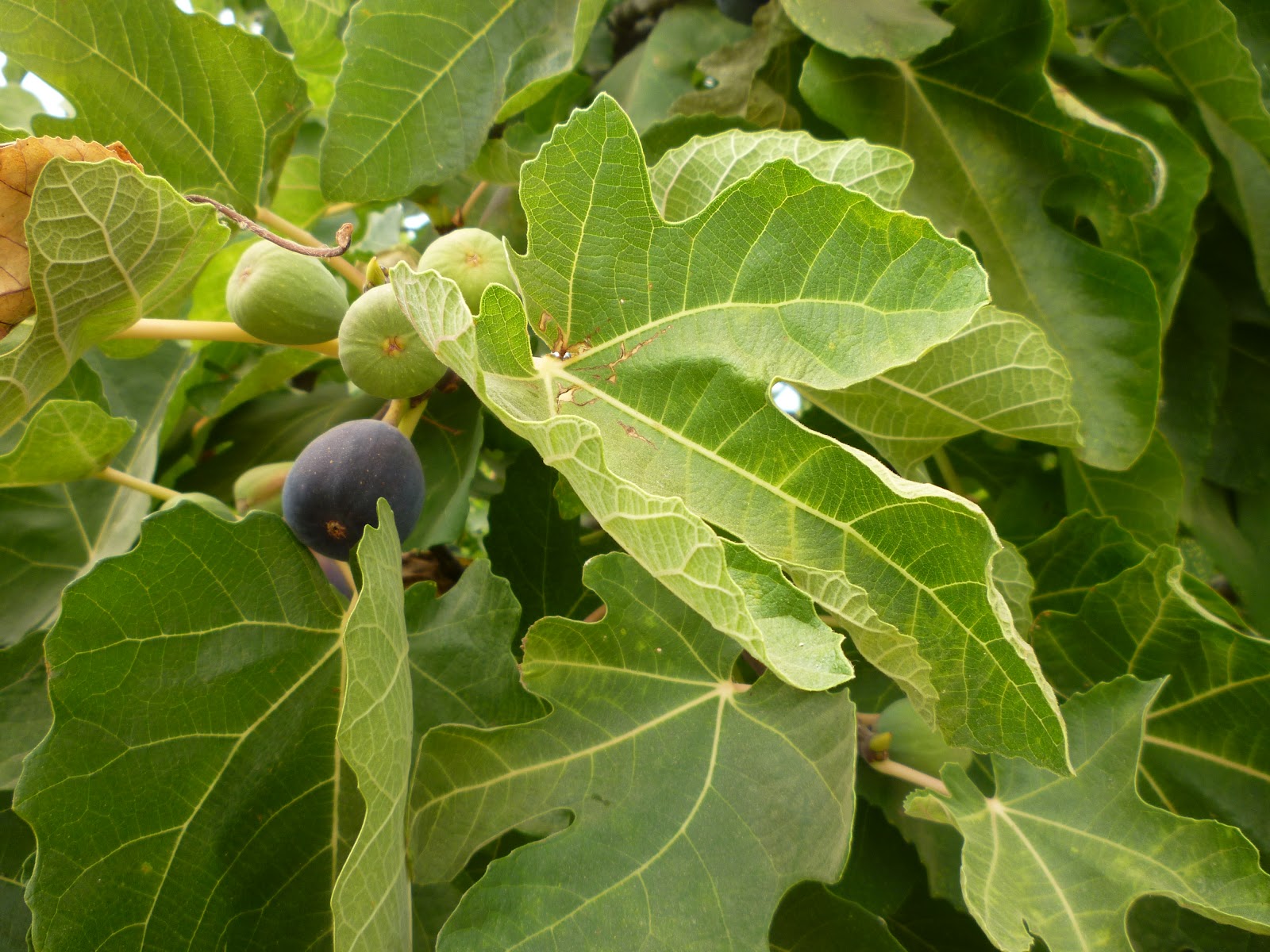
I do think there is nothing more lovely than a fig tree with its extravagant leaves on curvy branches, and fruits more refreshing than a cup of cold water. Though I grew up in the Valley this was my first sighting of a groveful. I didn’t notice what kind of irrigation system is used in the orchard, but no doubt there was one.
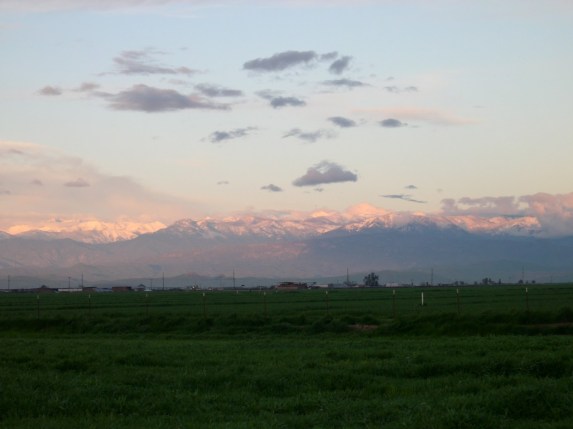
View of Sierras from Tulare County (Pippin pic)

By means of our state water projects we take all that melted mountain snow pack and hold it behind dams so that we can let it out bit-by-bit all through the summer. In this long agricultural center of the state, on less than one percent of the total farmland in the United States, we produce 8% of the nation’s agricultural output by value. (Wikipedia)
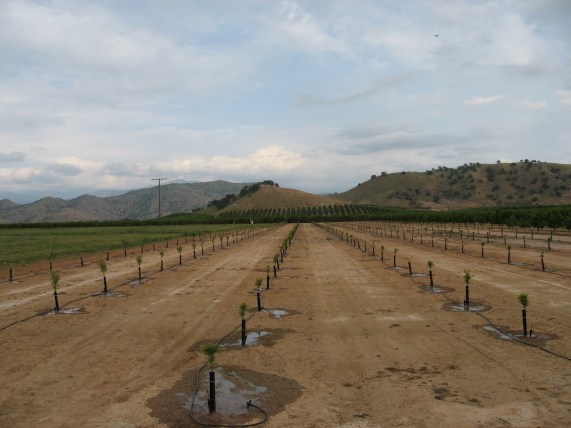
Tulare Co. in Spring – still green in places

I’ve been googling to find out how many dams are in California, but that list is too long for me to take the time to count. Maybe I’ll just stick to the ones in the Sierra Nevadas that end up feeding canals and rivers that water orange groves and almond orchards and alfalfa fields. It turns out that list above is sortable, and I can see that in Fresno County alone there are eleven dammed lakes.

When you drive across the state, from a dammed mountain lake to San Francisco Bay Area in one day, the repetition of scenes along the highway impresses on you the importance of water. There are dead almond orchards on Highway 5, on the “West Side” of the Valley, that testify to water wars still going on, and to our inability to grow very much without irrigation.

Westside tomato field in April

It was 101° as we headed home through that fertile swath. All the crops whose irrigation was current were happy. The corn was probably growing inches every day, and the almonds swelling in their shells. We were happy to look out from our car through the windows that were closed to keep in the cooled air.

A little north of the dead trees, on a slope above the freeway, a Hispanic family were systematically planting new almond trees. It dawned on me that Why, yes, it is a week day, a work day, isn’t it? Not all the farm work can be done in the cooler mornings or evenings.

I recalled my sweaty and tanned father getting off his tractor, coming into the house mid-afternoon with a watermelon and slicing it into rounds at the kitchen counter. He’d put one big slice on a plate and eat it with a fork before going back out to take care of his orange trees.

Water melon. Melons are some of those things of beauty that Uncle Melik likely envisioned as he was trying to find their necessary water. And the people who tend the earth’s gardens, who are willing to build the dams and plant the trees and irrigate them all summer long are beautiful to me, too.
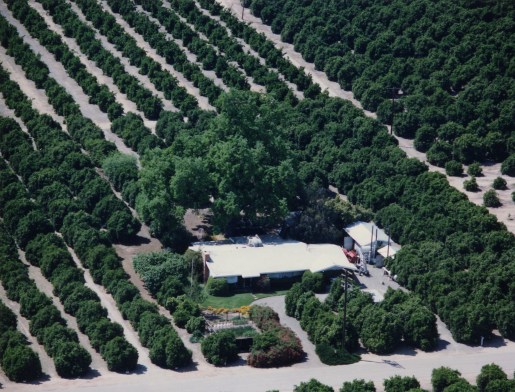
The house where my father ate watermelon.
Gardening requires lots of water – 
most of it in the form of perspiration. 

~Lou Erickson
I consider my difficulties.


My current difficulties stem from these realities:

1) The world is so full of a number of things
    I’m sure we should all be as happy as kings.

This rhyme has played in my head a million times since I learned it as a little girl. Maybe even then I suspected in my childish way the layers of truth in the sing-song, the irony of too-muchness.

2) I have been traveling a lot, and that brings me into contact with even more numbers of “things,” like real people, people in books, ideas in books, and new places I’ve visited. This summer, for example, I sat on airplanes for more than ten hours, and many of those hours were spent in the company of Alain de Botton as I read his book The Art of Travel. As I drifted off to sleep at night in a house not my own, I was soaking up the coastal delights of George Howe Colt’s childhood summer place, The Big House.

In the spaces between these literary adventures my more physical self was learning to reach right instead of left for a stirring spoon, and to relax in the hot tub of the Eastern summer atmosphere.

3) I need — o.k., I feel the need! — to write about at least some of the experiences in order to process the information and be restored from the overload/exhaustion of so much excitement. As Alain and I were musing together over the meaning of our travels, I scribbled notes in the margins and made a list in the back of the book of all the blog post ideas that were generated from our “discussion.” Every night for a week or two I have spent at least fifteen minutes writing and rewriting in my mind, in the dark, my review of the Colt book.

Even Archimandrite Sophrony is reported to have said, “Arrange whatever pieces come your way.” [update: It seems to be Virginia Woolf who said that.] I don’t know what the context of this quote was, but the urge is a basic, human, compelling one, and applies to just about everything I know.

4) When I am on the trip, just returned from a trip, or packing my bags and boxes to set off again, there is less time than ever for this kind of writing, and also less mental energy. When I hear Thomas Mann say, “A writer is somebody for whom writing is more difficult than it is for other people,” I feel that I am certainly one of those. I could coin my own saying: “A homemaker-writer with a large family is somebody for whom writing is even more more more difficult than it is for other people.”

I hope I am not complaining, by using the word difficulties. I could say challenges, or pieces. Or thoughts, as in “Bring every thought captive to Christ.” In my mind I have more challenging pieces of thoughts and prayers and connections to be made than there are dust bunnies floating up and down the stairs.

This morning it all seemed too much, as I add another item to the list of things that make us happy as kings: We are going to the cabin! There will be stimulating conversation on the way, as our numbers will be doubled by the presence of our dear Art and Di. (That will add pieces, to be sure.)

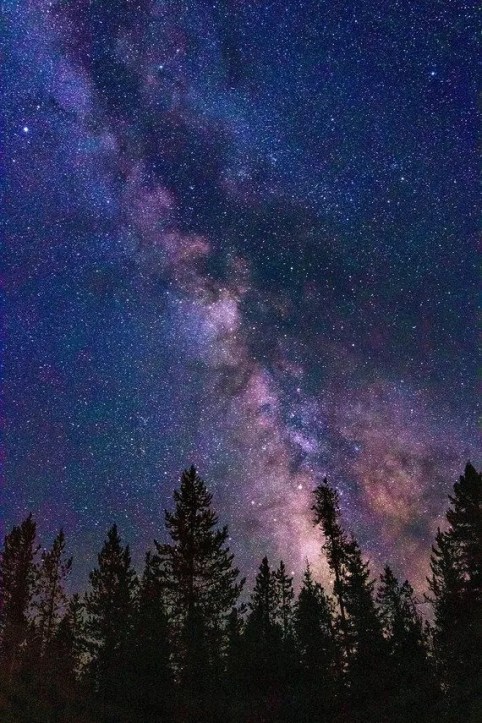
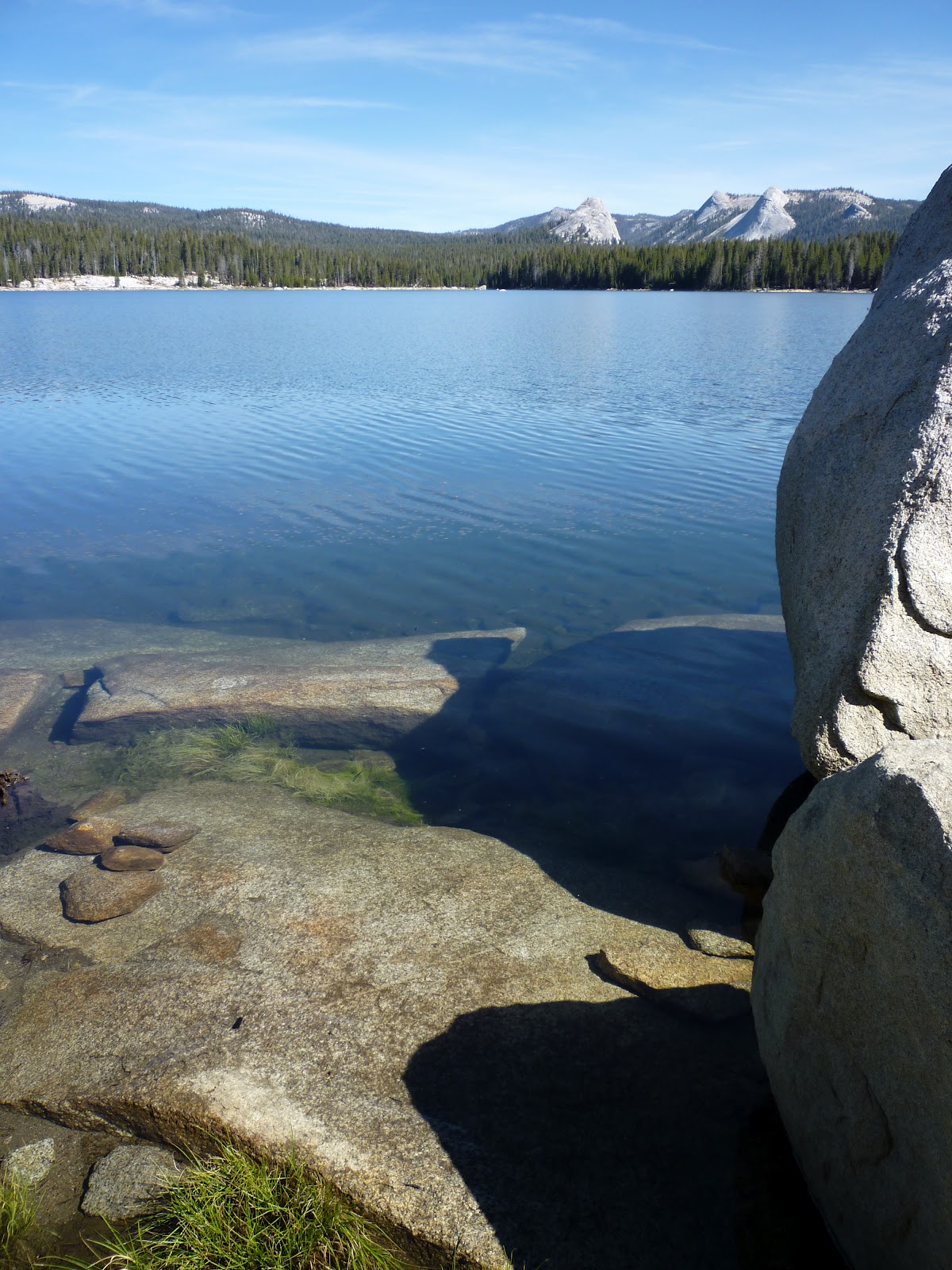
Stars will shine crisply in the black sky at night, and in the mornings chipmunks will scurry in the brush below the house. Humans will eat cookies and bacon and drink coffee on the deck while we watch the hummingbirds squabble, and we’ll paddle our canoe quietly over the lake.

(Past posts about our Sierra cabin: 2009  2010  and  2011 )

Though I have picked up only a few pieces here to tie in my bundle, it’s been quite comforting. Now I can face my lists of more practical things like dinner menus, shopping needs, and what to put in my book bag. That won’t be too difficult.

Elder Zosima and his brother

In my reading of The Brothers Karamazov, I came this morning, Monday of Holy Week, to the part “From the Life of the Elder Zosima.” The elder first relates about his older brother, who only at the age of seventeen and sick unto death, turned from anger and scoffing toward a path that might lead to repentance, and seemingly only to please his mother. But that is not an entirely bad reason.

…on Tuesday morning my brother started keeping the fast and going to church. “I’m doing it only for your sake, mother, to give you joy and peace,” he said to her….But he did not go to church for long, he took to his bed, so that he had to confess and receive communion at home. The days grew bright, clear, fragrant — Easter was late that year. All night, I remember, he used to cough, slept badly, but in the morning he would always get dressed and try to sit in an armchair. So I remember him: he sits, quiet and meek, he smiles, he is sick but his countenance is glad, joyful. He was utterly changed in spirit — such a wondrous change had suddenly begun in him!

The young man asked forgiveness of everyone and talked about his great sin, but at the same time was so happy and full of thankfulness and exhortations, that people thought he was going mad.

Thus he awoke every day with more and more tenderness, rejoicing and all atremble with love. The doctor would come — the old German Eisenschmidt used to come to us: “Well, what do you think, doctor, shall I live one more day in the world?” he would joke with him. “Not just one day, you will live many days,” the doctor would answer, “you will live months and years, too.” “But what are years, what are months!” he would exclaim. “Why count the days, when even one day is enough for a man to know all happiness. My dears, why do we quarrel, boast before each other, remember each other’s offenses? Let us go into the garden, let us walk and play and love and praise and kiss each other, and bless our life.”

This older brother died a few weeks after Easter, when the teller of the story, the elder Zosima, was only eight years old. He talks, now near death himself, more about his childhood, and how it was also during Holy Week that he began to see more when he went to church.

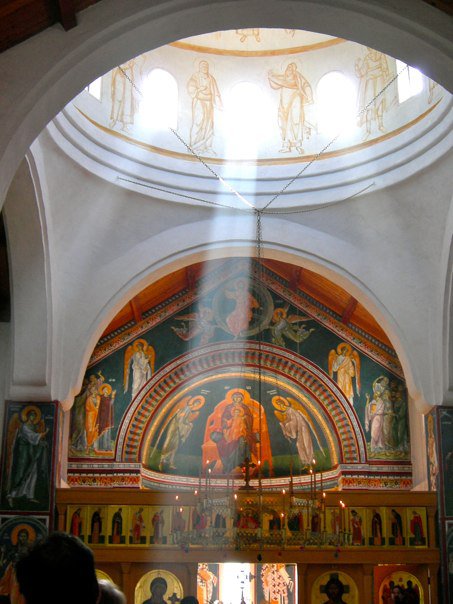
But I remember how, even before I learned to read, a certain spiritual perception visited me for the first time, when I was just eight years old. Mother took me to church by myself (I do not remember where my brother was then), during Holy Week, to the Monday liturgy. It was a clear day, and, remembering it now, I seem to see again the incense rising from the censer and quietly ascending upwards, and from above, through a narrow window in the cupola, God’s rays pouring down upon us in the church, and the incense rising up to them in waves, as if dissolving into them. I looked with deep tenderness, and for the first time in my life I consciously received the first seed of the word of God in my soul. A young man walked out into the middle of the church with a big book, so big that it seemed to me he even had difficulty in carrying it, and he placed it on the analogion [lectern], opened it, and began to read, and suddenly, then, for the first time I understood something, for the first time in my life I understood what was read in God’s church.

The reading was from the book of Job. And tonight I myself plan to attend this liturgy, and though I haven’t seen the program for the service, I now have confidence that I will hear this same reading. How many times have I also watched the beams of light shining down when I stood in church, and even felt their heat on my face, like the warmth of God’s Holy Spirit?

The Elder Zosima is a fictional character, but he is believed to be based on a real-life monk in old Russia. In the novel, where I am reading, Zosima goes on in his very moving fashion to tell his life’s story: “– and over all is God’s truth, moving, reconciling, all-forgiving!”

Isn’t it sweet that God should arrange for me to read this passage this morning, to help me in an unusual way to become even more receptive to His being with us tonight by means of hymns such as, “Let my prayer arise in Thy sight as incense….,” and the Psalms of Ascent — and the Holy Mysteries!

Last week our bishop was present with us, and he gave us a good word about the last days of Lent — well, technically Lent has come to an end, but we are still in the anticipation and preparation that is Holy Week. He said that Lent is not about finding every bit of dirt in our souls, but about the bridal chamber, about discovering the great love that our Lord Jesus has for us.

Perhaps Zosima’s brother went to a Bridegroom Matins service on Tuesday; we have three of them this week, and tomorrow I hope to attend at 6:30 in the morning. The Lord Himself has been filling my lamp with the oil of His Holy Spirit!