Category Archives: books

Joy in the Holy Spirit — Pentecost

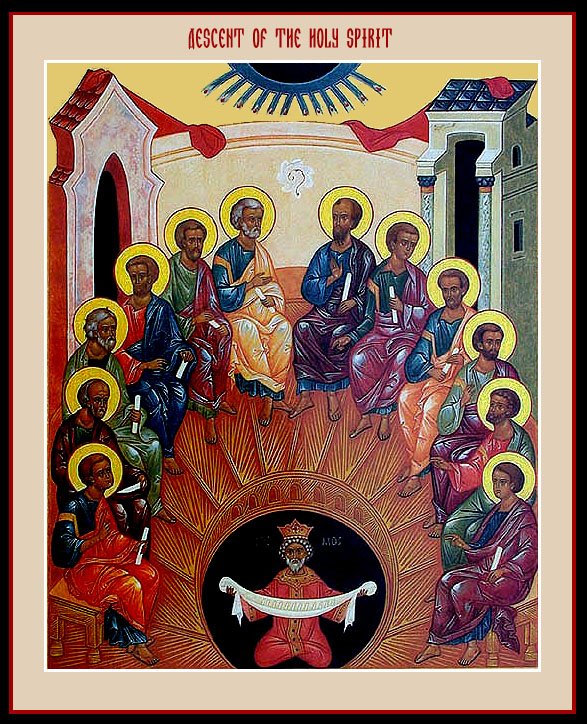
Today the church is decorated with green–ferns, birch branches, palm fronds, hanging from the chandelier and draped over everything. Lilies frame the icon that portrays the pouring out of the Holy Spirit 50 days after the Resurrection. The vestments and other cloths are green now as well. This passage from Alexander Schmemann’s For the Life of the World explains why we Orthodox take so much trouble for the sake of the appearance of our temple:

The liturgy [Communion service] is, before everything else, the joyous gathering of those who are to meet the risen Lord and to enter with Him into the bridal chamber. And it is this joy of expectation and expectation of joy that are expressed in singing and ritual, in vestments and in censing, in that whole “beauty” of the liturgy which has so often been denounced as unnecessary and even sinful.

Unnecessary it is indeed, for we are beyond the categories of the “necessary.” Beauty is never “necessary,” “functional” or “useful.” And when, expecting someone whom we love, we put a beautiful tablecloth on the table and decorate it with candles and flowers, we do all this not out of necessity, but out of love. And the Church is love, expectation and joy. It is Heaven on earth, according to our Orthodox tradition; it is the joy of recovered childhood, that free, unconditioned, and disinterested joy which alone is capable of transforming the world. In our adult, serious piety we ask for definitions and justifications, and they are rooted in fear–fear of corruption, deviation, “pagan influences,” whatnot. But “he that feareth is not made perfect in love “(I John 4:18). As long as Christians will love the Kingdom of God, and not only discuss it, they will “represent” it and signify it, in art and beauty. And the celebrant of the sacrament of joy will appear in a beautiful [robe], because he
is vested in the glory of the Kingdom….

Today is Pentecost, or Holy Trinity Sunday, so named because all the Persons of the Trinity are remembered–Christ sent the Holy Spirit from the Father. This event is, as our rector reminded us, the seal and crown and joy of Pascha, and our salvation. It is a feast second only to Pascha, to the Resurrection itself, and there is so much to celebrate that we have another Divine Liturgy tomorrow, on Holy Spirit Day.

During the time between Pascha and Pentecost, we withheld the prayer about the Holy Comforter from our daily selections, as we entered into a period of “waiting” for the Spirit to be given. Now its restoration imparts the reality of Pentecost as a historic event which has been given to us in Christ, and we pray:

O Heavenly King,
The Comforter, The Spirit of Truth,
Who art everywhere present and filleth all things,
Treasury of Blessing, and Giver of Life,
Come and abide in us,
And cleanse us from every impurity,
And save our souls, O Good One.
Curious about asparagus.

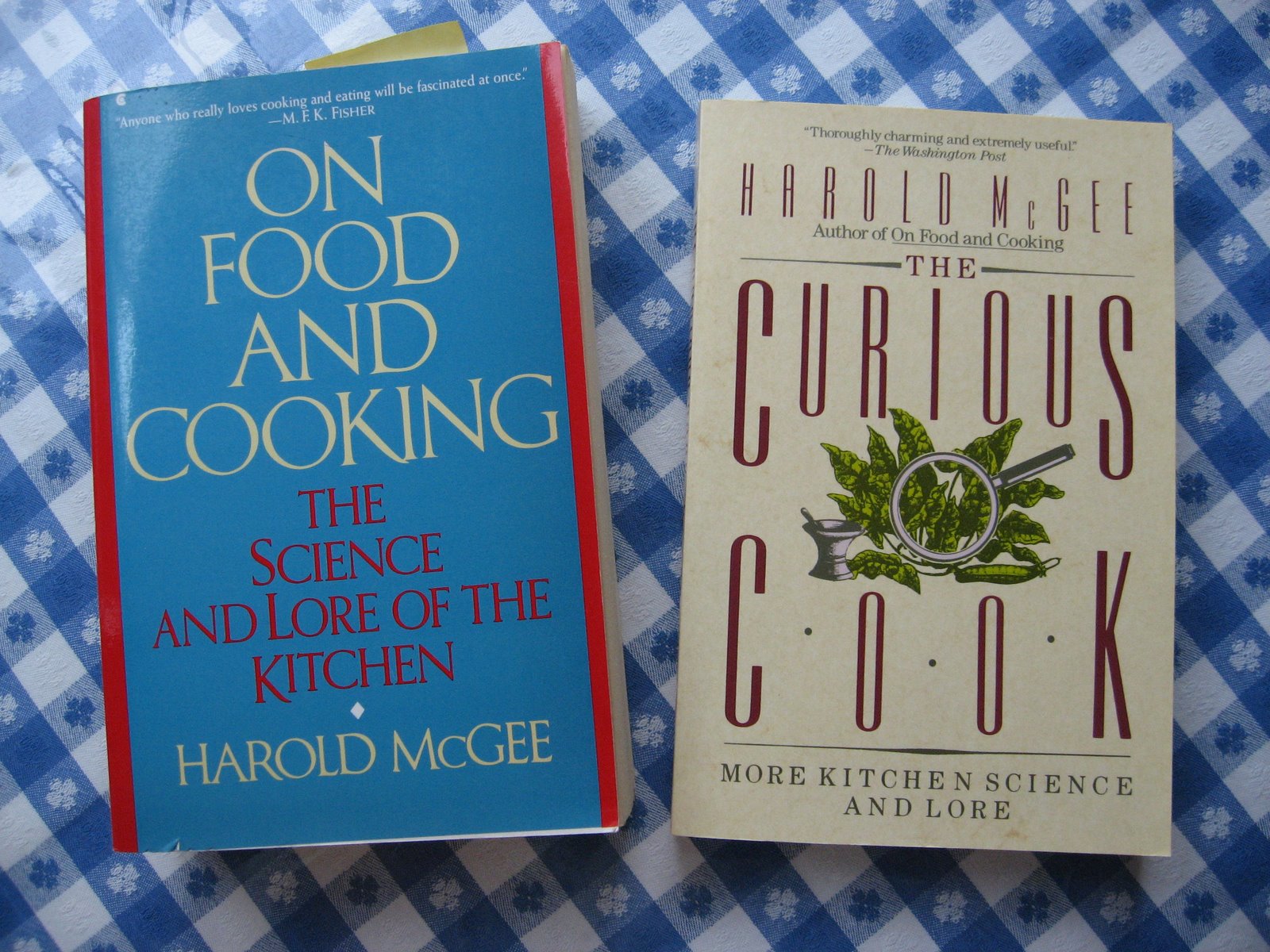
The Curious Cook, Harold McGee, has now studied whether asparagus-snapping is the best way to avoid this vegetable’s tough parts, and you can read his conclusions here . We were just having a discussion about this issue in our kitchen last week. My own style of trimming is sort of a variation on Harold’s. But I’ll tell you about that, maybe, next spring when I have more and fresher of the stalks to photograph. In the meantime, there is much fascinating and useful information to be had from the short article.

I haven’t made very much use of the two books by McGee that I invested in many years ago. But I am grateful to him for applying scientific research to our common kitchen tasks. I did learn–and remember– that if you happen to have a copper bowl around, you will get more volume to your egg whites if you beat them in it, because of a chemical reaction that happens. And it’s o.k. to wash mushrooms, because even sitting in a bowl of water, they hardly absorb any (he weighed them before and after) and don’t get soggy.

Recently I subscribed to his blog, but it isn’t very busy. And just taking his books off the shelf and leafing through them makes me think that if I put in a little time with them, I might be able to learn more for use in my current culinary phase.

Book Notes

This stack represents the top of the current pile I’ve been working on. Any guesses as to which one I’ve already abandoned? I’ll start from the top. At Large and Small by Anne Fadiman was a gift from Pippin. We had both enjoyed her earlier book for readers, Ex Libris. She specializes in the personal essay and does a fine job of it, but I like the first book better; this one ranges over topics not so interesting to me. At least it is a small and lightweight book, which makes it possible to read while lying down just before the eyelids get heavy.

Creators is the first book by Paul Johnson that I have actually completed, though I’ve started in on two others by him. It is a collection of essays on famous creative individuals “from Chaucer and Dürer to Picasso and Disney.” Um…to be exact, I didn’t complete the book; there were a few in whose stories I couldn’t drum up enough interest at bedtime. The chapter comparing Picasso and Disney was certainly thought-provoking. Johnson thinks that the ideas of Picasso will fade and be outmoded, while those of Disney will endure–not because Picasso was so selfish and violent and Disney a maker of “family movies,” but for an entirely different and more fundamental artistic reason, which I don’t want to give away here.

I learned a lot more about many people in this book: T.S. Eliot, Jane Austen, Mark Twain, J.S. Bach, fashion designers and landscape painters. How does Johnson know so much, and how can he be so opinionated? He is easy to read, and refreshing in his willingness to tell you just what he thinks, and to not be politically correct, either. This book is one of a series with two others: Intellectuals, published many years ago, and Heroes, which has come out since. Some critics thought Intellectuals somewhat of a downer, but these last books should make up for that.

My friend K. lent me The Folding Cliffs. It’s not a book I’d have ever picked up otherwise, written as it is without any punctuation and me a member of the Apostrophe Protection Society. Is this even English? I guess it is, as I am able to read it, though it is definitely a variant form. In this case it is worth the trouble, though I’m not ready to tackle Merwin’s other poems. Here’s a sample from Cliffs:

The story is as captivating as the imagery, and I certainly won’t abandon this one, even if it takes me a year of little snatches. I like the way the words flow as soothingly over my consciousness as the stream over the narrator’s body.

Steinbeck’s novel East of Eden was recommended to me by two friends, so I was happy to find it in the used book store. I’ve read almost half of it, and enjoyed several of those hundred pages. But this is the one I’m quitting. Mr. Glad says I could write a dissertation on “What Can Be Learned of Steinbeck by Reading Half a Book”; I gave him my whole dissertation while cooking dinner after my decision to quit, but I will spare you readers. It boils down to the reality that life is short, and there didn’t seem to be anything to be gained by continuing with Steinbeck. There has always been something missing between him and me. Perhaps this time would be different, and I’d be surprised and gratified if I’d finished it, but one can’t have everything in life.

The Hacienda by de Teran is a re-run for me, but now my husband and I are reading it aloud together. It’s a fascinating story of Venezuela in the 1970’s and of the author’s experience–how she got herself into a mess and lived in a primitive society for quite a while before escaping for her life. I’ve read a couple of other books by this author and she tells a good tale–the ones I’ve read were the autobiographical accounts.

I love to read on a airplane. There is not much else to do, usually, so hours can go by without the attention being distracted. The Everlasting Man by G.K. Chesterton I took on my last flight as a treat I’d been long waiting to enjoy again. I knew the first time I read it that it was the kind you have to read at least two or three times if you hope to get near the bottom of it.

Before our plane taxied down the runway I was well into the first chapter. My seatmate, who had initially seemed reserved, interrupted my reading to tell me that he much admired Chesterton and that particular book. Over the next ten or fifteen minutes we chatted on the subject of good writers, Christianity, how books had changed us, etc. And we still hadn’t taxied anywhere, because as it turned out, the plane had a mechanical problem which ended up delaying our flight for three hours, by which time we’d all disembarked and my new friend had got a different flight. I was quite pleased that the Lord had given me a short and sweet discussion time and a long and sweet reading time, all on the same leg of the journey.

Richard Wilbur may be my favorite poet. K.’s having introduced me to hers jogged me into digging out Wilbur’s poems again, which are so varied and beloved, I will have to write one or more posts just on him.

Now that there aren’t any travels in my near future, there might not be many new books begun, either. But as you can see, I’ve still plenty to keep me busy.

Last Days of Lent

When I write my own words about Orthodox spirituality I tend to confuse people, so today I am going to quote Fr. Schmemann, whose books have helped me so much.

” …fasting is the only means by which man recovers his true spiritual nature. It is not a theoretical but truly a practical challenge to the great Liar who managed to convince us that we depend on bread alone and built all human knowledge, science, and existence on that lie. Fasting is a denunciation of that lie and also proof that it is a lie….
….
“Let us understand …that what the Church wants us to do during Lent is to seek the enrichment of our spiritual and intellectual inner world, to read and to meditate upon those things which are most likely to help us recover that inner world and its joy. Of that joy, of the true vocation of man, the one that is fulfilled inside and not outside, the ‘modern world’ gives us no taste today; yet without it, without the understanding of Lent as a journey into the depth of our humanity, Lent loses its meaning.”

from Great Lent by Fr Alexander Schmemann