Category Archives: Christmas

Of course goblins can’t hurt him.

While at Pippin’s I had the great satisfaction of reading Christmas stories for a total of several hours during my stay. The genre seems most appropriate for reading aloud, but when we have our larger family gatherings, there doesn’t seem to be much opportunity for it. Meanwhile, my collection grows.
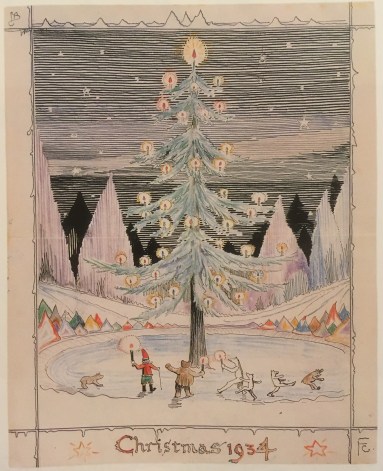
Recently I acquired Letters from Father Christmas by J.R.R. Tolkien, though in this case I think “recent” means 10-15 years ago. I’d glanced at them myself, but I think I was waiting to share the experience — to peek in on the Tolkien family and the stories that Tolkien the father created every year for his children. He wrote and illustrated them for over 20 years, starting by writing to three-year-old John, and continuing until he was only writing to his fourth child, Priscilla, with hopes that she will be hanging up her stocking “just once more.”
It is particularly interesting to me how Father Christmas refers to world events, in terms that place them in the context of the ages-long attempt of evil spiritual forces to destroy humanity once and for all. He first mentions goblins in 1932 and ’33, after he has written letters for about 12 years, and his goblins remind me of those in George MacDonald’s stories. They are a nuisance, and sometimes very scary  —“Goblins are to us as rats are to you,” — but if you stand up to them they flee. They have no real power.

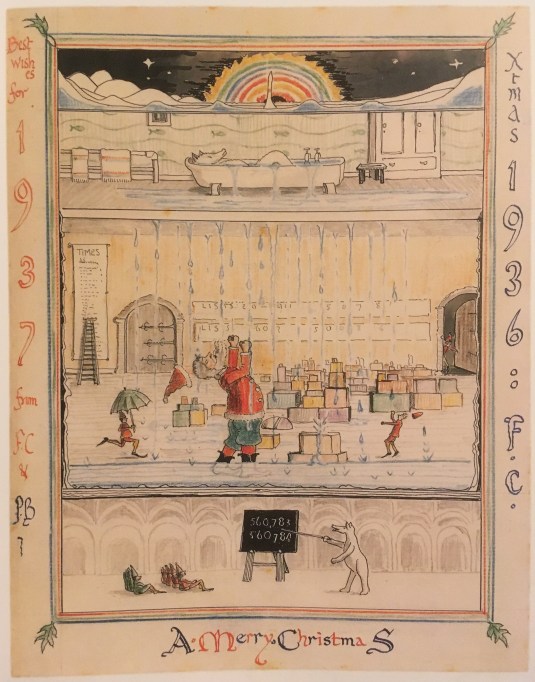
Most of the letters from the North Pole are about the mischief and adventures of all the people and creatures who live there: elves and snowmen, reindeer — and the North Polar Bear, who drew a bath, climbed in, and fell asleep with the water running, flooding the cellars full of toys.
But in 1932 the same bear had an encounter with a goblin:

“…he smelt a goblin! and became interested, and started to explore. Not very wise; for of course goblins can’t hurt him, but their caves are very dangerous.” In the next letter things are still heating up:

“Another Christmas! I almost thought at one time (in November) that there would not be one this year. There would be the 25th of December, of course, but nothing from your old great-great-etc. grandfather at the North Pole.

“Goblins. The worst attack we have had for centuries….”

More than once he mentions the last worst battle with these creatures, “the goblin-war in 1453, that I told you about.”

From then on the goblins show up regularly. The children are old enough to understand about the world situation as it affects them, and in 1940 F.C. writes more plainly, “We are having rather a difficult time this year. This horrible war is reducing all our stocks, and in so many countries children are living far from their homes. Polar Bear has had a very busy time trying to get our address-lists corrected. I’m glad you are still at home!” 
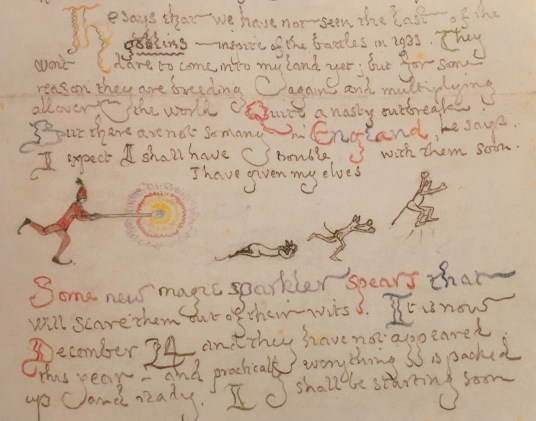
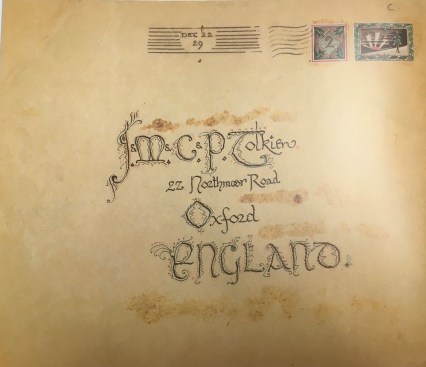
The text of the 1935 letter above reads: “[North Polar Bear] says that we have not seen the last of the goblins — in spite of the battles of 1933. They won’t dare to come into my land yet; but for some reason they are breeding again and multiplying all over the world. Quite a nasty outbreak. But there are not so many in England, he says. I expect I shall have trouble with them soon.

“I have given my elves some new magic sparkler spears that will scare them out of their wits. It is now December 24, and they have not appeared this year — and practically everything is packed up and ready. I shall be starting soon.”

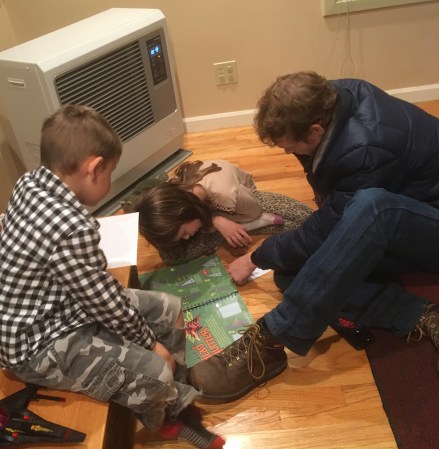
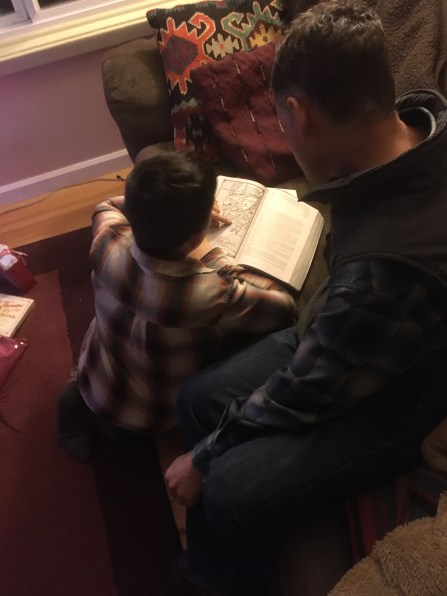
I’ve interspersed Tolkien’s illustrations with the last images from my northern adventure. Pippin and the children and I walked by the lake, and the stream flowing into it. We came home and snuggled again on the couch, with cats, and finished the last letters. I think we were all sad that the Tolkien children grew up!


Splash of fall – then Christmas.

The dwarf pomegranate bushes that are at the four corners of the fountain, are just now at their most beautiful. You can see how they contrast with the dark corner where the greenhouse spends winters, in the shade of my tall house. In spite of that darkness, I have hope for a more favorable growing environment in the greenhouse, because I got it wired with outlets for heat and light and even a breeze when needed.

Many unripe figs  held on to the tree, until they turned purple from frost and had to let go.

The day after I took this picture, I drove north to Pippin’s, for a sort of early Christmas. Here there is also some color — mostly forest-green and white; the snow began to fall just as I was arriving! But also some bright spots like this pumpkin.

The snow on the road turned to ice, sending one of our vehicles into the ditch. It wasn’t mine, and I didn’t hear about it until everything was resolved. Pippin baked a pie with Honeycrisp and vowed Never Again. Pippins (the apples) are the best! But the deer relished the peelings; I watched the doe repeatedly kicking one fawn away from the bowl in which they had been served. Other humans liked the pie very much and it was beautiful and tasty — just not appley enough.

We had the best sort of evening with a few family members I haven’t seen since last Christmas, and even sang carols — for a blessedly prolonged while. (We had already sung “O Come, O Come, Emmanuel” around the Advent wreath before dinner.) Enough of us could carry a tune and even lead off, that the two pianists present were glad to be able to sing rather than play, and it was truly joyous singing.

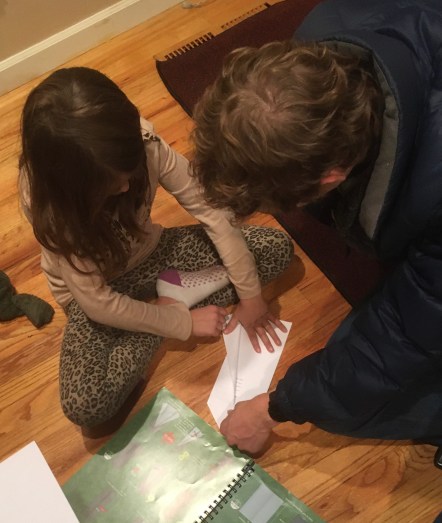
The cousins made paper airplanes together, and Scout told his uncle all about the latest novel he is reading. He also played his newly learned guitar piece. He has been busy cutting Christmas trees in the mountains and then selling at the Boy Scouts’ lot, and their tree was one of those. It is so pristine and elegant, and pointing straight to the heavens, that I could not believe it was real. It is a red fir.

Several of our group have been working really long and odd hours lately, and it seemed a miracle that the logistics worked out for us to be together. I am joining two church school meetings on ZOOM in two days, which meant that both teachers of our high school class and the special guest we had were all participating from a distance. If we weren’t meeting online I’d have had to get a substitute. So that worked well, too.

Too soon, I’ll be driving back down the road and home again, and will proceed with Advent. I think I might add to my preparations a new tradition, and start singing remotely — but oh, so closely — with my family, a nightly round of  “O Come, O Come, Emmanuel.”

A Rose dispels the darkness.

I didn’t encounter this Christmas carol,  “Lo, How a Rose E’er Blooming,” until long past my childhood. For various reasons it is one of my favorites now. Here it is sung in Ely Cathedral:

Lo, how a Rose e’er blooming
From tender stem hath sprung!
Of Jesse’s lineage coming,
As men of old have sung.
It came, a flow’ret bright,
Amid the cold of winter,
When half spent was the night.

Isaiah ’twas foretold it,
The Rose I have in mind;
With Mary we behold it,
The virgin mother kind.
To show God’s love aright,
She bore to men a Savior,
When half spent was the night.

This Flow’r, whose fragrance tender
With sweetness fills the air,
Dispels with glorious splendor
The darkness everywhere.
True man, yet very God,
From sin and death He saves us,
And lightens every load.

By the time our family brought this carol into our repertoire, several of us would enjoy singing the carol in its original language when we gathered at Christmastime, at least a few times. Even before their father ceased to be one of the singers, the details of our festivities had begun to change. It’s been a while since we have been able to sing as many carols as we would like, usually because of the needs of small children.

This year I will sing it by myself. It will be a good chance to try the German version again and work on memorizing it. The tone and the message are certainly sweet like the loveliest rose. I appreciate the reminder of how Christ ultimately defeated death by his death. God is with us! That’s why every Christmas can be a merry one, and why I’m eagerly looking forward to this feast.

The opposite of not getting in trouble.

My Christmas tree is still standing in my entryway, at the bottom of the stairwell. It’s handy to have an artificial tree so that it never starts looking worn out and dried up. I didn’t get it out of its box and trimmed until very late, and then all the days this month that I was mostly in bed because of my viruses, I couldn’t even see it much. I missed many services of Nativity and Theophany in which I might have been reminded by poetry and theology of the significance of “Immanuel: God with us.”

So bear with me if I continue on the theme of the Incarnation. After all it is, as was pointed out to me not long ago, the second most important point of Christian doctrine, after the Holy Trinity. If we truly live, we live it every day. And it’s worth giving extra attention to at least once a year. 🙂

One of the days I was in bed I started listening to The Fountain Overflows by Rebecca West. I would love to hear if any of  my readers has read this book or others in the Aubrey Trilogy of which it is first. This makes the third time I will have read this novel in the last ten years, and I could count on one hand the novels I’ve read three times in my whole life. I read the other two in the series as well, This Real Night and Cousin Rosamund, and a totally different novel of hers, The Birds Fall Down.

They have all made me ask what sort of woman could create these fascinating characters and dramas, portrayed by means of the most revealing dialogue and natural prose. After I started sitting up in the recliner I began to read The Extraordinary Life of Rebecca West by Lorna Gibb. It appears that there is a lot of autobiographical material in The Fountain Overflows, set in England in the Edwardian period. I don’t know if I will ever be able to write a good review of this book or any of West’s; they seem too vast and rich — and mysterious — for me to grasp, and that makes me wonder, Why am I so taken with her as a writer? and How does she accomplish this enchantment? I have some ideas — maybe they will lead to something!

The only reason I have for saying anything just now is, I ran across this passage about a Christmas Day the Aubrey Family celebrated. It contains one of the thought-provoking pearls of wisdom and understanding that are found liberally scattered throughout, not ever as little sermons, but as insights that come to the narrator Rose, or a phrase spoken by the mother as she’s trying to answer one of her children’s questions.

The father of the family wastes and loses money in various ways, so that they are always on the brink of disaster. In the passage below, the young Rose calls him “unlucky,” but the reader knows that it’s a case of children wanting to think the best of their father. His indiscretions or outright shameful behavior are the reason he and his family are always needing rescuing.

On Christmas Day the mother stays home with the maid to prepare Christmas dinner, and the father walks to church with the four children. The girls, having been musically trained to listen carefully and critically to every piece of music they hear, are often unable to enjoy anything slightly imperfect. The italics are mine:

“In church we were so contented that we did not think of the choir as music and did not approve or disapprove, but gratefully took it that it was giving tongue to what was in our hearts. ‘How bright,’ Mary whispered in my ear, ‘the silver dishes on the altar are.’ We liked the holly round the pulpit, the white chrysanthemums on the altar. Of late Mary and I had doubts about religion, we wished God had worked miracles that would have enabled Mamma to keep Aunt Clara’s furniture and saved Papa from his disappointment over the deal in Manchester, but now faith was restored to us. We saw that it was good of God to send His Son to earth because man had sinned, it was the opposite of keeping out of trouble, which was mean, it was the opposite of what Papa’s relatives were doing in not wanting to see him just because he had been unlucky. We liked the way Richard Quinn stood on the seat of the pew and, though he had been told he must be good and sit as still as a mouse in this holy place, nuzzled against Papa’s shoulder and sometimes put up his face for a kiss, certain that showing love for Papa must be part of being good.”

The picture of the family in church is sweet, but it’s the way the love of God and His willingness to come to our aid are put in a child’s very personal terms that strikes me. They paraphrase a word I really appreciate in regard to His taking on human flesh and frailty, human sin and soul-sickness and chains of death: solidarity. Glory to God in the highest!