Category Archives: church

Ways to Remember the Dead


My mother’s brother Bill died before she was even married, so I didn’t know him. He was a pilot who died in a plane crash during wartime, after having flown many successful bombing missions over Europe.

All my life I’ve never known more than that, and I never thought to ask my mother more. Or my grandmother, who lost her only son and half of her children when she lost him. No one in my family was very talkative generally, or the sort to tell family stories to children — especially stories of pain and loss.

I wonder what was wrong with me, that I never asked about him? I have recently inherited a beautiful framed portrait of my uncle in uniform, which I hope to put on the wall somewhere. If this portrait had been on the wall of our house when I was young, maybe it would have prompted my mother to talk about him, or me to inquire. Now that I am older, and want to know more about many of my ancestors and relations, there’s no one to ask!

I guess I shouldn’t blame myself for not being more inquisitive when I was younger; probably it isn’t in the nature of children, or even of young adults getting set up in the world, to think about their parents’ and grandparents’ past and about people who aren’t present in the here and now.

And if that is the case, knowing how I feel at this stage, when it’s too late to do anything about my own ignorance of my family history, I think about how to make it better for my own children when I’m gone and they are having similar regrets. All I know to do is to write down what I do know. Then it’s there for anyone to access at whatever time they do come to that place in life where they are more hungry for connection to deeper family roots.

What might it take to feel this connection? Your feelings remembering a grandparent you spent a lot of time with would differ, certainly, from those toward a family member you never met, even if the latter were famous and had a long entry on Wikipedia. There are different kinds of knowing — and loving.

Once my priest talked to me about how to keep from getting offended by other people and to avoid sinning against them. If we hold them in our minds, there are mostly facts there: this person does this, is that, said this, thinks that. We are set up for judging the facts and the person as to whether she is good or bad or whether she likes us or not, if he is trustworthy or not, and so forth.

But if we can hold the person in our hearts, he continued, where the Kingdom of God is, we are holding him in Love. God is there, and God is Love, and the warmth and peace of the Holy Spirit control our responses to the one we are called to love.

Perhaps this is what II Cor 5:16 refers to when it says, “…from now on, we regard no one according to the flesh.” If we strive to know another person according to Christ, in our hearts, there must be an element of prayer involved, as we carry them with us into God’s presence.

We Orthodox pray for the dead not because we have a doctrine of Purgatory (we don’t) but only out of love, a practice I considered at length two years ago in a blog post when my father died. Isn’t this a way to hold the departed, also, in our hearts, and not in our intellect, where for some of them we only have biographical sketches?

Memorial Day is a good day to express my love for my uncle, who died before I was born, and my longing to know him, in prayer. I never sat on his lap or flew a kite with him; I don’t know if he had a sweetheart or what he planned to do after the war. But God made him and knows him, and when He sees Uncle Bill and me, it is in the Now, because our Father sees everything at once.

I can remember my uncle in the Reality of the presence of God, and perhaps I’ll meet up with him later in the coming Kingdom, where it will be obvious that we didn’t miss much by not meeting here on earth, and where we’ll know each other in the best way.

Birthday of a Star

Dear GKC, HAPPY BIRTHDAY!

Here is a good reminder from our man of the gifts of God, which I think my favorite quote source used to the benefit of us all:

It is idle to talk always of the alternative of reason and faith. Reason is itself a matter of faith. It is an act of faith to assert that our thoughts have any relation to reality at all. If you are merely a skeptic, you must sooner or later ask yourself the question, ‘Why should anything go right; even observation or deduction? Why should not good logic be as misleading as bad logic? They are both movements in the brain of a bewildered.’ The young skeptic says ‘I have a right to think for myself.’ But the old skeptic, the complete skeptic says, ‘I have no right to think for myself. I have no right to think at all.’

–Gilbert Keith Chesterton   May 29, 1894-June 14, 1936

Flowing from Easter – The Church Year

I’m preparing for the expected blessing of having three dear and longtime friends as house guests at different times over the next two weeks. While my home is full of busyness and women’s talk, in The Orthodox Church we’ll be commemorating some of those events of the church year that are becoming more lovely to me with every cycle of the church calendar. And because I doubt I’ll even think of blogging while I am hostessing, I am looking ahead, blogging ahead.

In the years when I was first learning about Orthodoxy, I’m thankful I was able to participate quite a bit in various services throughout the seasons, so that I got a good foundation in how the intellectual knowing is the lesser part of a relationship with God. With every year that passes I see this more, and also feel my inability to convey in words this Reality that is Christ in His Church. Even the most eloquent and holy men and women would communicate by their entire persons, and relatively little by words, the Love that has been shed abroad in their hearts.

Still, their words are more eloquent than mine and express a deeper grasp of the realites by far, so I am depending on them to tell a little of how the day-to-day structure of the Church Year gives the grace of God. It all flows from the Resurrection. From the Orthodox Church in America site:

Although the first of September is considered the start of the Church year, according to the Orthodox Church calendar, the real liturgical center of the annual cycle of Orthodox worship is the feast of the Resurrection of Christ. All elements of Orthodox liturgical piety point to and flow from Easter, the celebration of the New Christian Passover. Even the “fixed feasts” of the Church such as Christmas and Epiphany which are celebrated according to a fixed date on the calendar take their liturgical form and inspiration from the Paschal feast.

Next week we have the Leavetaking of Pascha, which I love very much, because it always seems to me that I haven’t been able to sing enough times those exultant hymns of “Christ is risen from the dead, trampling down death by death.” Every year I become more familiar with some of the words and tunes, and try to learn a new one. “Why seek ye the living among the dead? Why mourn ye the incorrupt amid corruption?” On Leavetaking of Pascha we’ll repeat the Easter service in its entirety – and then won’t sing those hymns again until next year.

Even though we will still be in “the time of Easter” for another ten days, until Pentecost, we must say good-bye to the Feast of Feasts, so to speak, because we are coming up to the Ascension! Then we will update our greeting from “Christ is risen!” to “Christ is ascended!” the response to that being, “…from earth to heaven!”

In his book, The Year of Grace of the Lord, Fr. Lev Gillet tells at length the meaning of the Church Year. An excerpt from one paragraph, to which I have added breaks to make it more readable on the screen:

The liturgical year is, in fact, expressed as a calendar, but simply to identify it with a calendar would be totally inadequate. One could also say that the purpose of the liturgical year was to bring to the minds of believers the teachings of the Gospel and the main events of Christian history in a certain order. That is true, but this educational, pedagogical, function does not exhaust the significance of the liturgical year.

Perhaps we could say that its aim is to orient our prayer in a certain direction and also to provide it with an official channel which is objective, and even, in a certain way, artistic. This, too, is true, but the liturgy is more than a way of prayer, and it is more than a magnificent lyric poem.

The liturgy is a body of sacred “signs” which, in the thought and desire of the Church, have a present effect. Each liturgical feast renews and in some sense actualizes the event of which it is the symbol; it takes this event out of the past and makes it immediate; it offers us the appropriate grace, it becomes an “effectual sign,” and we experience this efficacy to the extent that we bring to it a corresponding inclination of our soul.

But still, this does not say everything. The liturgical year is, for us, a special means of union with Christ. No doubt every Eucharist unites us intimately with Christ, for in it he is “both he who offers and who is offered,” in the same way that every prayer, being the prayer of the members of the mystical body, shares in the prayer of him who is the head of the body and the only one whose prayer is perfect.

But, in the liturgical year, we are called to relive the whole life of Christ: from Christmas to Easter, from Easter to Pentecost, we are exhorted to unite ourselves to Christ in his birth and in his growth, to Christ suffering, to Christ dying, to Christ in triumph and to Christ inspiring his Church. The liturgical year forms Christ in us, from his birth to the full stature of the perfect man. According to a medieval Latin saying, the liturgical year is Christ himself, annus est Christus.

Unusual Monastery Visit


This time when I drove to the women’s monastery about an hour from here, it was not for a lecture or a service or for contemplative time; it was for a stint of strenuous gardening. The nuns had put out a call for helpers to get the woodsy place under control after the rainy winter and spring have brought out tall weeds of many sorts.

When I came through the open gate I didn’t see anyone around, so I wandered a bit in the direction of some hammering noise. It was Sister Xenia repairing a rabbit hutch. She took me to find Sister Mary, whose day it was for gardening, and she in turn led me to the area I’d be working in.

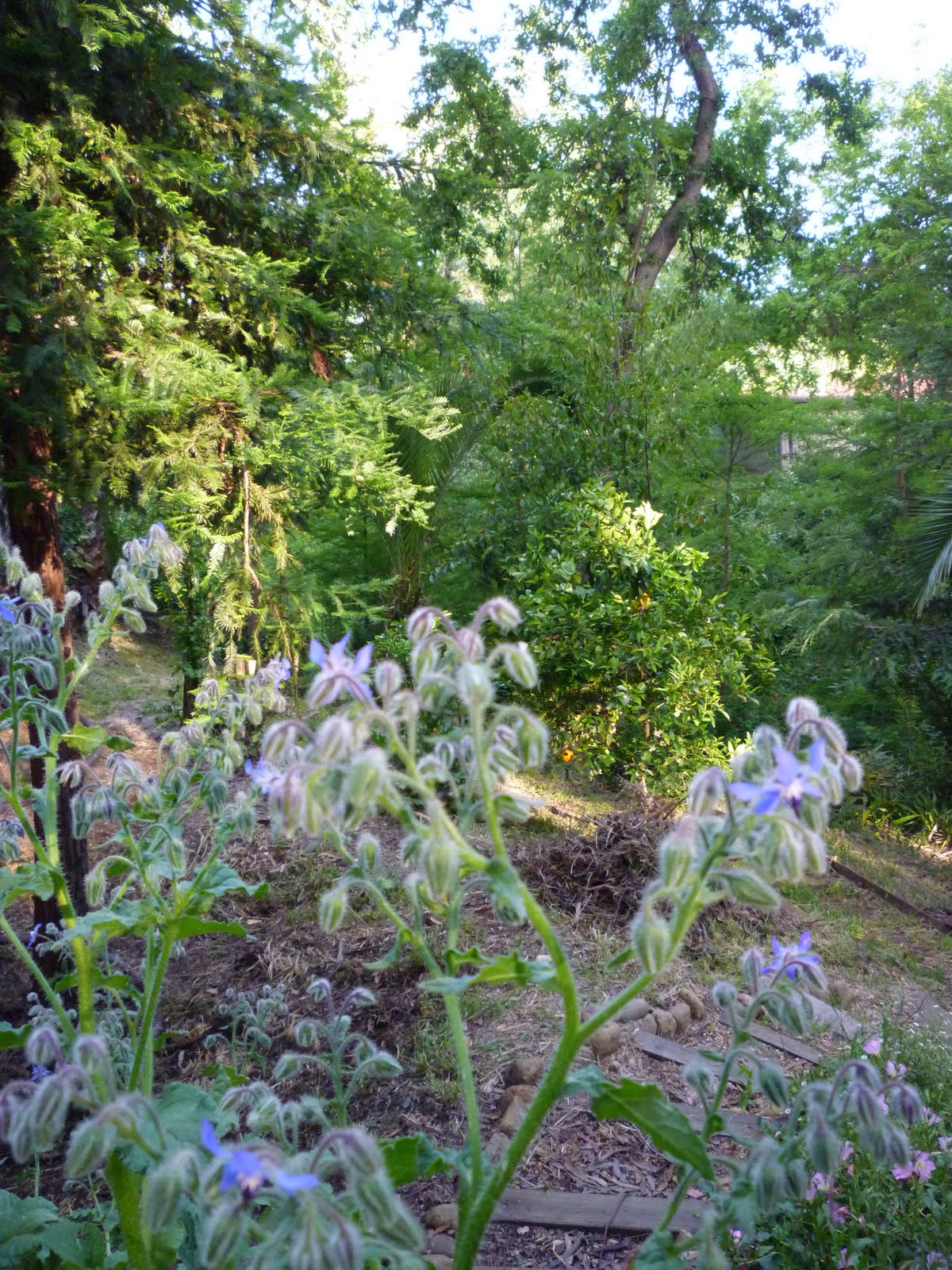
borage

“We got the weeds whacked down the other day, and now they need to be raked….This plant that is falling across the path needs to be trimmed back….Ivy is growing all over the quince tree and we want to get it out so the tree will have a better chance of bearing more than the three quinces it did last year.”

I put on my gloves, apron, and bandana to keep hair out of my face, and trimmed the blooming borage, leaving some branches so that the sisters could put the flowers in their salads.

Then the raking – whew! A giant eucalyptus tree stands above the monastery grounds and constantly drops pieces of bark, which combined with oak leaves and various other organic material have made a thick and tangled layer of debris that is turning into duff. On top of that were the strewn grassy weeds.

I pulled and yanked with my rake, and piles of scraped-up stuff grew tall in no time. “Someone” with a truck is now looked for both to haul all these piles away, and bring in some topsoil for the vegetable garden. I didn’t see the vegetable garden, but Sister Xenia said she works in it Wednesdays and Thursdays and maybe I would like to join her once a month or something like that? I always do think I can do anything, once a month. Maybe.

The poor quince tree took a long time. I hope he feels better and more fruitful. The sprucing-up was a challenge because on one side of the tree yard waste has been thrown down for many years, as we were led to understand (I had been joined by Tatiana and her son), creating a sort of man-made terrace. The ground level on that side is a several feet higher than on the other side, so that the tree is sort of growing out of a bank.

When I was below, I scrabbled up the “bank” that was mostly eucalyptus rubble, and stretched my tallest to pull as much ivy as I could from the branches. Sometimes three strands of ivy would be twisted round-and-round a thin branch, but at least this kind of ivy was tender and with care could be torn away.

Rescued quince

Then I walked back up the path to the other side and leaned way out, trying not to fall through the mulch, to pull at the ivy from that direction. After the ivy was gone, the many dead limbs were revealed, so I began pruning them out as well as I could with loppers. Several of them are so big they need to be sawed off, but I didn’t try doing it by myself in a precarious spot like that.

Galium aparine

Sticky weed is one plant that I went to war with at the monastery. Sister Mary called it that; I had never heard a name for it before, maybe because I never even saw it before a couple of years ago. Its usual common name is bedstraw or catchweed; it is Galium aparine. I pulled lots of this icky-sticky vine out of shrubs and flowers and everywhere, and it fought for its survival by depositing sticky little seeds all over my hair, gloves, socks….trying to come home and thrive here, no doubt.

Gardening is always a workout for me these days, given my age and the way the work always seems to have multiplied by the time I get there. A weed is easier to pull when it is small, to give a small example of what I’m talking about. Today was no different in that way, but the tasks I did made me use some different muscles, so I feel well exercised, shall we say.

It was lovely being at the monastery, and I’m glad I could be of use. I might have had some contemplative time while gardening if my mind hadn’t been so engrossed in solving garden problems and keeping my two feet under me. So if I go again, I’ll plan to spend the day and take breaks with the sisters in the church.