Morning light was filtering through fog as I read this passage from Luke Chapter 11:
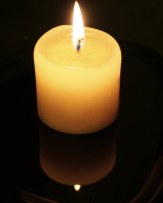 No man, when he hath lighted a candle, putteth it in a secret place, neither under a bushel, but on a candlestick, that they which come in may see the light. The light of the body is the eye: therefore when thine eye is single, thy whole body also is full of light; but when thine eye is evil, thy body also is full of darkness. Take heed therefore that the light which is in thee be not darkness. If thy whole body therefore be full of light, having no part dark, the whole shall be full of light, as when the bright shining of a candle doth give thee light.
Soon enough there began to play in my mind a hymn that I haven’t sung since childhood in the Presbyterian Church, “Open My Eyes, That I May See.” I looked up the hymn in one of the several hymnals our household has collected from previous generations of my late husband’s family, and the lyrics contain the essence of a humble prayer.
 But though spiritual sight must be part of what Christ is talking about, twice He uses the words, “whole body full of light.” Pause and think on that! What can it even mean? We can theorize about it, but Christ, Who called Himself “The light of the world,” is not an idea or a theory or a spiritual practice. He will have to teach us what this means by experience. Our yearly Lenten effort is our effort to return again and again to that lifelong process. And He has many ways of opening our eyes and bringing us to Himself, customized to each person’s unique situation.
In The Princess and Curdie, we meet Curdie again not long after the exciting events of The Princess and the Goblin, during which he learns a lesson on humility. But already Curdie, in his young teens,  is losing some of his youthful goodness. If our lives are like mirrors that are meant to reflect the glory of our Creator, his mirror is not doing that very well; it has gotten dirty by slow degrees and not even his parents understand why their son does not bring them joy as he used to.
One reason for his not being “in a good way,” our narrator describes like this: “As Curdie grew, he grew at this time faster in body than in mind – with the usual consequence, that he was getting rather stupid – one of the chief signs of which was that he believed less and less in things he had never seen.”
MacDonald sermonizes more in this book than in The Princess and the Goblin. But his little sermons are wise and kind, so I don’t mind them. I do wonder if children would make much use of them, however. He contrasts what is happening to Curdie with the ideal:
“The boy should enclose and keep, as his life, the old child at the heart of him, and never let it go. He must still, to be a right man, be his mother’s darling, and more, his father’s pride, and more. The child is not meant to die, but to be forever fresh born.”

Looking at Curdie, I am reminded of why we are on our Lenten journey: so that we can by some small effort cooperate with God as He does whatever work is necessary to bring us back home, as the Prodigal Son came home, to the “old child” of our heart.
For Curdie, the means involved a white pigeon:
“Curdie had made himself a bow and some arrows, and was teaching himself to shoot with them. One evening in the early summer, as he was walking home from the mine with them in his hand, a light flashed across his eyes. He looked, and there was a snow-white pigeon settling on a rock in front of him, in the red light of the level sun.
 “It was indeed a lovely being, and Curdie thought how happy it must be flitting through the air with a flash – a live bolt of light. For a moment he became so one with the bird that he seemed to feel both its bill and its feathers, as the one adjusted the other to fly again, and his heart swelled with the pleasure of its involuntary sympathy. Another moment and it would have been aloft in the waves of rosy light – it was just bending its little legs to spring: that moment it fell on the path broken-winged and bleeding from Curdie’s cruel arrow.
“With a gush of pride at his skill, and pleasure at his success, he ran to pick up his prey. I must say for him he picked it up gently — perhaps it was the beginning of his repentance….”
As the pigeon lay bleeding and limp in his hand, and looked long and wondering at him, “Curdie’s heart began to grow very large in his bosom. What could it mean? It was nothing but a pigeon, and why should he not kill a pigeon? But the fact was that not till this very moment had he ever known what a pigeon was.”
The drama of the next moments captures the storminess of a human heart when it strives against the pain of self-knowledge, and the temptation to despair. In the Curdie stories the white pigeons figure as messengers and angels of the divine Love, and 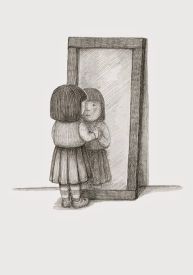 after an indefinable time out of time, which may be less than a minute, our boy comes through the storm with clarity, and proceeds with his repentance.
With clarity… under the influence of that Light that wants to fill all the dark corners of us, to make us radiant with Himself. It does seem an impossible image, until we remember that our personal task is to respond to the light we are given, respond to the Light Who is Christ, in this moment, and do the next thing that we are able, to “clean the dirt from our mirrors.”
During Lent, the Orthodox Church gives us many tools for this holy work, and one of them is the Holy Unction service. In addition to the one I described here, another General Unction service is often held during Lent in which anyone prepared may participate, whether or not they are gravely ill, and I am looking forward to being the recipient of its healing grace this evening.
May we all make good use of our sins,
and of the lights that come to us,
and Dear Lord, fill us with Your Light.

 more during Lent. He suggested the Psalms, because the use of them is a tradition that was without doubt handed down to us by the Apostles.
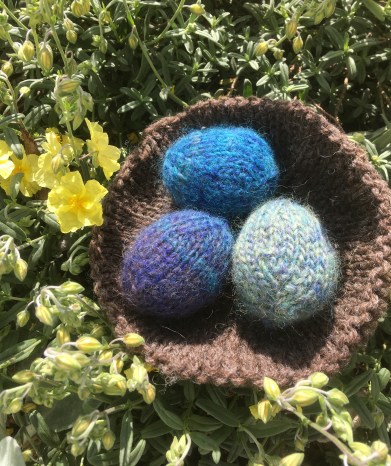
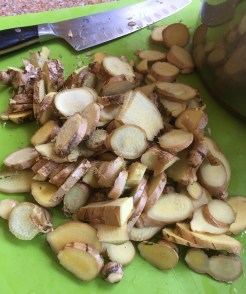 1) I cooked seedy crackers, vegan tapioca pudding, and pans and pans of roasted vegetables, including my own asparagus. I boiled a few quarts of ginger tea and tried out another vegan lemon cake recipe that I probably won’t make again. I’m done with cakes for a while. It makes sense to make cakes when one can use eggs and butter.




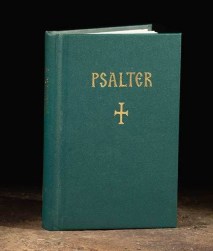 The Psalms of the Bible are the poetry that I am focusing on this year in National Poetry Month. They are helping me to also keep a Lenten focus. I’ve had my eye on two Psalms in particular that I wanted to memorize, but deliberately working at memorizing seems to “not be happening.” Maybe if I at least read them (a little) more frequently some of the lines and verses will start to stick. I love this green pocket Psalter so much. It is from
  This literal reading of the Psalms however is only the beginning. As one prays the Psalms one soon begins to realize that the enemy, the Amalekite or the Philistine, the nations that rage against God, are not people or situations outside myself, but are most poignantly referring to the wicked impulses and evil thoughts that I must battle within myself. The psalmist’s cry for deliverance becomes my own as I see within my own heart and mind the struggle between good and evil; the betraying thought, the accusing word, or the mocking laugh.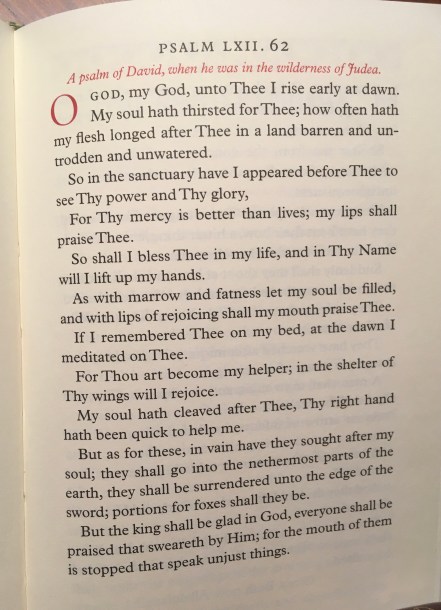
 Gladsome Lights